SEMINAR ON
E-PAPER TECHNOLOGY
2:36:56 PM
1
Contents
 Introduction
 History
 Construction
 Technologies
 Highlights of E-ink
 Advantages
 Disadvantages
 Challenges
 Applications
 Conclusion
 References
2:36:56 PM
2
Introduction
 E paper is a revolutionary material that can be
used to make next generation electronic
displays.
 Also named as radio paper or smart paper.
 Portable , reusable storage and display
medium.
 E paper display is a display technology
designed to mimic the appearance of ordinary
ink on paper.
 Unlike conventional displays , e-paper reflects
light just like paper.
 Capable of holding text and images.
2:36:56 PM
3
Cont..
2:36:56
PM
4
 Has potential to be more comfortable to read.
 Today’s E displays have evolved to be more light
weight , efficient and clear.
 Yet the importance of paper has not diminished.
 It offers us a paperless world and relieves us from
carrying loads of paper.
 E-ink is a pioneering invention that combines all
the desired features of a modern E display.
 Paper would be perfect except for one obvious
thing: printed words cannot be changed.
History
 Two companies are working on this.
 One is at Cambridge in USA.
 The other is Xerox at Xerox's Palo Alto
Research centre.
 It was first developed in 1970’s by Nick
Sheridon at Xerox's Palo Alto Research
centre.
2:36:56 PM
5
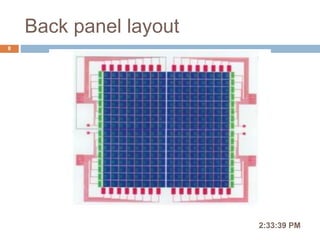
Construction
 It has two different parts.
 Front plane.
 Back plane.
 The front plane consist of E-ink.
 The back plane consist of electronic circuits.
2:36:56 PM
6
Front panel
2:36:56 PM
7
• The front plane consist of E-ink.
• E-ink is made up of millions of tiny
microcapsules.
• Microcapsules have diameter of the order
of 100 microns.
• Each microcapsule contains positively
charged white particles and negatively
charged black particles suspended in a
clear fluid .
Back panel layout
2:36:56 PM
8
Technologies
 Gyricon.
 Electrophoretic.
 Electrowetting.
 Electrofluidic.
2:36:56 PM
9
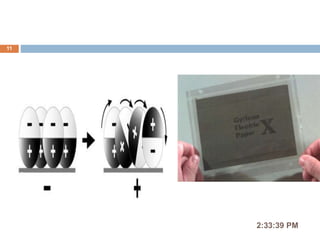
Gyricon
 The first Gyricon developed in 1970 by
“Nick Sheridon” at Xerox Palo Alto
Research Centre.
 Consists of polyethylene spheres, which
is a JENUS particle.
 The polarity of the voltage applied to each
pair of electrodes then determine whether
the white or black side is face-up.
 It is based on a thin layer of transparent
flexible plastic containing a layer of tiny
plastic beads each encapsulated in oil
and it rotate freely.
2:36:56 PM
10
2:36:56 PM
11
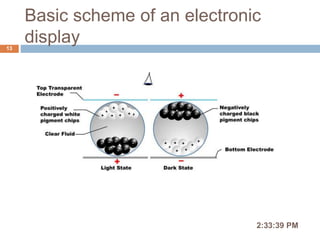
Electrophoretic
 It has titanium dioxide particles dispersed in
hydrocarbon oil.
 A dark colored dye is also added to the oil ,
along with surfactants and charging particles.
 It is placed between two parallel, conductive
plates.
 When the voltage is applied across them, the
particles will migrate electrophoeretically.
 When the particles at the front side of the
display, it appears white. 2:36:56 PM
12
Basic scheme of an electronic
display
2:36:56 PM
13
Electrowetting
2:36:56 PM
14
 Electrtrowetting display is based on controlling the
shape of a confirm water/oil interface by an applied
voltage.
 With no voltage applied , the colored oil forms a flat
film between water and a hydrophobic(water repellent)
, insulating coating of an electrode , resulting in a
colored pixel.
 When a voltage is applied between the electrodes and
the water, the interfacial tension between the water
and the coating changes.
 As a result the stacked state is no longer stable,
causing the water to move the oil aside.
 Switching is fast, low-power, low-voltage technology,
reflectivity and contrast are better.
Electrofluidic
2:36:56 PM
15
 Electrofluidic displays are a variation of an
electrowetting displays.
 They place an aqueous pigment dispersion inside
a tiny reservoir.
 The reservoir comprises < 5-10% of the viewable
pixel area and therefore the pigment is
substantially hidden from view.
 Voltage is used to electromechanically pull the
pigment out of the reservoir and spread it as a film
directly behind the viewing substrate.
 Hence it takes on color and brightness similar to
that of conventional pigments on paper.
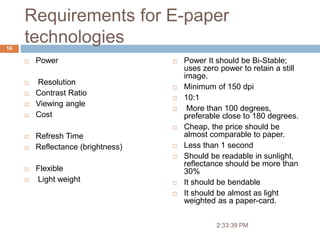
Requirements for E-paper
technologies
 Power
 Resolution
 Contrast Ratio
 Viewing angle
 Cost
 Refresh Time
 Reflectance (brightness)
 Flexible
 Light weight
 Power It should be Bi-Stable;
uses zero power to retain a still
image.
 Minimum of 150 dpi
 10:1
 More than 100 degrees,
preferable close to 180 degrees.
 Cheap, the price should be
almost comparable to paper.
 Less than 1 second
 Should be readable in sunlight,
reflectance should be more than
30%
 It should be bendable
 It should be almost as light
weighted as a paper-card.
2:36:56 PM
16
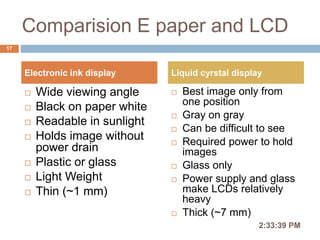
Comparision E paper and LCD
 Wide viewing angle
 Black on paper white
 Readable in sunlight
 Holds image without
power drain
 Plastic or glass
 Light Weight
 Thin (~1 mm)
 Best image only from
one position
 Gray on gray
 Can be difficult to see
 Required power to hold
images
 Glass only
 Power supply and glass
make LCDs relatively
heavy
 Thick (~7 mm)
2:36:56 PM
17
Electronic ink display Liquid cyrstal display
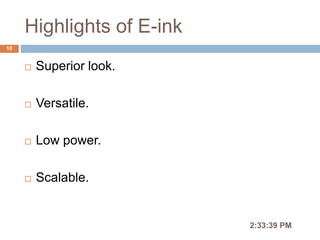
Highlights of E-ink
2:36:56 PM
18
 Superior look.
 Versatile.
 Low power.
 Scalable.
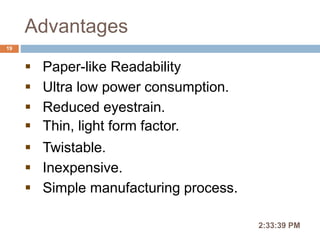
Advantages
2:36:56 PM
19
 Paper-like Readability
 Ultra low power consumption.
 Reduced eyestrain.
 Thin, light form factor.
 Twistable.
 Inexpensive.
 Simple manufacturing process.
Challenges
2:36:56 PM
20
 A method for encapsulation.
 An ink or active material to fill the
encapsulation.
 Electronics to activate the ink.
Disadvantages
2:36:56 PM
21
• Very low switching speed.
• Electrochemical complexity.
• Very low refresh rate.
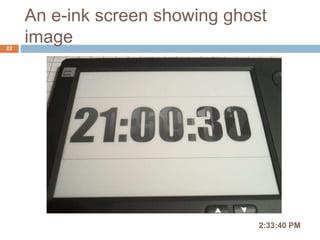
• Imprint of an image may be visible after
refreshing parts of the screen. Imprints are
known ghost images.
An e-ink screen showing ghost
image
2:36:56 PM
22
Applications
2:36:56 PM
23
Electronic shelf label.
Electronic watch and clock.
E Books.
Smart card display
Electronic Newspaper
Mobile display
Computer monitor.
Future scenario
2:36:56 PM
24
 The Holy Grail of E-ink technology is a digital
book that can typeset itself and that readers
could leaf through just as if it was made of
regular paper.
 Once you have finished, you could
automatically replace it by wirelessly
downloading the latest book from a computer
database.
 Just as E ink could radically change the way
we read books , it could change the way you
recieve your daily newspapers.
Conclusion
2:36:56 PM
25
 Researches found that in just few years this
technology can replace paper in many
situations, leading us to think of a truly
paperless world.
References
2:36:56 PM
26
 www.wikipedia.com/e-papertechnology
 www.pedian.com/e-papertechnology
 www.wikid.com
 www.gulfnews.com
2:36:56 PM
27
Thank you!

E paper technology ppt

  • 1.
  • 2.
    Contents  Introduction  History Construction  Technologies  Highlights of E-ink  Advantages  Disadvantages  Challenges  Applications  Conclusion  References 2:36:56 PM 2
  • 3.
    Introduction  E paperis a revolutionary material that can be used to make next generation electronic displays.  Also named as radio paper or smart paper.  Portable , reusable storage and display medium.  E paper display is a display technology designed to mimic the appearance of ordinary ink on paper.  Unlike conventional displays , e-paper reflects light just like paper.  Capable of holding text and images. 2:36:56 PM 3
  • 4.
    Cont.. 2:36:56 PM 4  Has potentialto be more comfortable to read.  Today’s E displays have evolved to be more light weight , efficient and clear.  Yet the importance of paper has not diminished.  It offers us a paperless world and relieves us from carrying loads of paper.  E-ink is a pioneering invention that combines all the desired features of a modern E display.  Paper would be perfect except for one obvious thing: printed words cannot be changed.
  • 5.
    History  Two companiesare working on this.  One is at Cambridge in USA.  The other is Xerox at Xerox's Palo Alto Research centre.  It was first developed in 1970’s by Nick Sheridon at Xerox's Palo Alto Research centre. 2:36:56 PM 5
  • 6.
    Construction  It hastwo different parts.  Front plane.  Back plane.  The front plane consist of E-ink.  The back plane consist of electronic circuits. 2:36:56 PM 6
  • 7.
    Front panel 2:36:56 PM 7 •The front plane consist of E-ink. • E-ink is made up of millions of tiny microcapsules. • Microcapsules have diameter of the order of 100 microns. • Each microcapsule contains positively charged white particles and negatively charged black particles suspended in a clear fluid .
  • 8.
  • 9.
    Technologies  Gyricon.  Electrophoretic. Electrowetting.  Electrofluidic. 2:36:56 PM 9
  • 10.
    Gyricon  The firstGyricon developed in 1970 by “Nick Sheridon” at Xerox Palo Alto Research Centre.  Consists of polyethylene spheres, which is a JENUS particle.  The polarity of the voltage applied to each pair of electrodes then determine whether the white or black side is face-up.  It is based on a thin layer of transparent flexible plastic containing a layer of tiny plastic beads each encapsulated in oil and it rotate freely. 2:36:56 PM 10
  • 11.
  • 12.
    Electrophoretic  It hastitanium dioxide particles dispersed in hydrocarbon oil.  A dark colored dye is also added to the oil , along with surfactants and charging particles.  It is placed between two parallel, conductive plates.  When the voltage is applied across them, the particles will migrate electrophoeretically.  When the particles at the front side of the display, it appears white. 2:36:56 PM 12
  • 13.
    Basic scheme ofan electronic display 2:36:56 PM 13
  • 14.
    Electrowetting 2:36:56 PM 14  Electrtrowettingdisplay is based on controlling the shape of a confirm water/oil interface by an applied voltage.  With no voltage applied , the colored oil forms a flat film between water and a hydrophobic(water repellent) , insulating coating of an electrode , resulting in a colored pixel.  When a voltage is applied between the electrodes and the water, the interfacial tension between the water and the coating changes.  As a result the stacked state is no longer stable, causing the water to move the oil aside.  Switching is fast, low-power, low-voltage technology, reflectivity and contrast are better.
  • 15.
    Electrofluidic 2:36:56 PM 15  Electrofluidicdisplays are a variation of an electrowetting displays.  They place an aqueous pigment dispersion inside a tiny reservoir.  The reservoir comprises < 5-10% of the viewable pixel area and therefore the pigment is substantially hidden from view.  Voltage is used to electromechanically pull the pigment out of the reservoir and spread it as a film directly behind the viewing substrate.  Hence it takes on color and brightness similar to that of conventional pigments on paper.
  • 16.
    Requirements for E-paper technologies Power  Resolution  Contrast Ratio  Viewing angle  Cost  Refresh Time  Reflectance (brightness)  Flexible  Light weight  Power It should be Bi-Stable; uses zero power to retain a still image.  Minimum of 150 dpi  10:1  More than 100 degrees, preferable close to 180 degrees.  Cheap, the price should be almost comparable to paper.  Less than 1 second  Should be readable in sunlight, reflectance should be more than 30%  It should be bendable  It should be almost as light weighted as a paper-card. 2:36:56 PM 16
  • 17.
    Comparision E paperand LCD  Wide viewing angle  Black on paper white  Readable in sunlight  Holds image without power drain  Plastic or glass  Light Weight  Thin (~1 mm)  Best image only from one position  Gray on gray  Can be difficult to see  Required power to hold images  Glass only  Power supply and glass make LCDs relatively heavy  Thick (~7 mm) 2:36:56 PM 17 Electronic ink display Liquid cyrstal display
  • 18.
    Highlights of E-ink 2:36:56PM 18  Superior look.  Versatile.  Low power.  Scalable.
  • 19.
    Advantages 2:36:56 PM 19  Paper-likeReadability  Ultra low power consumption.  Reduced eyestrain.  Thin, light form factor.  Twistable.  Inexpensive.  Simple manufacturing process.
  • 20.
    Challenges 2:36:56 PM 20  Amethod for encapsulation.  An ink or active material to fill the encapsulation.  Electronics to activate the ink.
  • 21.
    Disadvantages 2:36:56 PM 21 • Verylow switching speed. • Electrochemical complexity. • Very low refresh rate. • Imprint of an image may be visible after refreshing parts of the screen. Imprints are known ghost images.
  • 22.
    An e-ink screenshowing ghost image 2:36:56 PM 22
  • 23.
    Applications 2:36:56 PM 23 Electronic shelflabel. Electronic watch and clock. E Books. Smart card display Electronic Newspaper Mobile display Computer monitor.
  • 24.
    Future scenario 2:36:56 PM 24 The Holy Grail of E-ink technology is a digital book that can typeset itself and that readers could leaf through just as if it was made of regular paper.  Once you have finished, you could automatically replace it by wirelessly downloading the latest book from a computer database.  Just as E ink could radically change the way we read books , it could change the way you recieve your daily newspapers.
  • 25.
    Conclusion 2:36:56 PM 25  Researchesfound that in just few years this technology can replace paper in many situations, leading us to think of a truly paperless world.
  • 26.
    References 2:36:56 PM 26  www.wikipedia.com/e-papertechnology www.pedian.com/e-papertechnology  www.wikid.com  www.gulfnews.com
  • 27.