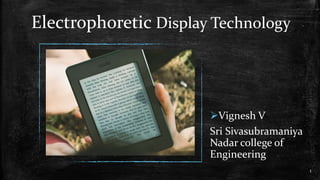
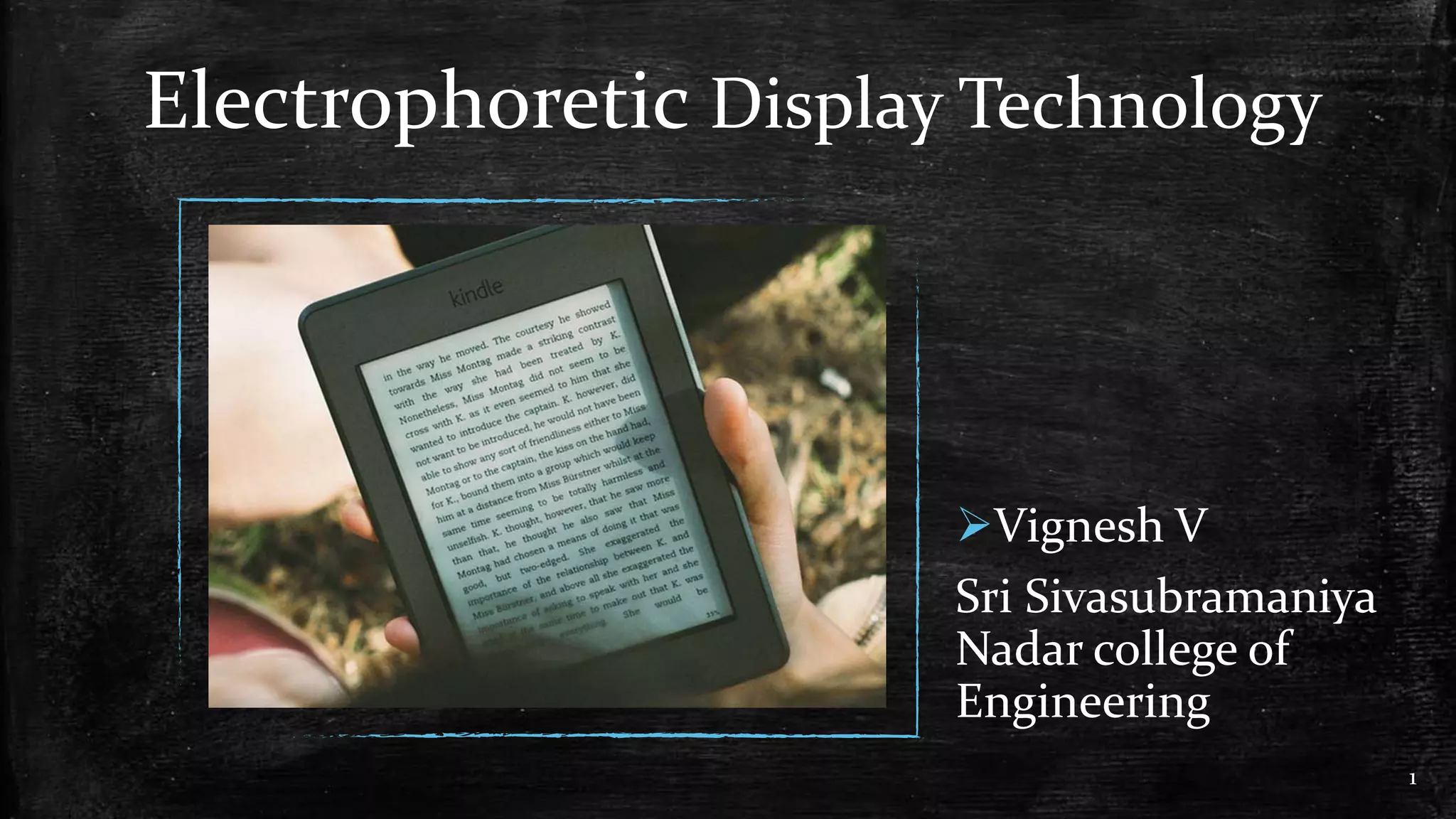

Electrophoretic Display Technology
Vignesh V
Sri Sivasubramaniya
Nadar college of
Engineering
1
Content
Introduction
Electrophoretic Image Display
Principle of EID
Electrophoretic Ink
Properties of E-Ink displays
Applications
Advantages and Disadvantages
Conclusion 2
Introduction
What is Electrophoresis?
The phenomenon of transport of charged particles in a
colloidal suspension by means of an applied electric
field is known as electrophoresis.
The term electrophoresis is a composition of 'electro'
and 'phoresis', two words that are derived from the
Greek words for 'charge' and 'the act of carrying'.
3
Electrophoretic Image Display
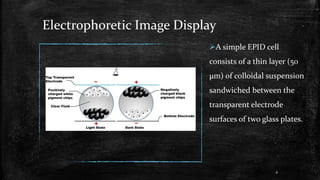
A simple EPID cell
consists of a thin layer (50
µm) of colloidal suspension
sandwiched between the
transparent electrode
surfaces of two glass plates.
4
Principle of EID
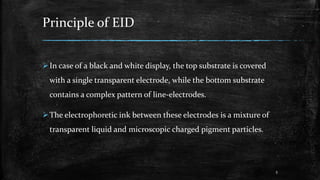
In case of a black and white display, the top substrate is covered
with a single transparent electrode, while the bottom substrate
contains a complex pattern of line-electrodes.
The electrophoretic ink between these electrodes is a mixture of
transparent liquid and microscopic charged pigment particles.
5
Principle of EID
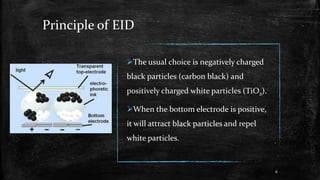
The usual choice is negatively charged
black particles (carbon black) and
positively charged white particles (TiO2).
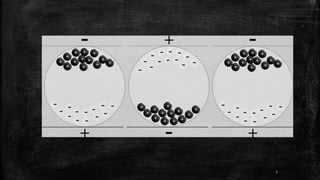
When the bottom electrode is positive,
it will attract black particles and repel
white particles.
6
7
Principle of EID
These white particles gather at the top-electrode, where they
reflect incident light in all directions.
 In the opposite case of a negative bottom electrode pushes the
black particles to the surface, where they absorb the light.
8
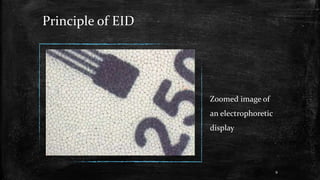
Zoomed image of
an electrophoretic
display
9
Principle of EID
Electrophoretic Ink
Electrophoretic or, electronic ink is the optical component of a
film used in Electronic Paper Displays (EPD).
It utilizes the same pigments used in the printing industry today.
10
Properties of E-Ink displays
The display is bistable which means that the image on the screen
will be retained even when all power sources are removed.
The displays are of reflective type.
Two pigment ink system i.e., Electronic ink is made up of millions
of tiny microcapsules, about the diameter of a human hair.
11
Properties of E-Ink displays
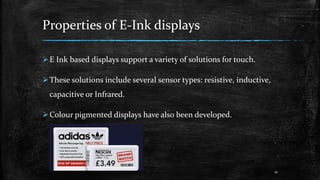
E Ink based displays support a variety of solutions for touch.
These solutions include several sensor types: resistive, inductive,
capacitive or Infrared.
Colour pigmented displays have also been developed.
12
Electronic paper
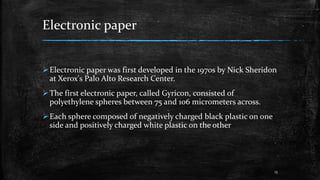
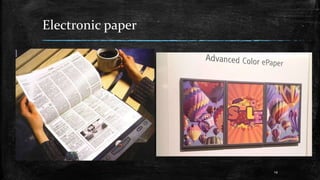
Electronic paper was first developed in the 1970s by Nick Sheridon
at Xerox's Palo Alto Research Center.
The first electronic paper, called Gyricon, consisted of
polyethylene spheres between 75 and 106 micrometers across.
Each sphere composed of negatively charged black plastic on one
side and positively charged white plastic on the other
13
Electronic paper
14
Applications
This technology is being used in many devices as of now. Some of
them are :
Wristwatches
Electronic paper
Mobile phones
Status display in USB
E-book readers
Electronic Shelf Labels
15
Advantages
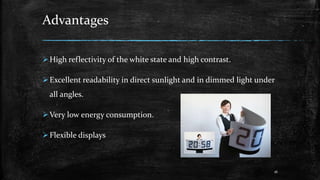
High reflectivity of the white state and high contrast.
Excellent readability in direct sunlight and in dimmed light under
all angles.
Very low energy consumption.
Flexible displays
16
Disadvantages
They have a very low refresh rate compared to other low-power
display technologies, such as LCD.
Environmental lighting is needed in some devices.
A shadow of an image may be visible after refreshing parts of the
screen.
17
Conclusion
 Technology giants like Phillips, Sony, LG and others are currently
doing researches to over come the disadvantages.
 With the increasing need of electronic gadgets with a lower
power consumption and longer use, this technology can be used
as an alternative.
 Usage of E-papers helps in reducing the usage of ordinary paper
and save a lot of natural resources.
18
References
http://www.eink.com/technology.html
https://lcp.elis.ugent.be/tutorials/tut_eink#advances
https://en.wikipedia.org/wiki/Electronic_paper
www.wikid.eu/index.php/Electrophoretic_display
http://ieeexplore.ieee.org/abstract/document/1480144/
www.intechopen.com/books/features.../active-matrix-driving-
and-circuit-simulation
19
Thank you
20

Electrophoretic display technology