Evolution-Data Optimized   Presented By: Daksh Kumar Anand 2006 EEC 63
INTRODUCTION Evolution-Data Optimized or Evolution-Data only , abbreviated as EV-DO or EVDO and often EV, is a telecommunications standard for the wireless transmission of data through radio signals, typically for broadband Internet access. It is standardized by  3rd Generation Partnership Project 2  (3GPP2) as part of the CDMA2000 family of standards and has been adopted by many mobile phone service providers around the world – particularly those previously employing CDMA networks.  It is also used on the Globalstar satellite phone network.
INTRODUCTION contd: An EV-DO channel has a bandwidth of 1.25 MHz, the same bandwidth size that IS-95A (IS-95) and IS-2000 (1xRTT) use. The back-end network is entirely  packet-based , and thus is not constrained by the restrictions typically present on a circuit switched network. The EV-DO feature of CDMA2000 networks provides access to mobile devices with  forward link  air interface speeds of up to 2.4 Mbit/s with Rev. 0 and up to 3.1 Mbit/s with Rev. A.  The  reverse link  rate for Rev. 0 can operate up to 153 kbit/s, while Rev. A can operate at up to 1.8 Mbit/s.
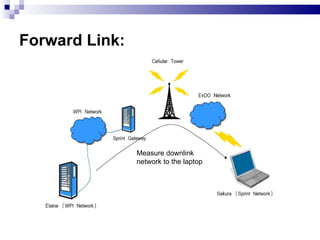
Forward Link: Measure downlink network to the laptop
STANDARD REVISIONS   1.1 TIA-856 Revision 0  1.2 TIA-856 Rev. 0 forward link channel structure  1.3 TIA-856 Rev. 0 reverse link structure  1.4 TIA-856 Rev. A  1.5 TIA-856 Rev. B  1.6 TIA-1121
TIA-856 Revision 0   The initial design of EV-DO was developed by  Qualcomm  in 1999 to meet IMT-2000 requirements for a greater-than-2-Mbit/s down link for stationary communications. Initially, the standard was called  High Data Rate  (HDR), but was renamed to 1xEV-DO after it was ratified by the ITU; it was given the numerical designation  TIA-856 .  “ 1x Evolution-Data Only”, refer to its being a direct evolution of the  1x  (1xRTT) air interface standard, with its channels carrying only data traffic.
TIA-856 Rev. 0:Forward link channel structure   Channel Being  Time Multiplexed  on the forward link means that a single mobile has full use of the forward traffic channel within a particular geographic area (a sector) during a given slot of time.  The forward channel is divided into slots, each being 1.667 ms long.  These streams include the  Pilot  which helps the mobile find and identify the channel, the  Media Access Channel (MAC ) which tells the mobiles when their data is scheduled, and the  Control Channel , which contains other information that the network needs the mobiles to know
Whole Communication Scenario: Mobile listens to the traffic on the channel, makes its best guess as to what data-rate it can sustain while maintaining a reasonable frame error rate of 1-2%.  It then communicates this information back to the serving sector in the form of an integer between 1 and 12 on the  "Digital Rate Control"  (DRC) channel.  Another important aspect of the EV-DO forward link channel is the scheduler called  "proportional fair".  .  The idea is to schedule mobiles reporting higher DRC indices more often, with the hope that those reporting worse conditions will improve in time.
TIA-856 Rev. 0 reverse link structure   The reverse link on EV-DO Rev. 0 operates very similar to that of 3G1X CDMA. The channel includes a reverse link pilot (helps with decoding the signal) along with the user data channels. Only the reverse link has any sort of Power control The reverse link has both open loop and closed loop power control.
All of the reverse link channels are combined using code division and transmitted back to the base station using QPSK where they are decoded.  The maximum speed available for user data is 153.2 kbit/s, but in real-life conditions this is rarely achieved.  Typical speeds achieved are between 20-50 kbit/s.
TIA-856 Rev. A   The changes included the introduction of several new forward link data rates that increase the maximum burst rate from 2.45 Mbit/s to 3.1 Mbit/s. Protocols that would decrease connection establishment time were introduced. The reverse link was enhanced to support higher complexity modulation (and thus higher bit rates). The reverse link has a maximum rate of 1.8 Mbit/s, but under normal conditions users experience a rate of approximately 500-1000kbit/s but with more latency than cable and dsl.
TIA-856 Rev. B   Higher rates per carrier (up to 4.9 Mbit/s on the downlink per carrier). Typical deployments are expected to include 2 or 3 carriers for a peak rate of 14.7 Mbit/s..  Increased talk-time and standby time  Efficient support for services that have asymmetric download and upload requirements such as file transfers, web browsing, and broadband multimedia content delivery.
TIA-1121  UMB (Ultra Mobile Broadband)  was the brand name for a project within 3GPP2 to improve the CDMA2000 mobile phone standard for next generation applications and requirements.  The UMB system was to be based upon Internet (TCP/IP) networking technologies with peak rates of up to 280 Mbit/s.  However 3GPP added this functionality to LTE(Long Term Evolution ) , allowing LTE to become the single upgrade path for all wireless networks.
POTENTIAL COMPETING STANDARDS   Motorola proposed a new system called  1Xtreme  as an evolution of CDMA2000, but it was rejected by the 3GPP2 standardization body.  Later, a competing standard called  EV-DV, for Evolution-Data and Voice , developed by Qualcomm, Lucent, Nokia, Motorola, etc. in 3GPP2 was proposed as an alternate evolution of CDMA.  EV-DO requires 1 or more (1.25 MHz) freq. bands in addition to the voice band.
The network cost was lower, since EV-DO uses an  IP network  and does not require a SS7 network and complex network switches such as a mobile switching center (MSC).  Also, equipment was not available for EV-DV in time to meet market demands whereas the EV-DO equipment and mobile  ASIC  were available and tested by the time the EV-DV standard was completed. In March 2005, Qualcomm suspended development of EV-DV chipsets, and focused on improving the EV-DO product line.
References and footnotes: Wikipedia,  Evolution-Data Optimized EVDOforums.com " CDMA2000 1xEV-DO ". QUALCOMM Technology and Solutions " 3G - CDMA2000 1xEV-DO Technologies ". CDMA development Group
THANK YOU

Dax

  • 1.
    Evolution-Data Optimized Presented By: Daksh Kumar Anand 2006 EEC 63
  • 2.
    INTRODUCTION Evolution-Data Optimizedor Evolution-Data only , abbreviated as EV-DO or EVDO and often EV, is a telecommunications standard for the wireless transmission of data through radio signals, typically for broadband Internet access. It is standardized by 3rd Generation Partnership Project 2 (3GPP2) as part of the CDMA2000 family of standards and has been adopted by many mobile phone service providers around the world – particularly those previously employing CDMA networks. It is also used on the Globalstar satellite phone network.
  • 3.
    INTRODUCTION contd: AnEV-DO channel has a bandwidth of 1.25 MHz, the same bandwidth size that IS-95A (IS-95) and IS-2000 (1xRTT) use. The back-end network is entirely packet-based , and thus is not constrained by the restrictions typically present on a circuit switched network. The EV-DO feature of CDMA2000 networks provides access to mobile devices with forward link air interface speeds of up to 2.4 Mbit/s with Rev. 0 and up to 3.1 Mbit/s with Rev. A. The reverse link rate for Rev. 0 can operate up to 153 kbit/s, while Rev. A can operate at up to 1.8 Mbit/s.
  • 4.
    Forward Link: Measuredownlink network to the laptop
  • 5.
    STANDARD REVISIONS 1.1 TIA-856 Revision 0 1.2 TIA-856 Rev. 0 forward link channel structure 1.3 TIA-856 Rev. 0 reverse link structure 1.4 TIA-856 Rev. A 1.5 TIA-856 Rev. B 1.6 TIA-1121
  • 6.
    TIA-856 Revision 0 The initial design of EV-DO was developed by Qualcomm in 1999 to meet IMT-2000 requirements for a greater-than-2-Mbit/s down link for stationary communications. Initially, the standard was called High Data Rate (HDR), but was renamed to 1xEV-DO after it was ratified by the ITU; it was given the numerical designation TIA-856 . “ 1x Evolution-Data Only”, refer to its being a direct evolution of the 1x (1xRTT) air interface standard, with its channels carrying only data traffic.
  • 7.
    TIA-856 Rev. 0:Forwardlink channel structure Channel Being Time Multiplexed on the forward link means that a single mobile has full use of the forward traffic channel within a particular geographic area (a sector) during a given slot of time. The forward channel is divided into slots, each being 1.667 ms long. These streams include the Pilot which helps the mobile find and identify the channel, the Media Access Channel (MAC ) which tells the mobiles when their data is scheduled, and the Control Channel , which contains other information that the network needs the mobiles to know
  • 8.
    Whole Communication Scenario:Mobile listens to the traffic on the channel, makes its best guess as to what data-rate it can sustain while maintaining a reasonable frame error rate of 1-2%. It then communicates this information back to the serving sector in the form of an integer between 1 and 12 on the "Digital Rate Control" (DRC) channel. Another important aspect of the EV-DO forward link channel is the scheduler called "proportional fair". . The idea is to schedule mobiles reporting higher DRC indices more often, with the hope that those reporting worse conditions will improve in time.
  • 9.
    TIA-856 Rev. 0reverse link structure The reverse link on EV-DO Rev. 0 operates very similar to that of 3G1X CDMA. The channel includes a reverse link pilot (helps with decoding the signal) along with the user data channels. Only the reverse link has any sort of Power control The reverse link has both open loop and closed loop power control.
  • 10.
    All of thereverse link channels are combined using code division and transmitted back to the base station using QPSK where they are decoded. The maximum speed available for user data is 153.2 kbit/s, but in real-life conditions this is rarely achieved. Typical speeds achieved are between 20-50 kbit/s.
  • 11.
    TIA-856 Rev. A The changes included the introduction of several new forward link data rates that increase the maximum burst rate from 2.45 Mbit/s to 3.1 Mbit/s. Protocols that would decrease connection establishment time were introduced. The reverse link was enhanced to support higher complexity modulation (and thus higher bit rates). The reverse link has a maximum rate of 1.8 Mbit/s, but under normal conditions users experience a rate of approximately 500-1000kbit/s but with more latency than cable and dsl.
  • 12.
    TIA-856 Rev. B Higher rates per carrier (up to 4.9 Mbit/s on the downlink per carrier). Typical deployments are expected to include 2 or 3 carriers for a peak rate of 14.7 Mbit/s.. Increased talk-time and standby time Efficient support for services that have asymmetric download and upload requirements such as file transfers, web browsing, and broadband multimedia content delivery.
  • 13.
    TIA-1121 UMB(Ultra Mobile Broadband) was the brand name for a project within 3GPP2 to improve the CDMA2000 mobile phone standard for next generation applications and requirements. The UMB system was to be based upon Internet (TCP/IP) networking technologies with peak rates of up to 280 Mbit/s. However 3GPP added this functionality to LTE(Long Term Evolution ) , allowing LTE to become the single upgrade path for all wireless networks.
  • 14.
    POTENTIAL COMPETING STANDARDS Motorola proposed a new system called 1Xtreme as an evolution of CDMA2000, but it was rejected by the 3GPP2 standardization body. Later, a competing standard called EV-DV, for Evolution-Data and Voice , developed by Qualcomm, Lucent, Nokia, Motorola, etc. in 3GPP2 was proposed as an alternate evolution of CDMA. EV-DO requires 1 or more (1.25 MHz) freq. bands in addition to the voice band.
  • 15.
    The network costwas lower, since EV-DO uses an IP network and does not require a SS7 network and complex network switches such as a mobile switching center (MSC). Also, equipment was not available for EV-DV in time to meet market demands whereas the EV-DO equipment and mobile ASIC were available and tested by the time the EV-DV standard was completed. In March 2005, Qualcomm suspended development of EV-DV chipsets, and focused on improving the EV-DO product line.
  • 16.
    References and footnotes:Wikipedia, Evolution-Data Optimized EVDOforums.com " CDMA2000 1xEV-DO ". QUALCOMM Technology and Solutions " 3G - CDMA2000 1xEV-DO Technologies ". CDMA development Group
  • 17.