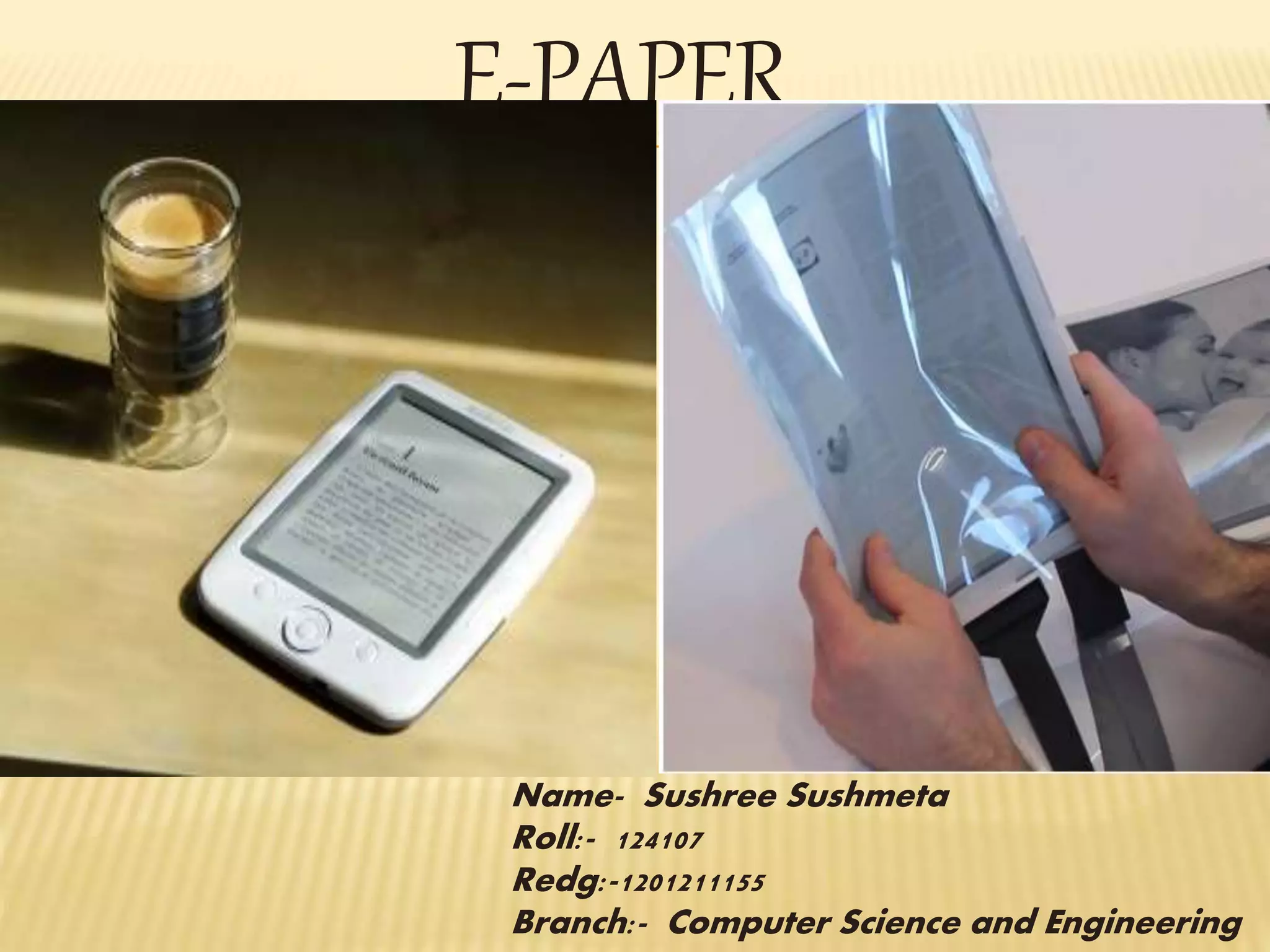
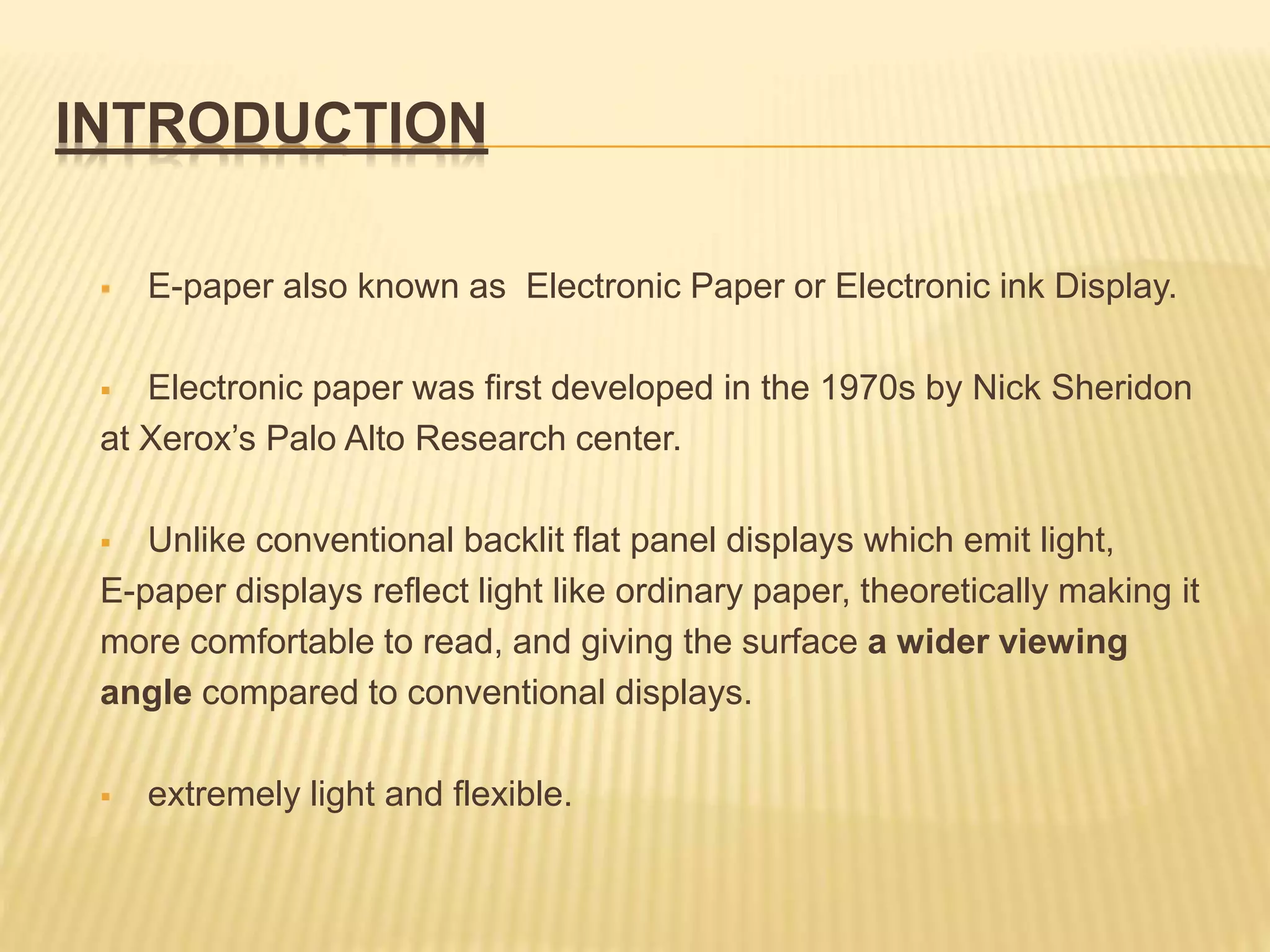

E-PAPER
Name- Sushree Sushmeta
Roll:- 124107
Redg:-1201211155
Branch:- Computer Science and Engineering
INTRODUCTION
 E-paper also known as Electronic Paper or Electronic ink Display.
 Electronic paper was first developed in the 1970s by Nick Sheridon
at Xerox’s Palo Alto Research center.
 Unlike conventional backlit flat panel displays which emit light,
E-paper displays reflect light like ordinary paper, theoretically making it
more comfortable to read, and giving the surface a wider viewing
angle compared to conventional displays.
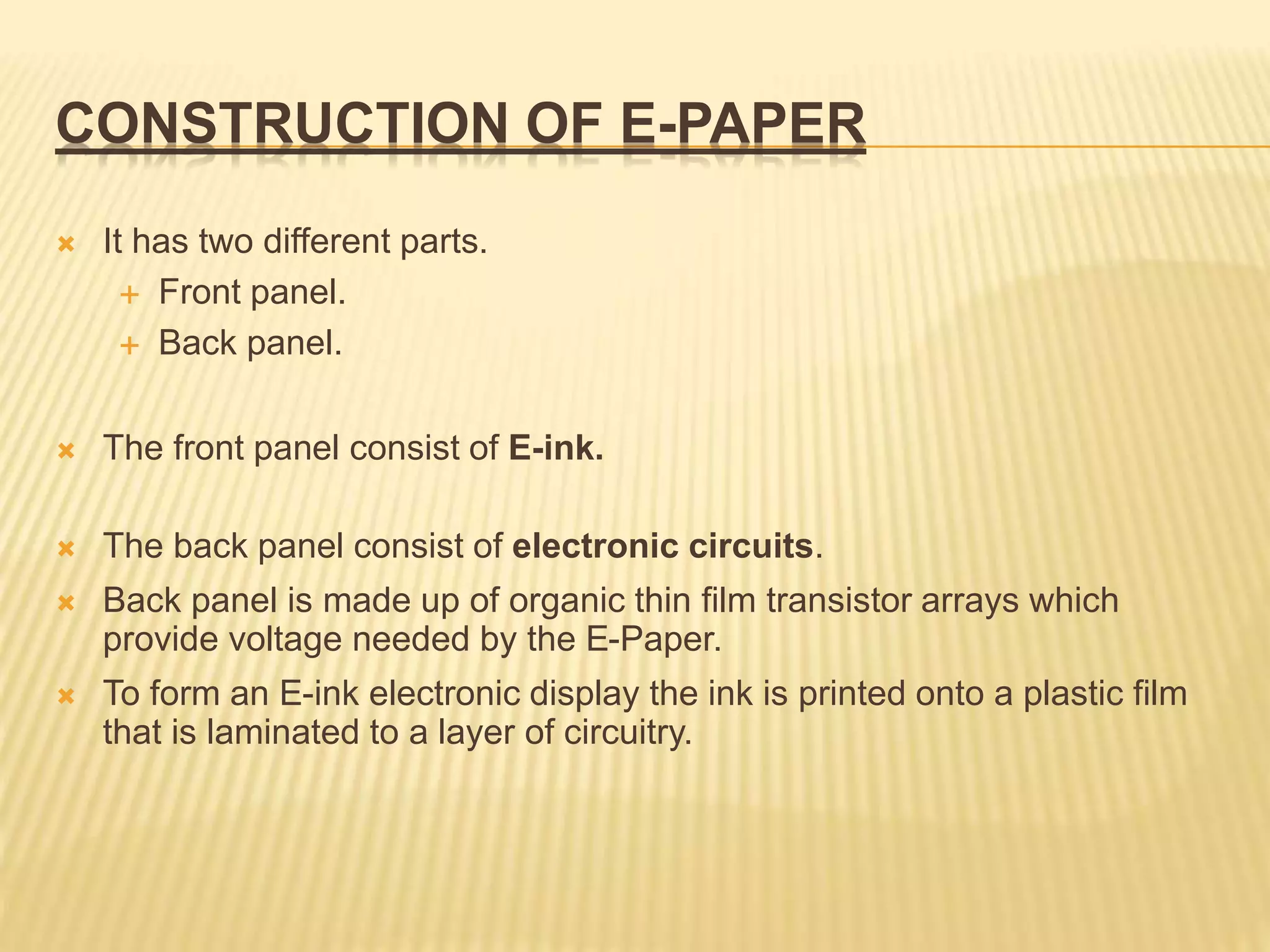
 extremely light and flexible.
CONSTRUCTION OF E-PAPER
 It has two different parts.
 Front panel.
 Back panel.
 The front panel consist of E-ink.
 The back panel consist of electronic circuits.
 Back panel is made up of organic thin film transistor arrays which
provide voltage needed by the E-Paper.
 To form an E-ink electronic display the ink is printed onto a plastic film
that is laminated to a layer of circuitry.
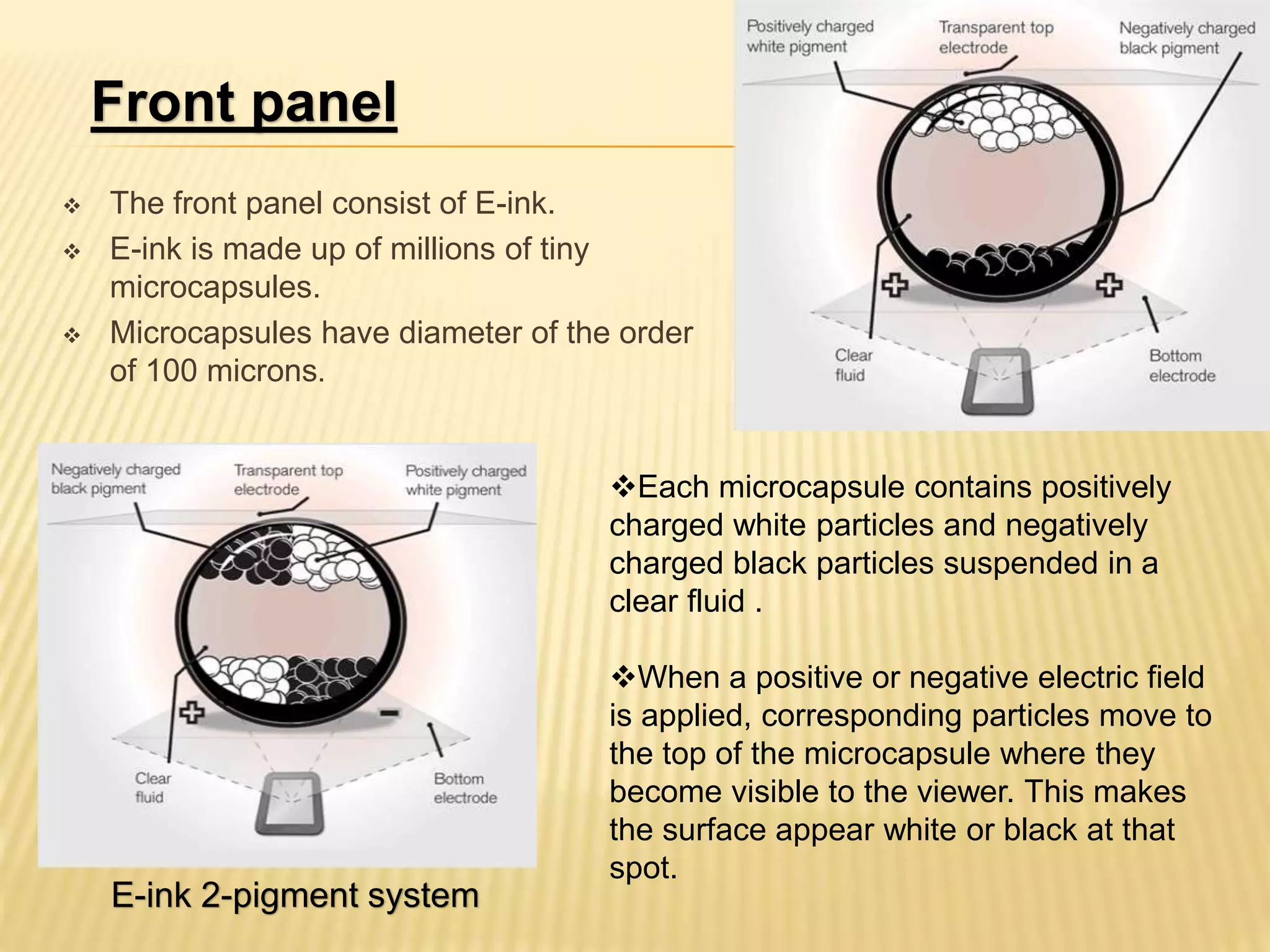
 The front panel consist of E-ink.
 E-ink is made up of millions of tiny
microcapsules.
 Microcapsules have diameter of the order
of 100 microns.
Front panel
E-ink 2-pigment system
Each microcapsule contains positively
charged white particles and negatively
charged black particles suspended in a
clear fluid .
When a positive or negative electric field
is applied, corresponding particles move to
the top of the microcapsule where they
become visible to the viewer. This makes
the surface appear white or black at that
spot.
TECHNOLOGIES PROPOSED SO FAR:
 Gyricon
 Electrophoretic display
 Electrowetting
GLYRICON
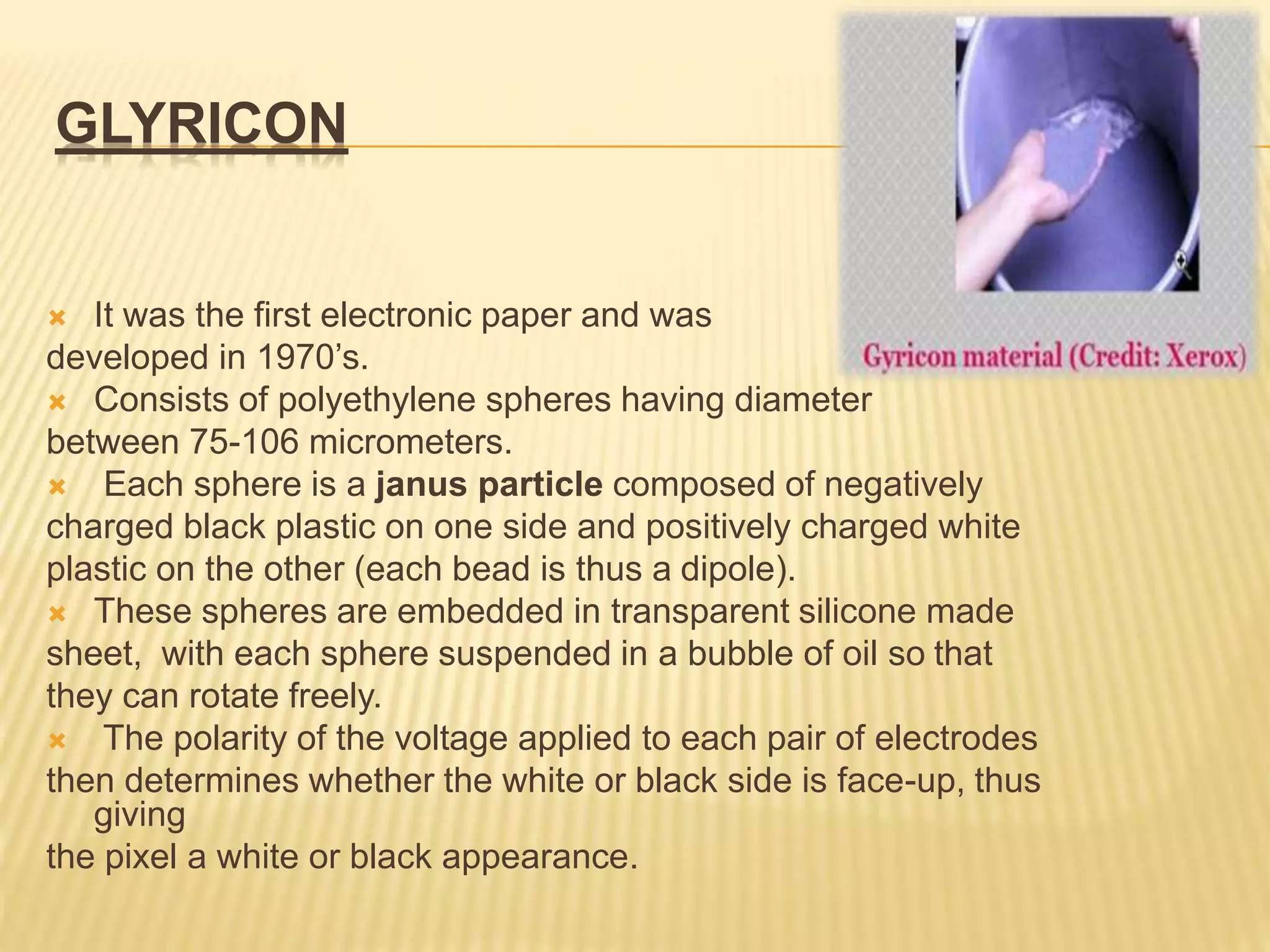
 It was the first electronic paper and was
developed in 1970’s.
 Consists of polyethylene spheres having diameter
between 75-106 micrometers.
 Each sphere is a janus particle composed of negatively
charged black plastic on one side and positively charged white
plastic on the other (each bead is thus a dipole).
 These spheres are embedded in transparent silicone made
sheet, with each sphere suspended in a bubble of oil so that
they can rotate freely.
 The polarity of the voltage applied to each pair of electrodes
then determines whether the white or black side is face-up, thus
giving
the pixel a white or black appearance.
ELECTROPHORETIC DISPLAY
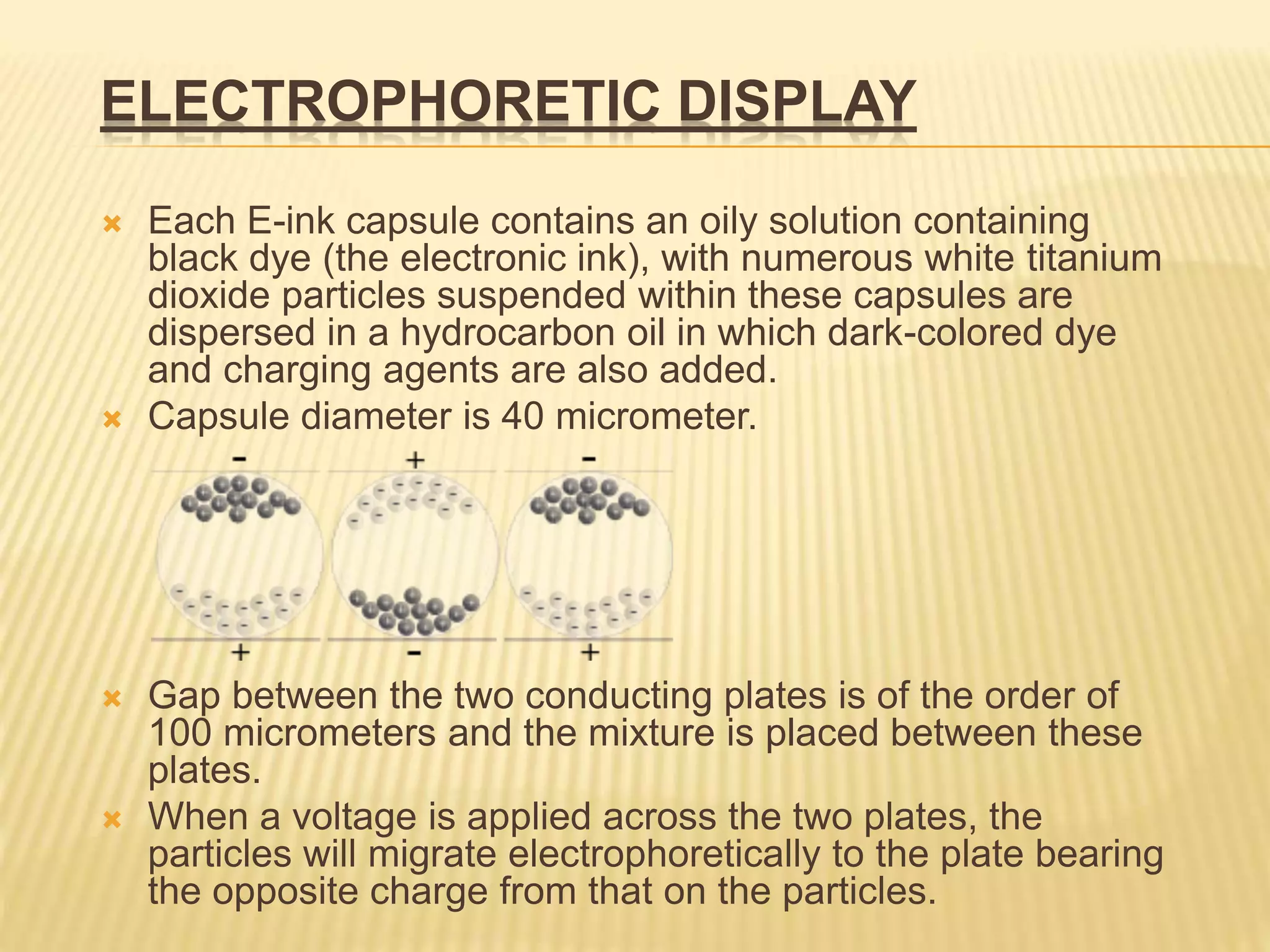
 Each E-ink capsule contains an oily solution containing
black dye (the electronic ink), with numerous white titanium
dioxide particles suspended within these capsules are
dispersed in a hydrocarbon oil in which dark-colored dye
and charging agents are also added.
 Capsule diameter is 40 micrometer.
 Gap between the two conducting plates is of the order of
100 micrometers and the mixture is placed between these
plates.
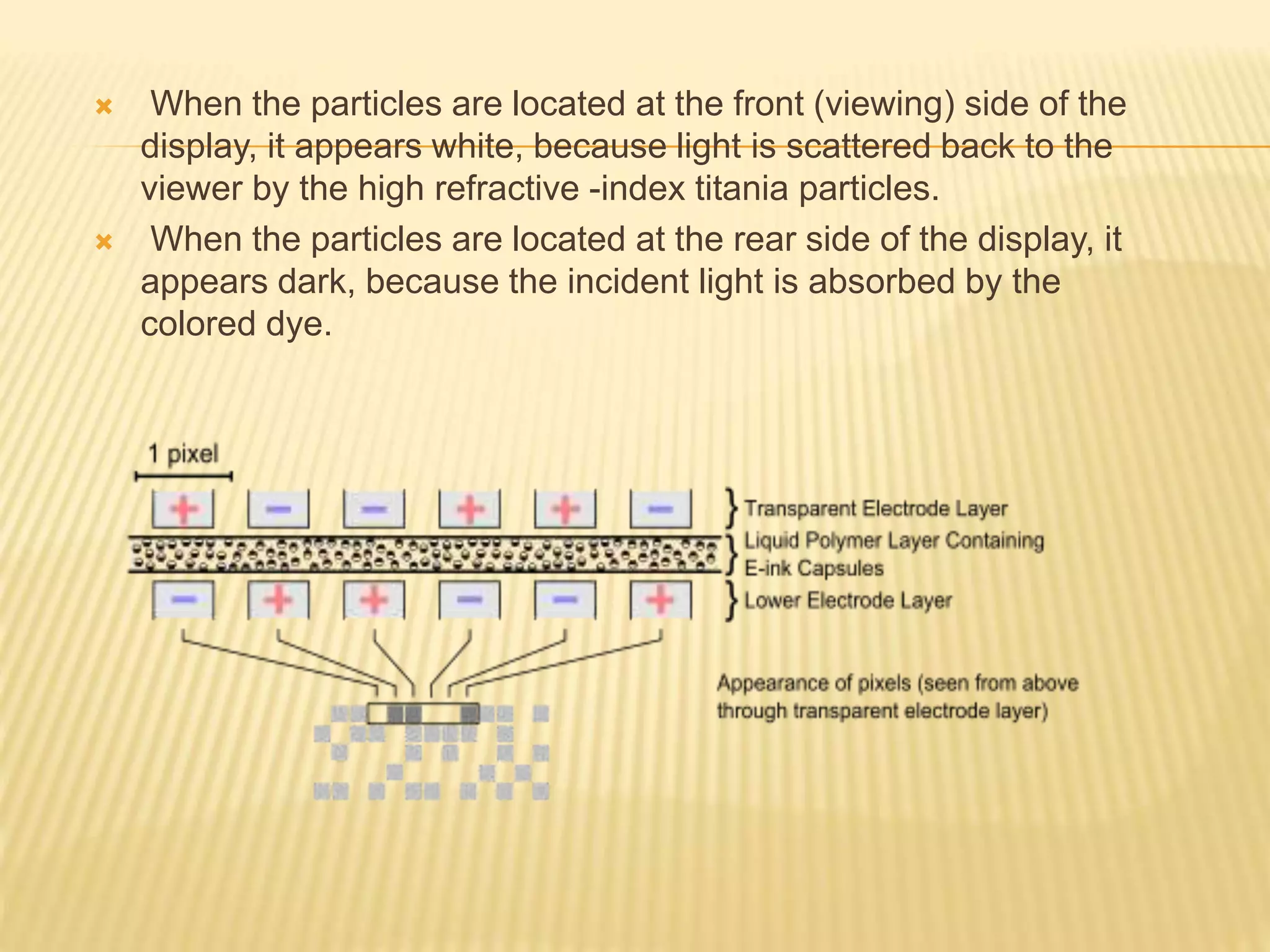
 When a voltage is applied across the two plates, the
particles will migrate electrophoretically to the plate bearing
the opposite charge from that on the particles.
 When the particles are located at the front (viewing) side of the
display, it appears white, because light is scattered back to the
viewer by the high refractive -index titania particles.
 When the particles are located at the rear side of the display, it
appears dark, because the incident light is absorbed by the
colored dye.
ELECTROWETTING
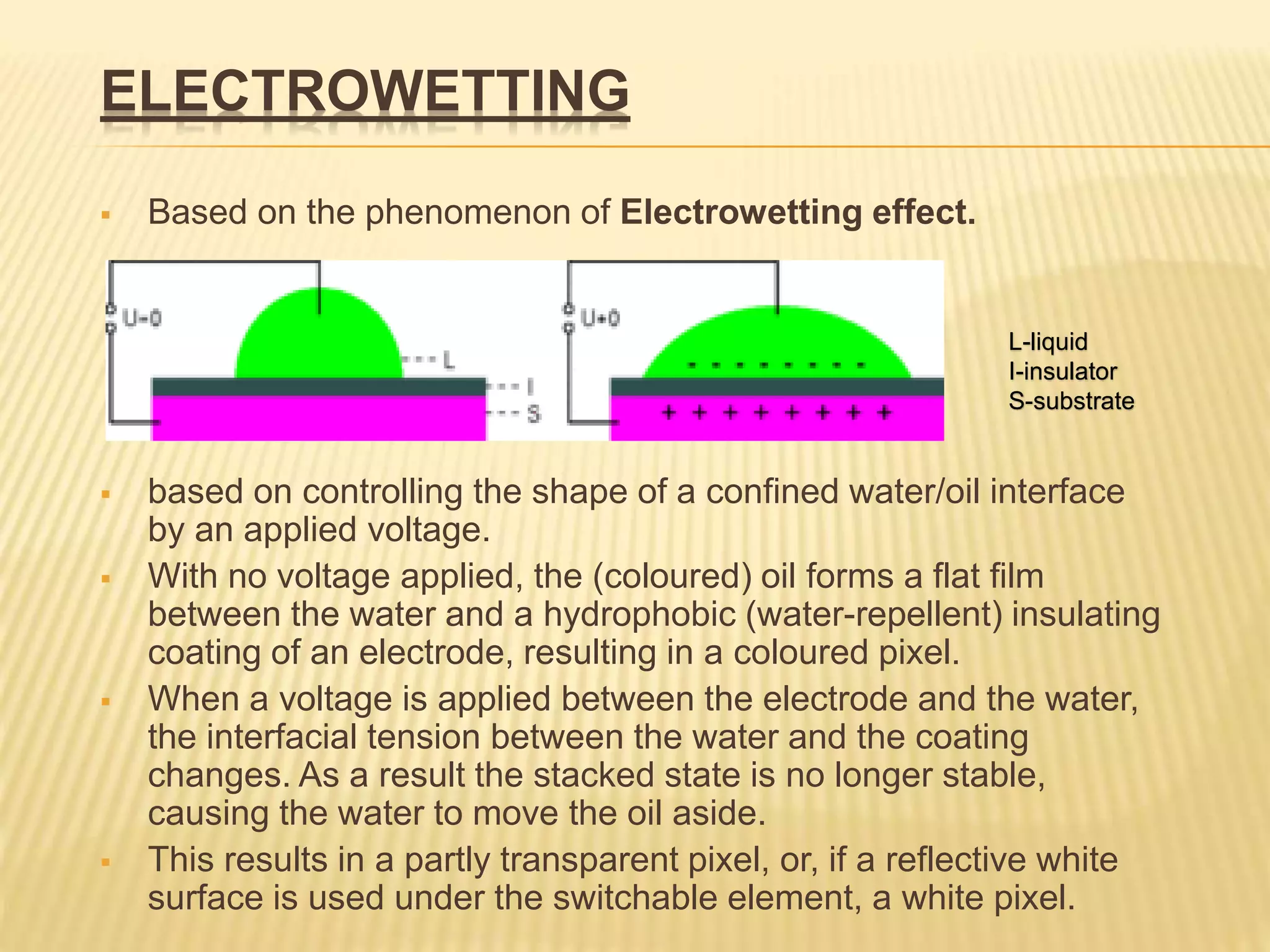
 Based on the phenomenon of Electrowetting effect.
 based on controlling the shape of a confined water/oil interface
by an applied voltage.
 With no voltage applied, the (coloured) oil forms a flat film
between the water and a hydrophobic (water-repellent) insulating
coating of an electrode, resulting in a coloured pixel.
 When a voltage is applied between the electrode and the water,
the interfacial tension between the water and the coating
changes. As a result the stacked state is no longer stable,
causing the water to move the oil aside.
 This results in a partly transparent pixel, or, if a reflective white
surface is used under the switchable element, a white pixel.
L-liquid
I-insulator
S-substrate
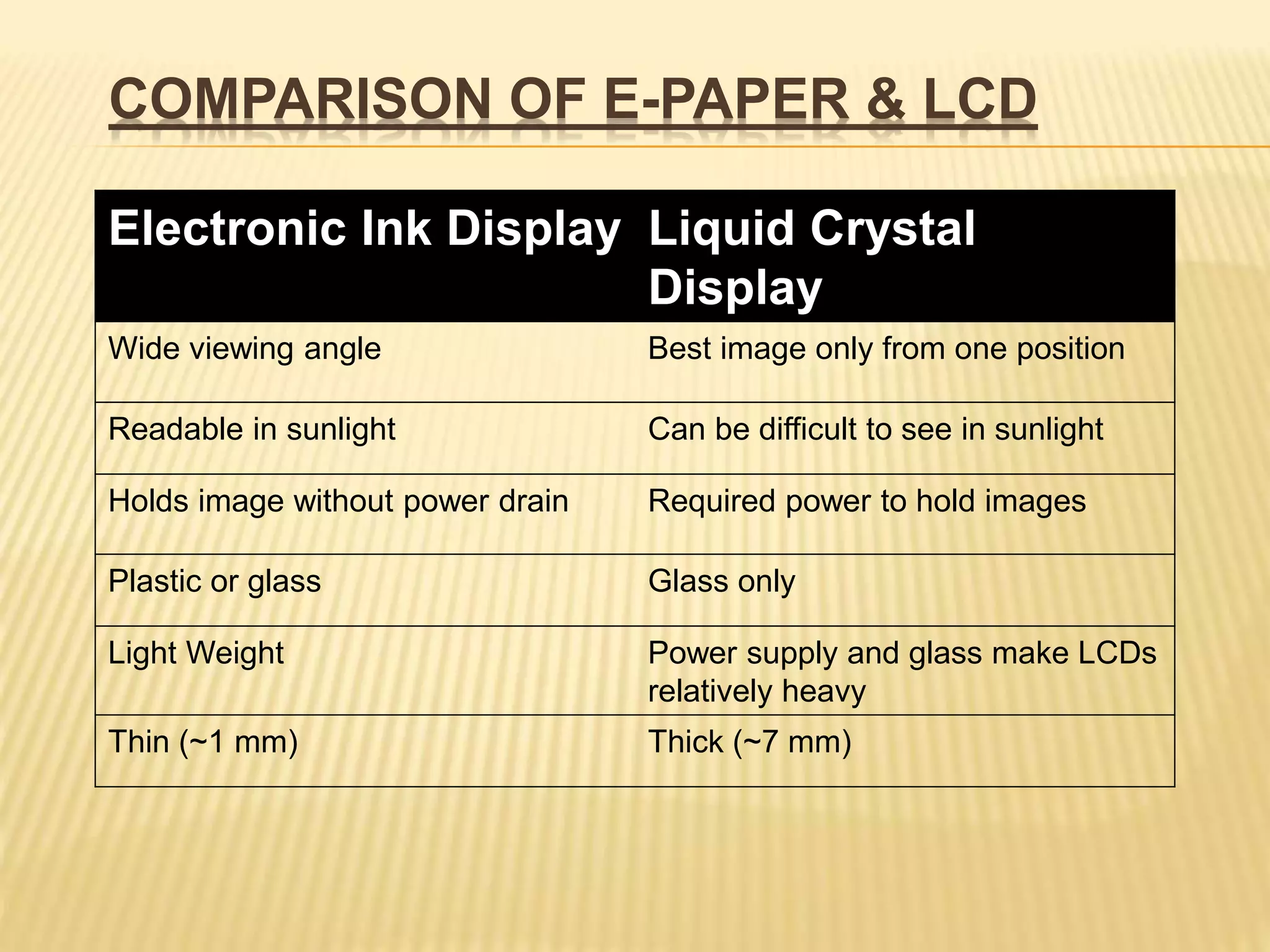
COMPARISON OF E-PAPER & LCD
Electronic Ink Display Liquid Crystal
Display
Wide viewing angle Best image only from one position
Readable in sunlight Can be difficult to see in sunlight
Holds image without power drain Required power to hold images
Plastic or glass Glass only
Light Weight Power supply and glass make LCDs
relatively heavy
Thin (~1 mm) Thick (~7 mm)
POWER CONSUMPTION
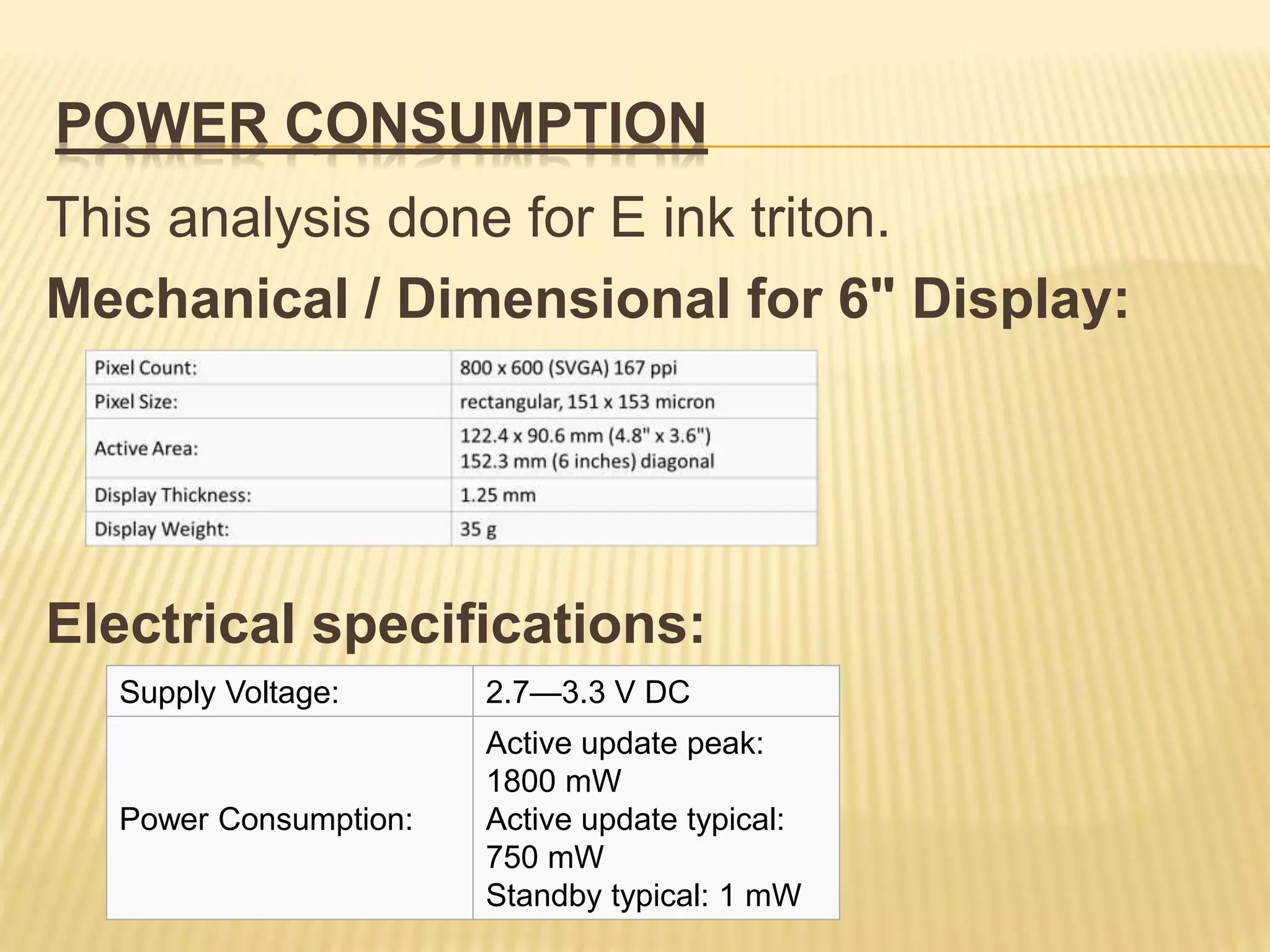
This analysis done for E ink triton.
Mechanical / Dimensional for 6" Display:
Electrical specifications:
Supply Voltage: 2.7—3.3 V DC
Power Consumption:
Active update peak:
1800 mW
Active update typical:
750 mW
Standby typical: 1 mW
MERITS OF E-PAPER
 Paper-like Readability
 They are persistent without power, drawing current only when
they change, which means low power consumption therefore
batteries can be smaller and last longer.
 An electronic ink display module is thinner, lighter weight, and
more robust than conventional LCD's.
 Electronic Paper is highly flexible and it is able to be twisted or
bended into different curvatures. The Electronic Paper can be
applied to different shapes of products, without being limited to
being bonded to flat display panels.
 They are completely reflective requiring no backlight.
 They are inherently bi-stable for extended periods of time.
 Simple Manufacturing Process
The manufacturing process is carried out using a roll- to-roll method, similar
to printing paper, by injecting dielectric fluid and charged particles into the
layer of capsules, and then sealing the top layer.
The production is performed continuously at high speed.
DEMERITS OF E-PAPER
 Electronic paper technologies have a very low refresh rate
compared to other low-power display technologies, such as
LCD.
An example of this limit is that a document cannot be
smoothly zoomed without either extreme blurring during the
transition or a very slow zoom.
 A shadow of an image may be visible after refreshing parts
of the screen. Such shadows are termed "ghost images",
and the effect is termed "ghosting“.
Because of ghosting the entire screen white and black
when loading a new image.
APPLICATIONS
 Wristwatches
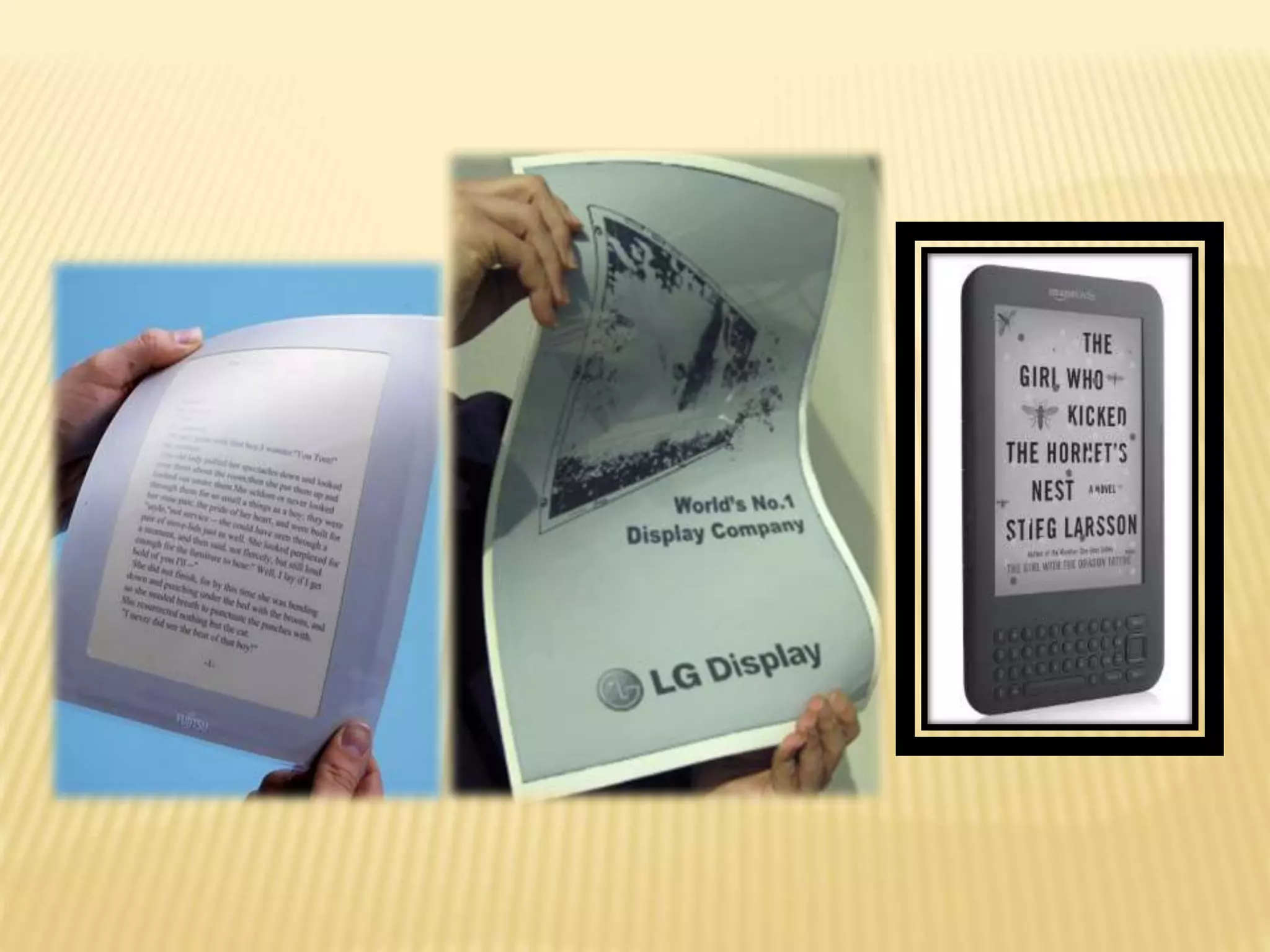
 e-Book reader
eg: Amazon kindle.
 Electronic Shelf Label
In a large department store or
supermarket, e-paper can be used for
labelling the shelves and price
tagging.
 Smart Card Display
Some credit cards contain a smart card to
store information such as accumulated
credit and money expenses etc.
 Mobile phones
 E-Newspaper
 Time Table at Stations
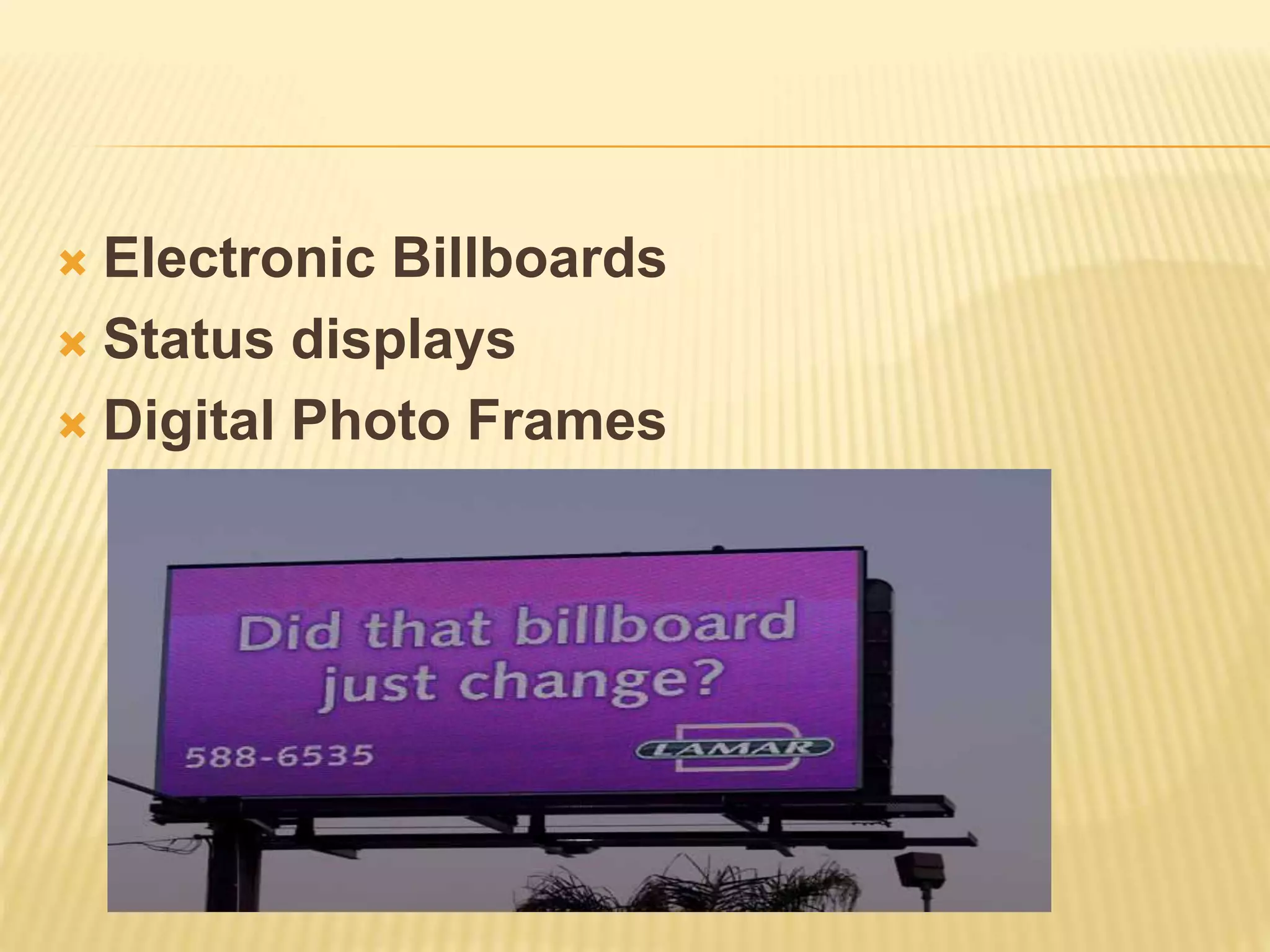
 Electronic Billboards
 Status displays
 Digital Photo Frames
CONCLUSION
Electronic ink is not intended to diminish or do away with traditional
displays. Instead electronic ink will initially co-exist with traditional paper
and other display technologies. In the long run, electronic ink may have
a multibillion-dollar impact on the publishing industry.
Ultimately electronic ink will permit almost any surface to become a
display, bringing information out of the confines of traditional devices
and into the world around us.
REFERENCES
 Flexible and Roll-able Displays/Electronic Paper A Brief Technology
Overview Rong-Chang (R.C.) Liang
 Paper Electronics and Electronic Paper
by Magnus Berggren*'**, Thomas Kugler*'**, Tommi Remonen*, David Nilsson**,Miaoxiang
Chen**, Petronella Norberg"*The Research Institute ACRE0 AB, Bredgatan 34, SE-602 21
Norrkoping, Sweden **Organic Electronics Group, Campus Norrkoping, SE-601 74, Sweden
 E-paper: Clarifying future R&D needs by a fundamental understanding of the
maximum performance of current technologies
Author(s): Heikenfeld, J.
Novel Devices Lab., Univ. of Cincinnati, Cincinnati, OH, USA
 http://en.wikipedia.org/wiki/Electronic_paper
 http://spectrum.ieee.org/consumer-
electronics/portable-devices/lighter-brighter-displays
 Image taken from:
http://www.eink.com/technology.html
http://www.amazon.in/gp/product/B007RF5F0Q/ref=famstripe_kp3
THANK YOU

E-Paper Technology report

  • 1.
    E-PAPER Name- Sushree Sushmeta Roll:-124107 Redg:-1201211155 Branch:- Computer Science and Engineering
  • 2.
    INTRODUCTION  E-paper alsoknown as Electronic Paper or Electronic ink Display.  Electronic paper was first developed in the 1970s by Nick Sheridon at Xerox’s Palo Alto Research center.  Unlike conventional backlit flat panel displays which emit light, E-paper displays reflect light like ordinary paper, theoretically making it more comfortable to read, and giving the surface a wider viewing angle compared to conventional displays.  extremely light and flexible.
  • 3.
    CONSTRUCTION OF E-PAPER It has two different parts.  Front panel.  Back panel.  The front panel consist of E-ink.  The back panel consist of electronic circuits.  Back panel is made up of organic thin film transistor arrays which provide voltage needed by the E-Paper.  To form an E-ink electronic display the ink is printed onto a plastic film that is laminated to a layer of circuitry.
  • 5.
     The frontpanel consist of E-ink.  E-ink is made up of millions of tiny microcapsules.  Microcapsules have diameter of the order of 100 microns. Front panel E-ink 2-pigment system Each microcapsule contains positively charged white particles and negatively charged black particles suspended in a clear fluid . When a positive or negative electric field is applied, corresponding particles move to the top of the microcapsule where they become visible to the viewer. This makes the surface appear white or black at that spot.
  • 6.
    TECHNOLOGIES PROPOSED SOFAR:  Gyricon  Electrophoretic display  Electrowetting
  • 7.
    GLYRICON  It wasthe first electronic paper and was developed in 1970’s.  Consists of polyethylene spheres having diameter between 75-106 micrometers.  Each sphere is a janus particle composed of negatively charged black plastic on one side and positively charged white plastic on the other (each bead is thus a dipole).  These spheres are embedded in transparent silicone made sheet, with each sphere suspended in a bubble of oil so that they can rotate freely.  The polarity of the voltage applied to each pair of electrodes then determines whether the white or black side is face-up, thus giving the pixel a white or black appearance.
  • 8.
    ELECTROPHORETIC DISPLAY  EachE-ink capsule contains an oily solution containing black dye (the electronic ink), with numerous white titanium dioxide particles suspended within these capsules are dispersed in a hydrocarbon oil in which dark-colored dye and charging agents are also added.  Capsule diameter is 40 micrometer.  Gap between the two conducting plates is of the order of 100 micrometers and the mixture is placed between these plates.  When a voltage is applied across the two plates, the particles will migrate electrophoretically to the plate bearing the opposite charge from that on the particles.
  • 9.
     When theparticles are located at the front (viewing) side of the display, it appears white, because light is scattered back to the viewer by the high refractive -index titania particles.  When the particles are located at the rear side of the display, it appears dark, because the incident light is absorbed by the colored dye.
  • 10.
    ELECTROWETTING  Based onthe phenomenon of Electrowetting effect.  based on controlling the shape of a confined water/oil interface by an applied voltage.  With no voltage applied, the (coloured) oil forms a flat film between the water and a hydrophobic (water-repellent) insulating coating of an electrode, resulting in a coloured pixel.  When a voltage is applied between the electrode and the water, the interfacial tension between the water and the coating changes. As a result the stacked state is no longer stable, causing the water to move the oil aside.  This results in a partly transparent pixel, or, if a reflective white surface is used under the switchable element, a white pixel. L-liquid I-insulator S-substrate
  • 11.
    COMPARISON OF E-PAPER& LCD Electronic Ink Display Liquid Crystal Display Wide viewing angle Best image only from one position Readable in sunlight Can be difficult to see in sunlight Holds image without power drain Required power to hold images Plastic or glass Glass only Light Weight Power supply and glass make LCDs relatively heavy Thin (~1 mm) Thick (~7 mm)
  • 12.
    POWER CONSUMPTION This analysisdone for E ink triton. Mechanical / Dimensional for 6" Display: Electrical specifications: Supply Voltage: 2.7—3.3 V DC Power Consumption: Active update peak: 1800 mW Active update typical: 750 mW Standby typical: 1 mW
  • 13.
    MERITS OF E-PAPER Paper-like Readability  They are persistent without power, drawing current only when they change, which means low power consumption therefore batteries can be smaller and last longer.  An electronic ink display module is thinner, lighter weight, and more robust than conventional LCD's.  Electronic Paper is highly flexible and it is able to be twisted or bended into different curvatures. The Electronic Paper can be applied to different shapes of products, without being limited to being bonded to flat display panels.  They are completely reflective requiring no backlight.  They are inherently bi-stable for extended periods of time.
  • 14.
     Simple ManufacturingProcess The manufacturing process is carried out using a roll- to-roll method, similar to printing paper, by injecting dielectric fluid and charged particles into the layer of capsules, and then sealing the top layer. The production is performed continuously at high speed.
  • 15.
    DEMERITS OF E-PAPER Electronic paper technologies have a very low refresh rate compared to other low-power display technologies, such as LCD. An example of this limit is that a document cannot be smoothly zoomed without either extreme blurring during the transition or a very slow zoom.  A shadow of an image may be visible after refreshing parts of the screen. Such shadows are termed "ghost images", and the effect is termed "ghosting“. Because of ghosting the entire screen white and black when loading a new image.
  • 16.
    APPLICATIONS  Wristwatches  e-Bookreader eg: Amazon kindle.  Electronic Shelf Label In a large department store or supermarket, e-paper can be used for labelling the shelves and price tagging.  Smart Card Display Some credit cards contain a smart card to store information such as accumulated credit and money expenses etc.  Mobile phones  E-Newspaper  Time Table at Stations
  • 17.
     Electronic Billboards Status displays  Digital Photo Frames
  • 18.
    CONCLUSION Electronic ink isnot intended to diminish or do away with traditional displays. Instead electronic ink will initially co-exist with traditional paper and other display technologies. In the long run, electronic ink may have a multibillion-dollar impact on the publishing industry. Ultimately electronic ink will permit almost any surface to become a display, bringing information out of the confines of traditional devices and into the world around us.
  • 19.
    REFERENCES  Flexible andRoll-able Displays/Electronic Paper A Brief Technology Overview Rong-Chang (R.C.) Liang  Paper Electronics and Electronic Paper by Magnus Berggren*'**, Thomas Kugler*'**, Tommi Remonen*, David Nilsson**,Miaoxiang Chen**, Petronella Norberg"*The Research Institute ACRE0 AB, Bredgatan 34, SE-602 21 Norrkoping, Sweden **Organic Electronics Group, Campus Norrkoping, SE-601 74, Sweden  E-paper: Clarifying future R&D needs by a fundamental understanding of the maximum performance of current technologies Author(s): Heikenfeld, J. Novel Devices Lab., Univ. of Cincinnati, Cincinnati, OH, USA  http://en.wikipedia.org/wiki/Electronic_paper  http://spectrum.ieee.org/consumer- electronics/portable-devices/lighter-brighter-displays  Image taken from: http://www.eink.com/technology.html http://www.amazon.in/gp/product/B007RF5F0Q/ref=famstripe_kp3
  • 20.