


EMERGING DISPLAY TECHNOLOGIES Presentation by: Pratishtha Shira Ram Sakshi Dixit GGITM, Bhopal Xperia -Erudition
A display device is an output device for presentation  information for visual, tactile or auditive reception, acquired, stored, or transmitted in various forms.  When the input information is supplied as an electrical signal, the display is called  electronic display . Display devices
Conventional displays CRT (Cathode Ray Tube) LCD ( Liquid  Crystal Display) LED (Light Emitting diode)
Display Technologies For the purpose of this presentation, four of the most promising technologies have been identified as: Electrophoretic pixel 3qi Multimode Photonic ink Electrofluidic pixel
Electrophoretic pixel Electrophoresis  is a process by which molecules (such as proteins, DNA, or RNA fragments) can be separated according to size and electrical charge by applying an electric current to them. Each kind of molecule travels through the medium at a different rate, depending on its electrical charge and molecular size .  An  electrophoretic display  is an information display that forms visible images by rearranging charged pigment particles using an applied electric field.
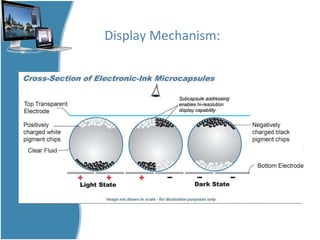
An electrophoretic pixel comprises numerous tiny capsules that contain a mixture of oppositely charged pigment particles,  Typically carbon for black,   and    titanium dioxide for white. A voltage attracts or repels the pigment particles within the capsules from the screen,  depending on whether a white or a black pixel is needed at that spot. Like mixing paints, with the right voltage control the system can also leave the particles in a partially mixed, or grayscale, state.  How it works
Display Mechanism:
Pros and cons Pros: It is simple to produce Does not need much power (because the pigments simply reflect—or don’t reflect—the ambient light). Cons: Slow switching limits video capabilities (40 micrometer thick ink layer). Full color is dim.
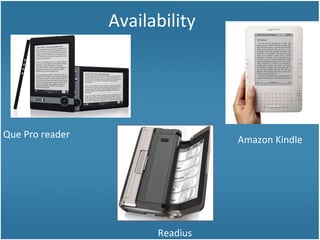
Availability Que Pro reader Amazon Kindle Readius
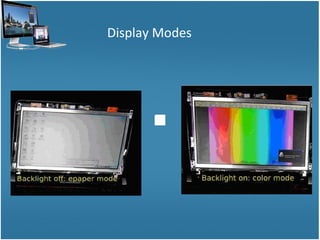
3qi Multimode This display combines reflective and transmissive liquid crystal technologies.  3Qi is going to have 3 modes: 1.  A very low-power, sunlight-readable, reflective E-paper mode 2.  A full-color, bright, conventional LCD mode 3.  A low-power, basic color transflective mode !! In bright sunlight, one can manually switch to the e-paper mode, relying on reflected light; while in a dark environment it is again possible to switch to the backlit LCD.
Display Modes
Pros and Cons Pros: Consumes minimal power (screens use 1/2 to ¼ the  power of a regular LCD screen)   . Is visible indoors and out. Cons: Low brightness. Color saturation is compromised.
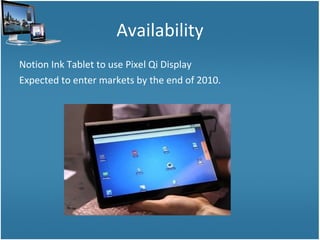
Availability Notion Ink Tablet to use Pixel Qi Display Expected to enter markets by the end of 2010.
Photonic ink (P-Ink) is a substance that can change colour electronically.  Unlike earlier prototype electronic inks, which could only display two colour values (usually black and white), photonic ink can display any colour value in the spectrum. Among other applications, photonic ink can be used for refreshable, full-color images to coordinate pictures with updated  content. Photonic ink
Photonics (from photon ) is an area of study centering around the generation and utilization of radiant energy , such as light , for various applications.  Photonic ink displays color through controlled diffraction, a special type of interference that is responsible for the iridescent color effects of opals and butterfly wings.  Photonics
P-ink particles are stacked in a uniform pattern, similar to the way any round objects are organized when stacked.  Interference occurs when light is deflected by the particles; this deflection causes some wavelengths to be eliminated, which results in the reflected light appearing as a particular color. Varying the size of the spaces between the particles creates different colors. How it works
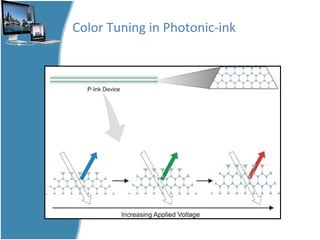
An electroactive polymer gel is packed between the stacked spheres (photonic crystals made out of silica beads measuring 200 nanometers).  The gel swells when soaked in a solvent and shrinks when it dries out.  This creates variances in the spacing between the tiny spheres. When a voltage is applied, an electrolyte fluid is drawn into the polymer composite, causing it to swell. This alters the spacing of the crystals, affecting which wavelengths of light they reflect.  When the spacing is carefully controlled, the pixel can be made to reflect any color in the visible spectrum.  Color Variation
Color Tuning in Photonic-ink
Pros and Cons Pros: A single pixel can generate any color. Low cost construction. Power efficient. Cons: Limited life of devices. Not bright.
Availability This technology is not commercially available as yet. Expected  to be in the markets by 2012.
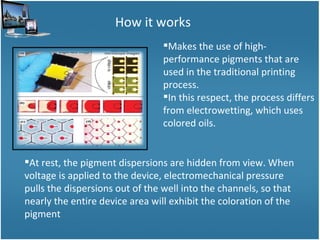
Electrofluidic displays place an aqueous pigment dispersion inside a tiny reservoir. The reservoir comprises <5-10% of the viewable pixel area and therefore the pigment is substantially hidden from view. Voltage is used to electromechanically pull the pigment out of the reservoir and spread it as a film directly behind the viewing substrate.  As a result, the display takes on color and brightness similar to that of conventional pigments printed on paper. When voltage is removed liquid surface tension causes the pigment dispersion to rapidly recoil into the reservoir. Electro-fluidic Ink
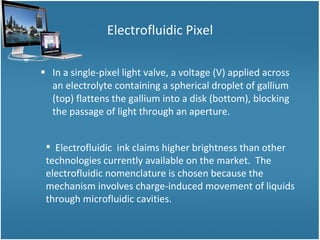
Electrofluidic Pixel In a single-pixel light valve, a voltage (V) applied across an electrolyte containing a spherical droplet of gallium (top) flattens the gallium into a disk (bottom), blocking the passage of light through an aperture.  Electrofluidic  ink claims higher brightness than other technologies currently available on the market.  The electrofluidic nomenclature is chosen because the mechanism involves charge-induced movement of liquids through microfluidic cavities.
How it works Makes the use of high-performance pigments that are used in the traditional printing process. In this respect, the process differs from electrowetting, which uses colored oils. At rest, the pigment dispersions are hidden from view. When voltage is applied to the device, electromechanical pressure pulls the dispersions out of the well into the channels, so that nearly the entire device area will exhibit the coloration of the pigment
Pros and Cons Pros: Mechanism is similar to ink on paper. Switches fast enough for videos. Cons: Technology in the initial developing stage.
Availability This technology is not commercially available as yet. Expected  to be in the markets by 2012.
Thank you
Any Queries?

Emerging Display Technologies

  • 1.
    EMERGING DISPLAY TECHNOLOGIESPresentation by: Pratishtha Shira Ram Sakshi Dixit GGITM, Bhopal Xperia -Erudition
  • 2.
    A display device is an outputdevice for presentation  information for visual, tactile or auditive reception, acquired, stored, or transmitted in various forms. When the input information is supplied as an electrical signal, the display is called  electronic display . Display devices
  • 3.
    Conventional displays CRT(Cathode Ray Tube) LCD ( Liquid Crystal Display) LED (Light Emitting diode)
  • 4.
    Display Technologies Forthe purpose of this presentation, four of the most promising technologies have been identified as: Electrophoretic pixel 3qi Multimode Photonic ink Electrofluidic pixel
  • 5.
    Electrophoretic pixel Electrophoresis is a process by which molecules (such as proteins, DNA, or RNA fragments) can be separated according to size and electrical charge by applying an electric current to them. Each kind of molecule travels through the medium at a different rate, depending on its electrical charge and molecular size . An electrophoretic display is an information display that forms visible images by rearranging charged pigment particles using an applied electric field.
  • 6.
    An electrophoretic pixelcomprises numerous tiny capsules that contain a mixture of oppositely charged pigment particles, Typically carbon for black, and titanium dioxide for white. A voltage attracts or repels the pigment particles within the capsules from the screen, depending on whether a white or a black pixel is needed at that spot. Like mixing paints, with the right voltage control the system can also leave the particles in a partially mixed, or grayscale, state. How it works
  • 7.
  • 8.
    Pros and consPros: It is simple to produce Does not need much power (because the pigments simply reflect—or don’t reflect—the ambient light). Cons: Slow switching limits video capabilities (40 micrometer thick ink layer). Full color is dim.
  • 9.
    Availability Que Proreader Amazon Kindle Readius
  • 10.
    3qi Multimode Thisdisplay combines reflective and transmissive liquid crystal technologies. 3Qi is going to have 3 modes: 1. A very low-power, sunlight-readable, reflective E-paper mode 2. A full-color, bright, conventional LCD mode 3. A low-power, basic color transflective mode !! In bright sunlight, one can manually switch to the e-paper mode, relying on reflected light; while in a dark environment it is again possible to switch to the backlit LCD.
  • 11.
  • 12.
    Pros and ConsPros: Consumes minimal power (screens use 1/2 to ¼ the power of a regular LCD screen) . Is visible indoors and out. Cons: Low brightness. Color saturation is compromised.
  • 13.
    Availability Notion InkTablet to use Pixel Qi Display Expected to enter markets by the end of 2010.
  • 14.
    Photonic ink (P-Ink)is a substance that can change colour electronically. Unlike earlier prototype electronic inks, which could only display two colour values (usually black and white), photonic ink can display any colour value in the spectrum. Among other applications, photonic ink can be used for refreshable, full-color images to coordinate pictures with updated content. Photonic ink
  • 15.
    Photonics (from photon ) isan area of study centering around the generation and utilization of radiant energy , such as light , for various applications. Photonic ink displays color through controlled diffraction, a special type of interference that is responsible for the iridescent color effects of opals and butterfly wings. Photonics
  • 16.
    P-ink particles arestacked in a uniform pattern, similar to the way any round objects are organized when stacked. Interference occurs when light is deflected by the particles; this deflection causes some wavelengths to be eliminated, which results in the reflected light appearing as a particular color. Varying the size of the spaces between the particles creates different colors. How it works
  • 17.
    An electroactive polymergel is packed between the stacked spheres (photonic crystals made out of silica beads measuring 200 nanometers). The gel swells when soaked in a solvent and shrinks when it dries out. This creates variances in the spacing between the tiny spheres. When a voltage is applied, an electrolyte fluid is drawn into the polymer composite, causing it to swell. This alters the spacing of the crystals, affecting which wavelengths of light they reflect. When the spacing is carefully controlled, the pixel can be made to reflect any color in the visible spectrum.  Color Variation
  • 18.
    Color Tuning inPhotonic-ink
  • 19.
    Pros and ConsPros: A single pixel can generate any color. Low cost construction. Power efficient. Cons: Limited life of devices. Not bright.
  • 20.
    Availability This technologyis not commercially available as yet. Expected to be in the markets by 2012.
  • 21.
    Electrofluidic displays placean aqueous pigment dispersion inside a tiny reservoir. The reservoir comprises <5-10% of the viewable pixel area and therefore the pigment is substantially hidden from view. Voltage is used to electromechanically pull the pigment out of the reservoir and spread it as a film directly behind the viewing substrate. As a result, the display takes on color and brightness similar to that of conventional pigments printed on paper. When voltage is removed liquid surface tension causes the pigment dispersion to rapidly recoil into the reservoir. Electro-fluidic Ink
  • 22.
    Electrofluidic Pixel Ina single-pixel light valve, a voltage (V) applied across an electrolyte containing a spherical droplet of gallium (top) flattens the gallium into a disk (bottom), blocking the passage of light through an aperture. Electrofluidic  ink claims higher brightness than other technologies currently available on the market.  The electrofluidic nomenclature is chosen because the mechanism involves charge-induced movement of liquids through microfluidic cavities.
  • 23.
    How it worksMakes the use of high-performance pigments that are used in the traditional printing process. In this respect, the process differs from electrowetting, which uses colored oils. At rest, the pigment dispersions are hidden from view. When voltage is applied to the device, electromechanical pressure pulls the dispersions out of the well into the channels, so that nearly the entire device area will exhibit the coloration of the pigment
  • 24.
    Pros and ConsPros: Mechanism is similar to ink on paper. Switches fast enough for videos. Cons: Technology in the initial developing stage.
  • 25.
    Availability This technologyis not commercially available as yet. Expected to be in the markets by 2012.
  • 26.
  • 27.