

E-paper
Technology
Instructor
Rethwan
Faiz
Assistant
Professor
AIUB
HELLO! EVERY ONE
American International University-Bangladesh
(AIUB)
Group Members-
1.Shahriar Niloy. 14-26876-2
2.Kabir,Md.Ahshan 14-26903-2
3. Shahabuddin,khan Istiak 13-24372-2
4.Hossain,Mohammad Ismail 14-27342-2
5. Nurnobe ,Md. 14-26845-2
Contents
• Introduction
• Construction of E-paper
• Working Technologies
• Properties
• Comparison E-paper & LCD
• Advantages & Disadvantages
• Application
• Future scope
• Conclusion
HISTORY OF E-PAPER
• In 1970, one of the Xerox’s teams led by Nicholas K. Sheridon gave the
concept of e-paper
• The first electronic paper, called Gyricon
• It took almost 30 years to enter in the market
• In 2004 Sony released in Japan, the first e-book reader with an electronic
paper E Ink display
• The contrast ratio in electronic displays available as of 2008 approaches
newspaper
WHAT IS E-PAPER ?
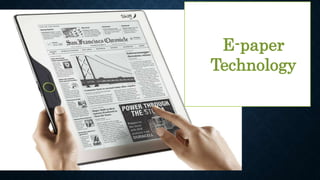
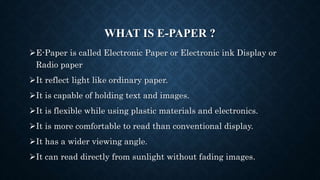
E-Paper is called Electronic Paper or Electronic ink Display or
Radio paper
It reflect light like ordinary paper.
It is capable of holding text and images.
It is flexible while using plastic materials and electronics.
It is more comfortable to read than conventional display.
It has a wider viewing angle.
It can read directly from sunlight without fading images.
E PAPER
Light weight and durable.
Low power consumption.
A digital pen is also used create handwriting document.
CONSTRUCTION OF E-PAPER
• It has two different parts.
• Front plane.
• Back plane.
BACK PLANE
• The back plane consist of electronic circuits.
• Back plane is made up of organic thin film transistor arrays which provide voltage
needed by the E-Paper.
• To form an E-ink electronic display the ink is printed onto a plastic film that is laminated
to a layer of circuitry.
FRONT PLANE
• The front plane consist of E-ink.
• E-ink is made up of millions of tiny
microcapsules.
• Microcapsules have diameter of the order of
100 microns.
• Each microcapsule contains positively
charged white particles and negatively
charged black particles suspended in a clear
fluid .
• When a positive or negative electric field is
applied, corresponding particles move to the
top of the microcapsule where they become
visible to the viewer. This makes the surface
appear white or black at that spot. E-ink 2-pigment system
TECHNOLOGIES PROPOSED SO FAR:
 Gyricon
 Electrophoretic display
 Electrowetting
GYRICON
• First electronic paper.
• Polyethylene spheres (75-106 micrometers).
• Each sphere is a janus particle composed of negatively charged black plastic on one
side and positively charged white plastic on the other.
• Embedded in transparent silicone made sheet, with each sphere suspended in a
bubble of oil for rotation .
• Voltage applied to each pair of electrodes determines whether the white or black
side is face-up.
LIMITATIONS OF THIS METHOD
APPLICATIONS :
Gyricon can be used for products such as e-book ,e-newspaper , portable signs ,
rollable displays etc.
1. Low brightness
2. Low resolution.
3. Lack of color.
ELECTROPHORETIC
• Each E-ink capsule contains an oily solution containing black dye (the electronic ink), with
numerous white titanium dioxide particles suspended within these capsules are dispersed in a
hydrocarbon oil in which dark-colored dye and charging agents are also added.
• Capsule diameter is 40 micrometer.
• Gap between the two conducting plates is of the order of 100 micrometers and the mixture is placed
between these plates.
• When a voltage is applied across the two plates, the particles will migrate electrophoretically to the
plate bearing the opposite charge from that on the particles.
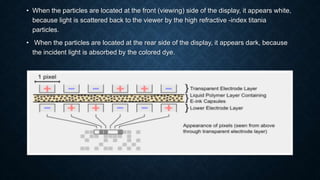
• When the particles are located at the front (viewing) side of the display, it appears white,
because light is scattered back to the viewer by the high refractive -index titania
particles.
• When the particles are located at the rear side of the display, it appears dark, because
the incident light is absorbed by the colored dye.
ELECTROWETTING
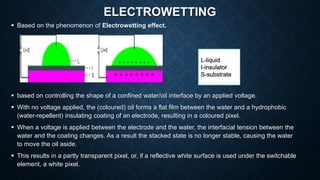
 Based on the phenomenon of Electrowetting effect.
 based on controlling the shape of a confined water/oil interface by an applied voltage.
 With no voltage applied, the (coloured) oil forms a flat film between the water and a hydrophobic
(water-repellent) insulating coating of an electrode, resulting in a coloured pixel.
 When a voltage is applied between the electrode and the water, the interfacial tension between the
water and the coating changes. As a result the stacked state is no longer stable, causing the water
to move the oil aside.
 This results in a partly transparent pixel, or, if a reflective white surface is used under the switchable
element, a white pixel.
L-liquid
I-insulator
S-substrate
PROPERTIES
• Ultra-thin and flexible energy cell.
• Eliminates the cost of the battery , weight and volume of the
battery holder.
• Can be made into almost any shape.
• Can be integrated on almost any surface.
• Low cost and simple to produce, using printing process.
• Environmentally friendly, non-caustic, no possibility of explosion,
burns, or overheating.
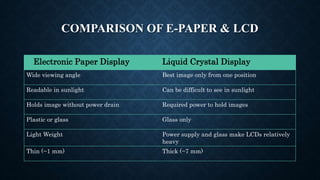
COMPARISON OF E-PAPER & LCD
Electronic Paper Display Liquid Crystal Display
Wide viewing angle Best image only from one position
Readable in sunlight Can be difficult to see in sunlight
Holds image without power drain Required power to hold images
Plastic or glass Glass only
Light Weight Power supply and glass make LCDs relatively
heavy
Thin (~1 mm) Thick (~7 mm)
ADVANTAGES
• Paper-like Readability.
• Ultra-Low Power Consumption.
• Clarity.
• Reduced Eyestrain.
• Mobile Display Solution.
• Hypertext.
• Multimedia Information.
• Include Graphics.
• Inexpensive.
DISADVANTAGES
• Very low switching speed
• Electrochemical complexity
• Slow response to change
• Too slow for video
• Problems in extremes temperatures,humidity
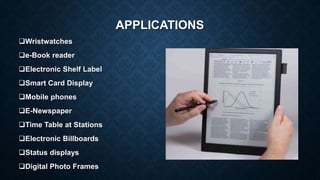
APPLICATIONS
Wristwatches
e-Book reader
Electronic Shelf Label
Smart Card Display
Mobile phones
E-Newspaper
Time Table at Stations
Electronic Billboards
Status displays
Digital Photo Frames
FUTURE OF E-PAPER
• The tube will contain a tightly rolled sheet of e-paper that can be spooled out of a slit
in the tube as a flat sheet, for reading, and stored again at the touch of a button.
Information will be downloaded—there will be simple user interface—from an
overhead satellite, a cell phone network, or an internal memory chip. This document
reader will be used for e-mail, the Internet, books downloaded from a global digital
library that is currently under construction, technical manuals, newspapers
(perhaps in larger format), magazines, and so forth, anywhere on the planet. It will
cost less than $100, and nearly everyone will have one!
CONCLUSION
Researches found that in just few years this
technology can replace paper in many situations, leading
us to think of a truly paperless world.
E paper technology

E paper technology

  • 1.
  • 2.
  • 3.
    HELLO! EVERY ONE AmericanInternational University-Bangladesh (AIUB) Group Members- 1.Shahriar Niloy. 14-26876-2 2.Kabir,Md.Ahshan 14-26903-2 3. Shahabuddin,khan Istiak 13-24372-2 4.Hossain,Mohammad Ismail 14-27342-2 5. Nurnobe ,Md. 14-26845-2
  • 4.
    Contents • Introduction • Constructionof E-paper • Working Technologies • Properties • Comparison E-paper & LCD • Advantages & Disadvantages • Application • Future scope • Conclusion
  • 5.
    HISTORY OF E-PAPER •In 1970, one of the Xerox’s teams led by Nicholas K. Sheridon gave the concept of e-paper • The first electronic paper, called Gyricon • It took almost 30 years to enter in the market • In 2004 Sony released in Japan, the first e-book reader with an electronic paper E Ink display • The contrast ratio in electronic displays available as of 2008 approaches newspaper
  • 6.
    WHAT IS E-PAPER? E-Paper is called Electronic Paper or Electronic ink Display or Radio paper It reflect light like ordinary paper. It is capable of holding text and images. It is flexible while using plastic materials and electronics. It is more comfortable to read than conventional display. It has a wider viewing angle. It can read directly from sunlight without fading images.
  • 7.
    E PAPER Light weightand durable. Low power consumption. A digital pen is also used create handwriting document.
  • 8.
    CONSTRUCTION OF E-PAPER •It has two different parts. • Front plane. • Back plane. BACK PLANE • The back plane consist of electronic circuits. • Back plane is made up of organic thin film transistor arrays which provide voltage needed by the E-Paper. • To form an E-ink electronic display the ink is printed onto a plastic film that is laminated to a layer of circuitry.
  • 9.
    FRONT PLANE • Thefront plane consist of E-ink. • E-ink is made up of millions of tiny microcapsules. • Microcapsules have diameter of the order of 100 microns. • Each microcapsule contains positively charged white particles and negatively charged black particles suspended in a clear fluid . • When a positive or negative electric field is applied, corresponding particles move to the top of the microcapsule where they become visible to the viewer. This makes the surface appear white or black at that spot. E-ink 2-pigment system
  • 10.
    TECHNOLOGIES PROPOSED SOFAR:  Gyricon  Electrophoretic display  Electrowetting
  • 11.
    GYRICON • First electronicpaper. • Polyethylene spheres (75-106 micrometers). • Each sphere is a janus particle composed of negatively charged black plastic on one side and positively charged white plastic on the other. • Embedded in transparent silicone made sheet, with each sphere suspended in a bubble of oil for rotation . • Voltage applied to each pair of electrodes determines whether the white or black side is face-up.
  • 12.
    LIMITATIONS OF THISMETHOD APPLICATIONS : Gyricon can be used for products such as e-book ,e-newspaper , portable signs , rollable displays etc. 1. Low brightness 2. Low resolution. 3. Lack of color.
  • 13.
    ELECTROPHORETIC • Each E-inkcapsule contains an oily solution containing black dye (the electronic ink), with numerous white titanium dioxide particles suspended within these capsules are dispersed in a hydrocarbon oil in which dark-colored dye and charging agents are also added. • Capsule diameter is 40 micrometer. • Gap between the two conducting plates is of the order of 100 micrometers and the mixture is placed between these plates. • When a voltage is applied across the two plates, the particles will migrate electrophoretically to the plate bearing the opposite charge from that on the particles.
  • 14.
    • When theparticles are located at the front (viewing) side of the display, it appears white, because light is scattered back to the viewer by the high refractive -index titania particles. • When the particles are located at the rear side of the display, it appears dark, because the incident light is absorbed by the colored dye.
  • 15.
    ELECTROWETTING  Based onthe phenomenon of Electrowetting effect.  based on controlling the shape of a confined water/oil interface by an applied voltage.  With no voltage applied, the (coloured) oil forms a flat film between the water and a hydrophobic (water-repellent) insulating coating of an electrode, resulting in a coloured pixel.  When a voltage is applied between the electrode and the water, the interfacial tension between the water and the coating changes. As a result the stacked state is no longer stable, causing the water to move the oil aside.  This results in a partly transparent pixel, or, if a reflective white surface is used under the switchable element, a white pixel. L-liquid I-insulator S-substrate
  • 16.
    PROPERTIES • Ultra-thin andflexible energy cell. • Eliminates the cost of the battery , weight and volume of the battery holder. • Can be made into almost any shape. • Can be integrated on almost any surface. • Low cost and simple to produce, using printing process. • Environmentally friendly, non-caustic, no possibility of explosion, burns, or overheating.
  • 17.
    COMPARISON OF E-PAPER& LCD Electronic Paper Display Liquid Crystal Display Wide viewing angle Best image only from one position Readable in sunlight Can be difficult to see in sunlight Holds image without power drain Required power to hold images Plastic or glass Glass only Light Weight Power supply and glass make LCDs relatively heavy Thin (~1 mm) Thick (~7 mm)
  • 18.
    ADVANTAGES • Paper-like Readability. •Ultra-Low Power Consumption. • Clarity. • Reduced Eyestrain. • Mobile Display Solution. • Hypertext. • Multimedia Information. • Include Graphics. • Inexpensive.
  • 19.
    DISADVANTAGES • Very lowswitching speed • Electrochemical complexity • Slow response to change • Too slow for video • Problems in extremes temperatures,humidity
  • 20.
    APPLICATIONS Wristwatches e-Book reader Electronic ShelfLabel Smart Card Display Mobile phones E-Newspaper Time Table at Stations Electronic Billboards Status displays Digital Photo Frames
  • 21.
    FUTURE OF E-PAPER •The tube will contain a tightly rolled sheet of e-paper that can be spooled out of a slit in the tube as a flat sheet, for reading, and stored again at the touch of a button. Information will be downloaded—there will be simple user interface—from an overhead satellite, a cell phone network, or an internal memory chip. This document reader will be used for e-mail, the Internet, books downloaded from a global digital library that is currently under construction, technical manuals, newspapers (perhaps in larger format), magazines, and so forth, anywhere on the planet. It will cost less than $100, and nearly everyone will have one!
  • 22.
    CONCLUSION Researches found thatin just few years this technology can replace paper in many situations, leading us to think of a truly paperless world.