A Presentation
     On
 E-PAPER
CONTENTS
      Introduction
      Construction of e-paper
      Working
      Properties
      Comparison of e-paper & LCD
      Advantages & Disadvantages
      Applications
      Conclusion
INTRODUCTION
    E-Paper is also called Electronic Paper or Electronic
     ink Display.
    The first E-Paper was developed in 1974’s by “Nicholas
     K Sheridon” at Xerox’s Palo Alto Research Centre.
    It is a display unit.
    E-Paper is flexible.
    E-paper have a wide viewing angle.
    A digital pen is also used to create handwritten
     document.
CONSTRUCTION OF E-PAPER
   It has two different parts.
     Front plane.
     Back plane.
 The front plane consist of E-ink.
 The back plane consist of electronic circuits.

 To form an E-ink electronic display the ink is
  printed onto a plastic film that is laminated to a
  layer of circuitry.
BACK PLANE LAYOUT
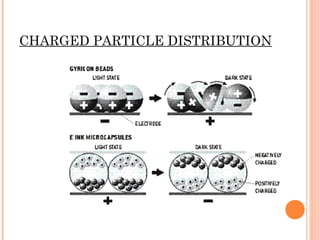
GYRICON
 The   first Gyricon developed in 1974 by
  “Nickolas K Sheridon” at Xerox Palo Alto
  Research Centre.
 It is based on a thin sheet of flexible plastic
  containing a layer of tiny plastic beads each
  encapsulated in oil and it rotate freely.

LIMITATIONS
 Low brightness and resolution.
 Lack of color.
   Other form of E-ink with improve properties
  compared to Gyricon is Electrophoretic.
Electrophoretic
 Electrophoretic frontplane consist of
  millions of micro capsules.
 Each micro capsule is filled with a clear
  fluid containing positively charged white
  particle and black particle.
 The disadvantage of this technology is it
  take time for the particle to move from
  one side to another.
Electrowetting
 It is used to display coloured images.
CHARGED PARTICLE DISTRIBUTION
PROPERTIES
 Ultra-thin   and flexible energy cell.
 Eliminates   the cost of the battery, weight
 and volume of the battery holder.
 Can   be made into almost any shape.
 Can  be integrated on almost any surface.
 Environmentally friendly, non-caustic, no
  possibility of explosion, burns, or
  overheating.
COMPARISON OF E-PAPER & LCD
Electronic Ink                    Liquid Crystal
Display                           Display
Wide viewing angle                Best image only from one position

Black on paper white              Gray on gray

Readable in sunlight              Can be difficult to see

Holds image without power drain   Required power to hold images


Plastic or glass                  Glass only

Light Weight                      Power supply and glass make
                                  LCDs relatively heavy
Thin (~1 mm)                      Thick (~7 mm)
ADVANTAGES
•   Paper-like Readability
•   Clarity
•   Reduced Eyestrain
•   Include Graphics
•   Inexpensive


DISADVANTAGES
•   Very low switching speed
•   Electrochemical complexity
APPLICATIO
 NS

 Electronic   Book
 Electronic   Newspaper
 Mobile   display
 Computer     monitor
CONCLUSION
   Researches found that in just few years
this technology can replace paper in many
situations, leading us to think of a truly
paperless world.
THANK
YOU

E paper

  • 1.
    A Presentation On E-PAPER
  • 2.
    CONTENTS  Introduction  Construction of e-paper  Working  Properties  Comparison of e-paper & LCD  Advantages & Disadvantages  Applications  Conclusion
  • 3.
    INTRODUCTION  E-Paper is also called Electronic Paper or Electronic ink Display.  The first E-Paper was developed in 1974’s by “Nicholas K Sheridon” at Xerox’s Palo Alto Research Centre.  It is a display unit.  E-Paper is flexible.  E-paper have a wide viewing angle.  A digital pen is also used to create handwritten document.
  • 4.
    CONSTRUCTION OF E-PAPER  It has two different parts.  Front plane.  Back plane.  The front plane consist of E-ink.  The back plane consist of electronic circuits.  To form an E-ink electronic display the ink is printed onto a plastic film that is laminated to a layer of circuitry.
  • 5.
  • 6.
    GYRICON  The first Gyricon developed in 1974 by “Nickolas K Sheridon” at Xerox Palo Alto Research Centre.  It is based on a thin sheet of flexible plastic containing a layer of tiny plastic beads each encapsulated in oil and it rotate freely. LIMITATIONS  Low brightness and resolution.  Lack of color. Other form of E-ink with improve properties compared to Gyricon is Electrophoretic.
  • 7.
    Electrophoretic  Electrophoretic frontplaneconsist of millions of micro capsules.  Each micro capsule is filled with a clear fluid containing positively charged white particle and black particle.  The disadvantage of this technology is it take time for the particle to move from one side to another. Electrowetting  It is used to display coloured images.
  • 8.
  • 9.
    PROPERTIES  Ultra-thin and flexible energy cell.  Eliminates the cost of the battery, weight and volume of the battery holder.  Can be made into almost any shape.  Can be integrated on almost any surface.  Environmentally friendly, non-caustic, no possibility of explosion, burns, or overheating.
  • 10.
    COMPARISON OF E-PAPER& LCD Electronic Ink Liquid Crystal Display Display Wide viewing angle Best image only from one position Black on paper white Gray on gray Readable in sunlight Can be difficult to see Holds image without power drain Required power to hold images Plastic or glass Glass only Light Weight Power supply and glass make LCDs relatively heavy Thin (~1 mm) Thick (~7 mm)
  • 11.
    ADVANTAGES • Paper-like Readability • Clarity • Reduced Eyestrain • Include Graphics • Inexpensive DISADVANTAGES • Very low switching speed • Electrochemical complexity
  • 12.
    APPLICATIO NS  Electronic Book  Electronic Newspaper  Mobile display  Computer monitor
  • 13.
    CONCLUSION Researches found that in just few years this technology can replace paper in many situations, leading us to think of a truly paperless world.
  • 14.