E - Paper
Nirav Joshi..
https://www.facebook.com/niravjoshi1993
Introduction
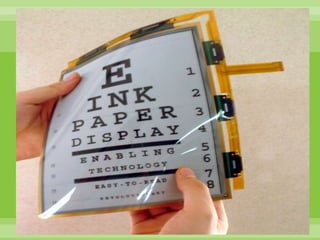
Electronic paper was developed in the
seventies by Xerox.
Made of flexible material, requiring ultra- low
power consumption, cheap to manufacture,
and most importantly, easy and convenient to
read.
The limitation of monitors which is backlight
hard on the human eye, while electronic
paper reflects light just like normal paper.
Electronic paper also has the potential to be
flexible because it is made of plastic.
Conti..
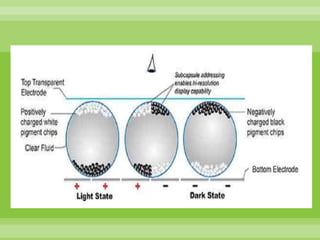
The spheres are embedded in a transparent
silicon sheet, with each sphere suspended in a
bubble of oil s o that they can rotate freely.
The polarity of the voltage applied to each pair
of electrodes then determines whether the white
or black side is face - up thus giving the pixel a
white or black appearance.
Construction
Electrophoresis is a process, which enables
separating molecules according to their size
and electrical charge by applying an electric
current.
Conti..
How it works
Electrophoresis is a process, which enables
separating molecules according to their size and
electrical charge by applying an electric current.
In an electrophoretic front plane, small charges
submicron particles are suspended in a
dielectric fluid .
When an electric filed is applied across the cell
or capsule, the ink particles will move towards
the electrode with the opposite charge.
The contrast is improved by using opposite
colored particles such as black and white -
and charging them with opposite polarities.
Conti..
Application
Education: (Digital School Books)
Wristwatches:
E- books:
Newspapers:
Cell Phones:
Status Displays:
Advantages
Keeps the image in the memory until it is erased.
Reflective Characteristics.
Excellent Visibility.
low power usage
flexibility
Better readability than most displays.
Electronic- ink can be printed in any surface,
choose you preferred level of magnification.
you can also use search to find
information quickly,
you have the option to print on to real
paper if required
It is also light and potentially inexpensive
Conti..
Disadvantage
very low refresh rate compared with other low-
power display technologies like LCD s.
Piracy has become a huge source of problems
for organizations in certain types of markets.
 it could be easy for organizations to lose a lot
of money from piracy
The technology behind E- paper cannot
support animation.
An imprint of an image may be visible after
refreshing parts of the screen. For Ghost
images.
This effect is reminiscent of screen burn- in
but unlike it, is solved after the screen is
refreshed several times.
This lack of color is huge disadvantage .
Colored images are of great value in
newspapers and magazines that requirement
not satisfied very well.
Conti..
Future of E-Paper
a person can comfortably carry in his or her
pocket.
The tube will contain a tightly rolled sheet of E-
paper out of a slit in the tube as a flat sheet, for
reading.
Information will be downloaded from an
overhead satellite.
The document reader will be used for E- mail, the
internet, books download from a digital library,
technical manuals newspapers, magazines etc.
E- paper technology is bright. In 10 to 20 years,
consumers might see large E- paper modules that
are as thin and as flexible as magazines are today,
with display brightness approaching that of
conventional print.
You might click on an image in a story, and it will
provide video or animation.
Conti..
Conclusion
Today, paper remains the most popular
document medium because of its credibility,
tangibility, ease of use, flexibility,
portability , and compatibility which has
made it difficult to replace.
 Even with the prevalence of computers and
online documents, the paperless office is more
used.
 we should reconsider the argument to
completely replace all paper documents
with electronic documents, and
consequently,.
we predict a co - existence between paper
and E-paper.
Conti..
https://www.facebook.co
m/niravjoshi1993

E paper

  • 1.
    E - Paper NiravJoshi.. https://www.facebook.com/niravjoshi1993
  • 2.
    Introduction Electronic paper wasdeveloped in the seventies by Xerox. Made of flexible material, requiring ultra- low power consumption, cheap to manufacture, and most importantly, easy and convenient to read. The limitation of monitors which is backlight hard on the human eye, while electronic paper reflects light just like normal paper.
  • 3.
    Electronic paper alsohas the potential to be flexible because it is made of plastic. Conti..
  • 4.
    The spheres areembedded in a transparent silicon sheet, with each sphere suspended in a bubble of oil s o that they can rotate freely. The polarity of the voltage applied to each pair of electrodes then determines whether the white or black side is face - up thus giving the pixel a white or black appearance. Construction
  • 5.
    Electrophoresis is aprocess, which enables separating molecules according to their size and electrical charge by applying an electric current. Conti..
  • 8.
    How it works Electrophoresisis a process, which enables separating molecules according to their size and electrical charge by applying an electric current. In an electrophoretic front plane, small charges submicron particles are suspended in a dielectric fluid . When an electric filed is applied across the cell or capsule, the ink particles will move towards the electrode with the opposite charge.
  • 9.
    The contrast isimproved by using opposite colored particles such as black and white - and charging them with opposite polarities. Conti..
  • 10.
    Application Education: (Digital SchoolBooks) Wristwatches: E- books: Newspapers: Cell Phones: Status Displays:
  • 11.
    Advantages Keeps the imagein the memory until it is erased. Reflective Characteristics. Excellent Visibility. low power usage flexibility Better readability than most displays. Electronic- ink can be printed in any surface, choose you preferred level of magnification.
  • 12.
    you can alsouse search to find information quickly, you have the option to print on to real paper if required It is also light and potentially inexpensive Conti..
  • 13.
    Disadvantage very low refreshrate compared with other low- power display technologies like LCD s. Piracy has become a huge source of problems for organizations in certain types of markets.  it could be easy for organizations to lose a lot of money from piracy The technology behind E- paper cannot support animation.
  • 14.
    An imprint ofan image may be visible after refreshing parts of the screen. For Ghost images. This effect is reminiscent of screen burn- in but unlike it, is solved after the screen is refreshed several times. This lack of color is huge disadvantage . Colored images are of great value in newspapers and magazines that requirement not satisfied very well. Conti..
  • 15.
    Future of E-Paper aperson can comfortably carry in his or her pocket. The tube will contain a tightly rolled sheet of E- paper out of a slit in the tube as a flat sheet, for reading. Information will be downloaded from an overhead satellite.
  • 16.
    The document readerwill be used for E- mail, the internet, books download from a digital library, technical manuals newspapers, magazines etc. E- paper technology is bright. In 10 to 20 years, consumers might see large E- paper modules that are as thin and as flexible as magazines are today, with display brightness approaching that of conventional print. You might click on an image in a story, and it will provide video or animation. Conti..
  • 22.
    Conclusion Today, paper remainsthe most popular document medium because of its credibility, tangibility, ease of use, flexibility, portability , and compatibility which has made it difficult to replace.  Even with the prevalence of computers and online documents, the paperless office is more used.
  • 23.
     we shouldreconsider the argument to completely replace all paper documents with electronic documents, and consequently,. we predict a co - existence between paper and E-paper. Conti..
  • 26.