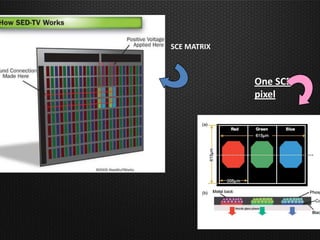
SED, or Surface Conduction Electron Emitter Display, is a flat panel display technology co-developed by Canon and Toshiba that combines aspects of LCD and CRT displays. SED has thousands of tiny electron guns called "emitters" for each color sub-pixel that emit electrons to illuminate phosphors when excited by moderate voltages, similar to a CRT, but without the deep vacuum required. Potential advantages of SED include fast response times, high brightness, excellent color and contrast, wide viewing angles, and low power consumption, but high production costs and potential for screen burn-in remain challenges.