Presented by
Contents:
 Transparent
 Electronics
 Objective
 Transparent electronics
 Introduction
 Fabrication
 Transparent optoelectronics devices
 Applications
 Advantages
 Disadvantages
 Conclusion
TRANSPARENT
Capable of transmitting the
light so that the object can seen
as if there were no intervening
material
ELECTRONICS
Branch of physics that deals with emission and effect of
electrons
TRANSPARENT ELECTRONICS
Introduction
 The transparent conducting oxide (TCO) is widely used as
oxide material
 Both properties optically transparent & electrically conductive
in a same material is contradictory
 TCO in transparent electronics are In2o3 , zno and Cdo
Fabrication
 Conventional vapor phase epitaxy techniques
1. RF sputtering
2. Vacuum evaporation
3. Chemical vapor deposition
4. Molecular beam epitaxy and
5. Pulsed-laser deposition
RF Sputtering
 Sputtering
 RF(radio frequency) sputtering
Vacuum evaporation
 Source material is evaporated in a vacuum
Chemical vapor deposition
 Volatile substance get decompose or react on the substrate
Molecular beam epitaxy
 Deposition of molecules on a substrate as a layer
Pulsed-Laser Deposition
Reactive solid phase epitaxy
1. Bilayer fabrication
2. Surface capping &
3. Thermal annealing
Transparent Optoelectronics Devices
A. Transparent thin film transistor
B. Transparent UV detector
Transparent thin film transistor
 Special kind of field-effect transistor
 TTFTs fabricated to gate using conventional TOSs are SnO2
and Zno
 A single crystalline film of the TOS InGaO3 is used for active
channel layer
 For fabricating TTFT the RSPE method
Transparent UV detector
 UV radiation wavelength 280-400 nm
 UV detectors have developed using pn or schottky-junction of
wide band gap semiconductor such as GaN, ZnSe,ZnS and
diamond
 It was fabricated using a pn-heterojunction diode composed
of p-type NiO
Applications
 OLED display
WORKING OF OLED
TYPES OF OLED
1. Passive-matrix OLED
2. Active-matrix OLED
3. Transparent OLED
4. Top-emitting OLED
5. Foldable OLED
6. White OLED
 Transparent solar panel
Working of OLED
Passive-matrix OLED
Active-matrix OLED
Transparent OLED
Top-emitting OLED
Foldable OLED
White OLED
 Have true-color qualities of incandescent lighting
 Their use could potentially reduce energy costs for lighting
Advantages of OLED
 Organic layers of an OLED are thinner , lighter and more
flexible
 Substrates of an OLED can br flexible instead of rigid
 OLEDs are brighter
 OLEDs are easier to produce and can be made to large and
thin sheets
 These have large fields of view, about 170 degrees
Disadvantages of OLED
 Lifetime-
1. red and green OLED –46,000 to 230,000 hours
2. Blue organics –up to around 14,000 hours
 Manufacturing processes are expensive
 Water can easily damage
Transparent solar panel
Other applications
 Domestic appliances
 Entertainment and communication
 Architecture
 Healthcare and surgical
 Military and industry
Domestic appliances
Entertainment & communication
Architecture
Healthcare & surgical
Military & Industry
References
 Hiromichi OTHA journal of ceramic society
 Japan 114 [2] 2006
 Ginley, D. S., and Bright, C., Mater. Res. Soc.
 Bull. (2000) 25 (8), 15 and articles Therein;
 Hosono, H., et al. (eds.) Thin Solid Films (2003)
 445 (2), 155-392
 “Transparent solar cells." PHYSorg.com. 2 Jun
 2009. http://phys.org/news163180542.html
 M. Orita, H. Ohta, M. Hirano, S. Narushima, H.
conclusion
Transparent electronics having the combination of two
properties that are optically transparent and electrically
conductive gives lots of advantages such as high mobility, low
processing temperature , high performance and flexibility which
indicates our improved technology
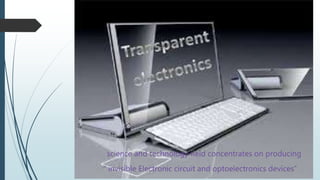
Transparent Electronics

Transparent Electronics