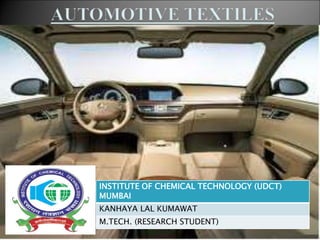
INSTITUTE OF CHEMICAL TECHNOLOGY (UDCT)
MUMBAI
KANHAYA LAL KUMAWAT
M.TECH. (RESEARCH STUDENT)
 The automobile industry is the largest user of technical textiles, with about 25 Kg for more
than 80 parts in each of the car made every year world wide.
 Textiles provides warm soft touch to the seats and the interior of the car, are also used in
applications such as heat insulation, stable dimension, good wearing resistance, inflaming
retardance, etc.
 Textile contribute in comfort and décor of the interior, ands plays important part in damping
of sound and vibration, and ventilation and antifouling..
 The use of textiles in tyres contributes to the performance, road handling, and tyre durability.
 Reinforcing textile yarns are essential for high pressure hoses and belts.
 Non-woven fabrics are used in air and oil filters, bonnet liners and as production aids during
manufacture.
 Fibre composites is replacement on metal components to reduce the weight.
 Seat belts, airbags and associated safety devices are contributing to road safety and saving
lives.
Apart from the decorative and soft touch properties of textiles used in most areas of car
interior, the functional uses of textiles generally demand very specific properties
such as;
a) High tenacity and low shrinkage important for tyres
b) High modulus important for composite structures
c) High temperature resistance for belts and hoses
d) Non woven fabrics are used extensively for both functional and decorative
applications in the car
e) In addition, textiles play a vital part in composites and rubber-based
products, which have brought tremendous benefits, increasing performance ,
durability and saving weight
 The Automotive Industry in India is one of the largest in the
world and one of the greatest fastest growing globally.
 Indian manufactures over 14.2 million vehicles (including 2
wheeled and 4 wheeled) and exports about 1.8 million in
2009-2010.
 It is the world’s second largest manufacturer of motorcycles,
with annual domestic sales of 9.37 million in 2009.
 Indian’s passanger car and commercial vehcle manufacturing
industry is the seventh largest in the world, with an annual
production of more than 2.9 million units in 2009-2010.
 In 2009, India emerged as Asia’s fourth largest exporter of
passanger cars, behind Japan, South Korea and Thailand.
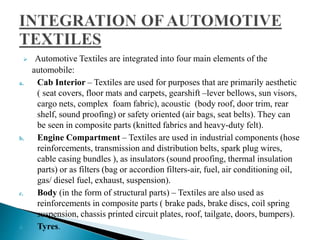
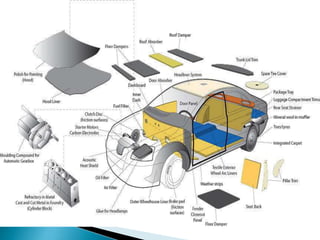
 Automotive Textiles are integrated into four main elements of the
automobile:
a. Cab Interior – Textiles are used for purposes that are primarily aesthetic
( seat covers, floor mats and carpets, gearshift –lever bellows, sun visors,
cargo nets, complex foam fabric), acoustic (body roof, door trim, rear
shelf, sound proofing) or safety oriented (air bags, seat belts). They can
be seen in composite parts (knitted fabrics and heavy-duty felt).
b. Engine Compartment – Textiles are used in industrial components (hose
reinforcements, transmission and distribution belts, spark plug wires,
cable casing bundles ), as insulators (sound proofing, thermal insulation
parts) or as filters (bag or accordion filters-air, fuel, air conditioning oil,
gas/ diesel fuel, exhaust, suspension).
c. Body (in the form of structural parts) – Textiles are also used as
reinforcements in composite parts ( brake pads, brake discs, coil spring
suspension, chassis printed circuit plates, roof, tailgate, doors, bumpers).
d. Tyres.
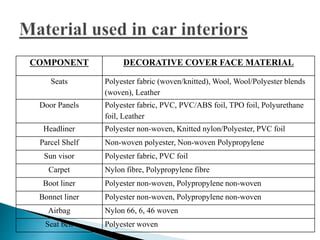
COMPONENT DECORATIVE COVER FACE MATERIAL
Seats Polyester fabric (woven/knitted), Wool, Wool/Polyester blends
(woven), Leather
Door Panels Polyester fabric, PVC, PVC/ABS foil, TPO foil, Polyurethane
foil, Leather
Headliner Polyester non-woven, Knitted nylon/Polyester, PVC foil
Parcel Shelf Non-woven polyester, Non-woven Polypropylene
Sun visor Polyester fabric, PVC foil
Carpet Nylon fibre, Polypropylene fibre
Boot liner Polyester non-woven, Polypropylene non-woven
Bonnet liner Polyester non-woven, Polypropylene non-woven
Airbag Nylon 66, 6, 46 woven
Seat belt Polyester woven
The seat is the most important item in the car interior. It is also the main
interface of man and machine and therefore seat comfort is of paramount
importance.
A. Early Seat Covers
a) Before the era of synthetic fibres, wool and cotton were used.
b) After World war II, Nylon began to be used, sometimes in blends
with other fibres such as cotton.
c) In the 1950s PVC-coated fabrics became widely used for car seat
covers but in hot weathers, PVC seats were hot and sticky.
d) The main requirements of a car seat fabric were; Cleanability,
Durability, Slideability, colour fastness and wrinkle-resistance.
B. Modern Seat Covers
a) The most important requirements of car seat cover fabric are high
abrasion resistance and resistance to UV degradation.
b) Cotton and other cellulosic-based yarns have significantly lower
abrasion resistance than nylon, polyester, acrylic and polypropylene.
c) Acrylic has the highest light and UV resistance but falls down on
abrasion compared to the other synthetic fibres.
d) The material which has risen to prominence during the 1970s and is
now used in over 90% of all car seats worldwide is POLYESTER.
e) POLYESTER is helped by the fact that glass filters out the UV light
radiation which harms it most combine with the very good abrasion
resistance and inexpensive price.
f) Other properties of polyester which makes it ideal for car seat covers
include, high tear strength, resistance to mildew, low water
absorbency, allowing it to be kept clean relatively easily, excellent
resilience and crease resistance (lamination of Polyurethane foam).
Methods of Seat Construction
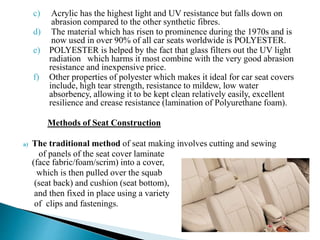
a) The traditional method of seat making involves cutting and sewing
of panels of the seat cover laminate
(face fabric/foam/scrim) into a cover,
which is then pulled over the squab
(seat back) and cushion (seat bottom),
and then fixed in place using a variety
of clips and fastenings.
b) Foam In Place
i. This technique was developed in the late 1980s. The method combined two
separate processes into one; foam cushion and squab moulding with the fixing
of the seat cover in place over the pre-moulded foam.
ii. Panels of the seat cover laminate were cut and sewn into a ‘bag’ and the liquid
foam components were poured in.
iii. These liquids reacted together to form the solid foam, but to prevent the
liquids seeping through the fabric cover laminate before the reaction was
complete, it was necessary to include a polyurethane barrier into the cover
laminate.
c) 3-D Knitting of car seat covers
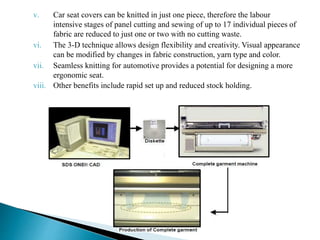
i. Since the introduction of seamless knitting techniques on V-bed machines in
1995, this technology has been considered an innovative process and is
currently growing in its commercial application around the world.
ii. This highly advanced, computer controlled knitting technique enables several
conventional cut and sew panels to be replaced with just a single 3-D shaped
piece.
iii. The objective was to knit garments in one piece, thus eliminating panel
cutting.
iv. Each needle is individually computer controlled to enable almost infinite color
combinations and design patterns.
v. Car seat covers can be knitted in just one piece, therefore the labour
intensive stages of panel cutting and sewing of up to 17 individual pieces of
fabric are reduced to just one or two with no cutting waste.
vi. The 3-D technique allows design flexibility and creativity. Visual appearance
can be modified by changes in fabric construction, yarn type and color.
vii. Seamless knitting for automotive provides a potential for designing a more
ergonomic seat.
viii. Other benefits include rapid set up and reduced stock holding.
a) Early Headliners --- was simply a covering for the metal roof
inside the car and consisted of a piece of fabric, PVC or some
other material sometimes simply ‘slung’.
b) Headliners now incorporate items such as driving mirrors,
interior lights with wiring, assist handles, sunvisors, sunroofs.
c) Contributing to the overall interior appearance, they are also
important for sound and vibration insulation.
d) Important requirements are light-weight, thin profile but rigid
without any tendency to buckle, flex or vibrate, dimensional
stability, aesthetically pleasing and with a soft touch. As
Headliners seem to be touched more often therefore anti-
soiling requirements.
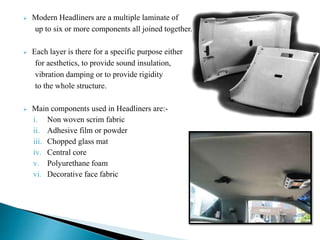
 Modern Headliners are a multiple laminate of
up to six or more components all joined together.
 Each layer is there for a specific purpose either
for aesthetics, to provide sound insulation,
vibration damping or to provide rigidity
to the whole structure.
 Main components used in Headliners are:-
i. Non woven scrim fabric
ii. Adhesive film or powder
iii. Chopped glass mat
iv. Central core
v. Polyurethane foam
vi. Decorative face fabric
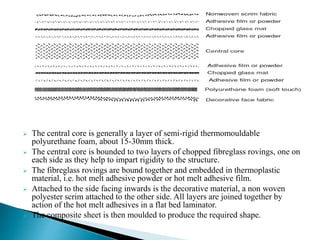
 The central core is generally a layer of semi-rigid thermomouldable
polyurethane foam, about 15-30mm thick.
 The central core is bounded to two layers of chopped fibreglass rovings, one on
each side as they help to impart rigidity to the structure.
 The fibreglass rovings are bound together and embedded in thermoplastic
material, i.e. hot melt adhesive powder or hot melt adhesive film.
 Attached to the side facing inwards is the decorative material, a non woven
polyester scrim attached to the other side. All layers are joined together by
action of the hot melt adhesives in a flat bed laminator.
 The composite sheet is then moulded to produce the required shape.
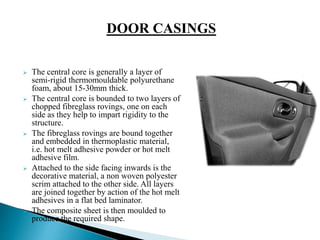
 The central core is generally a layer of
semi-rigid thermomouldable polyurethane
foam, about 15-30mm thick.
 The central core is bounded to two layers of
chopped fibreglass rovings, one on each
side as they help to impart rigidity to the
structure.
 The fibreglass rovings are bound together
and embedded in thermoplastic material,
i.e. hot melt adhesive powder or hot melt
adhesive film.
 Attached to the side facing inwards is the
decorative material, a non woven polyester
scrim attached to the other side. All layers
are joined together by action of the hot melt
adhesives in a flat bed laminator.
 The composite sheet is then moulded to
produce the required shape.
DOOR CASINGS
Textile-insert low-pressure
Moulding Technique
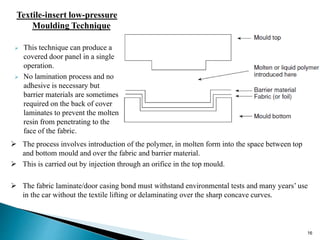
 This technique can produce a
covered door panel in a single
operation.
 No lamination process and no
adhesive is necessary but
barrier materials are sometimes
required on the back of cover
laminates to prevent the molten
resin from penetrating to the
face of the fabric.
16
 The process involves introduction of the polymer, in molten form into the space between top
and bottom mould and over the fabric and barrier material.
 This is carried out by injection through an orifice in the top mould.
 The fabric laminate/door casing bond must withstand environmental tests and many years’ use
in the car without the textile lifting or delaminating over the sharp concave curves.
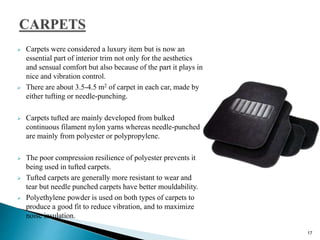
 Carpets were considered a luxury item but is now an
essential part of interior trim not only for the aesthetics
and sensual comfort but also because of the part it plays in
nice and vibration control.
 There are about 3.5-4.5 m2 of carpet in each car, made by
either tufting or needle-punching.
 Carpets tufted are mainly developed from bulked
continuous filament nylon yarns whereas needle-punched
are mainly from polyester or polypropylene.
 The poor compression resilience of polyester prevents it
being used in tufted carpets.
 Tufted carpets are generally more resistant to wear and
tear but needle punched carpets have better mouldability.
 Polyethylene powder is used on both types of carpets to
produce a good fit to reduce vibration, and to maximize
noise insulation.
17
 A Barrier film on the back of the carpet is necessary to prevent liquid foam from
penetrating to the carpet surface during moulding.
 Bitumen sheeting is widely used but this is now supplemented with resinated waste
or shoddy fibres.
 Carpet manufacture is made more complicated by the holes and gaps required for
cables and ducting and certain provision made for the fitting of seats and control
consoles.
18
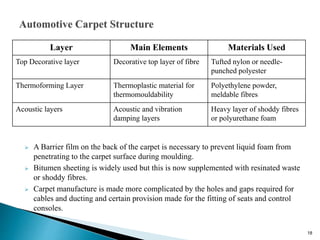
Layer Main Elements Materials Used
Top Decorative layer Decorative top layer of fibre Tufted nylon or needle-
punched polyester
Thermoforming Layer Thermoplastic material for
thermomouldability
Polyethylene powder,
meldable fibres
Acoustic layers Acoustic and vibration
damping layers
Heavy layer of shoddy fibres
or polyurethane foam
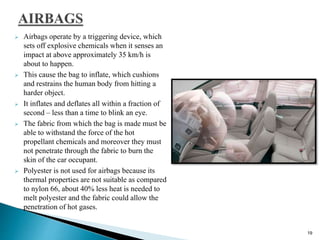
 Airbags operate by a triggering device, which
sets off explosive chemicals when it senses an
impact at above approximately 35 km/h is
about to happen.
 This cause the bag to inflate, which cushions
and restrains the human body from hitting a
harder object.
 It inflates and deflates all within a fraction of
second – less than a time to blink an eye.
 The fabric from which the bag is made must be
able to withstand the force of the hot
propellant chemicals and moreover they must
not penetrate through the fabric to burn the
skin of the car occupant.
 Polyester is not used for airbags because its
thermal properties are not suitable as compared
to nylon 66, about 40% less heat is needed to
melt polyester and the fabric could allow the
penetration of hot gases.
19
 Airbag fabric is not dyed but needs to be stabilized by heat setting and scoured to remove
impurities
 The fabric must be strong with high tear strength, high anti-seam slippage and needs to be
have controlled air permeability.
 It must be capable of being folded up in a small space for over 10 years or more without
deterioration and, in the case of coated fabric, without blocking or sticking together.
 Injuries caused by airbag inflation include eye damage, fractures, bruises and chemical burns
caused by penetration of the inflating material through the fabric.
20
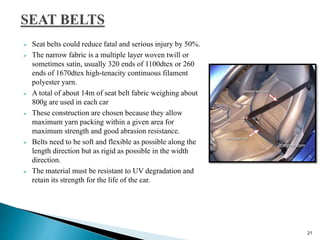
 Seat belts could reduce fatal and serious injury by 50%.
 The narrow fabric is a multiple layer woven twill or
sometimes satin, usually 320 ends of 1100dtex or 260
ends of 1670dtex high-tenacity continuous filament
polyester yarn.
 A total of about 14m of seat belt fabric weighing about
800g are used in each car
 These construction are chosen because they allow
maximum yarn packing within a given area for
maximum strength and good abrasion resistance.
 Belts need to be soft and flexible as possible along the
length direction but as rigid as possible in the width
direction.
 The material must be resistant to UV degradation and
retain its strength for the life of the car.
21
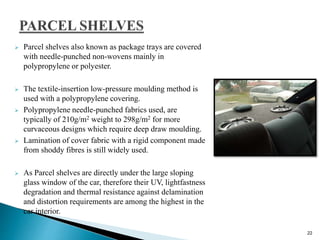
 Parcel shelves also known as package trays are covered
with needle-punched non-wovens mainly in
polypropylene or polyester.
 The textile-insertion low-pressure moulding method is
used with a polypropylene covering.
 Polypropylene needle-punched fabrics used, are
typically of 210g/m2 weight to 298g/m2 for more
curvaceous designs which require deep draw moulding.
 Lamination of cover fabric with a rigid component made
from shoddy fibres is still widely used.
 As Parcel shelves are directly under the large sloping
glass window of the car, therefore their UV, lightfastness
degradation and thermal resistance against delamination
and distortion requirements are among the highest in the
car interior.
22
SUNVISORS
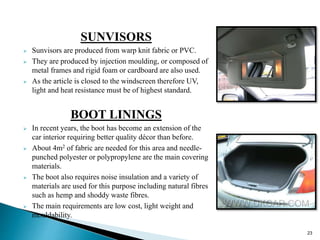
 Sunvisors are produced from warp knit fabric or PVC.
 They are produced by injection moulding, or composed of
metal frames and rigid foam or cardboard are also used.
 As the article is closed to the windscreen therefore UV,
light and heat resistance must be of highest standard.
BOOT LININGS
 In recent years, the boot has become an extension of the
car interior requiring better quality décor than before.
 About 4m2 of fabric are needed for this area and needle-
punched polyester or polypropylene are the main covering
materials.
 The boot also requires noise insulation and a variety of
materials are used for this purpose including natural fibres
such as hemp and shoddy waste fibres.
 The main requirements are low cost, light weight and
mouldability.
23
BONNET LINERS
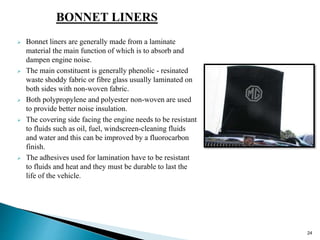
 Bonnet liners are generally made from a laminate
material the main function of which is to absorb and
dampen engine noise.
 The main constituent is generally phenolic - resinated
waste shoddy fabric or fibre glass usually laminated on
both sides with non-woven fabric.
 Both polypropylene and polyester non-woven are used
to provide better noise insulation.
 The covering side facing the engine needs to be resistant
to fluids such as oil, fuel, windscreen-cleaning fluids
and water and this can be improved by a fluorocarbon
finish.
 The adhesives used for lamination have to be resistant
to fluids and heat and they must be durable to last the
life of the vehicle.
24
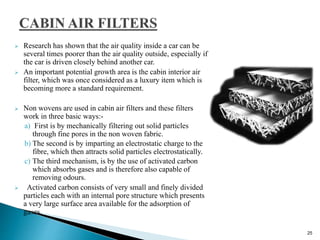
 Research has shown that the air quality inside a car can be
several times poorer than the air quality outside, especially if
the car is driven closely behind another car.
 An important potential growth area is the cabin interior air
filter, which was once considered as a luxury item which is
becoming more a standard requirement.
 Non wovens are used in cabin air filters and these filters
work in three basic ways:-
a) First is by mechanically filtering out solid particles
through fine pores in the non woven fabric.
b) The second is by imparting an electrostatic charge to the
fibre, which then attracts solid particles electrostatically.
c) The third mechanism, is by the use of activated carbon
which absorbs gases and is therefore also capable of
removing odours.
 Activated carbon consists of very small and finely divided
particles each with an internal pore structure which presents
a very large surface area available for the adsorption of
gases.
25
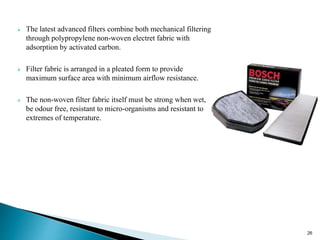
 The latest advanced filters combine both mechanical filtering
through polypropylene non-woven electret fabric with
adsorption by activated carbon.
 Filter fabric is arranged in a pleated form to provide
maximum surface area with minimum airflow resistance.
 The non-woven filter fabric itself must be strong when wet,
be odour free, resistant to micro-organisms and resistant to
extremes of temperature.
26
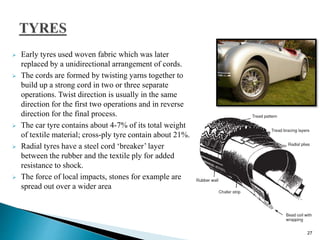
 Early tyres used woven fabric which was later
replaced by a unidirectional arrangement of cords.
 The cords are formed by twisting yarns together to
build up a strong cord in two or three separate
operations. Twist direction is usually in the same
direction for the first two operations and in reverse
direction for the final process.
 The car tyre contains about 4-7% of its total weight
of textile material; cross-ply tyre contain about 21%.
 Radial tyres have a steel cord ‘breaker’ layer
between the rubber and the textile ply for added
resistance to shock.
 The force of local impacts, stones for example are
spread out over a wider area
27
 Steel cords and polyester tyre cords, appeared during late 1950s, resulted in the decline
of rayon in car tyres. But poor dynamic performance of polyester at temperatures higher
than normally found in cars i.e. above 82oc.
 Introduction of high-tenacity, low-shrink polyester yarns and also in the continued
development of fibre-rubber bonding techniques overcome the previous limitations.
 Textiles are also used in smaller quantities in holding together the bead assembly on the
tyre rim.
 Bead warp is generally nylon cord or light-weight woven or knitted nylon pretreated
with adhesive to stick to the rubber.
 Nylon fabric is also used as the cheaper material, which protects the tyre during
manufacture and helps maintain the shape during curing.
28
 By the invention of high-performance fibres, both hoses and belts rely almost entirely on
the textile component for actual physical strength and various fibres have been used
including cotton, rayon, nylon and polyester.
 Rayon loses strength when wet and the rest have other limitations.
 At present, specialist polyester yarns are most frequently used. General requirements are
dimensional stability, moisture, oil, chemical and temperature resistance, strength and
good adhesion to the rubber.
 The textile rubber composite needs to be resistant to the materials the hoses or belts
come into contact with and also oxygen, moisture and all the various ingredients in the
compound mix.
29
Hoses
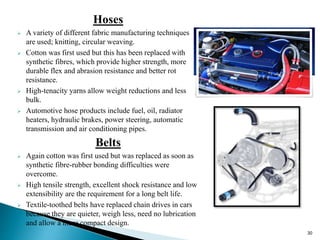
 A variety of different fabric manufacturing techniques
are used; knitting, circular weaving.
 Cotton was first used but this has been replaced with
synthetic fibres, which provide higher strength, more
durable flex and abrasion resistance and better rot
resistance.
 High-tenacity yarns allow weight reductions and less
bulk.
 Automotive hose products include fuel, oil, radiator
heaters, hydraulic brakes, power steering, automatic
transmission and air conditioning pipes.
Belts
 Again cotton was first used but was replaced as soon as
synthetic fibre-rubber bonding difficulties were
overcome.
 High tensile strength, excellent shock resistance and low
extensibility are the requirement for a long belt life.
 Textile-toothed belts have replaced chain drives in cars
because they are quieter, weigh less, need no lubrication
and allow a more compact design.
30
 The two main factors likely to continue to influence research and development in the
automobile industry for the foreseeable future are, the environment and the control of cost.
 The textile industry contributes to the environment by introducing lighter weight fabrics.
 New high-performance materials being developed by fibre and chemical companies, such as
the ultra-high-strength polyethylene fibre and the thermoplastic polyolefin foils.
 The use of cellulosic fibres in polyester blends in optimized constructions with engineered
yarns might lead to abrasion properties approaching automotive standard. If this becomes
possible, the benefits could include improved thermal comfort as well as softer handles.
 In addition to up-to-date, attractive, novel and imaginative fabric designs are the following
desirable properties: higher standards of cleanability; ‘lint’ resistance; anti-microbial
finishes; better thermal comfort; anti-static properties; softer ‘touch’ fabrics; easily replaced
seat covers; and fewer odours.
 Possibilities do exist for innovation and to offer something new or different- or simply to
keep up with the competition.
31
REFERENCES
 Textiles In Automotive Engineering by Walter Fung and Mike Hardcastle
Woodhead Publishing Limited
 Automotive & Transportation Interiors by Smith TL
 Non-wovens in the motor car, ITB Nonwovens Industrial Textiles
 The sound of silence, Rieter Automotive management brochure.
 Technical Textiles & Non Woven Excellence, Vol. 2 No. 2, Jan-Mar 2011( 19-
23)
32
THANK YOU
33

Autotech Technical Textile

  • 1.
    INSTITUTE OF CHEMICALTECHNOLOGY (UDCT) MUMBAI KANHAYA LAL KUMAWAT M.TECH. (RESEARCH STUDENT)
  • 2.
     The automobileindustry is the largest user of technical textiles, with about 25 Kg for more than 80 parts in each of the car made every year world wide.  Textiles provides warm soft touch to the seats and the interior of the car, are also used in applications such as heat insulation, stable dimension, good wearing resistance, inflaming retardance, etc.  Textile contribute in comfort and décor of the interior, ands plays important part in damping of sound and vibration, and ventilation and antifouling..  The use of textiles in tyres contributes to the performance, road handling, and tyre durability.  Reinforcing textile yarns are essential for high pressure hoses and belts.  Non-woven fabrics are used in air and oil filters, bonnet liners and as production aids during manufacture.  Fibre composites is replacement on metal components to reduce the weight.  Seat belts, airbags and associated safety devices are contributing to road safety and saving lives.
  • 3.
    Apart from thedecorative and soft touch properties of textiles used in most areas of car interior, the functional uses of textiles generally demand very specific properties such as; a) High tenacity and low shrinkage important for tyres b) High modulus important for composite structures c) High temperature resistance for belts and hoses d) Non woven fabrics are used extensively for both functional and decorative applications in the car e) In addition, textiles play a vital part in composites and rubber-based products, which have brought tremendous benefits, increasing performance , durability and saving weight
  • 4.
     The AutomotiveIndustry in India is one of the largest in the world and one of the greatest fastest growing globally.  Indian manufactures over 14.2 million vehicles (including 2 wheeled and 4 wheeled) and exports about 1.8 million in 2009-2010.  It is the world’s second largest manufacturer of motorcycles, with annual domestic sales of 9.37 million in 2009.  Indian’s passanger car and commercial vehcle manufacturing industry is the seventh largest in the world, with an annual production of more than 2.9 million units in 2009-2010.  In 2009, India emerged as Asia’s fourth largest exporter of passanger cars, behind Japan, South Korea and Thailand.
  • 5.
     Automotive Textilesare integrated into four main elements of the automobile: a. Cab Interior – Textiles are used for purposes that are primarily aesthetic ( seat covers, floor mats and carpets, gearshift –lever bellows, sun visors, cargo nets, complex foam fabric), acoustic (body roof, door trim, rear shelf, sound proofing) or safety oriented (air bags, seat belts). They can be seen in composite parts (knitted fabrics and heavy-duty felt). b. Engine Compartment – Textiles are used in industrial components (hose reinforcements, transmission and distribution belts, spark plug wires, cable casing bundles ), as insulators (sound proofing, thermal insulation parts) or as filters (bag or accordion filters-air, fuel, air conditioning oil, gas/ diesel fuel, exhaust, suspension). c. Body (in the form of structural parts) – Textiles are also used as reinforcements in composite parts ( brake pads, brake discs, coil spring suspension, chassis printed circuit plates, roof, tailgate, doors, bumpers). d. Tyres.
  • 7.
    COMPONENT DECORATIVE COVERFACE MATERIAL Seats Polyester fabric (woven/knitted), Wool, Wool/Polyester blends (woven), Leather Door Panels Polyester fabric, PVC, PVC/ABS foil, TPO foil, Polyurethane foil, Leather Headliner Polyester non-woven, Knitted nylon/Polyester, PVC foil Parcel Shelf Non-woven polyester, Non-woven Polypropylene Sun visor Polyester fabric, PVC foil Carpet Nylon fibre, Polypropylene fibre Boot liner Polyester non-woven, Polypropylene non-woven Bonnet liner Polyester non-woven, Polypropylene non-woven Airbag Nylon 66, 6, 46 woven Seat belt Polyester woven
  • 8.
    The seat isthe most important item in the car interior. It is also the main interface of man and machine and therefore seat comfort is of paramount importance. A. Early Seat Covers a) Before the era of synthetic fibres, wool and cotton were used. b) After World war II, Nylon began to be used, sometimes in blends with other fibres such as cotton. c) In the 1950s PVC-coated fabrics became widely used for car seat covers but in hot weathers, PVC seats were hot and sticky. d) The main requirements of a car seat fabric were; Cleanability, Durability, Slideability, colour fastness and wrinkle-resistance. B. Modern Seat Covers a) The most important requirements of car seat cover fabric are high abrasion resistance and resistance to UV degradation. b) Cotton and other cellulosic-based yarns have significantly lower abrasion resistance than nylon, polyester, acrylic and polypropylene.
  • 9.
    c) Acrylic hasthe highest light and UV resistance but falls down on abrasion compared to the other synthetic fibres. d) The material which has risen to prominence during the 1970s and is now used in over 90% of all car seats worldwide is POLYESTER. e) POLYESTER is helped by the fact that glass filters out the UV light radiation which harms it most combine with the very good abrasion resistance and inexpensive price. f) Other properties of polyester which makes it ideal for car seat covers include, high tear strength, resistance to mildew, low water absorbency, allowing it to be kept clean relatively easily, excellent resilience and crease resistance (lamination of Polyurethane foam). Methods of Seat Construction a) The traditional method of seat making involves cutting and sewing of panels of the seat cover laminate (face fabric/foam/scrim) into a cover, which is then pulled over the squab (seat back) and cushion (seat bottom), and then fixed in place using a variety of clips and fastenings.
  • 10.
    b) Foam InPlace i. This technique was developed in the late 1980s. The method combined two separate processes into one; foam cushion and squab moulding with the fixing of the seat cover in place over the pre-moulded foam. ii. Panels of the seat cover laminate were cut and sewn into a ‘bag’ and the liquid foam components were poured in. iii. These liquids reacted together to form the solid foam, but to prevent the liquids seeping through the fabric cover laminate before the reaction was complete, it was necessary to include a polyurethane barrier into the cover laminate. c) 3-D Knitting of car seat covers i. Since the introduction of seamless knitting techniques on V-bed machines in 1995, this technology has been considered an innovative process and is currently growing in its commercial application around the world. ii. This highly advanced, computer controlled knitting technique enables several conventional cut and sew panels to be replaced with just a single 3-D shaped piece. iii. The objective was to knit garments in one piece, thus eliminating panel cutting. iv. Each needle is individually computer controlled to enable almost infinite color combinations and design patterns.
  • 11.
    v. Car seatcovers can be knitted in just one piece, therefore the labour intensive stages of panel cutting and sewing of up to 17 individual pieces of fabric are reduced to just one or two with no cutting waste. vi. The 3-D technique allows design flexibility and creativity. Visual appearance can be modified by changes in fabric construction, yarn type and color. vii. Seamless knitting for automotive provides a potential for designing a more ergonomic seat. viii. Other benefits include rapid set up and reduced stock holding.
  • 12.
    a) Early Headliners--- was simply a covering for the metal roof inside the car and consisted of a piece of fabric, PVC or some other material sometimes simply ‘slung’. b) Headliners now incorporate items such as driving mirrors, interior lights with wiring, assist handles, sunvisors, sunroofs. c) Contributing to the overall interior appearance, they are also important for sound and vibration insulation. d) Important requirements are light-weight, thin profile but rigid without any tendency to buckle, flex or vibrate, dimensional stability, aesthetically pleasing and with a soft touch. As Headliners seem to be touched more often therefore anti- soiling requirements.
  • 13.
     Modern Headlinersare a multiple laminate of up to six or more components all joined together.  Each layer is there for a specific purpose either for aesthetics, to provide sound insulation, vibration damping or to provide rigidity to the whole structure.  Main components used in Headliners are:- i. Non woven scrim fabric ii. Adhesive film or powder iii. Chopped glass mat iv. Central core v. Polyurethane foam vi. Decorative face fabric
  • 14.
     The centralcore is generally a layer of semi-rigid thermomouldable polyurethane foam, about 15-30mm thick.  The central core is bounded to two layers of chopped fibreglass rovings, one on each side as they help to impart rigidity to the structure.  The fibreglass rovings are bound together and embedded in thermoplastic material, i.e. hot melt adhesive powder or hot melt adhesive film.  Attached to the side facing inwards is the decorative material, a non woven polyester scrim attached to the other side. All layers are joined together by action of the hot melt adhesives in a flat bed laminator.  The composite sheet is then moulded to produce the required shape.
  • 15.
     The centralcore is generally a layer of semi-rigid thermomouldable polyurethane foam, about 15-30mm thick.  The central core is bounded to two layers of chopped fibreglass rovings, one on each side as they help to impart rigidity to the structure.  The fibreglass rovings are bound together and embedded in thermoplastic material, i.e. hot melt adhesive powder or hot melt adhesive film.  Attached to the side facing inwards is the decorative material, a non woven polyester scrim attached to the other side. All layers are joined together by action of the hot melt adhesives in a flat bed laminator.  The composite sheet is then moulded to produce the required shape. DOOR CASINGS
  • 16.
    Textile-insert low-pressure Moulding Technique This technique can produce a covered door panel in a single operation.  No lamination process and no adhesive is necessary but barrier materials are sometimes required on the back of cover laminates to prevent the molten resin from penetrating to the face of the fabric. 16  The process involves introduction of the polymer, in molten form into the space between top and bottom mould and over the fabric and barrier material.  This is carried out by injection through an orifice in the top mould.  The fabric laminate/door casing bond must withstand environmental tests and many years’ use in the car without the textile lifting or delaminating over the sharp concave curves.
  • 17.
     Carpets wereconsidered a luxury item but is now an essential part of interior trim not only for the aesthetics and sensual comfort but also because of the part it plays in nice and vibration control.  There are about 3.5-4.5 m2 of carpet in each car, made by either tufting or needle-punching.  Carpets tufted are mainly developed from bulked continuous filament nylon yarns whereas needle-punched are mainly from polyester or polypropylene.  The poor compression resilience of polyester prevents it being used in tufted carpets.  Tufted carpets are generally more resistant to wear and tear but needle punched carpets have better mouldability.  Polyethylene powder is used on both types of carpets to produce a good fit to reduce vibration, and to maximize noise insulation. 17
  • 18.
     A Barrierfilm on the back of the carpet is necessary to prevent liquid foam from penetrating to the carpet surface during moulding.  Bitumen sheeting is widely used but this is now supplemented with resinated waste or shoddy fibres.  Carpet manufacture is made more complicated by the holes and gaps required for cables and ducting and certain provision made for the fitting of seats and control consoles. 18 Layer Main Elements Materials Used Top Decorative layer Decorative top layer of fibre Tufted nylon or needle- punched polyester Thermoforming Layer Thermoplastic material for thermomouldability Polyethylene powder, meldable fibres Acoustic layers Acoustic and vibration damping layers Heavy layer of shoddy fibres or polyurethane foam
  • 19.
     Airbags operateby a triggering device, which sets off explosive chemicals when it senses an impact at above approximately 35 km/h is about to happen.  This cause the bag to inflate, which cushions and restrains the human body from hitting a harder object.  It inflates and deflates all within a fraction of second – less than a time to blink an eye.  The fabric from which the bag is made must be able to withstand the force of the hot propellant chemicals and moreover they must not penetrate through the fabric to burn the skin of the car occupant.  Polyester is not used for airbags because its thermal properties are not suitable as compared to nylon 66, about 40% less heat is needed to melt polyester and the fabric could allow the penetration of hot gases. 19
  • 20.
     Airbag fabricis not dyed but needs to be stabilized by heat setting and scoured to remove impurities  The fabric must be strong with high tear strength, high anti-seam slippage and needs to be have controlled air permeability.  It must be capable of being folded up in a small space for over 10 years or more without deterioration and, in the case of coated fabric, without blocking or sticking together.  Injuries caused by airbag inflation include eye damage, fractures, bruises and chemical burns caused by penetration of the inflating material through the fabric. 20
  • 21.
     Seat beltscould reduce fatal and serious injury by 50%.  The narrow fabric is a multiple layer woven twill or sometimes satin, usually 320 ends of 1100dtex or 260 ends of 1670dtex high-tenacity continuous filament polyester yarn.  A total of about 14m of seat belt fabric weighing about 800g are used in each car  These construction are chosen because they allow maximum yarn packing within a given area for maximum strength and good abrasion resistance.  Belts need to be soft and flexible as possible along the length direction but as rigid as possible in the width direction.  The material must be resistant to UV degradation and retain its strength for the life of the car. 21
  • 22.
     Parcel shelvesalso known as package trays are covered with needle-punched non-wovens mainly in polypropylene or polyester.  The textile-insertion low-pressure moulding method is used with a polypropylene covering.  Polypropylene needle-punched fabrics used, are typically of 210g/m2 weight to 298g/m2 for more curvaceous designs which require deep draw moulding.  Lamination of cover fabric with a rigid component made from shoddy fibres is still widely used.  As Parcel shelves are directly under the large sloping glass window of the car, therefore their UV, lightfastness degradation and thermal resistance against delamination and distortion requirements are among the highest in the car interior. 22
  • 23.
    SUNVISORS  Sunvisors areproduced from warp knit fabric or PVC.  They are produced by injection moulding, or composed of metal frames and rigid foam or cardboard are also used.  As the article is closed to the windscreen therefore UV, light and heat resistance must be of highest standard. BOOT LININGS  In recent years, the boot has become an extension of the car interior requiring better quality décor than before.  About 4m2 of fabric are needed for this area and needle- punched polyester or polypropylene are the main covering materials.  The boot also requires noise insulation and a variety of materials are used for this purpose including natural fibres such as hemp and shoddy waste fibres.  The main requirements are low cost, light weight and mouldability. 23
  • 24.
    BONNET LINERS  Bonnetliners are generally made from a laminate material the main function of which is to absorb and dampen engine noise.  The main constituent is generally phenolic - resinated waste shoddy fabric or fibre glass usually laminated on both sides with non-woven fabric.  Both polypropylene and polyester non-woven are used to provide better noise insulation.  The covering side facing the engine needs to be resistant to fluids such as oil, fuel, windscreen-cleaning fluids and water and this can be improved by a fluorocarbon finish.  The adhesives used for lamination have to be resistant to fluids and heat and they must be durable to last the life of the vehicle. 24
  • 25.
     Research hasshown that the air quality inside a car can be several times poorer than the air quality outside, especially if the car is driven closely behind another car.  An important potential growth area is the cabin interior air filter, which was once considered as a luxury item which is becoming more a standard requirement.  Non wovens are used in cabin air filters and these filters work in three basic ways:- a) First is by mechanically filtering out solid particles through fine pores in the non woven fabric. b) The second is by imparting an electrostatic charge to the fibre, which then attracts solid particles electrostatically. c) The third mechanism, is by the use of activated carbon which absorbs gases and is therefore also capable of removing odours.  Activated carbon consists of very small and finely divided particles each with an internal pore structure which presents a very large surface area available for the adsorption of gases. 25
  • 26.
     The latestadvanced filters combine both mechanical filtering through polypropylene non-woven electret fabric with adsorption by activated carbon.  Filter fabric is arranged in a pleated form to provide maximum surface area with minimum airflow resistance.  The non-woven filter fabric itself must be strong when wet, be odour free, resistant to micro-organisms and resistant to extremes of temperature. 26
  • 27.
     Early tyresused woven fabric which was later replaced by a unidirectional arrangement of cords.  The cords are formed by twisting yarns together to build up a strong cord in two or three separate operations. Twist direction is usually in the same direction for the first two operations and in reverse direction for the final process.  The car tyre contains about 4-7% of its total weight of textile material; cross-ply tyre contain about 21%.  Radial tyres have a steel cord ‘breaker’ layer between the rubber and the textile ply for added resistance to shock.  The force of local impacts, stones for example are spread out over a wider area 27
  • 28.
     Steel cordsand polyester tyre cords, appeared during late 1950s, resulted in the decline of rayon in car tyres. But poor dynamic performance of polyester at temperatures higher than normally found in cars i.e. above 82oc.  Introduction of high-tenacity, low-shrink polyester yarns and also in the continued development of fibre-rubber bonding techniques overcome the previous limitations.  Textiles are also used in smaller quantities in holding together the bead assembly on the tyre rim.  Bead warp is generally nylon cord or light-weight woven or knitted nylon pretreated with adhesive to stick to the rubber.  Nylon fabric is also used as the cheaper material, which protects the tyre during manufacture and helps maintain the shape during curing. 28
  • 29.
     By theinvention of high-performance fibres, both hoses and belts rely almost entirely on the textile component for actual physical strength and various fibres have been used including cotton, rayon, nylon and polyester.  Rayon loses strength when wet and the rest have other limitations.  At present, specialist polyester yarns are most frequently used. General requirements are dimensional stability, moisture, oil, chemical and temperature resistance, strength and good adhesion to the rubber.  The textile rubber composite needs to be resistant to the materials the hoses or belts come into contact with and also oxygen, moisture and all the various ingredients in the compound mix. 29
  • 30.
    Hoses  A varietyof different fabric manufacturing techniques are used; knitting, circular weaving.  Cotton was first used but this has been replaced with synthetic fibres, which provide higher strength, more durable flex and abrasion resistance and better rot resistance.  High-tenacity yarns allow weight reductions and less bulk.  Automotive hose products include fuel, oil, radiator heaters, hydraulic brakes, power steering, automatic transmission and air conditioning pipes. Belts  Again cotton was first used but was replaced as soon as synthetic fibre-rubber bonding difficulties were overcome.  High tensile strength, excellent shock resistance and low extensibility are the requirement for a long belt life.  Textile-toothed belts have replaced chain drives in cars because they are quieter, weigh less, need no lubrication and allow a more compact design. 30
  • 31.
     The twomain factors likely to continue to influence research and development in the automobile industry for the foreseeable future are, the environment and the control of cost.  The textile industry contributes to the environment by introducing lighter weight fabrics.  New high-performance materials being developed by fibre and chemical companies, such as the ultra-high-strength polyethylene fibre and the thermoplastic polyolefin foils.  The use of cellulosic fibres in polyester blends in optimized constructions with engineered yarns might lead to abrasion properties approaching automotive standard. If this becomes possible, the benefits could include improved thermal comfort as well as softer handles.  In addition to up-to-date, attractive, novel and imaginative fabric designs are the following desirable properties: higher standards of cleanability; ‘lint’ resistance; anti-microbial finishes; better thermal comfort; anti-static properties; softer ‘touch’ fabrics; easily replaced seat covers; and fewer odours.  Possibilities do exist for innovation and to offer something new or different- or simply to keep up with the competition. 31
  • 32.
    REFERENCES  Textiles InAutomotive Engineering by Walter Fung and Mike Hardcastle Woodhead Publishing Limited  Automotive & Transportation Interiors by Smith TL  Non-wovens in the motor car, ITB Nonwovens Industrial Textiles  The sound of silence, Rieter Automotive management brochure.  Technical Textiles & Non Woven Excellence, Vol. 2 No. 2, Jan-Mar 2011( 19- 23) 32
  • 33.