
Theme 4 - Public Goods
Public Economics
1KANHAIYA KUMAWAT
MAIN THEORY – Paul
Samuelson
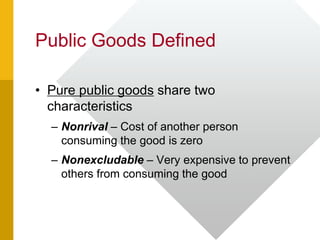
Public Goods Defined
• Pure public goods share two
characteristics
– Nonrival – Cost of another person
consuming the good is zero
– Nonexcludable – Very expensive to prevent
others from consuming the good
4
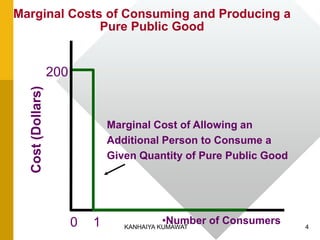
Marginal Costs of Consuming and Producing a
Pure Public Good
0
Cost(Dollars)
•Number of Consumers
200
Marginal Cost of Allowing an
Additional Person to Consume a
Given Quantity of Pure Public Good
1 KANHAIYA KUMAWAT
5
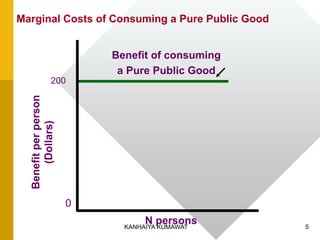
Marginal Costs of Consuming a Pure Public Good
Benefit of consuming
a Pure Public Good
200
N persons
Benefitperperson
(Dollars)
0
KANHAIYA KUMAWAT
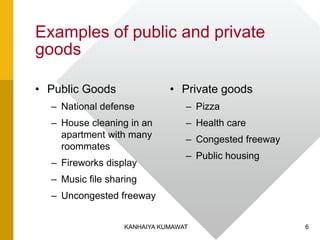
Examples of public and private
goods
• Public Goods
– National defense
– House cleaning in an
apartment with many
roommates
– Fireworks display
– Music file sharing
– Uncongested freeway
• Private goods
– Pizza
– Health care
– Congested freeway
– Public housing
6KANHAIYA KUMAWAT
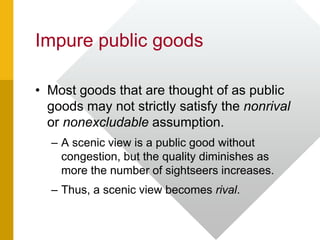
Impure public goods
• Most goods that are thought of as public
goods may not strictly satisfy the nonrival
or nonexcludable assumption.
– A scenic view is a public good without
congestion, but the quality diminishes as
more the number of sightseers increases.
– Thus, a scenic view becomes rival.
8
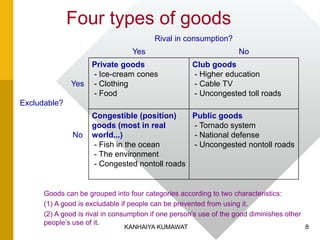
Four types of goods
Rival in consumption?
Yes No
Excludable?
Yes
Private goods
- Ice-cream cones
- Clothing
- Food
Club goods
- Higher education
- Cable TV
- Uncongested toll roads
No
Congestible (position)
goods (most in real
world...)
- Fish in the ocean
- The environment
- Congested nontoll roads
Public goods
- Tornado system
- National defense
- Uncongested nontoll roads
Goods can be grouped into four categories according to two characteristics:
(1) A good is excludable if people can be prevented from using it.
(2) A good is rival in consumption if one person’s use of the good diminishes other
people’s use of it.
KANHAIYA KUMAWAT
Congestible public goods
(position)
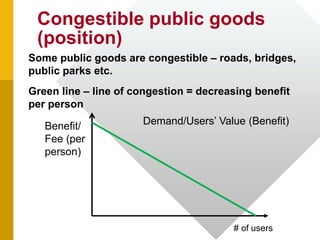
Some public goods are congestible – roads, bridges,
public parks etc.
Green line – line of congestion = decreasing benefit
per person
Benefit/
Fee (per
person)
# of users
Demand/Users’ Value (Benefit)
Congestible public goods
(position goods) with fee
Benefit/
Fee
# of users
•Demand/Users Value
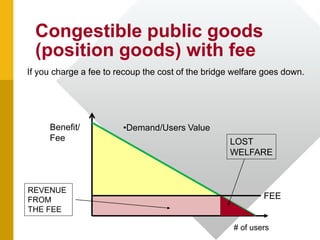
If you charge a fee to recoup the cost of the bridge welfare goes down.
FEE
REVENUE
FROM
THE FEE
LOST
WELFARE
Club goods
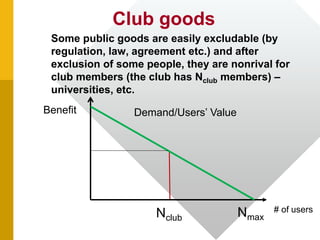
Some public goods are easily excludable (by
regulation, law, agreement etc.) and after
exclusion of some people, they are nonrival for
club members (the club has Nclub members) –
universities, etc.
Benefit
# of users
Demand/Users’ Value
Nclub Nmax
Valuation of public goods
• Everyone consumes same quantity of
public good
• Marginal benefit of public good varies by
person
– In the housecleaning example, different
roommates value the clean apartment
differently.
Private goods can be provided by
the public sector
• These are called “publicly provided private
goods.”
• Key criteria: is the good rival and excludable?
• Public housing is rival (one family consumes
one apartment) and excludable (easy to
prevent consumption).
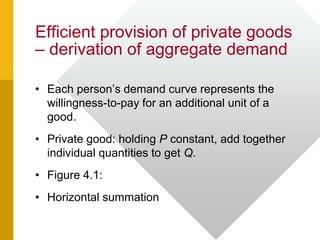
Efficient provision of private goods
– derivation of aggregate demand
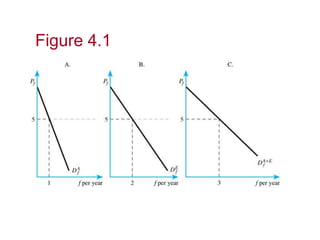
• Each person’s demand curve represents the
willingness-to-pay for an additional unit of a
good.
• Private good: holding P constant, add together
individual quantities to get Q.
• Figure 4.1:
• Horizontal summation
Figure 4.1
Equilibrium in private goods
market
• Equilibrium where supply curve intersects
aggregate demand curve.
• Everyone pays the same price, P.
• Individuals consume different quantities,
Q.
• Pareto efficient.
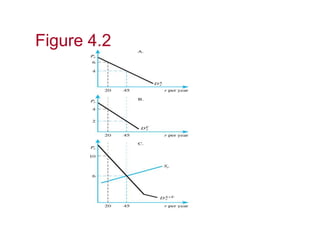
Efficient provision of public goods
• Consider a fireworks display as a public good –
it is nonrival and nonexcludable.
• Bigger displays give higher benefit.
• Figure 4.2:
• Public good: holding Q constant, add together
individual willingness-to-pay to get P.
• Vertical summation.
Figure 4.2
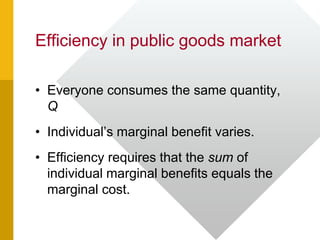
Efficiency in public goods market
• Everyone consumes the same quantity,
Q
• Individual’s marginal benefit varies.
• Efficiency requires that the sum of
individual marginal benefits equals the
marginal cost.
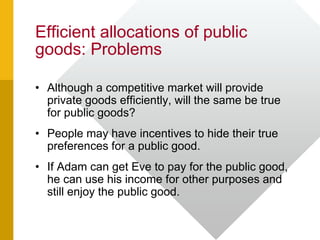
Efficient allocations of public
goods: Problems
• Although a competitive market will provide
private goods efficiently, will the same be true
for public goods?
• People may have incentives to hide their true
preferences for a public good.
• If Adam can get Eve to pay for the public good,
he can use his income for other purposes and
still enjoy the public good.
Problems, continued
• This incentive to let others pay for the
public good while still enjoying the
benefits is known as the “free rider
problem.”
• The private market may therefore fall
short of providing the efficient amount of
the public good.
Problems, continued
• This incentive to free ride occurs
because the public good is nonrival and
nonexcludable.
• A person gets to consume the good even
if he does not pay for it.
Solutions to the free rider problem
• Government intervention can potentially lead to a more
efficient outcome.
– Government can use coercive power to force people to
pay for public goods, through taxation.
• Free riding is not a fact, however. There are instances
when individuals do act collectively without coercion.
• Laboratory experiments on college students contradict
the notion that free riding will lead to zero contributions
for the public good. Some suggest the results derive
from a “warm glow” of giving.
23KANHAIYA KUMAWAT
Privatization debate
• Privatization means taking services that are
supplied by the government and turning them
over to the private sector for provision and/or
production.
• Examples with competing public/private
provision include policing, parks, and even the
judicial system.
24KANHAIYA KUMAWAT
Private provision
• Mix of private and public provision depends on:
– Relative wage and materials costs: Which sector is less
expensive?
– Administrative costs: Can these fixed costs be spread
over a large group of people?
– Diversity of tastes. Private provision is more efficient
with diverse tastes because people can tailor their
consumption to their own tastes.
– Distributional issues. Notions of fairness may require
that some commodities are available to everyone – such
as education or health care.
25KANHAIYA KUMAWAT
Private production
• Even if there is agreement that the public sector should
provide a good, it is not clear whether the public sector
should produce it.
– Airport security workers are a timely example.
• Public sector managers may not have a strong incentive
to control costs because of the lack of profit motive or
fears of takeovers or bankruptcy.
• Quality of public services may be higher, however. This
is more relevant when contracts are incomplete.
26KANHAIYA KUMAWAT
Recap of public goods
• Public good definition
• Derivation of aggregate demand curves
• Inefficient provision of public goods
• Free rider problem
• Public versus private provision
• Education
27KANHAIYA KUMAWAT

Public goods

  • 1.
    Theme 4 -Public Goods Public Economics 1KANHAIYA KUMAWAT
  • 2.
    MAIN THEORY –Paul Samuelson
  • 3.
    Public Goods Defined •Pure public goods share two characteristics – Nonrival – Cost of another person consuming the good is zero – Nonexcludable – Very expensive to prevent others from consuming the good
  • 4.
    4 Marginal Costs ofConsuming and Producing a Pure Public Good 0 Cost(Dollars) •Number of Consumers 200 Marginal Cost of Allowing an Additional Person to Consume a Given Quantity of Pure Public Good 1 KANHAIYA KUMAWAT
  • 5.
    5 Marginal Costs ofConsuming a Pure Public Good Benefit of consuming a Pure Public Good 200 N persons Benefitperperson (Dollars) 0 KANHAIYA KUMAWAT
  • 6.
    Examples of publicand private goods • Public Goods – National defense – House cleaning in an apartment with many roommates – Fireworks display – Music file sharing – Uncongested freeway • Private goods – Pizza – Health care – Congested freeway – Public housing 6KANHAIYA KUMAWAT
  • 7.
    Impure public goods •Most goods that are thought of as public goods may not strictly satisfy the nonrival or nonexcludable assumption. – A scenic view is a public good without congestion, but the quality diminishes as more the number of sightseers increases. – Thus, a scenic view becomes rival.
  • 8.
    8 Four types ofgoods Rival in consumption? Yes No Excludable? Yes Private goods - Ice-cream cones - Clothing - Food Club goods - Higher education - Cable TV - Uncongested toll roads No Congestible (position) goods (most in real world...) - Fish in the ocean - The environment - Congested nontoll roads Public goods - Tornado system - National defense - Uncongested nontoll roads Goods can be grouped into four categories according to two characteristics: (1) A good is excludable if people can be prevented from using it. (2) A good is rival in consumption if one person’s use of the good diminishes other people’s use of it. KANHAIYA KUMAWAT
  • 9.
    Congestible public goods (position) Somepublic goods are congestible – roads, bridges, public parks etc. Green line – line of congestion = decreasing benefit per person Benefit/ Fee (per person) # of users Demand/Users’ Value (Benefit)
  • 10.
    Congestible public goods (positiongoods) with fee Benefit/ Fee # of users •Demand/Users Value If you charge a fee to recoup the cost of the bridge welfare goes down. FEE REVENUE FROM THE FEE LOST WELFARE
  • 11.
    Club goods Some publicgoods are easily excludable (by regulation, law, agreement etc.) and after exclusion of some people, they are nonrival for club members (the club has Nclub members) – universities, etc. Benefit # of users Demand/Users’ Value Nclub Nmax
  • 12.
    Valuation of publicgoods • Everyone consumes same quantity of public good • Marginal benefit of public good varies by person – In the housecleaning example, different roommates value the clean apartment differently.
  • 13.
    Private goods canbe provided by the public sector • These are called “publicly provided private goods.” • Key criteria: is the good rival and excludable? • Public housing is rival (one family consumes one apartment) and excludable (easy to prevent consumption).
  • 14.
    Efficient provision ofprivate goods – derivation of aggregate demand • Each person’s demand curve represents the willingness-to-pay for an additional unit of a good. • Private good: holding P constant, add together individual quantities to get Q. • Figure 4.1: • Horizontal summation
  • 15.
  • 16.
    Equilibrium in privategoods market • Equilibrium where supply curve intersects aggregate demand curve. • Everyone pays the same price, P. • Individuals consume different quantities, Q. • Pareto efficient.
  • 17.
    Efficient provision ofpublic goods • Consider a fireworks display as a public good – it is nonrival and nonexcludable. • Bigger displays give higher benefit. • Figure 4.2: • Public good: holding Q constant, add together individual willingness-to-pay to get P. • Vertical summation.
  • 18.
  • 19.
    Efficiency in publicgoods market • Everyone consumes the same quantity, Q • Individual’s marginal benefit varies. • Efficiency requires that the sum of individual marginal benefits equals the marginal cost.
  • 20.
    Efficient allocations ofpublic goods: Problems • Although a competitive market will provide private goods efficiently, will the same be true for public goods? • People may have incentives to hide their true preferences for a public good. • If Adam can get Eve to pay for the public good, he can use his income for other purposes and still enjoy the public good.
  • 21.
    Problems, continued • Thisincentive to let others pay for the public good while still enjoying the benefits is known as the “free rider problem.” • The private market may therefore fall short of providing the efficient amount of the public good.
  • 22.
    Problems, continued • Thisincentive to free ride occurs because the public good is nonrival and nonexcludable. • A person gets to consume the good even if he does not pay for it.
  • 23.
    Solutions to thefree rider problem • Government intervention can potentially lead to a more efficient outcome. – Government can use coercive power to force people to pay for public goods, through taxation. • Free riding is not a fact, however. There are instances when individuals do act collectively without coercion. • Laboratory experiments on college students contradict the notion that free riding will lead to zero contributions for the public good. Some suggest the results derive from a “warm glow” of giving. 23KANHAIYA KUMAWAT
  • 24.
    Privatization debate • Privatizationmeans taking services that are supplied by the government and turning them over to the private sector for provision and/or production. • Examples with competing public/private provision include policing, parks, and even the judicial system. 24KANHAIYA KUMAWAT
  • 25.
    Private provision • Mixof private and public provision depends on: – Relative wage and materials costs: Which sector is less expensive? – Administrative costs: Can these fixed costs be spread over a large group of people? – Diversity of tastes. Private provision is more efficient with diverse tastes because people can tailor their consumption to their own tastes. – Distributional issues. Notions of fairness may require that some commodities are available to everyone – such as education or health care. 25KANHAIYA KUMAWAT
  • 26.
    Private production • Evenif there is agreement that the public sector should provide a good, it is not clear whether the public sector should produce it. – Airport security workers are a timely example. • Public sector managers may not have a strong incentive to control costs because of the lack of profit motive or fears of takeovers or bankruptcy. • Quality of public services may be higher, however. This is more relevant when contracts are incomplete. 26KANHAIYA KUMAWAT
  • 27.
    Recap of publicgoods • Public good definition • Derivation of aggregate demand curves • Inefficient provision of public goods • Free rider problem • Public versus private provision • Education 27KANHAIYA KUMAWAT