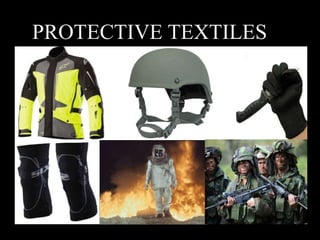
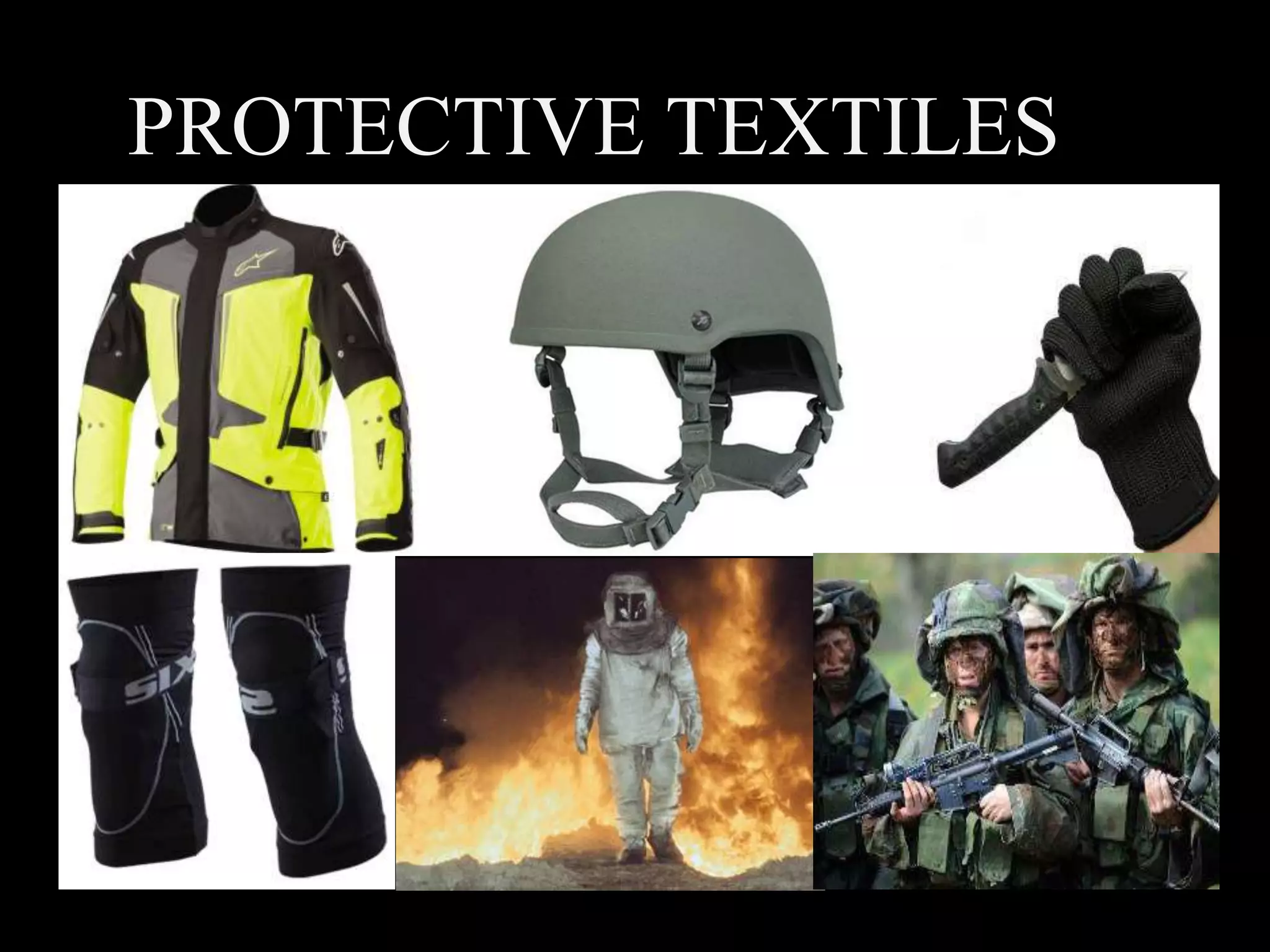
PROTECTIVE TEXTILES
Contents
►Protective Textiles – An Introduction
►Types of Protective Textiles
►Protective Textiles in India
►Centre of Excellence for Protective Textiles
1. Protective Textiles – An Introduction
• What are Protective Textiles?
Protective textiles comprise clothing and other textile-based systems whose main
function is to protect the users from hazards such as civil and military emergency
interventions, hospitals and manufacturing environments that require insulation
from bacterial and viral contamination.
• Applications of Protective Textiles
1. Thermal Protection e.g. flame, convective and radiant heat protection
(firefighters etc.)
2. Biological Protection (Protection from deadly Bacteria/Virus)
3. Radiation Protection (chemical, radioactive contamination)
4. Electrostatic Protection (Protection against electro-static charges)
5. Invisibility Protection (High Visibility warning clothing)
6. Mechanical Protection (Ballistic protection, cut resistant gloves etc.)
7. Environmental Protection (Astronaut's suits, petrochemical, gas, refineries,
adverse weather etc.)
Selection factors for designing of the protective textiles:
• Clothing configuration of components and options
• Sizes
• Ease of donning on and off
• Clothing construction
• Accommodation of other selected ensemble equipment
• Comfort and restriction of mobility
• Environment type from which protection is needed.
Fibres used for making protective textiles:
• Meta-Para aramides – Nomex: high resistance, tear, tensile strength, expensive,
• Wool viscoses polyamide – marlan : repelency of molten metal, heat insulation, transparency.
• Glass fiber - High resistance, insulating.
• Modacrylic cotton – Marko wiki: Marko : electric arc flash protection, comfort, flame-resistant,
efficient, skin friendly, antistatic.
• Polyamide – Kevlar : extreme resistance, low ageing
Protective Textiles find uses in the following industries:
 Military & Police Force
 Transport
 Medical
 Security Guards
 Climbing
 Skiing
 Water Sports
 Offshore Diving
 Foundries
 Winter Sports
 Coal Mining
 Glass Workers
 Health Care
 Sports
 Racing Drivers
 Astronauts
 Cold Storage Workers
 Oil And Gas Rig Workers
 Construction Industry
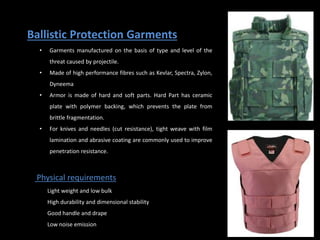
Ballistic Protection Garments
• Garments manufactured on the basis of type and level of the
threat caused by projectile.
• Made of high performance fibres such as Kevlar, Spectra, Zylon,
Dyneema
• Armor is made of hard and soft parts. Hard Part has ceramic
plate with polymer backing, which prevents the plate from
brittle fragmentation.
• For knives and needles (cut resistance), tight weave with film
lamination and abrasive coating are commonly used to improve
penetration resistance.
Physical requirements
Light weight and low bulk
High durability and dimensional stability
Good handle and drape
Low noise emission
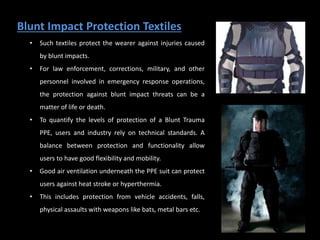
Blunt Impact Protection Textiles
• Such textiles protect the wearer against injuries caused
by blunt impacts.
• For law enforcement, corrections, military, and other
personnel involved in emergency response operations,
the protection against blunt impact threats can be a
matter of life or death.
• To quantify the levels of protection of a Blunt Trauma
PPE, users and industry rely on technical standards. A
balance between protection and functionality allow
users to have good flexibility and mobility.
• Good air ventilation underneath the PPE suit can protect
users against heat stroke or hyperthermia.
• This includes protection from vehicle accidents, falls,
physical assaults with weapons like bats, metal bars etc.
Pressure Hazard Protection
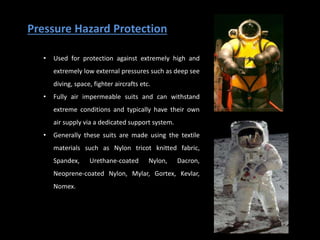
• Used for protection against extremely high and
extremely low external pressures such as deep see
diving, space, fighter aircrafts etc.
• Fully air impermeable suits and can withstand
extreme conditions and typically have their own
air supply via a dedicated support system.
• Generally these suits are made using the textile
materials such as Nylon tricot knitted fabric,
Spandex, Urethane-coated Nylon, Dacron,
Neoprene-coated Nylon, Mylar, Gortex, Kevlar,
Nomex.
Environmental Hazard Protection
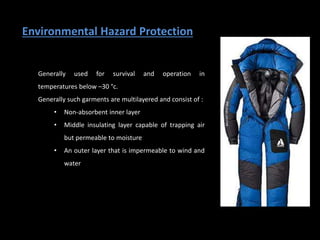
Generally used for survival and operation in
temperatures below –30 °c.
Generally such garments are multilayered and consist of :
• Non-absorbent inner layer
• Middle insulating layer capable of trapping air
but permeable to moisture
• An outer layer that is impermeable to wind and
water
Nuclear Radiation Protection
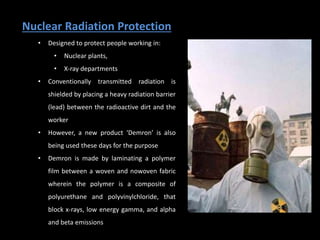
• Designed to protect people working in:
• Nuclear plants,
• X-ray departments
• Conventionally transmitted radiation is
shielded by placing a heavy radiation barrier
(lead) between the radioactive dirt and the
worker
• However, a new product ‘Demron’ is also
being used these days for the purpose
• Demron is made by laminating a polymer
film between a woven and nowoven fabric
wherein the polymer is a composite of
polyurethane and polyvinylchloride, that
block x-rays, low energy gamma, and alpha
and beta emissions
• Nomex
• Kevlar
• Glass
• Polyester
• Polyamide
• Carbon
• Propane treated cotton
• Modacrylic
• Polypropylene
Fire Hazard Protection
Flame resistance in fabrics is achieved using flame
resistant materials and fibres such as:
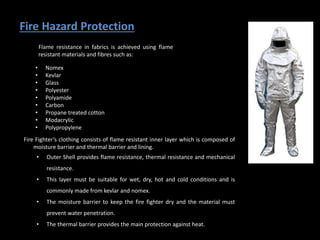
Fire Fighter’s clothing consists of flame resistant inner layer which is composed of
moisture barrier and thermal barrier and lining.
• Outer Shell provides flame resistance, thermal resistance and mechanical
resistance.
• This layer must be suitable for wet, dry, hot and cold conditions and is
commonly made from kevlar and nomex.
• The moisture barrier to keep the fire fighter dry and the material must
prevent water penetration.
• The thermal barrier provides the main protection against heat.
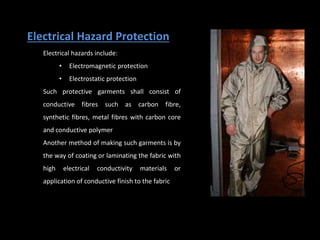
Electrical Hazard Protection
Electrical hazards include:
• Electromagnetic protection
• Electrostatic protection
Such protective garments shall consist of
conductive fibres such as carbon fibre,
synthetic fibres, metal fibres with carbon core
and conductive polymer
Another method of making such garments is by
the way of coating or laminating the fabric with
high electrical conductivity materials or
application of conductive finish to the fabric
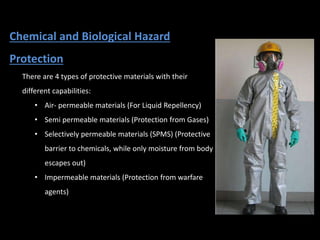
Chemical and Biological Hazard
Protection
There are 4 types of protective materials with their
different capabilities:
• Air- permeable materials (For Liquid Repellency)
• Semi permeable materials (Protection from Gases)
• Selectively permeable materials (SPMS) (Protective
barrier to chemicals, while only moisture from body
escapes out)
• Impermeable materials (Protection from warfare
agents)
• The current size of the Personal Protective clothing and Equipment (PPE) market in the EU is estimated
around €10 billion
• The protective textiles segment in India has grown from INR 1,302 crore in 2007-08 to INR 1,890 crores by
the year 2011-12 with a CAGR of 9.77%.
• As per the sub group on technical textiles, the protective textiles segment in India grew from INR 2,325
crore in 2012-13 to INR 5,322 crore by 2016-17 at a CAGR of 23%
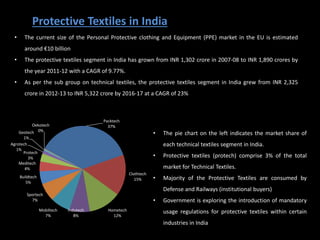
Protective Textiles in India
Packtech
37%
Clothtech
15%
Hometech
12%
Indutech
8%
Mobiltech
7%
Sportech
7%
Buildtech
5%
Meditech
4%
Protech
3%
Agrotech
1%
Geotech
1%
Oekotech
0%
• The pie chart on the left indicates the market share of
each technical textiles segment in India.
• Protective textiles (protech) comprise 3% of the total
market for Technical Textiles.
• Majority of the Protective Textiles are consumed by
Defense and Railways (institutional buyers)
• Government is exploring the introduction of mandatory
usage regulations for protective textiles within certain
industries in India
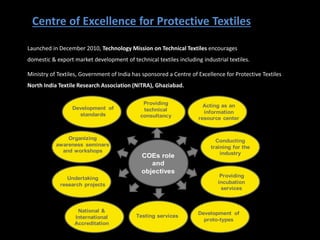
Centre of Excellence for Protective Textiles
Ministry of Textiles, Government of India has sponsored a Centre of Excellence for Protective Textiles
North India Textile Research Association (NITRA), Ghaziabad.
Providing
technical
consultancy
Acting as an
information
resource center
Conducting
training for the
industry
Providing
incubation
services
Development of
proto-types
Testing services
National &
International
Accreditation
Undertaking
research projects
Organizing
awareness seminars
and workshops
Development of
standards
COEs role
and
objectives
Launched in December 2010, Technology Mission on Technical Textiles encourages
domestic & export market development of technical textiles including industrial textiles.
Thank You
Anshu Lakhwani
Disha Pawar
Sem - 4

Protective textiles types and scope

  • 1.
  • 2.
    Contents ►Protective Textiles –An Introduction ►Types of Protective Textiles ►Protective Textiles in India ►Centre of Excellence for Protective Textiles
  • 3.
    1. Protective Textiles– An Introduction • What are Protective Textiles? Protective textiles comprise clothing and other textile-based systems whose main function is to protect the users from hazards such as civil and military emergency interventions, hospitals and manufacturing environments that require insulation from bacterial and viral contamination. • Applications of Protective Textiles 1. Thermal Protection e.g. flame, convective and radiant heat protection (firefighters etc.) 2. Biological Protection (Protection from deadly Bacteria/Virus) 3. Radiation Protection (chemical, radioactive contamination) 4. Electrostatic Protection (Protection against electro-static charges) 5. Invisibility Protection (High Visibility warning clothing) 6. Mechanical Protection (Ballistic protection, cut resistant gloves etc.) 7. Environmental Protection (Astronaut's suits, petrochemical, gas, refineries, adverse weather etc.)
  • 4.
    Selection factors fordesigning of the protective textiles: • Clothing configuration of components and options • Sizes • Ease of donning on and off • Clothing construction • Accommodation of other selected ensemble equipment • Comfort and restriction of mobility • Environment type from which protection is needed. Fibres used for making protective textiles: • Meta-Para aramides – Nomex: high resistance, tear, tensile strength, expensive, • Wool viscoses polyamide – marlan : repelency of molten metal, heat insulation, transparency. • Glass fiber - High resistance, insulating. • Modacrylic cotton – Marko wiki: Marko : electric arc flash protection, comfort, flame-resistant, efficient, skin friendly, antistatic. • Polyamide – Kevlar : extreme resistance, low ageing
  • 5.
    Protective Textiles finduses in the following industries:  Military & Police Force  Transport  Medical  Security Guards  Climbing  Skiing  Water Sports  Offshore Diving  Foundries  Winter Sports  Coal Mining  Glass Workers  Health Care  Sports  Racing Drivers  Astronauts  Cold Storage Workers  Oil And Gas Rig Workers  Construction Industry
  • 6.
    Ballistic Protection Garments •Garments manufactured on the basis of type and level of the threat caused by projectile. • Made of high performance fibres such as Kevlar, Spectra, Zylon, Dyneema • Armor is made of hard and soft parts. Hard Part has ceramic plate with polymer backing, which prevents the plate from brittle fragmentation. • For knives and needles (cut resistance), tight weave with film lamination and abrasive coating are commonly used to improve penetration resistance. Physical requirements Light weight and low bulk High durability and dimensional stability Good handle and drape Low noise emission
  • 7.
    Blunt Impact ProtectionTextiles • Such textiles protect the wearer against injuries caused by blunt impacts. • For law enforcement, corrections, military, and other personnel involved in emergency response operations, the protection against blunt impact threats can be a matter of life or death. • To quantify the levels of protection of a Blunt Trauma PPE, users and industry rely on technical standards. A balance between protection and functionality allow users to have good flexibility and mobility. • Good air ventilation underneath the PPE suit can protect users against heat stroke or hyperthermia. • This includes protection from vehicle accidents, falls, physical assaults with weapons like bats, metal bars etc.
  • 8.
    Pressure Hazard Protection •Used for protection against extremely high and extremely low external pressures such as deep see diving, space, fighter aircrafts etc. • Fully air impermeable suits and can withstand extreme conditions and typically have their own air supply via a dedicated support system. • Generally these suits are made using the textile materials such as Nylon tricot knitted fabric, Spandex, Urethane-coated Nylon, Dacron, Neoprene-coated Nylon, Mylar, Gortex, Kevlar, Nomex.
  • 9.
    Environmental Hazard Protection Generallyused for survival and operation in temperatures below –30 °c. Generally such garments are multilayered and consist of : • Non-absorbent inner layer • Middle insulating layer capable of trapping air but permeable to moisture • An outer layer that is impermeable to wind and water
  • 10.
    Nuclear Radiation Protection •Designed to protect people working in: • Nuclear plants, • X-ray departments • Conventionally transmitted radiation is shielded by placing a heavy radiation barrier (lead) between the radioactive dirt and the worker • However, a new product ‘Demron’ is also being used these days for the purpose • Demron is made by laminating a polymer film between a woven and nowoven fabric wherein the polymer is a composite of polyurethane and polyvinylchloride, that block x-rays, low energy gamma, and alpha and beta emissions
  • 11.
    • Nomex • Kevlar •Glass • Polyester • Polyamide • Carbon • Propane treated cotton • Modacrylic • Polypropylene Fire Hazard Protection Flame resistance in fabrics is achieved using flame resistant materials and fibres such as: Fire Fighter’s clothing consists of flame resistant inner layer which is composed of moisture barrier and thermal barrier and lining. • Outer Shell provides flame resistance, thermal resistance and mechanical resistance. • This layer must be suitable for wet, dry, hot and cold conditions and is commonly made from kevlar and nomex. • The moisture barrier to keep the fire fighter dry and the material must prevent water penetration. • The thermal barrier provides the main protection against heat.
  • 12.
    Electrical Hazard Protection Electricalhazards include: • Electromagnetic protection • Electrostatic protection Such protective garments shall consist of conductive fibres such as carbon fibre, synthetic fibres, metal fibres with carbon core and conductive polymer Another method of making such garments is by the way of coating or laminating the fabric with high electrical conductivity materials or application of conductive finish to the fabric
  • 13.
    Chemical and BiologicalHazard Protection There are 4 types of protective materials with their different capabilities: • Air- permeable materials (For Liquid Repellency) • Semi permeable materials (Protection from Gases) • Selectively permeable materials (SPMS) (Protective barrier to chemicals, while only moisture from body escapes out) • Impermeable materials (Protection from warfare agents)
  • 14.
    • The currentsize of the Personal Protective clothing and Equipment (PPE) market in the EU is estimated around €10 billion • The protective textiles segment in India has grown from INR 1,302 crore in 2007-08 to INR 1,890 crores by the year 2011-12 with a CAGR of 9.77%. • As per the sub group on technical textiles, the protective textiles segment in India grew from INR 2,325 crore in 2012-13 to INR 5,322 crore by 2016-17 at a CAGR of 23% Protective Textiles in India Packtech 37% Clothtech 15% Hometech 12% Indutech 8% Mobiltech 7% Sportech 7% Buildtech 5% Meditech 4% Protech 3% Agrotech 1% Geotech 1% Oekotech 0% • The pie chart on the left indicates the market share of each technical textiles segment in India. • Protective textiles (protech) comprise 3% of the total market for Technical Textiles. • Majority of the Protective Textiles are consumed by Defense and Railways (institutional buyers) • Government is exploring the introduction of mandatory usage regulations for protective textiles within certain industries in India
  • 15.
    Centre of Excellencefor Protective Textiles Ministry of Textiles, Government of India has sponsored a Centre of Excellence for Protective Textiles North India Textile Research Association (NITRA), Ghaziabad. Providing technical consultancy Acting as an information resource center Conducting training for the industry Providing incubation services Development of proto-types Testing services National & International Accreditation Undertaking research projects Organizing awareness seminars and workshops Development of standards COEs role and objectives Launched in December 2010, Technology Mission on Technical Textiles encourages domestic & export market development of technical textiles including industrial textiles.
  • 16.