Subject Code : BTTEX05002 Semester : Vth
Textile Technology Department
CTF, MPSTME, SVKMs, NMIMS, Shirpur
By: Prof. P. P. Kolte
Lecture 1
Objectives:
 To study combing preparatory.
 To study necessity of combing preparatory.
 To study various objectives of combing preparatory.
Combing Preparatory
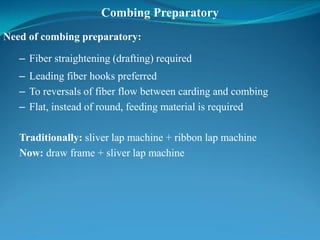
Need of combing preparatory:
– Fiber straightening (drafting) required
– Leading fiber hooks preferred
– To reversals of fiber flow between carding and combing
– Flat, instead of round, feeding material is required
Traditionally: sliver lap machine + ribbon lap machine
Now: draw frame + sliver lap machine
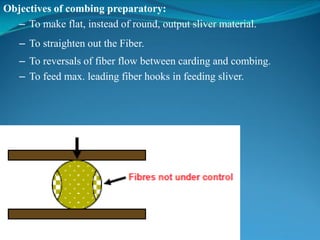
Objectives of combing preparatory:
– To make flat, instead of round, output sliver material.
– To straighten out the Fiber.
– To reversals of fiber flow between carding and combing.
– To feed max. leading fiber hooks in feeding sliver.
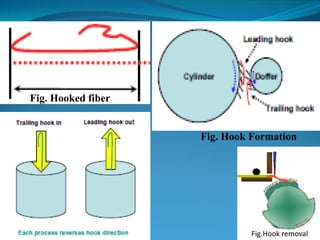
Fig. Hooked fiber
Fig. Hook Formation
Fig.Hook removal
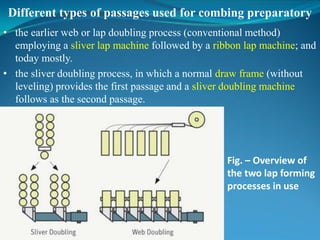
Different types of passages used for combing preparatory
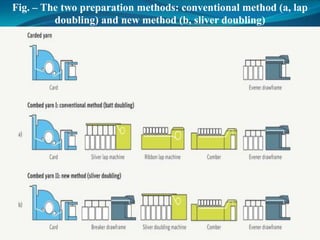
• the earlier web or lap doubling process (conventional method)
employing a sliver lap machine followed by a ribbon lap machine; and
today mostly.
• the sliver doubling process, in which a normal draw frame (without
leveling) provides the first passage and a sliver doubling machine
follows as the second passage.
Fig. – Overview of
the two lap forming
processes in use
Web doubling and sliver doubling processes
These are the methods of comber lap preparation
Commercially two systems of preparing the comber lap are used:
(1) Lap/web Doubling System
(2) Sliver Doubling System
(1) Lap Doubling System
In the lap doubling comber preparation system the carded sliver is
passed through a sliver lap machine followed by a ribbon lap machine.
Lap doubling method became more apparent for longer-staple material
(i.e.. For higher waste elimination rates).
(2) Sliver Doubling System
In the sliver doubling process the carded sliver is given first passage
through a normal draw frame and then series of drawn slivers are given
second passage through a sliver doubling machine.
It was considered that the sliver doubling method tended, to be
advantageous for processing shorter staple material (i.e.. with, low-
to-medium generation of noil).
Now a days, with modern preparation machines it is difficult to detect
any difference between the two techniques, so that a trend toward sliver
doubling is become established.
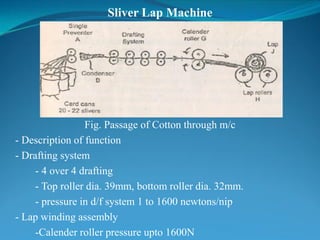
Sliver Lap Machine
Fig. Passage of Cotton through m/c
- Description of function
- Drafting system
- 4 over 4 drafting
- Top roller dia. 39mm, bottom roller dia. 32mm.
- pressure in d/f system 1 to 1600 newtons/nip
- Lap winding assembly
-Calender roller pressure upto 1600N
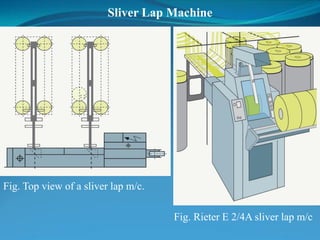
Sliver Lap Machine
Fig. Top view of a sliver lap m/c.
Fig. Rieter E 2/4A sliver lap m/c
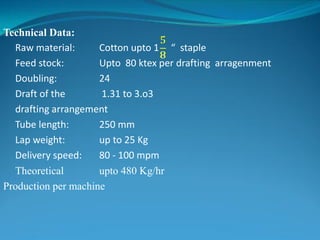
Technical Data:
Raw material: Cotton upto 1 “ staple
Feed stock: Upto 80 ktex per drafting arragenment
Doubling: 24
Draft of the 1.31 to 3.o3
drafting arrangement
Tube length: 250 mm
Lap weight: up to 25 Kg
Delivery speed: 80 - 100 mpm
Theoretical upto 480 Kg/hr
Production per machine
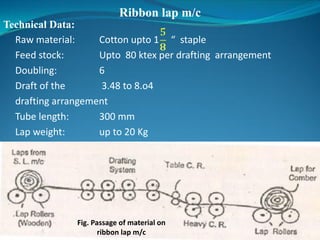
Ribbon lap m/c
Technical Data:
Raw material: Cotton upto 1 “ staple
Feed stock: Upto 80 ktex per drafting arrangement
Doubling: 6
Draft of the 3.48 to 8.o4
drafting arrangement
Tube length: 300 mm
Lap weight: up to 20 Kg
Fig. Passage of material on
ribbon lap m/c
Delivery speed: 85 - 100 mpm
Theoretical upto 480 Kg/hr
Production per machine
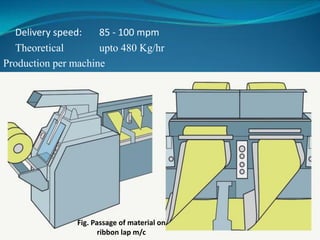
Fig. Passage of material on
ribbon lap m/c
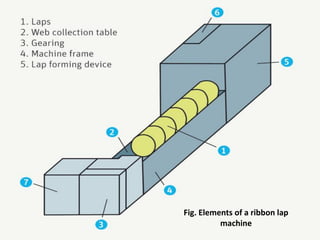
Fig. Elements of a ribbon lap
machine
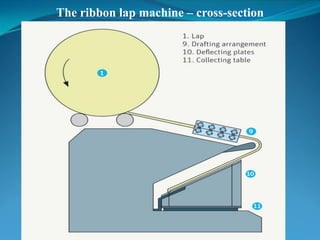
The ribbon lap machine – cross-section
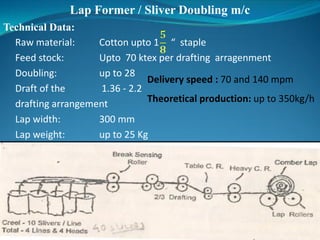
Lap Former / Sliver Doubling m/c
Technical Data:
Raw material: Cotton upto 1 “ staple
Feed stock: Upto 70 ktex per drafting arragenment
Doubling: up to 28
Draft of the 1.36 - 2.2
drafting arrangement
Lap width: 300 mm
Lap weight: up to 25 Kg
Delivery speed : 70 and 140 mpm
Theoretical production: up to 350kg/h
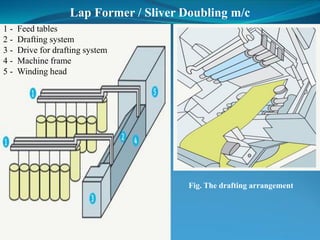
Lap Former / Sliver Doubling m/c
1 - Feed tables
2 - Drafting system
3 - Drive for drafting system
4 - Machine frame
5 - Winding head
Fig. The drafting arrangement
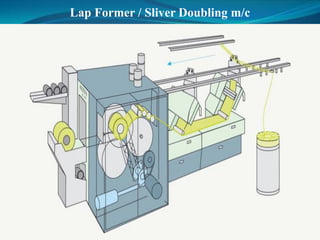
Lap Former / Sliver Doubling m/c
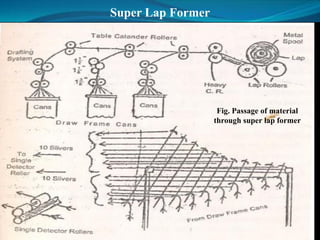
Super Lap Former
Fig. Passage of material
through super lap former
- 4/5 drafting system
- drafting capacity 10, generally working draft 8.
- Three sliver creel with stand, each has capacity 20 and are double
sided. Hence, 60 doublings possible.
- Maximum total draft of 3.75 with 60 doubling.
- Lap weight 1200 grains/yard [85 gms/m]
- Production rate 250-290 Kg/hr
Fig. Sliver feeding at super lap former
Preparation of stock for combing
[System of lap preparation configuration of fibre feed and its effect on
the quality of product]
Fig. – Clamped slivers between
the nipper plates
Fig. – Fibers projecting from
the nippers
Fig. – The two preparation methods: conventional method (a, lap
doubling) and new method (b, sliver doubling)
Production Calculation
Question Answer Session
Question:
 What are the different objectives of the carding?
 What are the necessities of carding?
 Enlist the different zones in carding.
Question Bank
1. Discuss in detail the passage of material through draw-frame machine.
2. Explain in detail operating principles of material through sliver lap
machine.
3. Discuss in detail the passage of material through ribbon lap machine.
4. Explain in detail operating principles of material through super lap former
machine.
5. Compare web doubling and sliver doubling processes.
6. Explain in brief systems of lap preparation configuration of fibre feed.
7. In detail effect of systems of lap preparation configuration of fibre feed on
the quality of product.
8. Discuss the effect of fibre feed on quality of product in combing
preparatory.
9. Explain with neat sketch construction and working of lap former m/c.
10. What is the object and need of combing preparatory?
11. Explain the operating principle of sliver lap m/c.
Objectives of Combing Process / Comber
For improving yarn characteristics:
 To eliminate precisely pre-determined quantity of short fibers;
 To eliminate the remaining impurities;
 To eliminate a large proportion (not all) of the neps in the fiber
material;
 To form a sliver having maximum possible evenness;
 To produce more straight and parallel fibers.
Improving yarn characteristics following fabric characteristics improves:
 Smoothness of the fabric;
 Visual appearance of the fabric; and
 Handle of the fabric
Task of Comber
The comber is used in the production of medium, medium-fine and
fine yarns.
Within overall spinning process, the combing operation serves to
improve the raw material.
To achieve an improvement in quality, the comber must perform the
following operations:
 elimination of a precisely pre-determined quantity of short fibers;
 elimination of the remaining impurities;
 elimination of a large proportion (not all can be removed) of the neps
in the fiber material;
 formation of a sliver having the optimal possible quality parameters.
Types of Application
The amount of material combed out varies within the range between
8% and 25% of the infeed stock.
1] For Long Staple combing mills:
Processing first-class, expensive cotton of high strength,
containing a low proportion of short fibers and little dirt.
The product is a fine to very fine yarn of top quality.
The demands placed on know-how and skill of operating personnel
is correspondingly high, as they are on the design
and maintenance of the machines.
Yarn production is low, while generation of noil is high.
2] For Medium-staple combing mills:
Medium cotton qualities with a wide spread of quality parameters are
spun into medium (to fine) yarns of good quality at economic production
costs.
The process is problematic in that it has to achieve a high strand of
quality and at the same time give high production at low cost.
The maximum demands placed on medium staple combing can only
be fulfilled by optimally trained personnel.
3] Short to Medium staple combing mills:
Raw material used have the same as that for production of carded
yarns.
In this combination with low level noil level (6 – 14%).
This process is the most widely used in practice; it is technologically
undemanding and can be operated without problems when good m/c
are available.
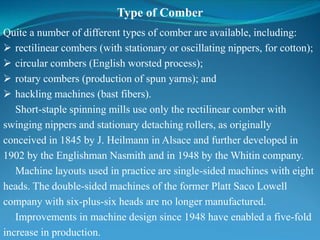
Type of Comber
Quite a number of different types of comber are available, including:
 rectilinear combers (with stationary or oscillating nippers, for cotton);
 circular combers (English worsted process);
 rotary combers (production of spun yarns); and
 hackling machines (bast fibers).
Short-staple spinning mills use only the rectilinear comber with
swinging nippers and stationary detaching rollers, as originally
conceived in 1845 by J. Heilmann in Alsace and further developed in
1902 by the Englishman Nasmith and in 1948 by the Whitin company.
Machine layouts used in practice are single-sided machines with eight
heads. The double-sided machines of the former Platt Saco Lowell
company with six-plus-six heads are no longer manufactured.
Improvements in machine design since 1948 have enabled a five-fold
increase in production.
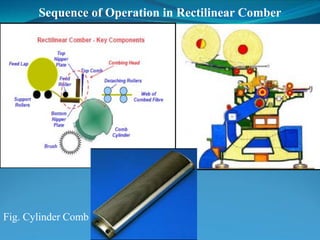
Sequence of Operation in Rectilinear Comber
Fig. Cylinder Comb
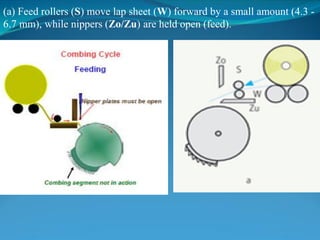
(a) Feed rollers (S) move lap sheet (W) forward by a small amount (4.3 -
6.7 mm), while nippers (Zo/Zu) are held open (feed).
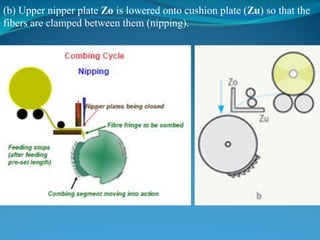
(b) Upper nipper plate Zo is lowered onto cushion plate (Zu) so that the
fibers are clamped between them (nipping).
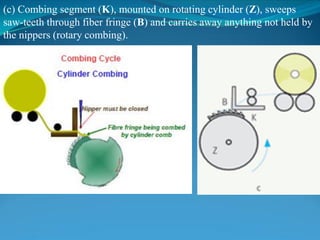
(c) Combing segment (K), mounted on rotating cylinder (Z), sweeps
saw-teeth through fiber fringe (B) and carries away anything not held by
the nippers (rotary combing).
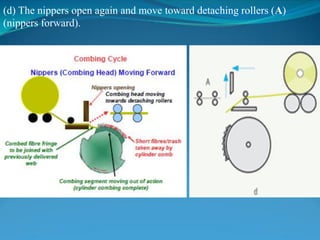
(d) The nippers open again and move toward detaching rollers (A)
(nippers forward).
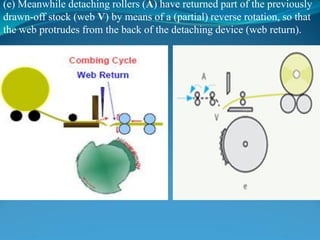
(e) Meanwhile detaching rollers (A) have returned part of the previously
drawn-off stock (web V) by means of a (partial) reverse rotation, so that
the web protrudes from the back of the detaching device (web return).
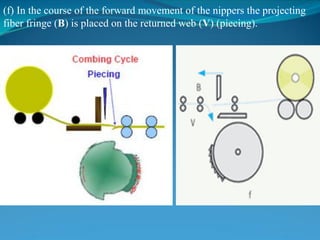
(f) In the course of the forward movement of the nippers the projecting
fiber fringe (B) is placed on the returned web (V) (piecing).
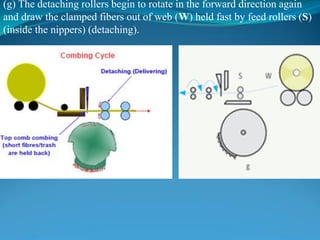
(g) The detaching rollers begin to rotate in the forward direction again
and draw the clamped fibers out of web (W) held fast by feed rollers (S)
(inside the nippers) (detaching).
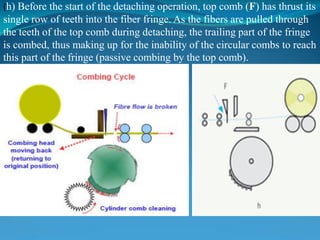
(h) Before the start of the detaching operation, top comb (F) has thrust its
single row of teeth into the fiber fringe. As the fibers are pulled through
the teeth of the top comb during detaching, the trailing part of the fringe
is combed, thus making up for the inability of the circular combs to reach
this part of the fringe (passive combing by the top comb).
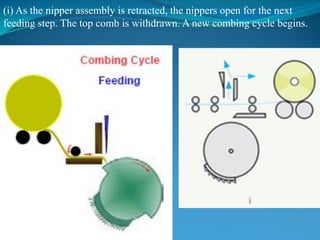
(i) As the nipper assembly is retracted, the nippers open for the next
feeding step. The top comb is withdrawn. A new combing cycle begins.
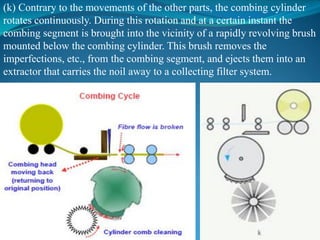
(k) Contrary to the movements of the other parts, the combing cylinder
rotates continuously. During this rotation and at a certain instant the
combing segment is brought into the vicinity of a rapidly revolving brush
mounted below the combing cylinder. This brush removes the
imperfections, etc., from the combing segment, and ejects them into an
extractor that carries the noil away to a collecting filter system.
Technology of combing
Parameters influencing the combing operation
Raw material
Material preparation
Factors associated with the machine
Machine settings
Ambient conditions
Parameter Influencing Combing Operation
Raw material:
Fiber type;
Fiber fineness (Micronaire)
Fiber length
Uniformity of fiber length (CV);
Fiber stiffness
Moisture content;
Foreign material associated with the fibers
Material preparation:
 Parallelization of the fibers in the sheet (batt);
 batt / lap thickness
 batt / lap evenness
 orientation of the hooks
Factors associated with the machine:
 condition of the machine;
 condition of the combs;
 speeds;
 operational performance of the combs;
 type of sliver forming element (diagonal shift of the piecings);
 accuracy of the settings;
 drafting arrangement;
 movement of the elements;
 weight of the elements;
 type of withdrawal of the combed web (either straight forward or
oblique).
Machine settings:
feed distance;
type of feed;
detachment setting;
point density of the combs;
circular comb clothing (angles of teeth, density of teeth, etc);
depth of penetration of the top comb;
piecing;
draft;
drafting arrangement settings.
Ambient conditions:
room temperature;
relative humidity in the room.
Influences of the feed stock on combing
1. Parallalisation of the fibres in the batt / lap
2. Batt / lap Thickness[Weight]
3. Eveneness of the batt / lap sheet
4. The disposition of the hooks
Parallalisation of the fibres in the batt / lap
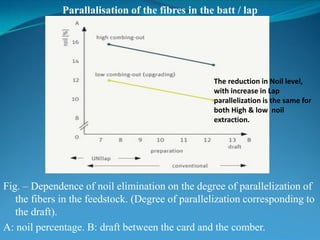
Fig. – Dependence of noil elimination on the degree of parallelization of
the fibers in the feedstock. (Degree of parallelization corresponding to
the draft).
A: noil percentage. B: draft between the card and the comber.
The reduction in Noil level,
with increase in Lap
parallelization is the same for
both High & low noil
extraction.
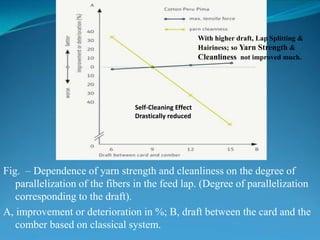
Fig. – Dependence of yarn strength and cleanliness on the degree of
parallelization of the fibers in the feed lap. (Degree of parallelization
corresponding to the draft).
A, improvement or deterioration in %; B, draft between the card and the
comber based on classical system.
With higher draft, Lap Splitting &
Hairiness; so Yarn Strength &
Cleanliness not improved much.
Self-Cleaning Effect
Drastically reduced
 Lack of longitudinal orientation, i.e. noticeable fiber disorder, leads to
elimination of longer fibers, and hence overloading the cylindrical
comb (Thick sheet).
 At same machine settings, noil quantity decreases linearly with
increasing parallelization of the fibers without any reduction in yarn
quality. (see figure)
 It is not always follow that more noil is automatically associated with
better yarn quality.
 The correct goal is always a predetermined waste elimination level.
 The self cleaning effect of the sheet, will be greater the more random
is the disposition of the fibers making up the sheet.
 If the fibers have a very high degree of parallelization, the retaining
power of the sheet can be so strongly reduced that it is no longer also
able to hold back the neps as it usually does.
 Some of the sheet neps also pass through the top comb. Neppiness of
the web is increased.
 If the degree of order of fibers is too high, the sheet does not hold
together well.
 High degree of parallelization always leads to marked hairiness of the
lap.
 The degree of parallelization depends on the total draft between the
card and the comber (see figure )
Lap / Batt Thickness[Weight]

Fig. – Batt weight in relation to staple length
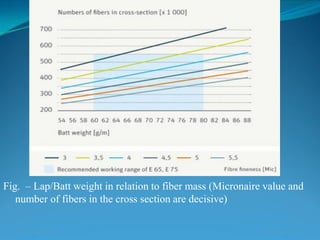
Fig. – Lap/Batt weight in relation to fiber mass (Micronaire value and
number of fibers in the cross section are decisive)
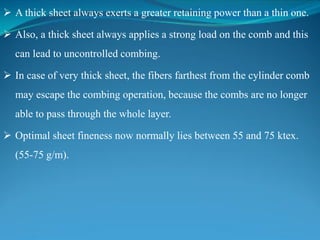
 A thick sheet always exerts a greater retaining power than a thin one.
 Also, a thick sheet always applies a strong load on the comb and this
can lead to uncontrolled combing.
 In case of very thick sheet, the fibers farthest from the cylinder comb
may escape the combing operation, because the combs are no longer
able to pass through the whole layer.
 Optimal sheet fineness now normally lies between 55 and 75 ktex.
(55-75 g/m).
Lap Thickness (Weight)
 Self cleaning effect has considerable influencing combing operation.
This effect arising from retaining power of fibres to hold back the
impurities. Along with the fibre disorder (less parallelization), it also
depends upon thickness of the sheet. Thus a thicker sheet exhibits
more retaining power.
 So also, the bite of the nippers is more effective with higher thickness.
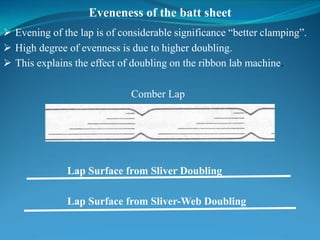
Eveneness of the batt sheet
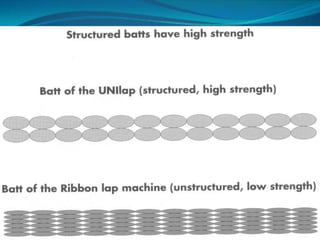
 Evening of the lap is of considerable significance “better clamping”.
 High degree of evenness is due to higher doubling.
 This explains the effect of doubling on the ribbon lab machine.
Comber Lap
Lap Surface from Sliver Doubling
Lap Surface from Sliver-Web Doubling
The disposition of the hooks
 Fibers should be presented to the comber so that leading hooks
predominate in the feedstock.
 If the sheet is fed in the wrong direction, the number of neps rises
markedly.
 Quantity and form of fiber hooks depend mainly upon the stiffness of
the fibers; this rises to the second or third power with increasing the
coarseness of the fibers.
 Fine and long fibers, will always exhibit more and longer hooks
(horseshoe shape) than short fibers, coarse fibers (hokey stick form).
 Accordingly the role of fiber hooks in spinning process becomes more
significant as fibers become finer.
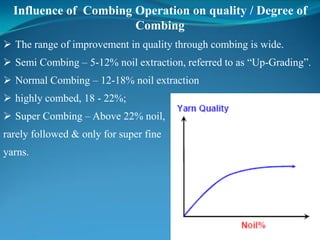
Influence of Combing Operation on quality / Degree of
Combing
 The range of improvement in quality through combing is wide.
 Semi Combing – 5-12% noil extraction, referred to as “Up-Grading”.
 Normal Combing – 12-18% noil extraction
 highly combed, 18 - 22%;
 Super Combing – Above 22% noil,
rarely followed & only for super fine
yarns.
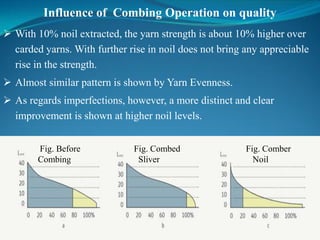
Influence of Combing Operation on quality
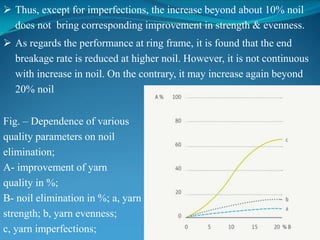
 With 10% noil extracted, the yarn strength is about 10% higher over
carded yarns. With further rise in noil does not bring any appreciable
rise in the strength.
 Almost similar pattern is shown by Yarn Evenness.
 As regards imperfections, however, a more distinct and clear
improvement is shown at higher noil levels.
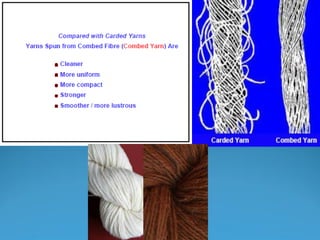
Fig. Before
Combing
Fig. Combed
Sliver
Fig. Comber
Noil
 Thus, except for imperfections, the increase beyond about 10% noil
does not bring corresponding improvement in strength & evenness.
 As regards the performance at ring frame, it is found that the end
breakage rate is reduced at higher noil. However, it is not continuous
with increase in noil. On the contrary, it may increase again beyond
20% noil
Fig. – Dependence of various
quality parameters on noil
elimination;
A- improvement of yarn
quality in %;
B- noil elimination in %; a, yarn
strength; b, yarn evenness;
c, yarn imperfections;
Noil Extraction Theory
 The noil theory developed by Charles Gégauff.
 The noil theory is the effects of detachment setting and feed distance
moved per cycle on the elimination of noil.
 It show the correlation between feed amount and noil percentage with
either forward (concurrent) or backward (counter) feeding.
 However, calculations made on the basis of the theory are often
intractable and should therefore not be attempted.
 Forward feed implies that feeding of the sheet into the nippers occurs
while the nippers are moved toward the detaching rollers.
 Backward feed implies that feeding of the sheet occurs during return
of the nippers. The triangular areas represent stylized staple diagrams.
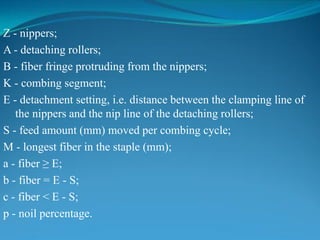
Z - nippers;
A - detaching rollers;
B - fiber fringe protruding from the nippers;
K - combing segment;
E - detachment setting, i.e. distance between the clamping line of
the nippers and the nip line of the detaching rollers;
S - feed amount (mm) moved per combing cycle;
M - longest fiber in the staple (mm);
a - fiber ≥ E;
b - fiber = E - S;
c - fiber < E - S;
p - noil percentage.
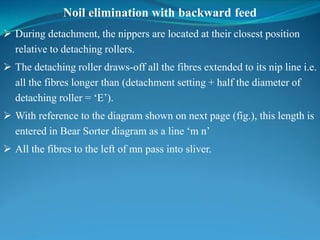
Noil elimination with backward feed
 During detachment, the nippers are located at their closest position
relative to detaching rollers.
 The detaching roller draws-off all the fibres extended to its nip line i.e.
all the fibres longer than (detachment setting + half the diameter of
detaching roller = ‘E’).
 With reference to the diagram shown on next page (fig.), this length is
entered in Bear Sorter diagram as a line ‘m n’
 All the fibres to the left of mn pass into sliver.
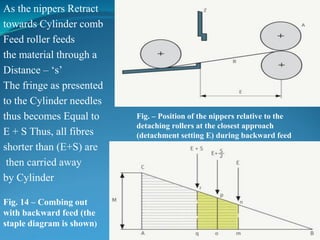
As the nippers Retract
towards Cylinder comb
Feed roller feeds
the material through a
Distance – ‘s’
The fringe as presented
to the Cylinder needles
thus becomes Equal to
E + S Thus, all fibres
shorter than (E+S) are
then carried away
by Cylinder
Fig. – Position of the nippers relative to the
detaching rollers at the closest approach
(detachment setting E) during backward feed
Fig. 14 – Combing out
with backward feed (the
staple diagram is shown)
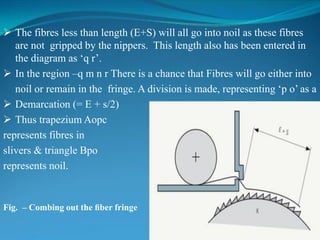
 The fibres less than length (E+S) will all go into noil as these fibres
are not gripped by the nippers. This length also has been entered in
the diagram as ‘q r’.
 In the region –q m n r There is a chance that Fibres will go either into
noil or remain in the fringe. A division is made, representing ‘p o’ as a
 Demarcation (= E + s/2)
 Thus trapezium Aopc
represents fibres in
slivers & triangle Bpo
represents noil.
Fig. – Combing out the fiber fringe
Derivation of Gegauff’s expression:
• The ‘po’ is dividing line representing a length (E+s/2). Further, in
similar triangles, the ratio of the areas are proportional to squares of
the sides, and as the areas represents the noil percentage based on the
ratio of weight of noil to that of feed stock, following can be stated :
∆opB (op)2
• Noil (p%) = ------ x 100 = ------- x 100
∆ABC (AC)2
= [ E + s/2]2 / M2 x 100
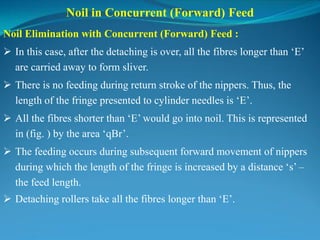
Noil in Concurrent (Forward) Feed
Noil Elimination with Concurrent (Forward) Feed :
 In this case, after the detaching is over, all the fibres longer than ‘E’
are carried away to form sliver.
 There is no feeding during return stroke of the nippers. Thus, the
length of the fringe presented to cylinder needles is ‘E’.
 All the fibres shorter than ‘E’ would go into noil. This is represented
in (fig. ) by the area ‘qBr’.
 The feeding occurs during subsequent forward movement of nippers
during which the length of the fringe is increased by a distance ‘s’ –
the feed length.
 Detaching rollers take all the fibres longer than ‘E’.
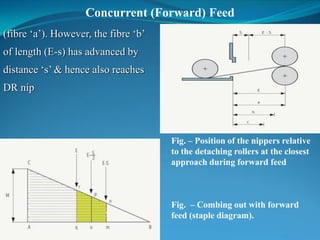
Concurrent (Forward) Feed
Fig. – Position of the nippers relative
to the detaching rollers at the closest
approach during forward feed
Fig. – Combing out with forward
feed (staple diagram).
(fibre ‘a’). However, the fibre ‘b’
of length (E-s) has advanced by
distance ‘s’ & hence also reaches
DR nip
Concurrent (Forward) Feed
 Fibre ‘C’, still shorter than distance (E-S), thus will not be able to
reach the detaching roller nip.
 With earlier logic the diagram (fig. ), gives three lines representing –
‘E’, ‘E-S/2’ and ‘E-S’ lines.
 Thus, percentage of noil will be –
 Noil% = [ ∆(opB) / ∆(ABC)] x 100
= [ (op)2 / AC2] x 100
= [E – (S/2)2 / M2] x 100 (Forward feed)
and [E+ (S/2)2 / M2] x 100 (Backward feed)
 From the two derived expressions, it follows that in Counter
(Backward) Feed, the noil level is increased as the feed distance is
raised. Whereas, in the Concurrent (Forward) Feed, the noil is
reduced.
Quality of Combing in Concurrent & Counter Feed
 It is seen from earlier discussion that in Concurrent (Forward) feed, all
the fibres longer than (E-S) instead of (E), will be allowed to pass into
sliver. Thus, the quality of the combing operation also is different.
 Consider a fibre with its trailing end, just lying in the nipper bite.
During the forward motion, with concurrent (forward) feed, this fibre
will be pushed ahead, further to D.R., and possibly would go into
sliver web. In counter (backward) feed, however, the fibre still will
maintain its position as there is no feeding during detachment. During
backward movement, the feeding takes place and the fibre will be
pushed ahead and would be removed by cylinder.
 It may be noted that this fibre had received its one extra combing in
earlier combing cycle.
 In counter feed thus, a fibre gets comparatively more raking
(combing) by cylinder needles. This helps in more elimination of
impurities & neps.
Influence of Machine Components & Settings
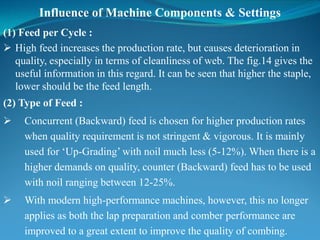
(1) Feed per Cycle :
 High feed increases the production rate, but causes deterioration in
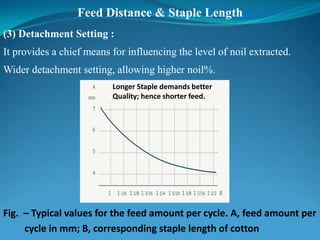
quality, especially in terms of cleanliness of web. The fig.14 gives the
useful information in this regard. It can be seen that higher the staple,
lower should be the feed length.
(2) Type of Feed :
 Concurrent (Backward) feed is chosen for higher production rates
when quality requirement is not stringent & vigorous. It is mainly
used for ‘Up-Grading’ with noil much less (5-12%). When there is a
higher demands on quality, counter (Backward) feed has to be used
with noil ranging between 12-25%.
 With modern high-performance machines, however, this no longer
applies as both the lap preparation and comber performance are
improved to a great extent to improve the quality of combing.
Feed Distance & Staple Length
(3) Detachment Setting :
It provides a chief means for influencing the level of noil extracted.
Wider detachment setting, allowing higher noil%.
Fig. – Typical values for the feed amount per cycle. A, feed amount per
cycle in mm; B, corresponding staple length of cotton
Longer Staple demands better
Quality; hence shorter feed.
Detachment Setting & Combing Segment
• The normal detachment setting ranges between 15-25 mm. As stated
earlier, widening the setting beyond what normally is used, would
only improve quality in terms of imperfection (not much in terms of
strength or evenness of yarns).
• When the settings are constant and still the noil% varies, there is
nothing wrong with machine, but the cause lies with raw material.
(4) Combing Segment :
With conventional half-lap, there are series of rows with needles. Both
the density & fineness are adapted to the raw material used.
Modern Combers are equipped with combing segment consisting of
saw-tooth wire (Unicomb).
Combing Segment & Top Comb
• However, the top comb still remains as a single row of needles, as in
conventional.
• New cylinder clothing is more strong & sturdy, needs less
maintenance and is universally applicable.
• As it is the cylinder which is called upon to perform the main work,
the influence of this new type of combing segment on quality is
considerable. A sturdy segment is also able to work effectively with
heavier lap weight, another advantage helping to increase the
production.
(5) Top Comb :
• The top comb needles are flat in cross section and have a typical
characteristic bend at their tip. There are 23-32 needles per centimeter.
Top Comb & Piecing of Fibre Fringe
• Fewer needle would permit higher production rates with lower noil
level. Obviously, more needles per cm would give more noil.
• Top Comb Depth : Lowering the top comb by about 0.5 mm results
in increase of noil by 2%. In this case, neps are preferentially
prevented from going into web. Too much penetration (depth),
however, disturbs the normal fibre movement during piecing and it
would deteriorate the quality of web.
(6) Piecing :
• Detaching roller draws out part of the fringe presented to them. The
tufts thus withdrawn lack internal coherence. The piecing operation
allows the two strip – one combed in previous cycle and the other
freshly combed to superimpose on each other partially. Thus the
coherence of the web and then the continuity of the web is maintained.
Piecing
• Piecing is, however, a distinct source of fault. The joint, where
superimposition has taken place is never a perfect join. A wave like
structure with periodic variation is the result. These variations are seen
in Uster spectrogram with a wave length of about 30-35 cm. The
spinner must try to keep this irregularity as low as possible.
• The machine designers provide eccentric (asymmetric) withdrawal of
the web from the nip of second detaching roller. The spinner, however,
has to adjust this by correctly setting the detachment timing, when the
detaching rollers would be starting their withdrawal. The fringe being
detached has its front end more blunt than its trailing (towards
nippers) end.
Piecing & Combing Preparation
• Therefore, it is possible to cancel out the unevenness of trailing end of
the fringe by suitably superimposing the fringe at the time of
detachment.
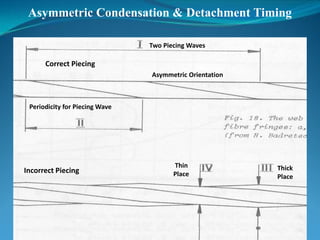
• When this setting (timing) is not correct, it will aggravate the
unevenness in the form of thick or thin place at regular interval.
• Earlier detachment timing will lead to lesser overlapping whereas, late
timing will cause excess of overlapping.
Combing Preparation :
• Two systems are currently in use – (a) Conventional Sliver
Lap/Ribbon Lap (b) Draw Frame followed by Lap doubling machine.
Sliver doubling was considered to be an advantage before the advent
of Modern Comber.
Asymmetric Condensation & Detachment Timing
Correct Piecing
Two Piecing Waves
Asymmetric Orientation
Periodicity for Piecing Wave
Incorrect Piecing
Thin
Place
Thick
Place
Degree of Combing
The percentage waste extraction during combing depends on the
Short-fiber content of the raw material, the final end use of the yarn,
and the economics with respect to the effect of material cost on yarn
cost. There are, particularly for cotton, four degrees of combing.
Scratch Combing, where up to 5% noil is removed. This gives no
great improvement in average yarn properties but has the benefit or
reducing end breakage rates in spinning and winding.
Half-combing, which involves around 9% waste, resulting in reduced
yarn irregularity and improved spinning performance
Ordinary combing, involving between 10 to 18% noil, which is
necessary for spinning yarns in the finer end of the count range.
Full combing, resulting in greater than 18% noil. This often means
double combing to obtain the highest quality yarns – 18% removed in the
first combing and 7% in the second.
Full combing, resulting in greater than 18% noil. This often means
double combing to obtain the highest quality yarns – 18% removed in the
first combing and 7% in the second
In short staple spinning, cotton fibre having stable lengths greater than
about 27 mm are commonly combed and ; those greater than 30 mm are
used for finer counts, also generally combed. Usually, 13 to 15% is
considered sufficient to meet high- quality requirements. In worsted
processing, the ratio of top and noil is called the tear and is often used as
a measure of the degree of combing. With 60s quality wool, the noil
extract can be around 4 to 8%. When tops are dyed, they are either gilled
or recombed, followed by two additional gilling.
Fractionating Efficiency
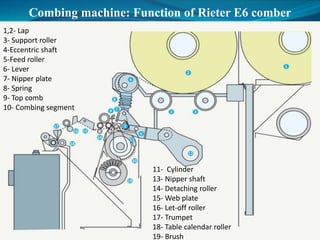
Combing machine: Function of Rieter E6 comber
1,2- Lap
3- Support roller
4-Eccentric shaft
5-Feed roller
6- Lever
7- Nipper plate
8- Spring
9- Top comb
10- Combing segment
11- Cylinder
13- Nipper shaft
14- Detaching roller
15- Web plate
16- Let-off roller
17- Trumpet
18- Table calendar roller
19- Brush
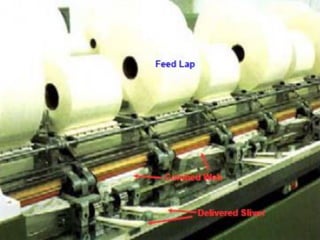
Feed: Feed of the lap sheet
Two fluted rollers (Fig. 37, 3), driven at constant speed, unroll the web
from lap (2). An eccentric shaft (4) is fitted between the rollers and feed
cylinder (5). The web is fed over this shaft, which is rotated
intermittently in time with the nipper cycle. Each shaft rotation
represents less than a full revolution, first in a forward direction and then
in backward feed. This back-and-forth rotation ensures even tension in
the web and hence prevents false drafts, which could otherwise arise as a
result of fluttering of the web as the distance between the stationary
rollers and the feed rollers increases and decreases with the backward
and forward movement of the nippers. The eccentricity of the shaft
compensates for these changes in distance.
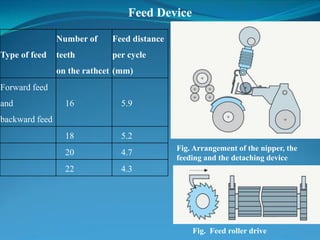
Feed Device
Type of feed
Number of
teeth
on the rathcet
Feed distance
per cycle
(mm)
Forward feed
and
backward feed
16 5.9
18 5.2
20 4.7
22 4.3
Fig. Arrangement of the nipper, the
feeding and the detaching device
Fig. Feed roller drive
Feed : Feed device
• There is no machine drive of the feed rollers as such; they are driven
indirectly by the opening and closing of the nipper plates. Forward
shift of the web by the feed roller into the opened nippers can be
performed:
• while the nippers move forward (described above as forward feed);
or
• when the nippers swing back (described as backward feed).
Feed: Feed Device
Some types of comber can be operated in only one feed mode (forward
feed), others can be operated selectively in either mode. Selection of the
required mode then involves an adjustment. On the Rieter comber this
can be carried out quickly and easily by replacement of the two drive
change gears on opposite sides of the feed roller (Fig. 39). Rotation of
the feed rollers to feed the lap sheet forward by 4.3 to 6.7 mm is derived
from the relative movements of the upper and lower nippers. For
example, in the case of forward feed, when the upper nipper plate is
opened it rotates the roller via the ratchet (by one ratchet tooth) by
withdrawing the pawl secured to the upper nipper plate. In the case of
backward feed, i.e. rotation of the cylinder as the nippers close, a pair of
gear wheels and an internally toothed ratchet are needed. The change
wheels can be replaced to adjust the type of feed and the feed amount per
cycle.
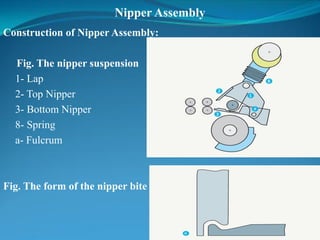
Nipper Assembly
Construction of Nipper Assembly:
Fig. The nipper suspension
1- Lap
2- Top Nipper
3- Bottom Nipper
8- Spring
a- Fulcrum
Fig. The form of the nipper bite
Nipper Assembly
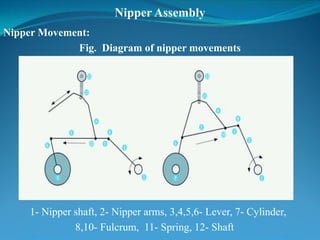
Nipper Movement:
Fig. Diagram of nipper movements
1- Nipper shaft, 2- Nipper arms, 3,4,5,6- Lever, 7- Cylinder,
8,10- Fulcrum, 11- Spring, 12- Shaft

Yarn Manufacturing Process : Comber Part I

  • 1.
    Subject Code :BTTEX05002 Semester : Vth Textile Technology Department CTF, MPSTME, SVKMs, NMIMS, Shirpur By: Prof. P. P. Kolte
  • 3.
    Lecture 1 Objectives:  Tostudy combing preparatory.  To study necessity of combing preparatory.  To study various objectives of combing preparatory.
  • 4.
    Combing Preparatory Need ofcombing preparatory: – Fiber straightening (drafting) required – Leading fiber hooks preferred – To reversals of fiber flow between carding and combing – Flat, instead of round, feeding material is required Traditionally: sliver lap machine + ribbon lap machine Now: draw frame + sliver lap machine
  • 5.
    Objectives of combingpreparatory: – To make flat, instead of round, output sliver material. – To straighten out the Fiber. – To reversals of fiber flow between carding and combing. – To feed max. leading fiber hooks in feeding sliver.
  • 6.
    Fig. Hooked fiber Fig.Hook Formation Fig.Hook removal
  • 7.
    Different types ofpassages used for combing preparatory • the earlier web or lap doubling process (conventional method) employing a sliver lap machine followed by a ribbon lap machine; and today mostly. • the sliver doubling process, in which a normal draw frame (without leveling) provides the first passage and a sliver doubling machine follows as the second passage. Fig. – Overview of the two lap forming processes in use
  • 8.
    Web doubling andsliver doubling processes These are the methods of comber lap preparation Commercially two systems of preparing the comber lap are used: (1) Lap/web Doubling System (2) Sliver Doubling System (1) Lap Doubling System In the lap doubling comber preparation system the carded sliver is passed through a sliver lap machine followed by a ribbon lap machine. Lap doubling method became more apparent for longer-staple material (i.e.. For higher waste elimination rates).
  • 9.
    (2) Sliver DoublingSystem In the sliver doubling process the carded sliver is given first passage through a normal draw frame and then series of drawn slivers are given second passage through a sliver doubling machine. It was considered that the sliver doubling method tended, to be advantageous for processing shorter staple material (i.e.. with, low- to-medium generation of noil). Now a days, with modern preparation machines it is difficult to detect any difference between the two techniques, so that a trend toward sliver doubling is become established.
  • 10.
    Sliver Lap Machine Fig.Passage of Cotton through m/c - Description of function - Drafting system - 4 over 4 drafting - Top roller dia. 39mm, bottom roller dia. 32mm. - pressure in d/f system 1 to 1600 newtons/nip - Lap winding assembly -Calender roller pressure upto 1600N
  • 11.
    Sliver Lap Machine Fig.Top view of a sliver lap m/c. Fig. Rieter E 2/4A sliver lap m/c
  • 12.
    Technical Data: Raw material:Cotton upto 1 “ staple Feed stock: Upto 80 ktex per drafting arragenment Doubling: 24 Draft of the 1.31 to 3.o3 drafting arrangement Tube length: 250 mm Lap weight: up to 25 Kg Delivery speed: 80 - 100 mpm Theoretical upto 480 Kg/hr Production per machine
  • 13.
    Ribbon lap m/c TechnicalData: Raw material: Cotton upto 1 “ staple Feed stock: Upto 80 ktex per drafting arrangement Doubling: 6 Draft of the 3.48 to 8.o4 drafting arrangement Tube length: 300 mm Lap weight: up to 20 Kg Fig. Passage of material on ribbon lap m/c
  • 14.
    Delivery speed: 85- 100 mpm Theoretical upto 480 Kg/hr Production per machine Fig. Passage of material on ribbon lap m/c
  • 15.
    Fig. Elements ofa ribbon lap machine
  • 16.
    The ribbon lapmachine – cross-section
  • 17.
    Lap Former /Sliver Doubling m/c Technical Data: Raw material: Cotton upto 1 “ staple Feed stock: Upto 70 ktex per drafting arragenment Doubling: up to 28 Draft of the 1.36 - 2.2 drafting arrangement Lap width: 300 mm Lap weight: up to 25 Kg Delivery speed : 70 and 140 mpm Theoretical production: up to 350kg/h
  • 18.
    Lap Former /Sliver Doubling m/c 1 - Feed tables 2 - Drafting system 3 - Drive for drafting system 4 - Machine frame 5 - Winding head Fig. The drafting arrangement
  • 19.
    Lap Former /Sliver Doubling m/c
  • 20.
    Super Lap Former Fig.Passage of material through super lap former
  • 21.
    - 4/5 draftingsystem - drafting capacity 10, generally working draft 8. - Three sliver creel with stand, each has capacity 20 and are double sided. Hence, 60 doublings possible. - Maximum total draft of 3.75 with 60 doubling. - Lap weight 1200 grains/yard [85 gms/m] - Production rate 250-290 Kg/hr Fig. Sliver feeding at super lap former
  • 22.
    Preparation of stockfor combing [System of lap preparation configuration of fibre feed and its effect on the quality of product] Fig. – Clamped slivers between the nipper plates Fig. – Fibers projecting from the nippers
  • 23.
    Fig. – Thetwo preparation methods: conventional method (a, lap doubling) and new method (b, sliver doubling)
  • 24.
  • 25.
    Question Answer Session Question: What are the different objectives of the carding?  What are the necessities of carding?  Enlist the different zones in carding.
  • 26.
    Question Bank 1. Discussin detail the passage of material through draw-frame machine. 2. Explain in detail operating principles of material through sliver lap machine. 3. Discuss in detail the passage of material through ribbon lap machine. 4. Explain in detail operating principles of material through super lap former machine. 5. Compare web doubling and sliver doubling processes. 6. Explain in brief systems of lap preparation configuration of fibre feed. 7. In detail effect of systems of lap preparation configuration of fibre feed on the quality of product. 8. Discuss the effect of fibre feed on quality of product in combing preparatory. 9. Explain with neat sketch construction and working of lap former m/c. 10. What is the object and need of combing preparatory? 11. Explain the operating principle of sliver lap m/c.
  • 28.
    Objectives of CombingProcess / Comber For improving yarn characteristics:  To eliminate precisely pre-determined quantity of short fibers;  To eliminate the remaining impurities;  To eliminate a large proportion (not all) of the neps in the fiber material;  To form a sliver having maximum possible evenness;  To produce more straight and parallel fibers. Improving yarn characteristics following fabric characteristics improves:  Smoothness of the fabric;  Visual appearance of the fabric; and  Handle of the fabric
  • 29.
    Task of Comber Thecomber is used in the production of medium, medium-fine and fine yarns. Within overall spinning process, the combing operation serves to improve the raw material. To achieve an improvement in quality, the comber must perform the following operations:  elimination of a precisely pre-determined quantity of short fibers;  elimination of the remaining impurities;  elimination of a large proportion (not all can be removed) of the neps in the fiber material;  formation of a sliver having the optimal possible quality parameters.
  • 31.
    Types of Application Theamount of material combed out varies within the range between 8% and 25% of the infeed stock. 1] For Long Staple combing mills: Processing first-class, expensive cotton of high strength, containing a low proportion of short fibers and little dirt. The product is a fine to very fine yarn of top quality. The demands placed on know-how and skill of operating personnel is correspondingly high, as they are on the design and maintenance of the machines. Yarn production is low, while generation of noil is high.
  • 32.
    2] For Medium-staplecombing mills: Medium cotton qualities with a wide spread of quality parameters are spun into medium (to fine) yarns of good quality at economic production costs. The process is problematic in that it has to achieve a high strand of quality and at the same time give high production at low cost. The maximum demands placed on medium staple combing can only be fulfilled by optimally trained personnel. 3] Short to Medium staple combing mills: Raw material used have the same as that for production of carded yarns. In this combination with low level noil level (6 – 14%). This process is the most widely used in practice; it is technologically undemanding and can be operated without problems when good m/c are available.
  • 33.
    Type of Comber Quitea number of different types of comber are available, including:  rectilinear combers (with stationary or oscillating nippers, for cotton);  circular combers (English worsted process);  rotary combers (production of spun yarns); and  hackling machines (bast fibers). Short-staple spinning mills use only the rectilinear comber with swinging nippers and stationary detaching rollers, as originally conceived in 1845 by J. Heilmann in Alsace and further developed in 1902 by the Englishman Nasmith and in 1948 by the Whitin company. Machine layouts used in practice are single-sided machines with eight heads. The double-sided machines of the former Platt Saco Lowell company with six-plus-six heads are no longer manufactured. Improvements in machine design since 1948 have enabled a five-fold increase in production.
  • 34.
    Sequence of Operationin Rectilinear Comber Fig. Cylinder Comb
  • 36.
    (a) Feed rollers(S) move lap sheet (W) forward by a small amount (4.3 - 6.7 mm), while nippers (Zo/Zu) are held open (feed).
  • 37.
    (b) Upper nipperplate Zo is lowered onto cushion plate (Zu) so that the fibers are clamped between them (nipping).
  • 38.
    (c) Combing segment(K), mounted on rotating cylinder (Z), sweeps saw-teeth through fiber fringe (B) and carries away anything not held by the nippers (rotary combing).
  • 39.
    (d) The nippersopen again and move toward detaching rollers (A) (nippers forward).
  • 40.
    (e) Meanwhile detachingrollers (A) have returned part of the previously drawn-off stock (web V) by means of a (partial) reverse rotation, so that the web protrudes from the back of the detaching device (web return).
  • 41.
    (f) In thecourse of the forward movement of the nippers the projecting fiber fringe (B) is placed on the returned web (V) (piecing).
  • 42.
    (g) The detachingrollers begin to rotate in the forward direction again and draw the clamped fibers out of web (W) held fast by feed rollers (S) (inside the nippers) (detaching).
  • 43.
    (h) Before thestart of the detaching operation, top comb (F) has thrust its single row of teeth into the fiber fringe. As the fibers are pulled through the teeth of the top comb during detaching, the trailing part of the fringe is combed, thus making up for the inability of the circular combs to reach this part of the fringe (passive combing by the top comb).
  • 44.
    (i) As thenipper assembly is retracted, the nippers open for the next feeding step. The top comb is withdrawn. A new combing cycle begins.
  • 45.
    (k) Contrary tothe movements of the other parts, the combing cylinder rotates continuously. During this rotation and at a certain instant the combing segment is brought into the vicinity of a rapidly revolving brush mounted below the combing cylinder. This brush removes the imperfections, etc., from the combing segment, and ejects them into an extractor that carries the noil away to a collecting filter system.
  • 46.
    Technology of combing Parametersinfluencing the combing operation Raw material Material preparation Factors associated with the machine Machine settings Ambient conditions
  • 47.
    Parameter Influencing CombingOperation Raw material: Fiber type; Fiber fineness (Micronaire) Fiber length Uniformity of fiber length (CV); Fiber stiffness Moisture content; Foreign material associated with the fibers
  • 48.
    Material preparation:  Parallelizationof the fibers in the sheet (batt);  batt / lap thickness  batt / lap evenness  orientation of the hooks Factors associated with the machine:  condition of the machine;  condition of the combs;  speeds;  operational performance of the combs;  type of sliver forming element (diagonal shift of the piecings);  accuracy of the settings;  drafting arrangement;  movement of the elements;  weight of the elements;  type of withdrawal of the combed web (either straight forward or oblique).
  • 49.
    Machine settings: feed distance; typeof feed; detachment setting; point density of the combs; circular comb clothing (angles of teeth, density of teeth, etc); depth of penetration of the top comb; piecing; draft; drafting arrangement settings. Ambient conditions: room temperature; relative humidity in the room.
  • 50.
    Influences of thefeed stock on combing 1. Parallalisation of the fibres in the batt / lap 2. Batt / lap Thickness[Weight] 3. Eveneness of the batt / lap sheet 4. The disposition of the hooks
  • 51.
    Parallalisation of thefibres in the batt / lap Fig. – Dependence of noil elimination on the degree of parallelization of the fibers in the feedstock. (Degree of parallelization corresponding to the draft). A: noil percentage. B: draft between the card and the comber. The reduction in Noil level, with increase in Lap parallelization is the same for both High & low noil extraction.
  • 52.
    Fig. – Dependenceof yarn strength and cleanliness on the degree of parallelization of the fibers in the feed lap. (Degree of parallelization corresponding to the draft). A, improvement or deterioration in %; B, draft between the card and the comber based on classical system. With higher draft, Lap Splitting & Hairiness; so Yarn Strength & Cleanliness not improved much. Self-Cleaning Effect Drastically reduced
  • 53.
     Lack oflongitudinal orientation, i.e. noticeable fiber disorder, leads to elimination of longer fibers, and hence overloading the cylindrical comb (Thick sheet).  At same machine settings, noil quantity decreases linearly with increasing parallelization of the fibers without any reduction in yarn quality. (see figure)  It is not always follow that more noil is automatically associated with better yarn quality.  The correct goal is always a predetermined waste elimination level.  The self cleaning effect of the sheet, will be greater the more random is the disposition of the fibers making up the sheet.  If the fibers have a very high degree of parallelization, the retaining power of the sheet can be so strongly reduced that it is no longer also able to hold back the neps as it usually does.
  • 54.
     Some ofthe sheet neps also pass through the top comb. Neppiness of the web is increased.  If the degree of order of fibers is too high, the sheet does not hold together well.  High degree of parallelization always leads to marked hairiness of the lap.  The degree of parallelization depends on the total draft between the card and the comber (see figure )
  • 55.
    Lap / BattThickness[Weight] Fig. – Batt weight in relation to staple length
  • 56.
    Fig. – Lap/Battweight in relation to fiber mass (Micronaire value and number of fibers in the cross section are decisive)
  • 57.
     A thicksheet always exerts a greater retaining power than a thin one.  Also, a thick sheet always applies a strong load on the comb and this can lead to uncontrolled combing.  In case of very thick sheet, the fibers farthest from the cylinder comb may escape the combing operation, because the combs are no longer able to pass through the whole layer.  Optimal sheet fineness now normally lies between 55 and 75 ktex. (55-75 g/m).
  • 58.
    Lap Thickness (Weight) Self cleaning effect has considerable influencing combing operation. This effect arising from retaining power of fibres to hold back the impurities. Along with the fibre disorder (less parallelization), it also depends upon thickness of the sheet. Thus a thicker sheet exhibits more retaining power.  So also, the bite of the nippers is more effective with higher thickness.
  • 60.
    Eveneness of thebatt sheet  Evening of the lap is of considerable significance “better clamping”.  High degree of evenness is due to higher doubling.  This explains the effect of doubling on the ribbon lab machine. Comber Lap Lap Surface from Sliver Doubling Lap Surface from Sliver-Web Doubling
  • 61.
    The disposition ofthe hooks  Fibers should be presented to the comber so that leading hooks predominate in the feedstock.  If the sheet is fed in the wrong direction, the number of neps rises markedly.  Quantity and form of fiber hooks depend mainly upon the stiffness of the fibers; this rises to the second or third power with increasing the coarseness of the fibers.  Fine and long fibers, will always exhibit more and longer hooks (horseshoe shape) than short fibers, coarse fibers (hokey stick form).  Accordingly the role of fiber hooks in spinning process becomes more significant as fibers become finer.
  • 62.
    Influence of CombingOperation on quality / Degree of Combing  The range of improvement in quality through combing is wide.  Semi Combing – 5-12% noil extraction, referred to as “Up-Grading”.  Normal Combing – 12-18% noil extraction  highly combed, 18 - 22%;  Super Combing – Above 22% noil, rarely followed & only for super fine yarns.
  • 63.
    Influence of CombingOperation on quality  With 10% noil extracted, the yarn strength is about 10% higher over carded yarns. With further rise in noil does not bring any appreciable rise in the strength.  Almost similar pattern is shown by Yarn Evenness.  As regards imperfections, however, a more distinct and clear improvement is shown at higher noil levels. Fig. Before Combing Fig. Combed Sliver Fig. Comber Noil
  • 64.
     Thus, exceptfor imperfections, the increase beyond about 10% noil does not bring corresponding improvement in strength & evenness.  As regards the performance at ring frame, it is found that the end breakage rate is reduced at higher noil. However, it is not continuous with increase in noil. On the contrary, it may increase again beyond 20% noil Fig. – Dependence of various quality parameters on noil elimination; A- improvement of yarn quality in %; B- noil elimination in %; a, yarn strength; b, yarn evenness; c, yarn imperfections;
  • 65.
    Noil Extraction Theory The noil theory developed by Charles Gégauff.  The noil theory is the effects of detachment setting and feed distance moved per cycle on the elimination of noil.  It show the correlation between feed amount and noil percentage with either forward (concurrent) or backward (counter) feeding.  However, calculations made on the basis of the theory are often intractable and should therefore not be attempted.  Forward feed implies that feeding of the sheet into the nippers occurs while the nippers are moved toward the detaching rollers.  Backward feed implies that feeding of the sheet occurs during return of the nippers. The triangular areas represent stylized staple diagrams.
  • 66.
    Z - nippers; A- detaching rollers; B - fiber fringe protruding from the nippers; K - combing segment; E - detachment setting, i.e. distance between the clamping line of the nippers and the nip line of the detaching rollers; S - feed amount (mm) moved per combing cycle; M - longest fiber in the staple (mm); a - fiber ≥ E; b - fiber = E - S; c - fiber < E - S; p - noil percentage.
  • 67.
    Noil elimination withbackward feed  During detachment, the nippers are located at their closest position relative to detaching rollers.  The detaching roller draws-off all the fibres extended to its nip line i.e. all the fibres longer than (detachment setting + half the diameter of detaching roller = ‘E’).  With reference to the diagram shown on next page (fig.), this length is entered in Bear Sorter diagram as a line ‘m n’  All the fibres to the left of mn pass into sliver.
  • 68.
    As the nippersRetract towards Cylinder comb Feed roller feeds the material through a Distance – ‘s’ The fringe as presented to the Cylinder needles thus becomes Equal to E + S Thus, all fibres shorter than (E+S) are then carried away by Cylinder Fig. – Position of the nippers relative to the detaching rollers at the closest approach (detachment setting E) during backward feed Fig. 14 – Combing out with backward feed (the staple diagram is shown)
  • 69.
     The fibresless than length (E+S) will all go into noil as these fibres are not gripped by the nippers. This length also has been entered in the diagram as ‘q r’.  In the region –q m n r There is a chance that Fibres will go either into noil or remain in the fringe. A division is made, representing ‘p o’ as a  Demarcation (= E + s/2)  Thus trapezium Aopc represents fibres in slivers & triangle Bpo represents noil. Fig. – Combing out the fiber fringe
  • 70.
    Derivation of Gegauff’sexpression: • The ‘po’ is dividing line representing a length (E+s/2). Further, in similar triangles, the ratio of the areas are proportional to squares of the sides, and as the areas represents the noil percentage based on the ratio of weight of noil to that of feed stock, following can be stated : ∆opB (op)2 • Noil (p%) = ------ x 100 = ------- x 100 ∆ABC (AC)2 = [ E + s/2]2 / M2 x 100
  • 71.
    Noil in Concurrent(Forward) Feed Noil Elimination with Concurrent (Forward) Feed :  In this case, after the detaching is over, all the fibres longer than ‘E’ are carried away to form sliver.  There is no feeding during return stroke of the nippers. Thus, the length of the fringe presented to cylinder needles is ‘E’.  All the fibres shorter than ‘E’ would go into noil. This is represented in (fig. ) by the area ‘qBr’.  The feeding occurs during subsequent forward movement of nippers during which the length of the fringe is increased by a distance ‘s’ – the feed length.  Detaching rollers take all the fibres longer than ‘E’.
  • 72.
    Concurrent (Forward) Feed Fig.– Position of the nippers relative to the detaching rollers at the closest approach during forward feed Fig. – Combing out with forward feed (staple diagram). (fibre ‘a’). However, the fibre ‘b’ of length (E-s) has advanced by distance ‘s’ & hence also reaches DR nip
  • 73.
    Concurrent (Forward) Feed Fibre ‘C’, still shorter than distance (E-S), thus will not be able to reach the detaching roller nip.  With earlier logic the diagram (fig. ), gives three lines representing – ‘E’, ‘E-S/2’ and ‘E-S’ lines.  Thus, percentage of noil will be –  Noil% = [ ∆(opB) / ∆(ABC)] x 100 = [ (op)2 / AC2] x 100 = [E – (S/2)2 / M2] x 100 (Forward feed) and [E+ (S/2)2 / M2] x 100 (Backward feed)  From the two derived expressions, it follows that in Counter (Backward) Feed, the noil level is increased as the feed distance is raised. Whereas, in the Concurrent (Forward) Feed, the noil is reduced.
  • 74.
    Quality of Combingin Concurrent & Counter Feed  It is seen from earlier discussion that in Concurrent (Forward) feed, all the fibres longer than (E-S) instead of (E), will be allowed to pass into sliver. Thus, the quality of the combing operation also is different.  Consider a fibre with its trailing end, just lying in the nipper bite. During the forward motion, with concurrent (forward) feed, this fibre will be pushed ahead, further to D.R., and possibly would go into sliver web. In counter (backward) feed, however, the fibre still will maintain its position as there is no feeding during detachment. During backward movement, the feeding takes place and the fibre will be pushed ahead and would be removed by cylinder.  It may be noted that this fibre had received its one extra combing in earlier combing cycle.  In counter feed thus, a fibre gets comparatively more raking (combing) by cylinder needles. This helps in more elimination of impurities & neps.
  • 75.
    Influence of MachineComponents & Settings (1) Feed per Cycle :  High feed increases the production rate, but causes deterioration in quality, especially in terms of cleanliness of web. The fig.14 gives the useful information in this regard. It can be seen that higher the staple, lower should be the feed length. (2) Type of Feed :  Concurrent (Backward) feed is chosen for higher production rates when quality requirement is not stringent & vigorous. It is mainly used for ‘Up-Grading’ with noil much less (5-12%). When there is a higher demands on quality, counter (Backward) feed has to be used with noil ranging between 12-25%.  With modern high-performance machines, however, this no longer applies as both the lap preparation and comber performance are improved to a great extent to improve the quality of combing.
  • 76.
    Feed Distance &Staple Length (3) Detachment Setting : It provides a chief means for influencing the level of noil extracted. Wider detachment setting, allowing higher noil%. Fig. – Typical values for the feed amount per cycle. A, feed amount per cycle in mm; B, corresponding staple length of cotton Longer Staple demands better Quality; hence shorter feed.
  • 77.
    Detachment Setting &Combing Segment • The normal detachment setting ranges between 15-25 mm. As stated earlier, widening the setting beyond what normally is used, would only improve quality in terms of imperfection (not much in terms of strength or evenness of yarns). • When the settings are constant and still the noil% varies, there is nothing wrong with machine, but the cause lies with raw material. (4) Combing Segment : With conventional half-lap, there are series of rows with needles. Both the density & fineness are adapted to the raw material used. Modern Combers are equipped with combing segment consisting of saw-tooth wire (Unicomb).
  • 78.
    Combing Segment &Top Comb • However, the top comb still remains as a single row of needles, as in conventional. • New cylinder clothing is more strong & sturdy, needs less maintenance and is universally applicable. • As it is the cylinder which is called upon to perform the main work, the influence of this new type of combing segment on quality is considerable. A sturdy segment is also able to work effectively with heavier lap weight, another advantage helping to increase the production. (5) Top Comb : • The top comb needles are flat in cross section and have a typical characteristic bend at their tip. There are 23-32 needles per centimeter.
  • 79.
    Top Comb &Piecing of Fibre Fringe • Fewer needle would permit higher production rates with lower noil level. Obviously, more needles per cm would give more noil. • Top Comb Depth : Lowering the top comb by about 0.5 mm results in increase of noil by 2%. In this case, neps are preferentially prevented from going into web. Too much penetration (depth), however, disturbs the normal fibre movement during piecing and it would deteriorate the quality of web. (6) Piecing : • Detaching roller draws out part of the fringe presented to them. The tufts thus withdrawn lack internal coherence. The piecing operation allows the two strip – one combed in previous cycle and the other freshly combed to superimpose on each other partially. Thus the coherence of the web and then the continuity of the web is maintained.
  • 80.
    Piecing • Piecing is,however, a distinct source of fault. The joint, where superimposition has taken place is never a perfect join. A wave like structure with periodic variation is the result. These variations are seen in Uster spectrogram with a wave length of about 30-35 cm. The spinner must try to keep this irregularity as low as possible. • The machine designers provide eccentric (asymmetric) withdrawal of the web from the nip of second detaching roller. The spinner, however, has to adjust this by correctly setting the detachment timing, when the detaching rollers would be starting their withdrawal. The fringe being detached has its front end more blunt than its trailing (towards nippers) end.
  • 81.
    Piecing & CombingPreparation • Therefore, it is possible to cancel out the unevenness of trailing end of the fringe by suitably superimposing the fringe at the time of detachment. • When this setting (timing) is not correct, it will aggravate the unevenness in the form of thick or thin place at regular interval. • Earlier detachment timing will lead to lesser overlapping whereas, late timing will cause excess of overlapping. Combing Preparation : • Two systems are currently in use – (a) Conventional Sliver Lap/Ribbon Lap (b) Draw Frame followed by Lap doubling machine. Sliver doubling was considered to be an advantage before the advent of Modern Comber.
  • 82.
    Asymmetric Condensation &Detachment Timing Correct Piecing Two Piecing Waves Asymmetric Orientation Periodicity for Piecing Wave Incorrect Piecing Thin Place Thick Place
  • 83.
    Degree of Combing Thepercentage waste extraction during combing depends on the Short-fiber content of the raw material, the final end use of the yarn, and the economics with respect to the effect of material cost on yarn cost. There are, particularly for cotton, four degrees of combing. Scratch Combing, where up to 5% noil is removed. This gives no great improvement in average yarn properties but has the benefit or reducing end breakage rates in spinning and winding. Half-combing, which involves around 9% waste, resulting in reduced yarn irregularity and improved spinning performance Ordinary combing, involving between 10 to 18% noil, which is necessary for spinning yarns in the finer end of the count range. Full combing, resulting in greater than 18% noil. This often means double combing to obtain the highest quality yarns – 18% removed in the first combing and 7% in the second.
  • 84.
    Full combing, resultingin greater than 18% noil. This often means double combing to obtain the highest quality yarns – 18% removed in the first combing and 7% in the second In short staple spinning, cotton fibre having stable lengths greater than about 27 mm are commonly combed and ; those greater than 30 mm are used for finer counts, also generally combed. Usually, 13 to 15% is considered sufficient to meet high- quality requirements. In worsted processing, the ratio of top and noil is called the tear and is often used as a measure of the degree of combing. With 60s quality wool, the noil extract can be around 4 to 8%. When tops are dyed, they are either gilled or recombed, followed by two additional gilling.
  • 85.
  • 87.
    Combing machine: Functionof Rieter E6 comber 1,2- Lap 3- Support roller 4-Eccentric shaft 5-Feed roller 6- Lever 7- Nipper plate 8- Spring 9- Top comb 10- Combing segment 11- Cylinder 13- Nipper shaft 14- Detaching roller 15- Web plate 16- Let-off roller 17- Trumpet 18- Table calendar roller 19- Brush
  • 88.
    Feed: Feed ofthe lap sheet Two fluted rollers (Fig. 37, 3), driven at constant speed, unroll the web from lap (2). An eccentric shaft (4) is fitted between the rollers and feed cylinder (5). The web is fed over this shaft, which is rotated intermittently in time with the nipper cycle. Each shaft rotation represents less than a full revolution, first in a forward direction and then in backward feed. This back-and-forth rotation ensures even tension in the web and hence prevents false drafts, which could otherwise arise as a result of fluttering of the web as the distance between the stationary rollers and the feed rollers increases and decreases with the backward and forward movement of the nippers. The eccentricity of the shaft compensates for these changes in distance.
  • 89.
    Feed Device Type offeed Number of teeth on the rathcet Feed distance per cycle (mm) Forward feed and backward feed 16 5.9 18 5.2 20 4.7 22 4.3 Fig. Arrangement of the nipper, the feeding and the detaching device Fig. Feed roller drive
  • 90.
    Feed : Feeddevice • There is no machine drive of the feed rollers as such; they are driven indirectly by the opening and closing of the nipper plates. Forward shift of the web by the feed roller into the opened nippers can be performed: • while the nippers move forward (described above as forward feed); or • when the nippers swing back (described as backward feed).
  • 91.
    Feed: Feed Device Sometypes of comber can be operated in only one feed mode (forward feed), others can be operated selectively in either mode. Selection of the required mode then involves an adjustment. On the Rieter comber this can be carried out quickly and easily by replacement of the two drive change gears on opposite sides of the feed roller (Fig. 39). Rotation of the feed rollers to feed the lap sheet forward by 4.3 to 6.7 mm is derived from the relative movements of the upper and lower nippers. For example, in the case of forward feed, when the upper nipper plate is opened it rotates the roller via the ratchet (by one ratchet tooth) by withdrawing the pawl secured to the upper nipper plate. In the case of backward feed, i.e. rotation of the cylinder as the nippers close, a pair of gear wheels and an internally toothed ratchet are needed. The change wheels can be replaced to adjust the type of feed and the feed amount per cycle.
  • 92.
    Nipper Assembly Construction ofNipper Assembly: Fig. The nipper suspension 1- Lap 2- Top Nipper 3- Bottom Nipper 8- Spring a- Fulcrum Fig. The form of the nipper bite
  • 93.
    Nipper Assembly Nipper Movement: Fig.Diagram of nipper movements 1- Nipper shaft, 2- Nipper arms, 3,4,5,6- Lever, 7- Cylinder, 8,10- Fulcrum, 11- Spring, 12- Shaft