Public Goods
Introduction to Economics
Kanhaiya kumawat
What do we do today?
• Lect. 11: what happens when markets cannot
provide a price for goods?
• Lect. 11: what’s the difference between
private goods and public goods?
• Lect. 11: how can we come avoid
opportunistic behaviour (free rider)?
3
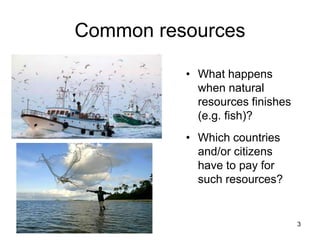
Common resources
• What happens
when natural
resources finishes
(e.g. fish)?
• Which countries
and/or citizens
have to pay for
such resources?
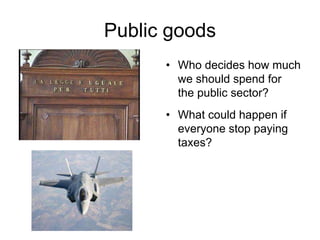
Public goods
• Who decides how much
we should spend for
the public sector?
• What could happen if
everyone stop paying
taxes?
In our economic system (private capitalism) most
goods are allocated though the market
mechanism.
For these goods, the price is the reference point
for consumers (how much to buy) and producers
(how much to sell).
The allocative function of prices
However, there are also free goods (nice walk in
Parco Ducale).
For free goods, markets are not good devices to
design the allocation of the resources.
The price does not reflect the consumers’ willingness
to pay.
Indeed, the price cannot equalize supply and
demand.
Not everything has a price…
In this case:
Public intervention
can solve market failure & increase economic
welfare.
Not everything has a price…
Market efficiency and good typology
The efficiency of markets depends on the type of
goods.
The various goods available in our economy differ
along two dimensions
Excludability
and
Rivalry
Excludability
An individual can be prevented from using a good
(e.g. laws usually recognize the private property of
a good)
Typologies of economic goods
Rivalry
The consumption of a good by an individual
prevents the simultaneous consumption of the
same good by other individuals
Typologies of economic goods
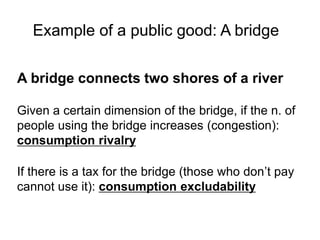
A bridge connects two shores of a river
Given a certain dimension of the bridge, if the n. of
people using the bridge increases (congestion):
consumption rivalry
If there is a tax for the bridge (those who don’t pay
cannot use it): consumption excludability
Example of a public good: A bridge
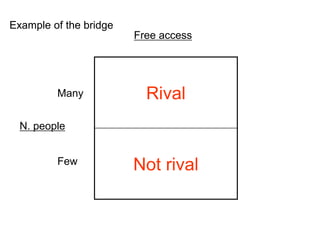
Rival
Not rival
N. people
Many
Few
Free access
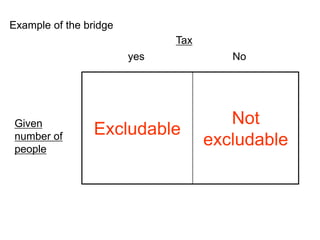
Example of the bridge
Excludable
Not
excludable
Tax
yes No
Given
number of
people
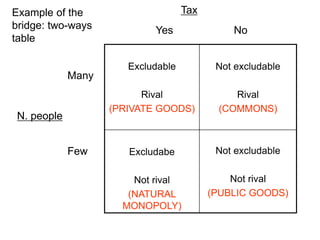
Example of the bridge
Excludable
Rival
(PRIVATE GOODS)
Not excludable
Rival
(COMMONS)
Excludabe
Not rival
(NATURAL
MONOPOLY)
Not excludable
Not rival
(PUBLIC GOODS)
Tax
Yes No
N. people
Many
Few
Example of the
bridge: two-ways
table
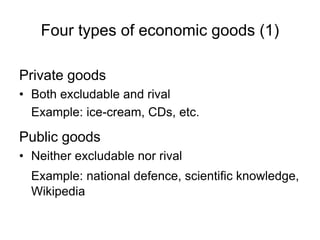
Four types of economic goods (1)
Private goods
• Both excludable and rival
Example: ice-cream, CDs, etc.
Public goods
• Neither excludable nor rival
Example: national defence, scientific knowledge,
Wikipedia
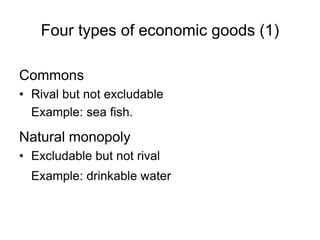
Four types of economic goods (1)
Commons
• Rival but not excludable
Example: sea fish.
Natural monopoly
• Excludable but not rival
Example: drinkable water
Public goods and externalities
Non-excludable goods  all can benefit without
paying the price, p = 0
Access to the good cannot be limited; private value =
0, social value > 0
But: production costs > 0 (scarce resources)
Who is it going to produce the good, if not paid?
Therefore: positive externalities of a public good
(autonomously, market produces too few).
The problem of free riding
A free rider is a person who can enjoy
the benefit of a good without paying the
price
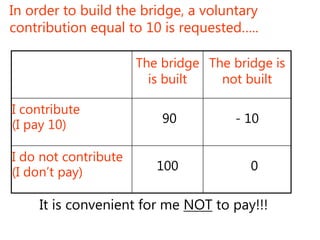
The bridge
is built
The bridge is
not built
I contribute
(I pay 10) 90 - 10
I do not contribute
(I don’t pay) 100 0
In order to build the bridge, a voluntary
contribution equal to 10 is requested…..
It is convenient for me NOT to pay!!!
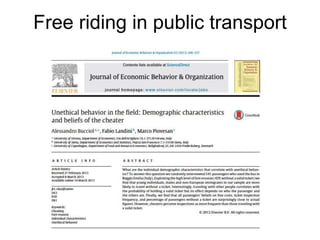
Free riding in public transport
The problem of free riding
Since public goods are not excludable, each
individual can refuse to pay the good, hoping that
other people will pay in his/her place.
If everybody reasons the same, the good is not
produced.
IMPORTANT: the presence of free riding makes it
impossible to rely on the market to supply public
goods.
Solution of the free riding problem
If the benefits > costs (social value > 0), public
authorities can produce the good by relying on taxes.
Example: fireworks by Moena’s Municipality
– 500 inhabitants; value for each inhabitant =10 €;
cost of fireworks = 1000 €.
– Fireworks tax for each inhabitant = 2€, it covers
the costs.
– Consumer surplus = 8€ (= 10€ - 2€).
The need for a State to produces public goods,
whose cost is financed via taxes, represents
the main economic justification for the
existence of taxation (and thus for the fight
against tax evasion): that is the “minimum
State”.
Common resources
Common resources are not excludable
They are freely available for anybody to exploit
But they are rival: the consumption of the good by
one individual reduces the possibility for other
individual to consume
Examples of common resources
• Air and clean water
• Congested streets
• Fishes, whale and other wild species
The tragedy of the commons
When an individual, by using a resource,
diminishes the availability of the resource for
others we encounter the tragedy of the
commons.
Common resources tend to be over-exploited
This generates a negative externality.
The public administration can:
• Impose a tax on usage;
• Regulate the use of the resource;
• Transform the common resource in a private
good (by defining and enforcing individual
property rights on the resource).
The tragedy of the commons
The importance of property rights
When the absence of property rights is the cause of
market failures, public intervention can potentially
solve the problem in 3 ways
1) By defining property rights, which enable the
market to operate efficiently;
2) By regulating individual behaviour;
3) By producing a good that the market does not
supply.
Economic goods differ in terms of excludability and
rivalry.
The market can function when goods are private i.e.
both excludable and rival.
Public goods are neither excludable nor rival, hence
the market does not function well.
In because of free riding, it is the public sector who
is responsible to supply public goods.
Conclusion
Conclusion
Collective resources are rival but not
excludable.
Since individuals do not pay for the use of the
resource, there is a tendency toward over-
exploitation.
Public administration may limit the use of
common resources via access regulation and
taxes

Public goods

  • 1.
    Public Goods Introduction toEconomics Kanhaiya kumawat
  • 2.
    What do wedo today? • Lect. 11: what happens when markets cannot provide a price for goods? • Lect. 11: what’s the difference between private goods and public goods? • Lect. 11: how can we come avoid opportunistic behaviour (free rider)?
  • 3.
    3 Common resources • Whathappens when natural resources finishes (e.g. fish)? • Which countries and/or citizens have to pay for such resources?
  • 4.
    Public goods • Whodecides how much we should spend for the public sector? • What could happen if everyone stop paying taxes?
  • 5.
    In our economicsystem (private capitalism) most goods are allocated though the market mechanism. For these goods, the price is the reference point for consumers (how much to buy) and producers (how much to sell). The allocative function of prices
  • 6.
    However, there arealso free goods (nice walk in Parco Ducale). For free goods, markets are not good devices to design the allocation of the resources. The price does not reflect the consumers’ willingness to pay. Indeed, the price cannot equalize supply and demand. Not everything has a price…
  • 7.
    In this case: Publicintervention can solve market failure & increase economic welfare. Not everything has a price…
  • 8.
    Market efficiency andgood typology The efficiency of markets depends on the type of goods. The various goods available in our economy differ along two dimensions Excludability and Rivalry
  • 9.
    Excludability An individual canbe prevented from using a good (e.g. laws usually recognize the private property of a good) Typologies of economic goods
  • 10.
    Rivalry The consumption ofa good by an individual prevents the simultaneous consumption of the same good by other individuals Typologies of economic goods
  • 11.
    A bridge connectstwo shores of a river Given a certain dimension of the bridge, if the n. of people using the bridge increases (congestion): consumption rivalry If there is a tax for the bridge (those who don’t pay cannot use it): consumption excludability Example of a public good: A bridge
  • 12.
    Rival Not rival N. people Many Few Freeaccess Example of the bridge
  • 13.
  • 14.
    Excludable Rival (PRIVATE GOODS) Not excludable Rival (COMMONS) Excludabe Notrival (NATURAL MONOPOLY) Not excludable Not rival (PUBLIC GOODS) Tax Yes No N. people Many Few Example of the bridge: two-ways table
  • 15.
    Four types ofeconomic goods (1) Private goods • Both excludable and rival Example: ice-cream, CDs, etc. Public goods • Neither excludable nor rival Example: national defence, scientific knowledge, Wikipedia
  • 16.
    Four types ofeconomic goods (1) Commons • Rival but not excludable Example: sea fish. Natural monopoly • Excludable but not rival Example: drinkable water
  • 17.
    Public goods andexternalities Non-excludable goods  all can benefit without paying the price, p = 0 Access to the good cannot be limited; private value = 0, social value > 0 But: production costs > 0 (scarce resources) Who is it going to produce the good, if not paid? Therefore: positive externalities of a public good (autonomously, market produces too few).
  • 18.
    The problem offree riding A free rider is a person who can enjoy the benefit of a good without paying the price
  • 19.
    The bridge is built Thebridge is not built I contribute (I pay 10) 90 - 10 I do not contribute (I don’t pay) 100 0 In order to build the bridge, a voluntary contribution equal to 10 is requested….. It is convenient for me NOT to pay!!!
  • 20.
    Free riding inpublic transport
  • 21.
    The problem offree riding Since public goods are not excludable, each individual can refuse to pay the good, hoping that other people will pay in his/her place. If everybody reasons the same, the good is not produced. IMPORTANT: the presence of free riding makes it impossible to rely on the market to supply public goods.
  • 22.
    Solution of thefree riding problem If the benefits > costs (social value > 0), public authorities can produce the good by relying on taxes. Example: fireworks by Moena’s Municipality – 500 inhabitants; value for each inhabitant =10 €; cost of fireworks = 1000 €. – Fireworks tax for each inhabitant = 2€, it covers the costs. – Consumer surplus = 8€ (= 10€ - 2€).
  • 23.
    The need fora State to produces public goods, whose cost is financed via taxes, represents the main economic justification for the existence of taxation (and thus for the fight against tax evasion): that is the “minimum State”.
  • 24.
    Common resources Common resourcesare not excludable They are freely available for anybody to exploit But they are rival: the consumption of the good by one individual reduces the possibility for other individual to consume
  • 25.
    Examples of commonresources • Air and clean water • Congested streets • Fishes, whale and other wild species
  • 26.
    The tragedy ofthe commons When an individual, by using a resource, diminishes the availability of the resource for others we encounter the tragedy of the commons. Common resources tend to be over-exploited This generates a negative externality.
  • 27.
    The public administrationcan: • Impose a tax on usage; • Regulate the use of the resource; • Transform the common resource in a private good (by defining and enforcing individual property rights on the resource). The tragedy of the commons
  • 28.
    The importance ofproperty rights When the absence of property rights is the cause of market failures, public intervention can potentially solve the problem in 3 ways 1) By defining property rights, which enable the market to operate efficiently; 2) By regulating individual behaviour; 3) By producing a good that the market does not supply.
  • 29.
    Economic goods differin terms of excludability and rivalry. The market can function when goods are private i.e. both excludable and rival. Public goods are neither excludable nor rival, hence the market does not function well. In because of free riding, it is the public sector who is responsible to supply public goods. Conclusion
  • 30.
    Conclusion Collective resources arerival but not excludable. Since individuals do not pay for the use of the resource, there is a tendency toward over- exploitation. Public administration may limit the use of common resources via access regulation and taxes