Welcome to My Presentation
Presented by
G.M Atiq Faysal Alif
ID:16172207002
Intake:18th
B.Sc. InTextile Engineering
Bangladesh University Of Business andTechnology
My presentation topic is
Stiffness, Handle, Drape Properties of Fabric
Today I am going to discuss about
1. Stiffness
2. Stiffness testing machine
3. Testing condition.
4. Shirley Stiffness tester.
5. Required Apparatus to determine stiffness.
6. Stiffness Determination.
7. Handle Property.
8. Factors of fabric handle property.
9. Drape property.
10.Required apparatus to drape measurement.
11.Drape co-efficient measurement.
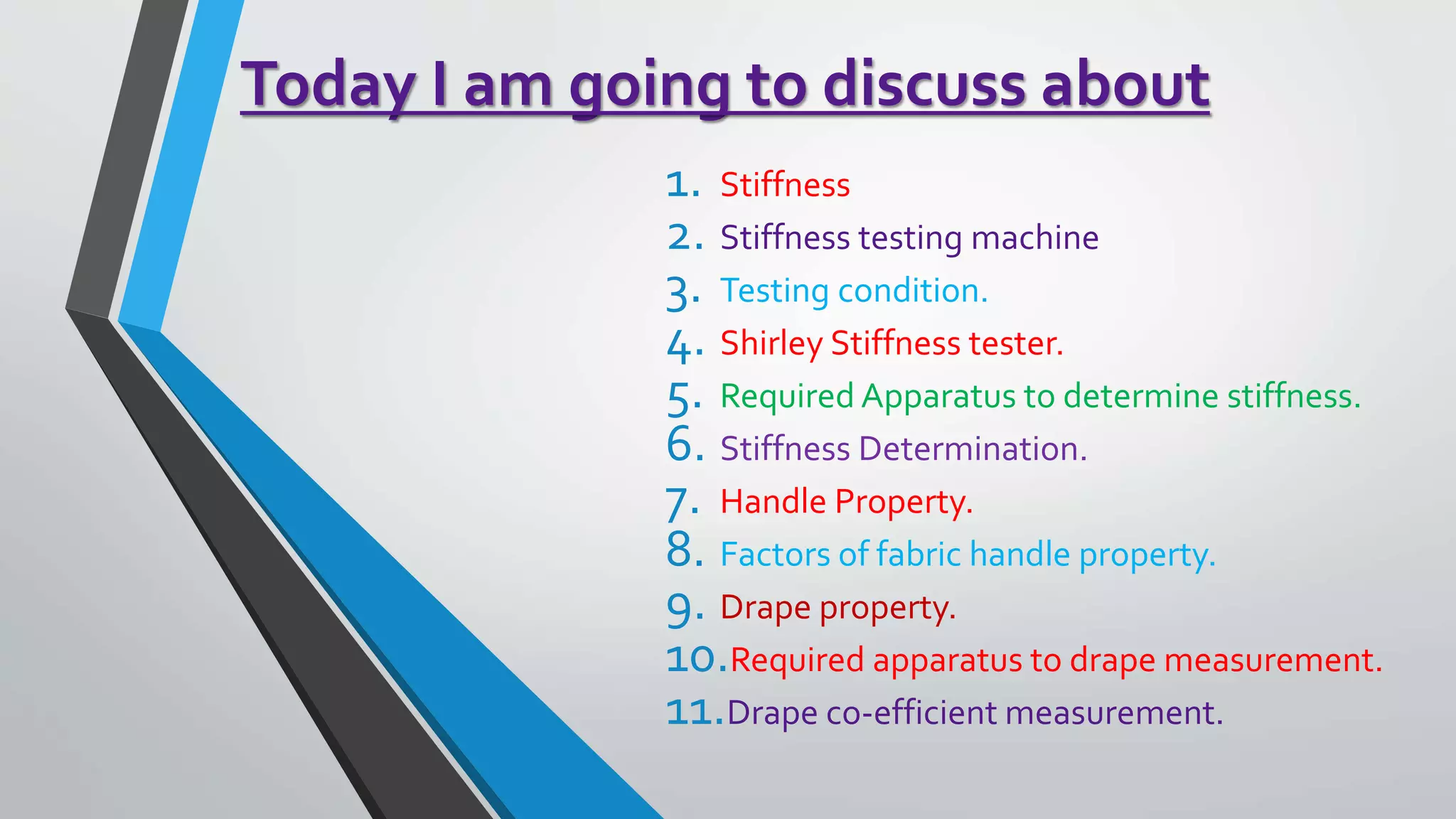
What is Stiffness..?
Stiffness is a special property of fabric. It is the
tendency of fabric to keep standing without any
support. It is a key factor in the study of handle and
drape of fabric.
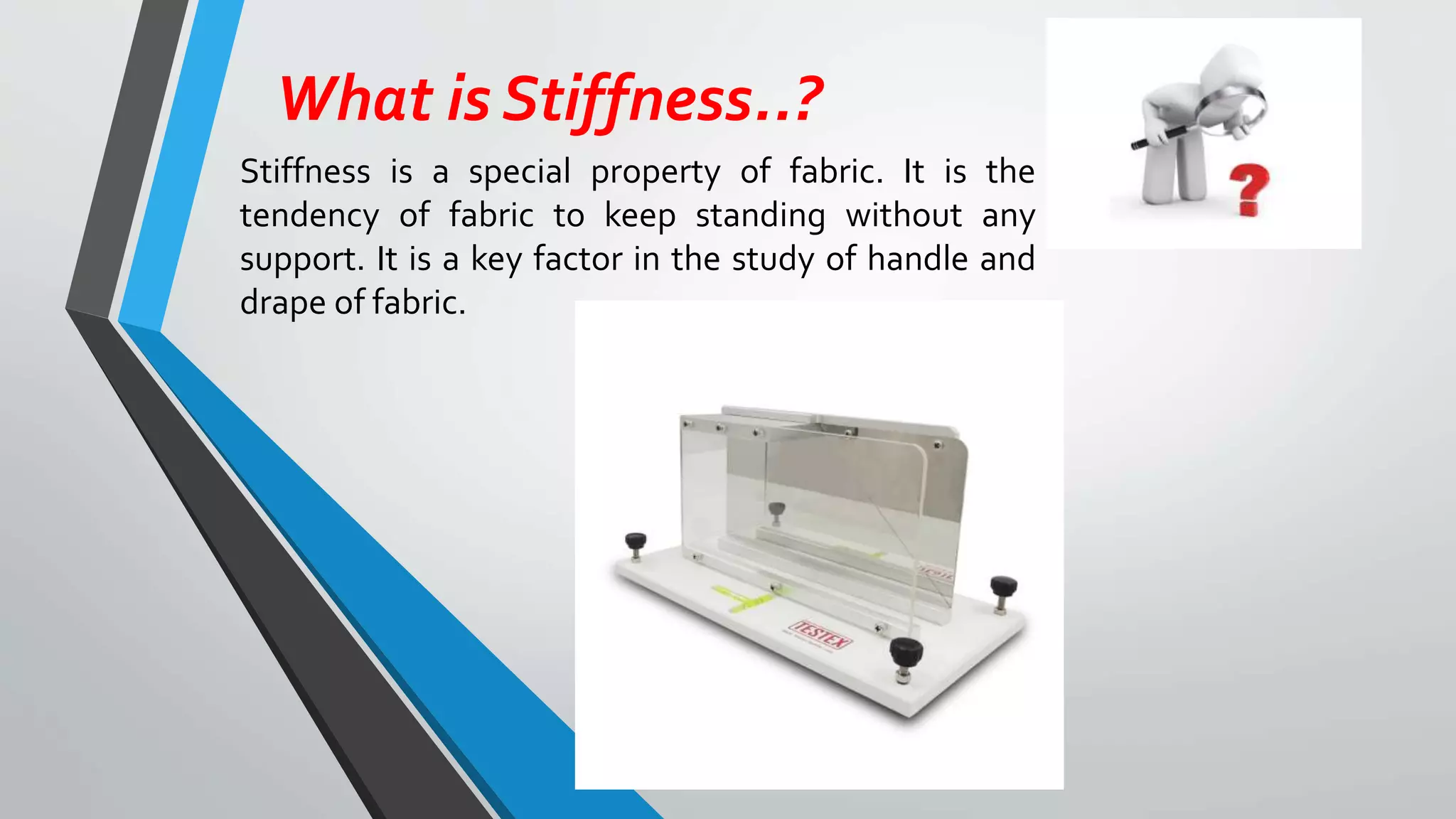
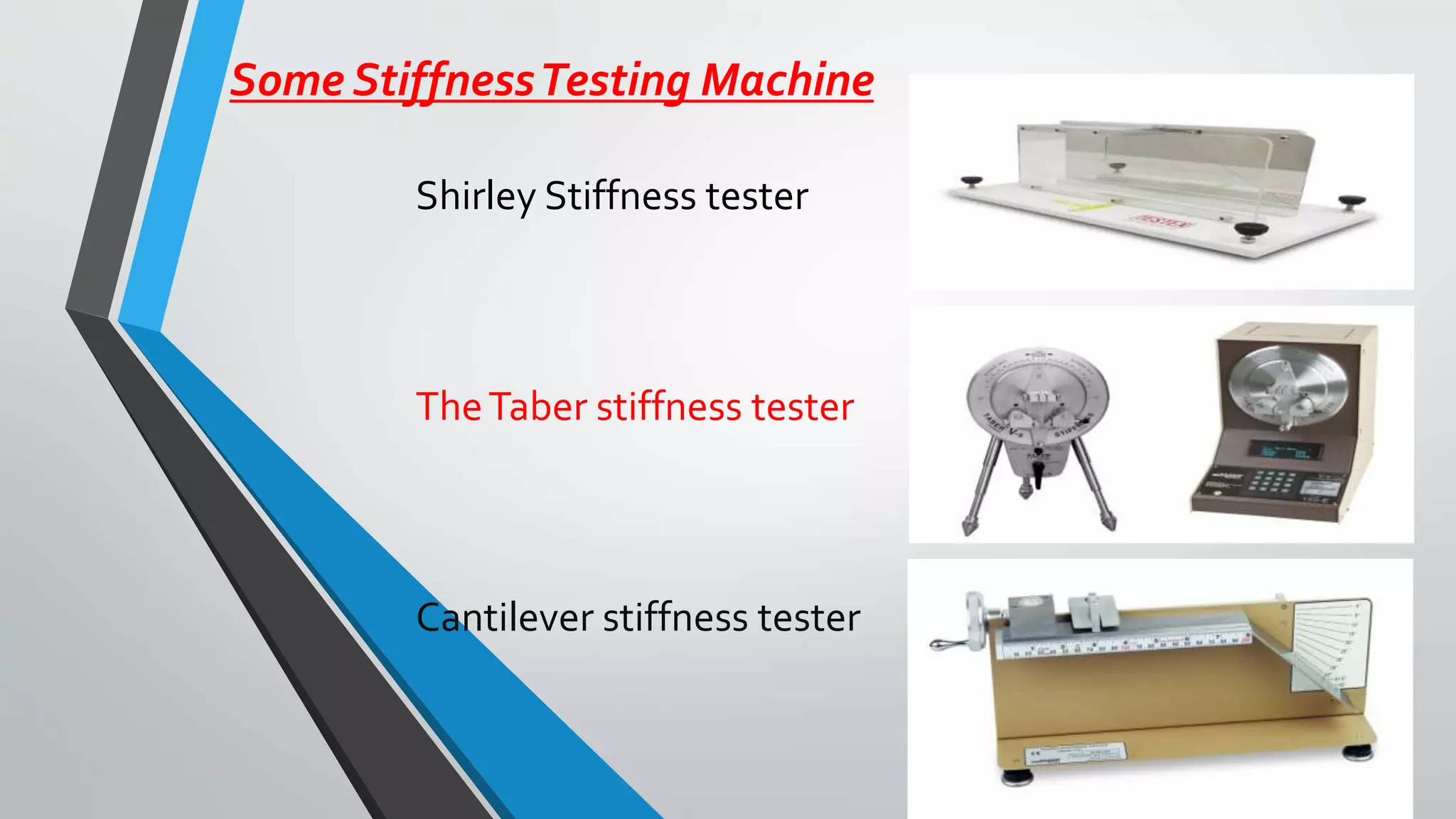
Some StiffnessTesting Machine
Shirley Stiffness tester
TheTaber stiffness tester
Cantilever stiffness tester
Testing Condition
•Standard testingTemperature 25±2°C
•Standard Relative Humidity (R.H %) 65±2%
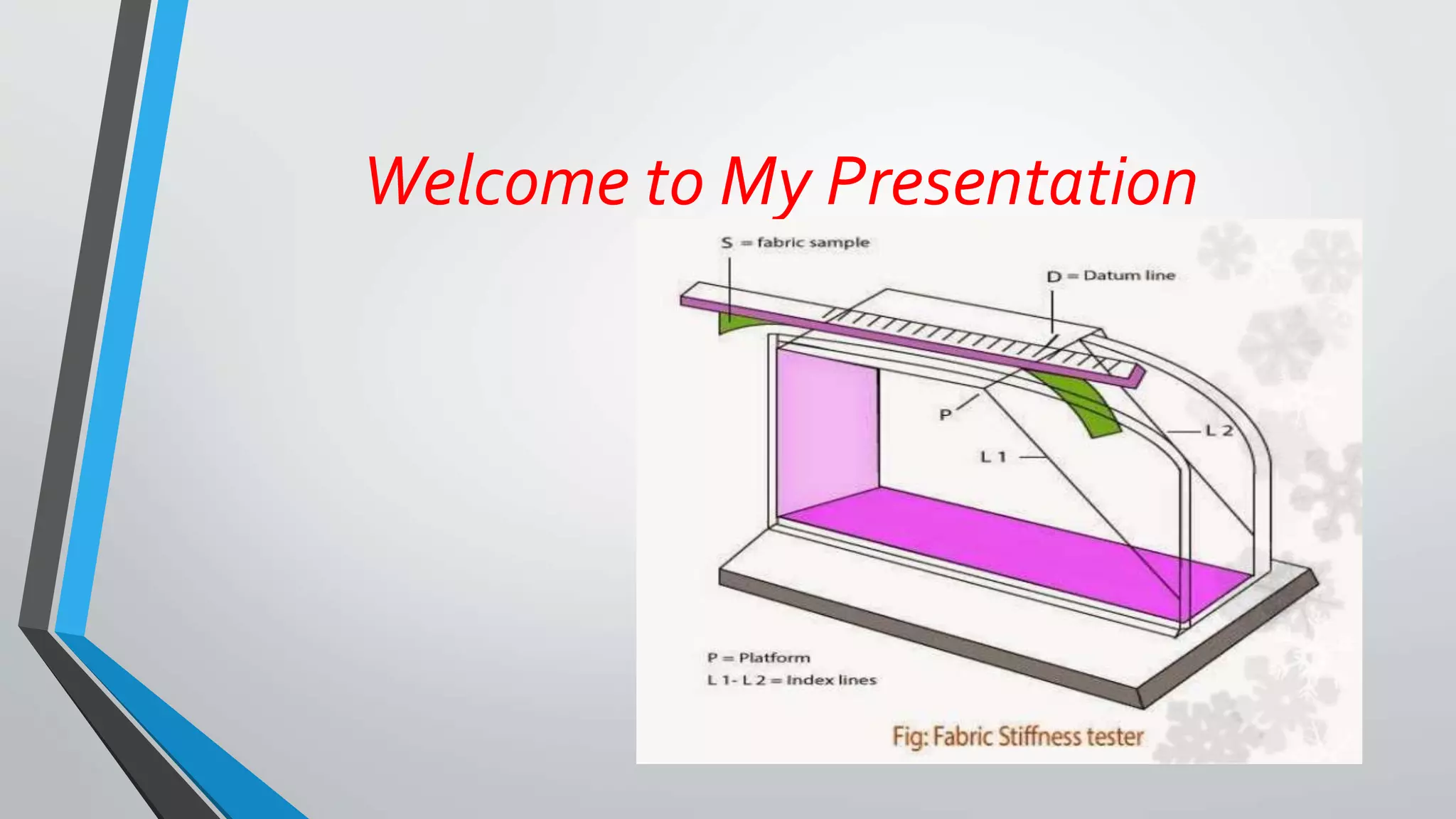
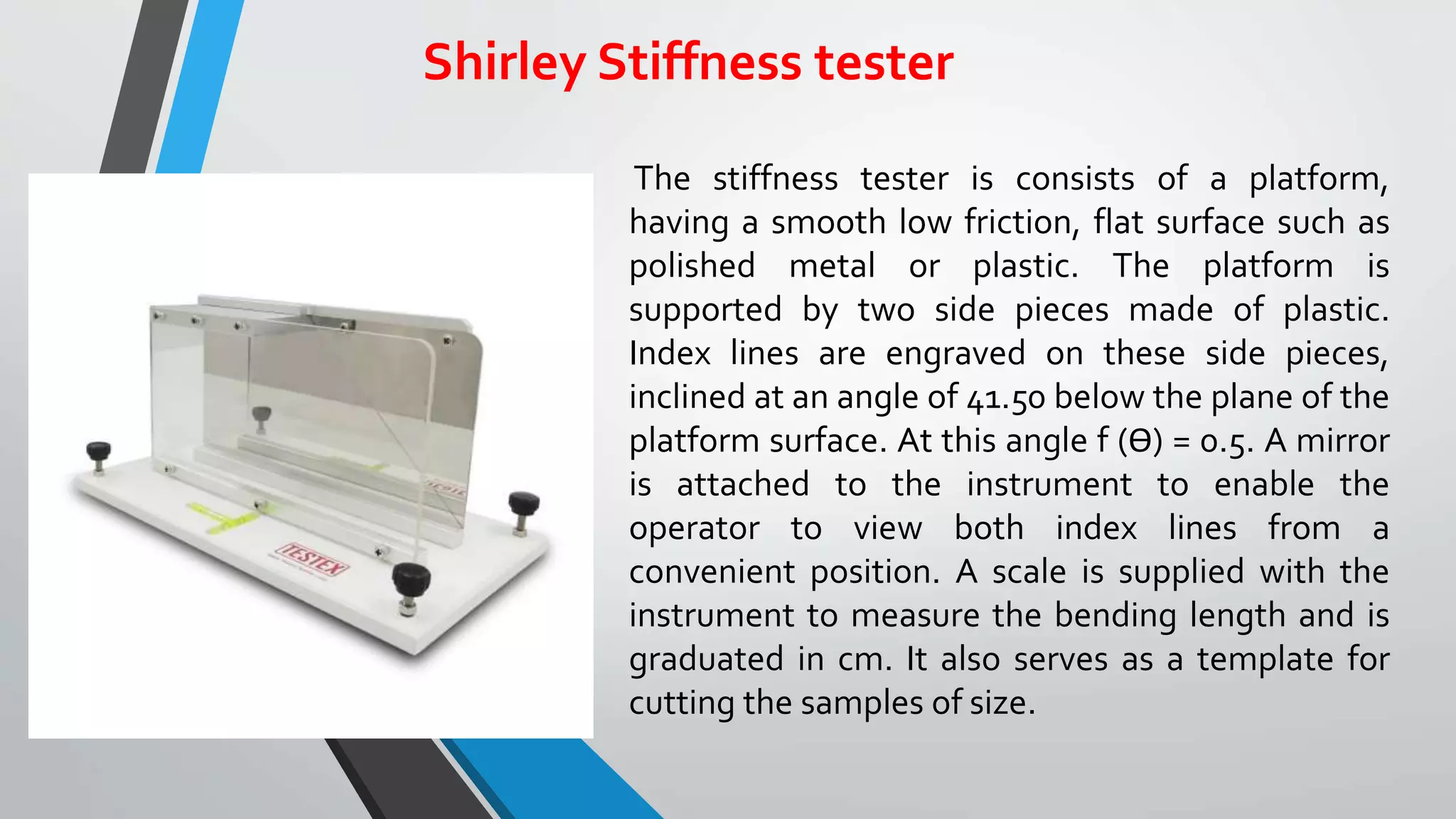
Shirley Stiffness tester
The stiffness tester is consists of a platform,
having a smooth low friction, flat surface such as
polished metal or plastic. The platform is
supported by two side pieces made of plastic.
Index lines are engraved on these side pieces,
inclined at an angle of 41.50 below the plane of the
platform surface. At this angle f (ϴ) = 0.5. A mirror
is attached to the instrument to enable the
operator to view both index lines from a
convenient position. A scale is supplied with the
instrument to measure the bending length and is
graduated in cm. It also serves as a template for
cutting the samples of size.
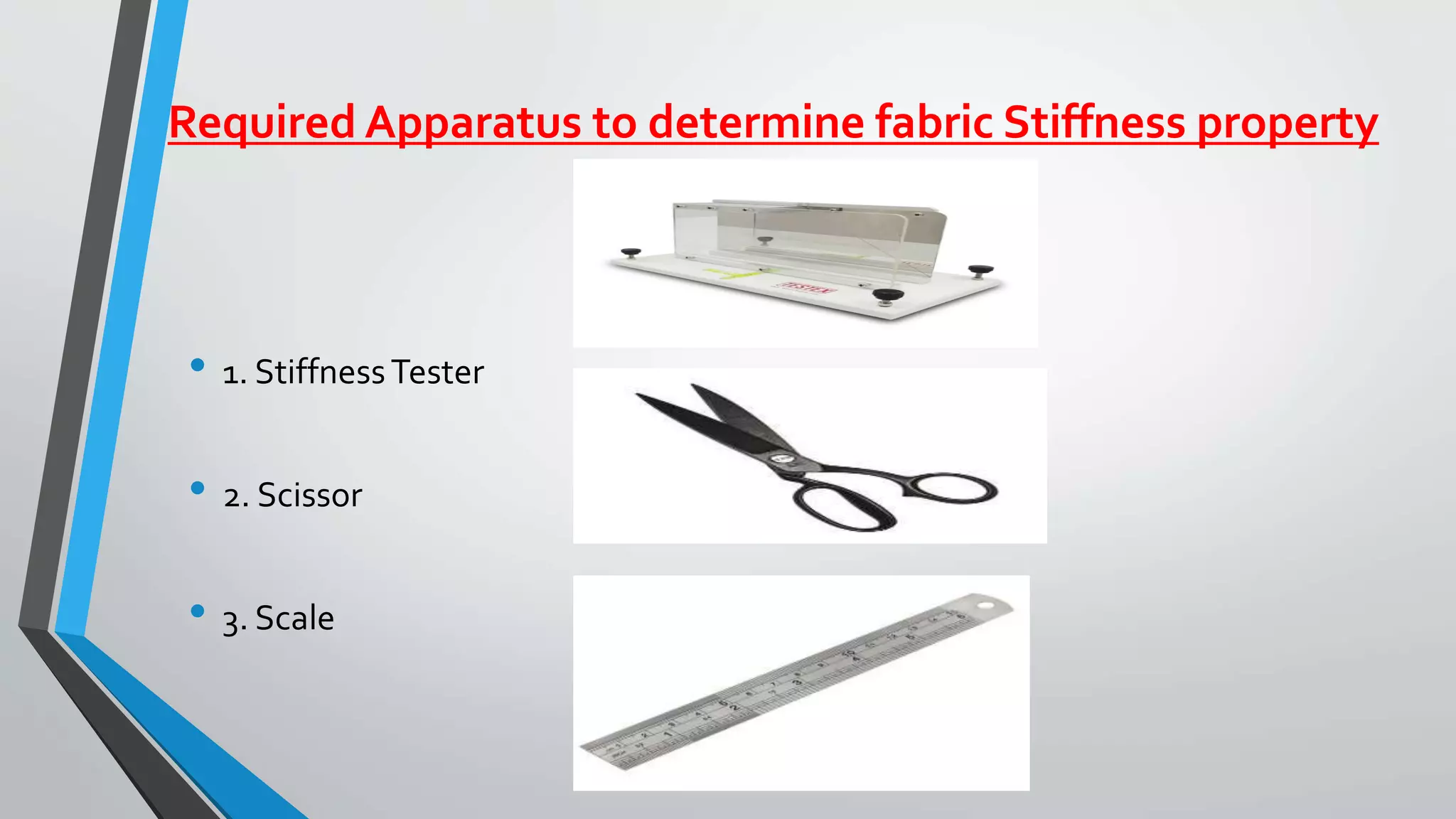
Required Apparatus to determine fabric Stiffness property
• 1. StiffnessTester
• 2. Scissor
• 3. Scale
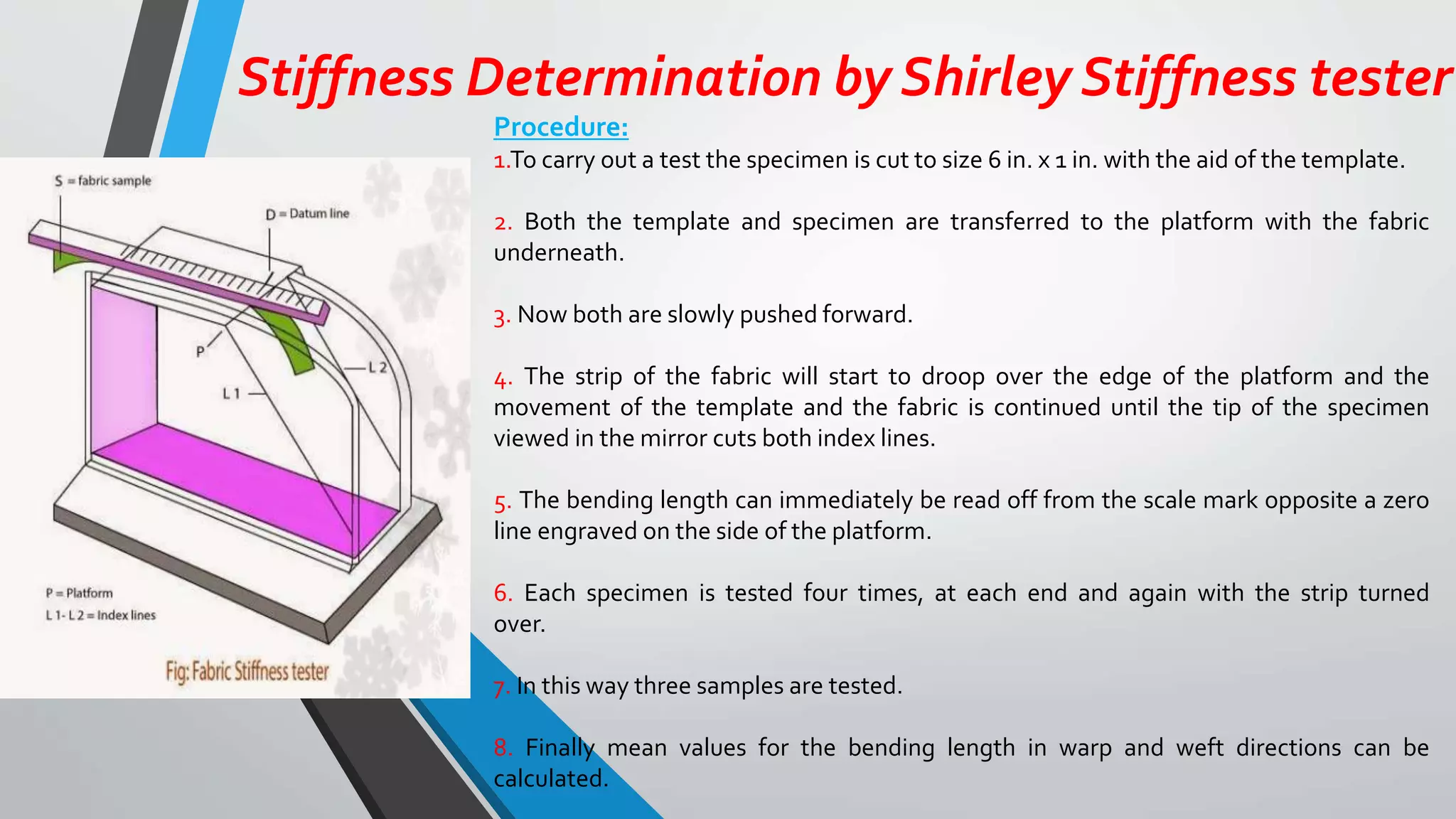
Stiffness Determination by Shirley Stiffness tester
Procedure:
1.To carry out a test the specimen is cut to size 6 in. x 1 in. with the aid of the template.
2. Both the template and specimen are transferred to the platform with the fabric
underneath.
3. Now both are slowly pushed forward.
4. The strip of the fabric will start to droop over the edge of the platform and the
movement of the template and the fabric is continued until the tip of the specimen
viewed in the mirror cuts both index lines.
5. The bending length can immediately be read off from the scale mark opposite a zero
line engraved on the side of the platform.
6. Each specimen is tested four times, at each end and again with the strip turned
over.
7. In this way three samples are tested.
8. Finally mean values for the bending length in warp and weft directions can be
calculated.
Handle Property
The handle properties of textile materials, which
are defined as the attributes and performances of
comfort sensations during contact between the
human hand and the textile materials, have long
been used in the clothing industries as the
evaluation indices of product quality.
Factors of fabric handle properties:
Weight and density: Weight per unit area (GSM) or unit volume is considered. If
the fabric weight is high it will be hard to feel as compared to low weight fabric.
Density measures the compactness or relaxation of fabric. It the thread density in
the fabric is more it will be more compact to low density.
Surface friction: It refers to resistance to be slipping either on the finger or on
another piece of fabric. For balanced fabric surface friction should be adjustable.
Otherwise it will create problem during processing and using. Fabrics vary in
surface friction from harsh to slippery.
Flexibility: It refers case of squeezing of a fabric. Fabrics vary in compressibility
from pliable to stiff.
Compress ability: It refers case of squeezing of a fabric. Fabrics vary in compress
ability from soft to hard.
Drape Property of Fabric
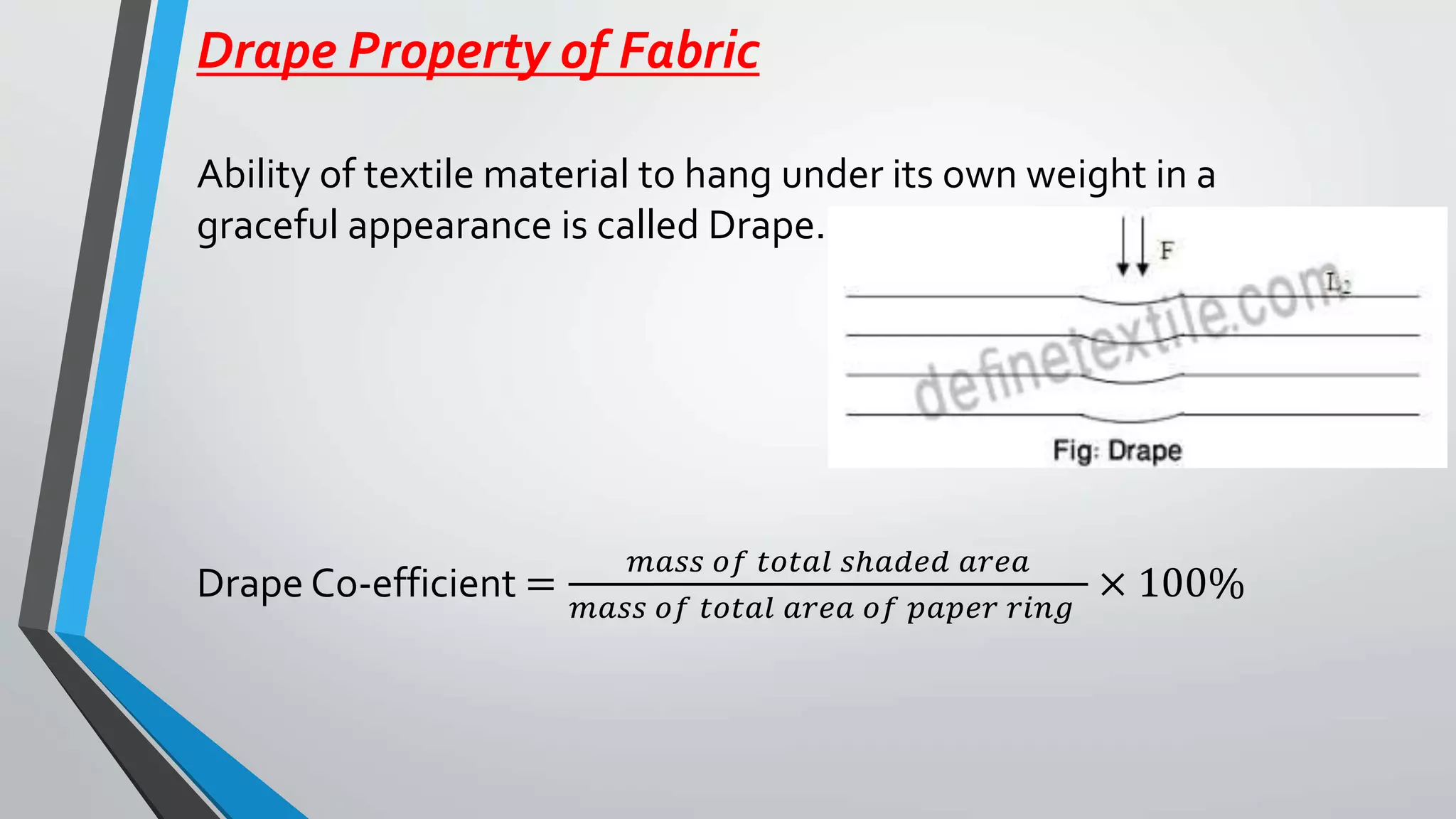
Ability of textile material to hang under its own weight in a
graceful appearance is called Drape.
Drape Co-efficient =
𝑚𝑎𝑠𝑠 𝑜𝑓 𝑡𝑜𝑡𝑎𝑙 𝑠ℎ𝑎𝑑𝑒𝑑 𝑎𝑟𝑒𝑎
𝑚𝑎𝑠𝑠 𝑜𝑓 𝑡𝑜𝑡𝑎𝑙 𝑎𝑟𝑒𝑎 𝑜𝑓 𝑝𝑎𝑝𝑒𝑟 𝑟𝑖𝑛𝑔
× 100%
Testing condition
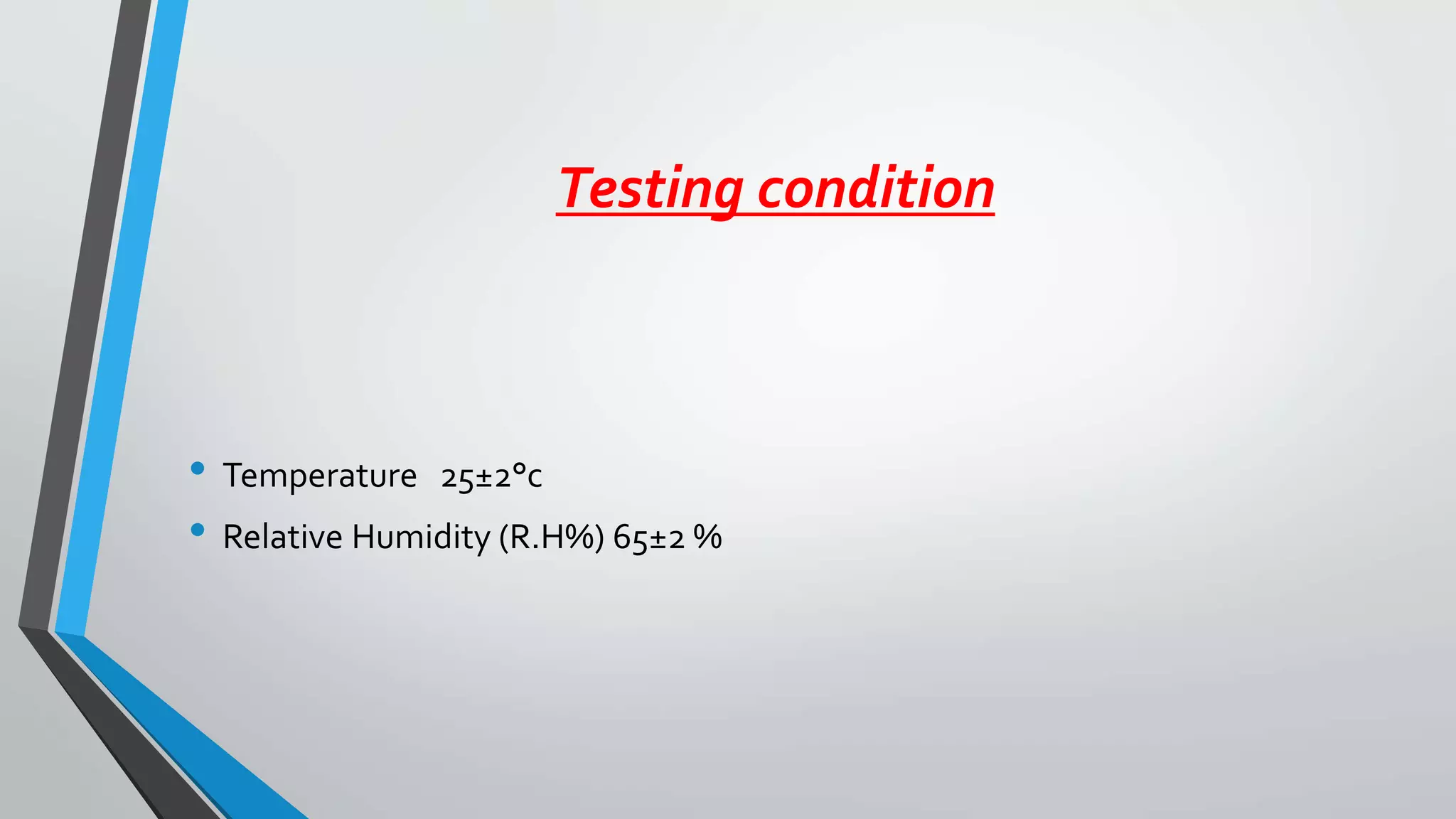
• Temperature 25±2°c
• Relative Humidity (R.H%) 65±2 %
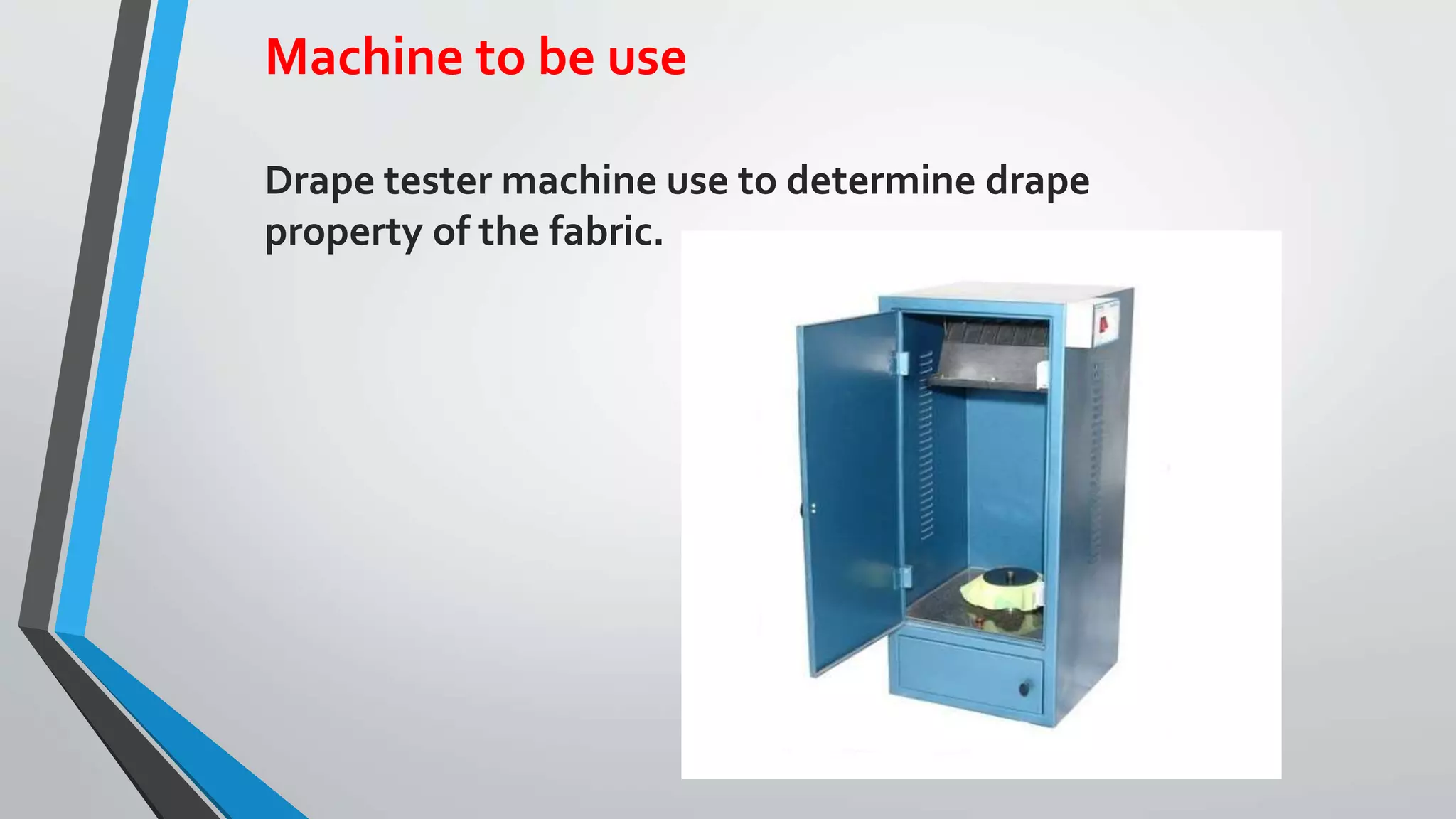
Machine to be use
Drape tester machine use to determine drape
property of the fabric.
Required Apparatus and Equipment to
determine drape co-efficient
DrapeTester
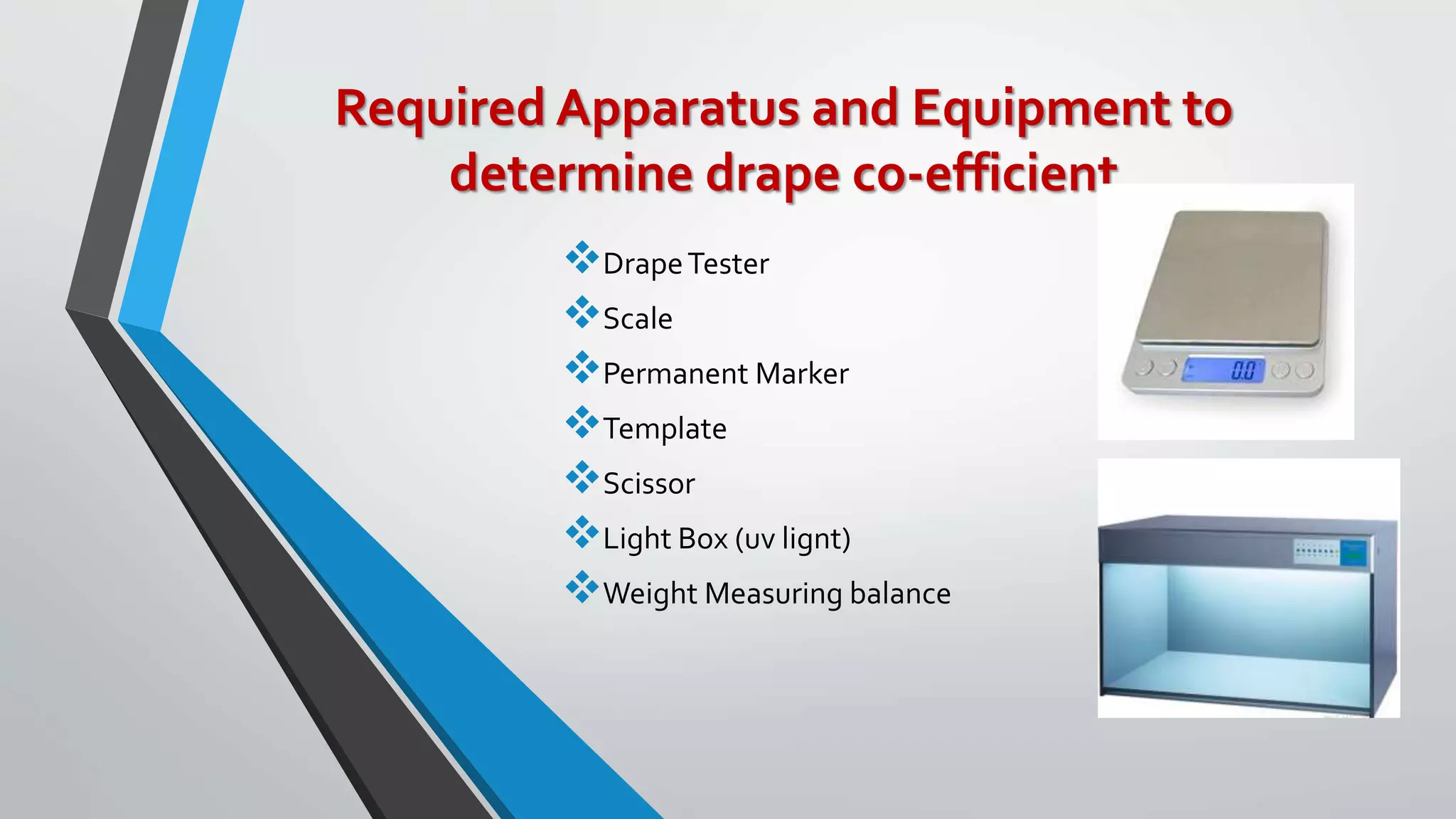
Scale
Permanent Marker
Template
Scissor
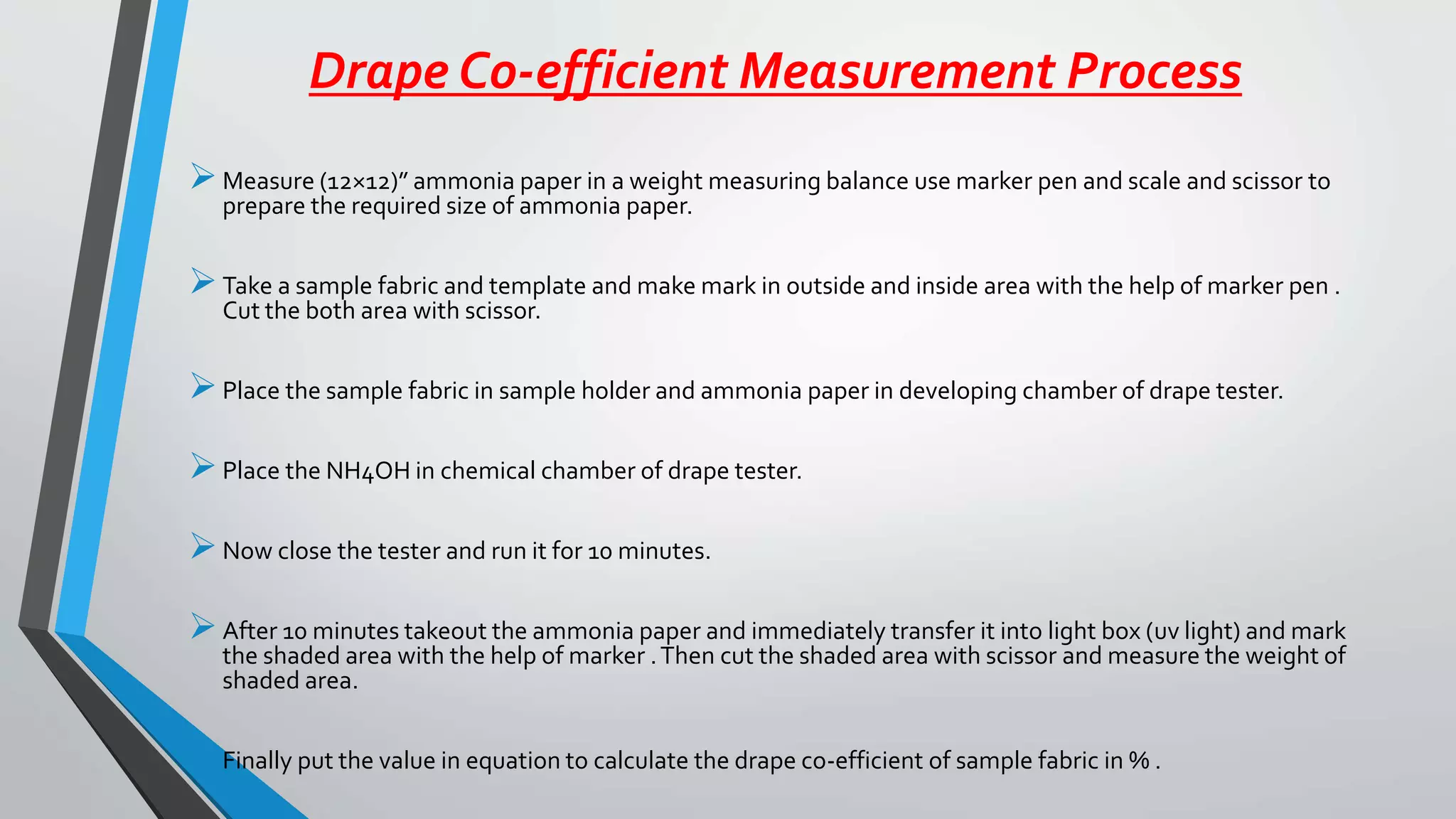
Light Box (uv lignt)
Weight Measuring balance
Drape Co-efficient Measurement Process
Measure (12×12)” ammonia paper in a weight measuring balance use marker pen and scale and scissor to
prepare the required size of ammonia paper.
Take a sample fabric and template and make mark in outside and inside area with the help of marker pen .
Cut the both area with scissor.
Place the sample fabric in sample holder and ammonia paper in developing chamber of drape tester.
Place the NH4OH in chemical chamber of drape tester.
Now close the tester and run it for 10 minutes.
After 10 minutes takeout the ammonia paper and immediately transfer it into light box (uv light) and mark
the shaded area with the help of marker .Then cut the shaded area with scissor and measure the weight of
shaded area.
Finally put the value in equation to calculate the drape co-efficient of sample fabric in % .
Reference Book & website
• Principle ofTextileTesting.
J.E. BOOTH
www.textilelerner.com
www.definetextile.com
www.slideshare.com
THANK YOU
Everyone
Any Question …???

stiffness,Handle,Drape properties of fabric ,Fabric property TTQC-2

  • 1.
    Welcome to MyPresentation
  • 2.
    Presented by G.M AtiqFaysal Alif ID:16172207002 Intake:18th B.Sc. InTextile Engineering Bangladesh University Of Business andTechnology
  • 3.
    My presentation topicis Stiffness, Handle, Drape Properties of Fabric
  • 4.
    Today I amgoing to discuss about 1. Stiffness 2. Stiffness testing machine 3. Testing condition. 4. Shirley Stiffness tester. 5. Required Apparatus to determine stiffness. 6. Stiffness Determination. 7. Handle Property. 8. Factors of fabric handle property. 9. Drape property. 10.Required apparatus to drape measurement. 11.Drape co-efficient measurement.
  • 5.
    What is Stiffness..? Stiffnessis a special property of fabric. It is the tendency of fabric to keep standing without any support. It is a key factor in the study of handle and drape of fabric.
  • 6.
    Some StiffnessTesting Machine ShirleyStiffness tester TheTaber stiffness tester Cantilever stiffness tester
  • 7.
    Testing Condition •Standard testingTemperature25±2°C •Standard Relative Humidity (R.H %) 65±2%
  • 8.
    Shirley Stiffness tester Thestiffness tester is consists of a platform, having a smooth low friction, flat surface such as polished metal or plastic. The platform is supported by two side pieces made of plastic. Index lines are engraved on these side pieces, inclined at an angle of 41.50 below the plane of the platform surface. At this angle f (ϴ) = 0.5. A mirror is attached to the instrument to enable the operator to view both index lines from a convenient position. A scale is supplied with the instrument to measure the bending length and is graduated in cm. It also serves as a template for cutting the samples of size.
  • 9.
    Required Apparatus todetermine fabric Stiffness property • 1. StiffnessTester • 2. Scissor • 3. Scale
  • 10.
    Stiffness Determination byShirley Stiffness tester Procedure: 1.To carry out a test the specimen is cut to size 6 in. x 1 in. with the aid of the template. 2. Both the template and specimen are transferred to the platform with the fabric underneath. 3. Now both are slowly pushed forward. 4. The strip of the fabric will start to droop over the edge of the platform and the movement of the template and the fabric is continued until the tip of the specimen viewed in the mirror cuts both index lines. 5. The bending length can immediately be read off from the scale mark opposite a zero line engraved on the side of the platform. 6. Each specimen is tested four times, at each end and again with the strip turned over. 7. In this way three samples are tested. 8. Finally mean values for the bending length in warp and weft directions can be calculated.
  • 11.
    Handle Property The handleproperties of textile materials, which are defined as the attributes and performances of comfort sensations during contact between the human hand and the textile materials, have long been used in the clothing industries as the evaluation indices of product quality.
  • 12.
    Factors of fabrichandle properties: Weight and density: Weight per unit area (GSM) or unit volume is considered. If the fabric weight is high it will be hard to feel as compared to low weight fabric. Density measures the compactness or relaxation of fabric. It the thread density in the fabric is more it will be more compact to low density. Surface friction: It refers to resistance to be slipping either on the finger or on another piece of fabric. For balanced fabric surface friction should be adjustable. Otherwise it will create problem during processing and using. Fabrics vary in surface friction from harsh to slippery. Flexibility: It refers case of squeezing of a fabric. Fabrics vary in compressibility from pliable to stiff. Compress ability: It refers case of squeezing of a fabric. Fabrics vary in compress ability from soft to hard.
  • 13.
    Drape Property ofFabric Ability of textile material to hang under its own weight in a graceful appearance is called Drape. Drape Co-efficient = 𝑚𝑎𝑠𝑠 𝑜𝑓 𝑡𝑜𝑡𝑎𝑙 𝑠ℎ𝑎𝑑𝑒𝑑 𝑎𝑟𝑒𝑎 𝑚𝑎𝑠𝑠 𝑜𝑓 𝑡𝑜𝑡𝑎𝑙 𝑎𝑟𝑒𝑎 𝑜𝑓 𝑝𝑎𝑝𝑒𝑟 𝑟𝑖𝑛𝑔 × 100%
  • 14.
    Testing condition • Temperature25±2°c • Relative Humidity (R.H%) 65±2 %
  • 15.
    Machine to beuse Drape tester machine use to determine drape property of the fabric.
  • 16.
    Required Apparatus andEquipment to determine drape co-efficient DrapeTester Scale Permanent Marker Template Scissor Light Box (uv lignt) Weight Measuring balance
  • 17.
    Drape Co-efficient MeasurementProcess Measure (12×12)” ammonia paper in a weight measuring balance use marker pen and scale and scissor to prepare the required size of ammonia paper. Take a sample fabric and template and make mark in outside and inside area with the help of marker pen . Cut the both area with scissor. Place the sample fabric in sample holder and ammonia paper in developing chamber of drape tester. Place the NH4OH in chemical chamber of drape tester. Now close the tester and run it for 10 minutes. After 10 minutes takeout the ammonia paper and immediately transfer it into light box (uv light) and mark the shaded area with the help of marker .Then cut the shaded area with scissor and measure the weight of shaded area. Finally put the value in equation to calculate the drape co-efficient of sample fabric in % .
  • 18.
    Reference Book &website • Principle ofTextileTesting. J.E. BOOTH www.textilelerner.com www.definetextile.com www.slideshare.com
  • 19.
  • 20.