TEXTILES IN AUTOMOBILES
S.SIVAKUMAR
ASSOCIATE PROFESSOR
DEPARTMENT OF AUTOMOBILE ENGINEERING
KUMARAGURU COLLEGE OF TECHNOLOGY
COIMBATORE-641049 9444283430
sivakumar.s.auto@kct.ac.in
Contents:
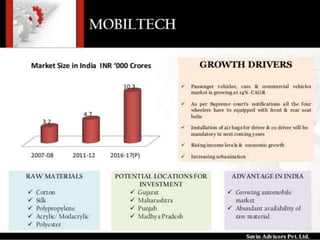
Mobiltech
Fiber Composition in Automobiles
Automobile Components using Textiles
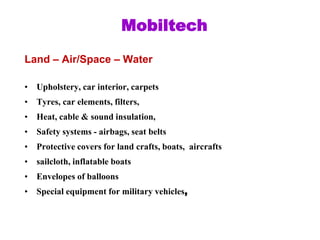
Land – Air/Space – Water
• Upholstery, car interior, carpets
• Tyres, car elements, filters,
• Heat, cable & sound insulation,
• Safety systems - airbags, seat belts
• Protective covers for land crafts, boats, aircrafts
• sailcloth, inflatable boats
• Envelopes of balloons
• Special equipment for military vehicles,
Mobiltech
Textiles in Automobiles
Visible components :
upholstery, carpets, headliners..(45 m2 approx.)
Concealed components :
tyre cords, hoses, belts, airbags, air and fuel
filters, noise and vibration dampening and
body panel reinforcement in composites etc.
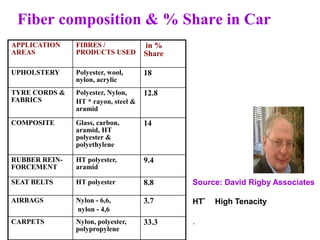
Fiber composition & % Share in Car
APPLICATION
AREAS
FIBRES /
PRODUCTS USED
in %
Share
UPHOLSTERY Polyester, wool,
nylon, acrylic
18
TYRE CORDS &
FABRICS
Polyester, Nylon,
HT * rayon, steel &
aramid
12.8
COMPOSITE Glass, carbon,
aramid, HT
polyester &
polyethylene
14
RUBBER REIN-
FORCEMENT
HT polyester,
aramid
9.4
SEAT BELTS HT polyester 8.8
AIRBAGS Nylon - 6,6,
nylon - 4,6
3.7
CARPETS Nylon, polyester,
polypropylene
33.3
Source: David Rigby Associates
HT* High Tenacity
.
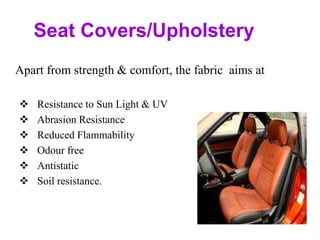
Seat Covers/Upholstery
Apart from strength & comfort, the fabric aims at
 Resistance to Sun Light & UV
 Abrasion Resistance
 Reduced Flammability
 Odour free
 Antistatic
 Soil resistance.
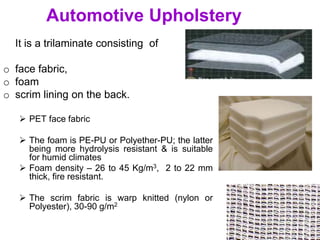
Automotive Upholstery
It is a trilaminate consisting of
o face fabric,
o foam
o scrim lining on the back.
 PET face fabric
 The foam is PE-PU or Polyether-PU; the latter
being more hydrolysis resistant & is suitable
for humid climates
 Foam density – 26 to 45 Kg/m3, 2 to 22 mm
thick, fire resistant.
 The scrim fabric is warp knitted (nylon or
Polyester), 30-90 g/m2
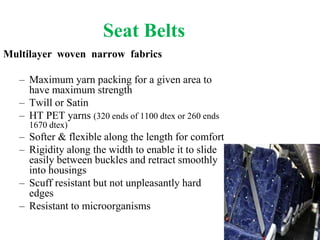
Seat Belts
Multilayer woven narrow fabrics
– Maximum yarn packing for a given area to
have maximum strength
– Twill or Satin
– HT PET yarns (320 ends of 1100 dtex or 260 ends
1670 dtex)
– Softer & flexible along the length for comfort
– Rigidity along the width to enable it to slide
easily between buckles and retract smoothly
into housings
– Scuff resistant but not unpleasantly hard
edges
– Resistant to microorganisms
Performance Standards
(Seat Belts)
 Restrain a passenger weighing 90 Kg involved in a
collision at 50 Km/h into a fixed object
 Minimum straight pull strength 30kN/50mm
 Finished product – resistance to fastening &
unfastening 10,000 times
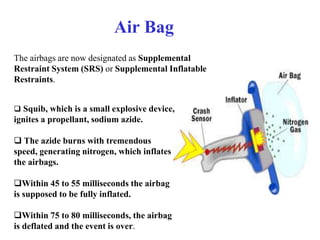
Air Bag
 Squib, which is a small explosive device,
ignites a propellant, sodium azide.
 The azide burns with tremendous
speed, generating nitrogen, which inflates
the airbags.
Within 45 to 55 milliseconds the airbag
is supposed to be fully inflated.
Within 75 to 80 milliseconds, the airbag
is deflated and the event is over.
The airbags are now designated as Supplemental
Restraint System (SRS) or Supplemental Inflatable
Restraints.
Fabrics for Airbag
• The fabric from which the air bag is made must withstand the
force of the propellant chemicals. More importantly, the hot
gases must not penetrate the fabric and burn the skin of the car
occupant.
• The earlier airbags were Neoprene coated Nylon 6,6 but
lighter and thinner silicon coated versions soon followed.
Latter, uncoated fabrics have appeared.
• Airbags vary in size and configuration
– driver side airbags: from 35 lit capacity upwards
– for front passengers: form about 65 lit capacity upwards
Recent Trends in Airbags
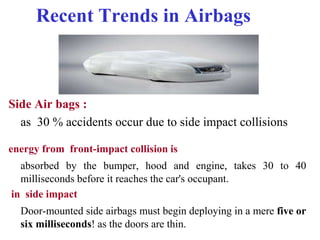
Side Air bags :
as 30 % accidents occur due to side impact collisions
energy from front-impact collision is
absorbed by the bumper, hood and engine, takes 30 to 40
milliseconds before it reaches the car's occupant.
in side impact
Door-mounted side airbags must begin deploying in a mere five or
six milliseconds! as the doors are thin.
Shaped Airbags
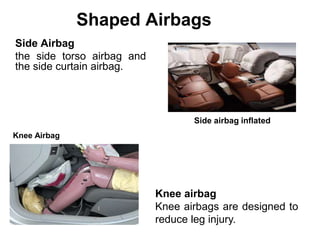
Side Airbag
the side torso airbag and
the side curtain airbag.
Side airbag inflated
Knee airbag
Knee airbags are designed to
reduce leg injury.
Knee Airbag
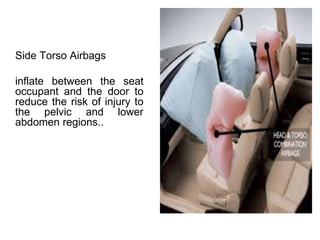
Side Torso Airbags
inflate between the seat
occupant and the door to
reduce the risk of injury to
the pelvic and lower
abdomen regions..
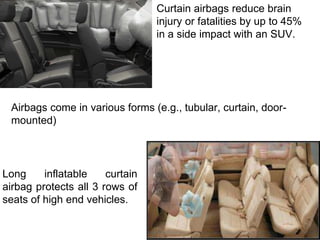
Long inflatable curtain
airbag protects all 3 rows of
seats of high end vehicles.
Curtain airbags reduce brain
injury or fatalities by up to 45%
in a side impact with an SUV.
Airbags come in various forms (e.g., tubular, curtain, door-
mounted)
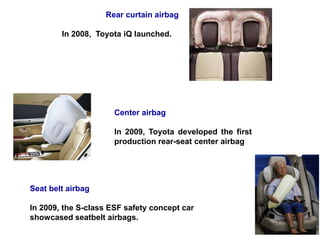
Seat belt airbag
In 2009, the S-class ESF safety concept car
showcased seatbelt airbags.
Rear curtain airbag
In 2008, Toyota iQ launched.
Center airbag
In 2009, Toyota developed the first
production rear-seat center airbag
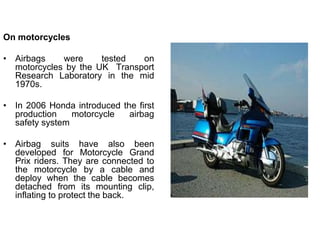
On motorcycles
• Airbags were tested on
motorcycles by the UK Transport
Research Laboratory in the mid
1970s.
• In 2006 Honda introduced the first
production motorcycle airbag
safety system
• Airbag suits have also been
developed for Motorcycle Grand
Prix riders. They are connected to
the motorcycle by a cable and
deploy when the cable becomes
detached from its mounting clip,
inflating to protect the back.
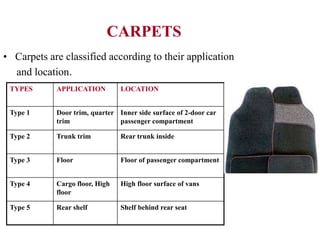
CARPETS
• Carpets are classified according to their application
and location.
TYPES APPLICATION LOCATION
Type 1 Door trim, quarter
trim
Inner side surface of 2-door car
passenger compartment
Type 2 Trunk trim Rear trunk inside
Type 3 Floor Floor of passenger compartment
Type 4 Cargo floor, High
floor
High floor surface of vans
Type 5 Rear shelf Shelf behind rear seat
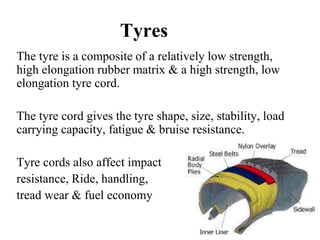
Tyres
The tyre is a composite of a relatively low strength,
high elongation rubber matrix & a high strength, low
elongation tyre cord.
The tyre cord gives the tyre shape, size, stability, load
carrying capacity, fatigue & bruise resistance.
Tyre cords also affect impact
resistance, Ride, handling,
tread wear & fuel economy
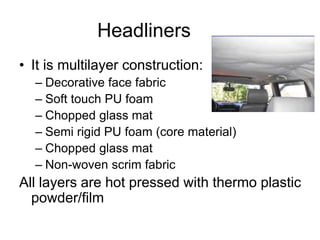
Headliners
• It is multilayer construction:
– Decorative face fabric
– Soft touch PU foam
– Chopped glass mat
– Semi rigid PU foam (core material)
– Chopped glass mat
– Non-woven scrim fabric
All layers are hot pressed with thermo plastic
powder/film
Nonwoven Applications
• Bonnet: Bi-component yarn (nylon6 sheath with PET
cover) to reinforce acoustic insulation
• Air-filters: nonwoven with activated carbon and
antibacterial chemicals to remove malodours
• Carpets: less weight, low cost & recycling -
needle felt PP
• Surfaces such as window seals, dash board
components – PET & Nylon 66 flocked surfaces to
eliminate rattles & squeaks as well as
contributing to overall aesthetics.
Composite market of India
Current level of composites production is 3,05,000 Metric Tonnes
The per capita usage of Composites in India is 0.24 kg which offers
enormous potential for growth
Growth driving factors:
Automotive and Marine sectors are changing from conventional steel/metal
combination to advanced composites.
Off-Shore wind energy will bring new innovation in advanced composites
whereby a huge market will be made available.
Improvements made on the quality of raw materials, processes and on finished
products has increased customer confidence.
Carbon Fiber
 Carbon fiber is a long thin strand of carbon atoms that are
bonded together in a honeycomb crystal lattice called Graphene.
 Some of the Graphene layers are folded around each other in
random orientations but most are aligned parallel to the long axis
of the strand.
 This makes the fiber incredibly strong along the axis of the
strand.
 The fabric is then mixed with epoxy and molded to form the
desired shape.
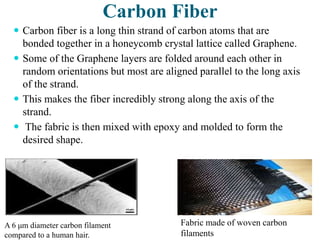
A 6 μm diameter carbon filament
compared to a human hair.
Fabric made of woven carbon
filaments
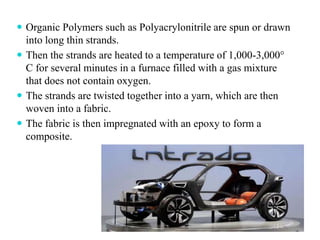
 Organic Polymers such as Polyacrylonitrile are spun or drawn
into long thin strands.
 Then the strands are heated to a temperature of 1,000-3,000°
C for several minutes in a furnace filled with a gas mixture
that does not contain oxygen.
 The strands are twisted together into a yarn, which are then
woven into a fabric.
 The fabric is then impregnated with an epoxy to form a
composite.
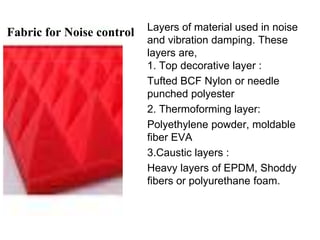
Fabric for Noise control Layers of material used in noise
and vibration damping. These
layers are,
1. Top decorative layer :
Tufted BCF Nylon or needle
punched polyester
2. Thermoforming layer:
Polyethylene powder, moldable
fiber EVA
3.Caustic layers :
Heavy layers of EPDM, Shoddy
fibers or polyurethane foam.
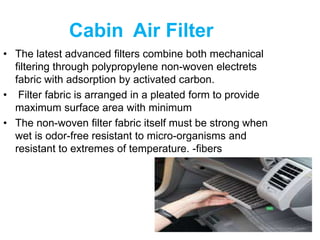
Cabin Air Filter
• The latest advanced filters combine both mechanical
filtering through polypropylene non-woven electrets
fabric with adsorption by activated carbon.
• Filter fabric is arranged in a pleated form to provide
maximum surface area with minimum
• The non-woven filter fabric itself must be strong when
wet is odor-free resistant to micro-organisms and
resistant to extremes of temperature. -fibers
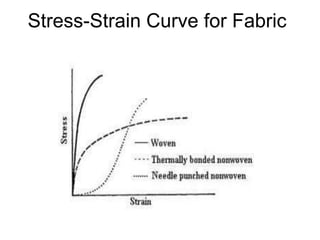
Stress-Strain Curve for Fabric
FUTURE
The factors influencing future of
automotive textiles:
• Environment
• Cost
• Safety
THANK YOU

Textiles in automobile

  • 1.
    TEXTILES IN AUTOMOBILES S.SIVAKUMAR ASSOCIATEPROFESSOR DEPARTMENT OF AUTOMOBILE ENGINEERING KUMARAGURU COLLEGE OF TECHNOLOGY COIMBATORE-641049 9444283430 sivakumar.s.auto@kct.ac.in
  • 2.
    Contents: Mobiltech Fiber Composition inAutomobiles Automobile Components using Textiles
  • 4.
    Land – Air/Space– Water • Upholstery, car interior, carpets • Tyres, car elements, filters, • Heat, cable & sound insulation, • Safety systems - airbags, seat belts • Protective covers for land crafts, boats, aircrafts • sailcloth, inflatable boats • Envelopes of balloons • Special equipment for military vehicles, Mobiltech
  • 5.
    Textiles in Automobiles Visiblecomponents : upholstery, carpets, headliners..(45 m2 approx.) Concealed components : tyre cords, hoses, belts, airbags, air and fuel filters, noise and vibration dampening and body panel reinforcement in composites etc.
  • 6.
    Fiber composition &% Share in Car APPLICATION AREAS FIBRES / PRODUCTS USED in % Share UPHOLSTERY Polyester, wool, nylon, acrylic 18 TYRE CORDS & FABRICS Polyester, Nylon, HT * rayon, steel & aramid 12.8 COMPOSITE Glass, carbon, aramid, HT polyester & polyethylene 14 RUBBER REIN- FORCEMENT HT polyester, aramid 9.4 SEAT BELTS HT polyester 8.8 AIRBAGS Nylon - 6,6, nylon - 4,6 3.7 CARPETS Nylon, polyester, polypropylene 33.3 Source: David Rigby Associates HT* High Tenacity .
  • 7.
    Seat Covers/Upholstery Apart fromstrength & comfort, the fabric aims at  Resistance to Sun Light & UV  Abrasion Resistance  Reduced Flammability  Odour free  Antistatic  Soil resistance.
  • 8.
    Automotive Upholstery It isa trilaminate consisting of o face fabric, o foam o scrim lining on the back.  PET face fabric  The foam is PE-PU or Polyether-PU; the latter being more hydrolysis resistant & is suitable for humid climates  Foam density – 26 to 45 Kg/m3, 2 to 22 mm thick, fire resistant.  The scrim fabric is warp knitted (nylon or Polyester), 30-90 g/m2
  • 9.
    Seat Belts Multilayer wovennarrow fabrics – Maximum yarn packing for a given area to have maximum strength – Twill or Satin – HT PET yarns (320 ends of 1100 dtex or 260 ends 1670 dtex) – Softer & flexible along the length for comfort – Rigidity along the width to enable it to slide easily between buckles and retract smoothly into housings – Scuff resistant but not unpleasantly hard edges – Resistant to microorganisms
  • 10.
    Performance Standards (Seat Belts) Restrain a passenger weighing 90 Kg involved in a collision at 50 Km/h into a fixed object  Minimum straight pull strength 30kN/50mm  Finished product – resistance to fastening & unfastening 10,000 times
  • 11.
    Air Bag  Squib,which is a small explosive device, ignites a propellant, sodium azide.  The azide burns with tremendous speed, generating nitrogen, which inflates the airbags. Within 45 to 55 milliseconds the airbag is supposed to be fully inflated. Within 75 to 80 milliseconds, the airbag is deflated and the event is over. The airbags are now designated as Supplemental Restraint System (SRS) or Supplemental Inflatable Restraints.
  • 12.
    Fabrics for Airbag •The fabric from which the air bag is made must withstand the force of the propellant chemicals. More importantly, the hot gases must not penetrate the fabric and burn the skin of the car occupant. • The earlier airbags were Neoprene coated Nylon 6,6 but lighter and thinner silicon coated versions soon followed. Latter, uncoated fabrics have appeared. • Airbags vary in size and configuration – driver side airbags: from 35 lit capacity upwards – for front passengers: form about 65 lit capacity upwards
  • 13.
    Recent Trends inAirbags Side Air bags : as 30 % accidents occur due to side impact collisions energy from front-impact collision is absorbed by the bumper, hood and engine, takes 30 to 40 milliseconds before it reaches the car's occupant. in side impact Door-mounted side airbags must begin deploying in a mere five or six milliseconds! as the doors are thin.
  • 14.
    Shaped Airbags Side Airbag theside torso airbag and the side curtain airbag. Side airbag inflated Knee airbag Knee airbags are designed to reduce leg injury. Knee Airbag
  • 15.
    Side Torso Airbags inflatebetween the seat occupant and the door to reduce the risk of injury to the pelvic and lower abdomen regions..
  • 16.
    Long inflatable curtain airbagprotects all 3 rows of seats of high end vehicles. Curtain airbags reduce brain injury or fatalities by up to 45% in a side impact with an SUV. Airbags come in various forms (e.g., tubular, curtain, door- mounted)
  • 17.
    Seat belt airbag In2009, the S-class ESF safety concept car showcased seatbelt airbags. Rear curtain airbag In 2008, Toyota iQ launched. Center airbag In 2009, Toyota developed the first production rear-seat center airbag
  • 18.
    On motorcycles • Airbagswere tested on motorcycles by the UK Transport Research Laboratory in the mid 1970s. • In 2006 Honda introduced the first production motorcycle airbag safety system • Airbag suits have also been developed for Motorcycle Grand Prix riders. They are connected to the motorcycle by a cable and deploy when the cable becomes detached from its mounting clip, inflating to protect the back.
  • 19.
    CARPETS • Carpets areclassified according to their application and location. TYPES APPLICATION LOCATION Type 1 Door trim, quarter trim Inner side surface of 2-door car passenger compartment Type 2 Trunk trim Rear trunk inside Type 3 Floor Floor of passenger compartment Type 4 Cargo floor, High floor High floor surface of vans Type 5 Rear shelf Shelf behind rear seat
  • 20.
    Tyres The tyre isa composite of a relatively low strength, high elongation rubber matrix & a high strength, low elongation tyre cord. The tyre cord gives the tyre shape, size, stability, load carrying capacity, fatigue & bruise resistance. Tyre cords also affect impact resistance, Ride, handling, tread wear & fuel economy
  • 21.
    Headliners • It ismultilayer construction: – Decorative face fabric – Soft touch PU foam – Chopped glass mat – Semi rigid PU foam (core material) – Chopped glass mat – Non-woven scrim fabric All layers are hot pressed with thermo plastic powder/film
  • 22.
    Nonwoven Applications • Bonnet:Bi-component yarn (nylon6 sheath with PET cover) to reinforce acoustic insulation • Air-filters: nonwoven with activated carbon and antibacterial chemicals to remove malodours • Carpets: less weight, low cost & recycling - needle felt PP • Surfaces such as window seals, dash board components – PET & Nylon 66 flocked surfaces to eliminate rattles & squeaks as well as contributing to overall aesthetics.
  • 23.
    Composite market ofIndia Current level of composites production is 3,05,000 Metric Tonnes The per capita usage of Composites in India is 0.24 kg which offers enormous potential for growth Growth driving factors: Automotive and Marine sectors are changing from conventional steel/metal combination to advanced composites. Off-Shore wind energy will bring new innovation in advanced composites whereby a huge market will be made available. Improvements made on the quality of raw materials, processes and on finished products has increased customer confidence.
  • 24.
    Carbon Fiber  Carbonfiber is a long thin strand of carbon atoms that are bonded together in a honeycomb crystal lattice called Graphene.  Some of the Graphene layers are folded around each other in random orientations but most are aligned parallel to the long axis of the strand.  This makes the fiber incredibly strong along the axis of the strand.  The fabric is then mixed with epoxy and molded to form the desired shape. A 6 μm diameter carbon filament compared to a human hair. Fabric made of woven carbon filaments
  • 25.
     Organic Polymerssuch as Polyacrylonitrile are spun or drawn into long thin strands.  Then the strands are heated to a temperature of 1,000-3,000° C for several minutes in a furnace filled with a gas mixture that does not contain oxygen.  The strands are twisted together into a yarn, which are then woven into a fabric.  The fabric is then impregnated with an epoxy to form a composite.
  • 26.
    Fabric for Noisecontrol Layers of material used in noise and vibration damping. These layers are, 1. Top decorative layer : Tufted BCF Nylon or needle punched polyester 2. Thermoforming layer: Polyethylene powder, moldable fiber EVA 3.Caustic layers : Heavy layers of EPDM, Shoddy fibers or polyurethane foam.
  • 27.
    Cabin Air Filter •The latest advanced filters combine both mechanical filtering through polypropylene non-woven electrets fabric with adsorption by activated carbon. • Filter fabric is arranged in a pleated form to provide maximum surface area with minimum • The non-woven filter fabric itself must be strong when wet is odor-free resistant to micro-organisms and resistant to extremes of temperature. -fibers
  • 28.
  • 29.
    FUTURE The factors influencingfuture of automotive textiles: • Environment • Cost • Safety
  • 30.