
KANHAIYA KUMAWAT
INTRODUCTION TO
CHROMATOGRAPHY
• Invention:
• By M.Twsett in 1906
• ‘chroma’ means color and ‘graphy’ means writing
• Definition :
It is an instrumental method for separation and
identification of chemical compounds.
• Principle :
This technique is based on the difference in the rate at
which the components of a mixture move through a
porous medium (stationary phase) under the influence of
some solvent or gas (moving phase).
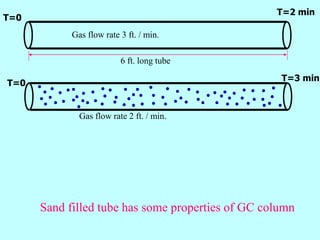
T=0
T=2 min
6 ft. long tube
Gas flow rate 3 ft. / min.
Gas flow rate 2 ft. / min.
T=0
T=3 min
Sand filled tube has some properties of GC column
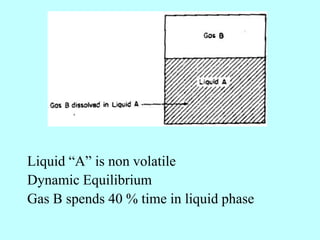
Liquid “A” is non volatile
Dynamic Equilibrium
Gas B spends 40 % time in liquid phase
T=0
T=2 min
6 ft. long tube
Gas flow rate 3 ft. / min.
Gas flow rate 2 ft. / min.
T=0
T=3 min
T=0
T=5 min
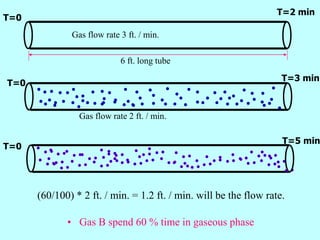
(60/100) * 2 ft. / min. = 1.2 ft. / min. will be the flow rate.
• Gas B spend 60 % time in gaseous phase
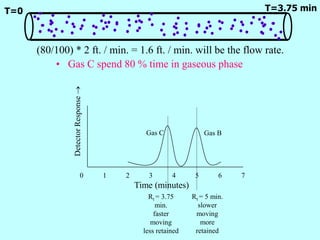
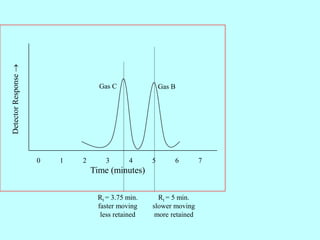
• Gas C spend 80 % time in gaseous phase
(80/100) * 2 ft. / min. = 1.6 ft. / min. will be the flow rate.
T=0 T=3.75 min
Rt = 3.75
min.
faster
moving
less retained
Rt = 5 min.
slower
moving
more
retained
0 1 2 3 4 5 6 7
Time (minutes)
DetectorResponse
Gas C Gas B
T=10’
T=20’
T=0
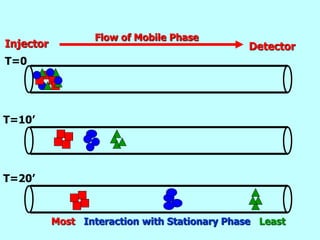
Injector Detector
Most Interaction with Stationary Phase Least
Flow of Mobile Phase
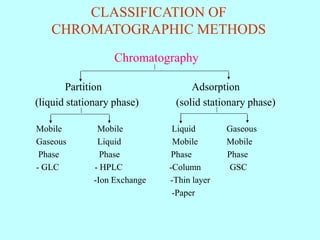
CLASSIFICATION OF
CHROMATOGRAPHIC METHODS
Chromatography
Partition Adsorption
(liquid stationary phase) (solid stationary phase)
Mobile Mobile Liquid Gaseous
Gaseous Liquid Mobile Mobile
Phase Phase Phase Phase
- GLC - HPLC -Column GSC
-Ion Exchange -Thin layer
-Paper
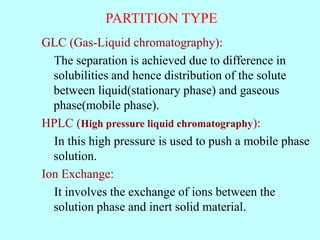
PARTITION TYPE
GLC (Gas-Liquid chromatography):
The separation is achieved due to difference in
solubilities and hence distribution of the solute
between liquid(stationary phase) and gaseous
phase(mobile phase).
HPLC (High pressure liquid chromatography):
In this high pressure is used to push a mobile phase
solution.
Ion Exchange:
It involves the exchange of ions between the
solution phase and inert solid material.
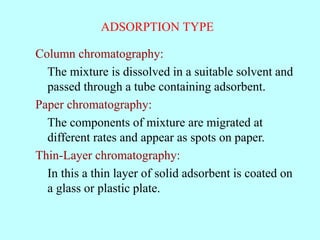
ADSORPTION TYPE
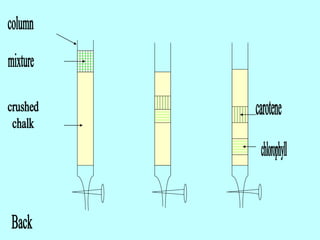
Column chromatography:
The mixture is dissolved in a suitable solvent and
passed through a tube containing adsorbent.
Paper chromatography:
The components of mixture are migrated at
different rates and appear as spots on paper.
Thin-Layer chromatography:
In this a thin layer of solid adsorbent is coated on
a glass or plastic plate.
In GAS CHROMATOGRAPHY
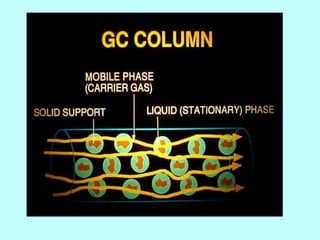
• The mobile phase is an inert carrier gas.
• The stationary phase is a solid or a liquid coated
on a solid contained in a coiled column.
INSTRUMENTATION OF GAS
CHROMATOGRAPHY
• Operating principle of GC:
A sample is,
• Introduced into a injector port.
• Passed through column with inert carrier gas.
• Detected as a series of peaks by detector.
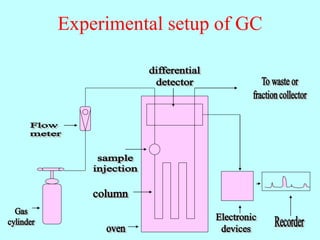
Experimental setup of GC
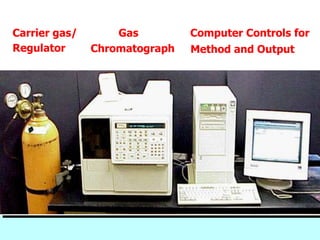
Carrier gas/
Regulator
Gas
Chromatograph
Computer Controls for
Method and Output
CARRIER GAS
• It is stored in gas cylinder under pressure.
• Its flow rate is controlled by two stage regulator.
• carrier gas should have following properties :
• Inert
• Suitable for detector and sample.
• Readily available in pure form.
• Cheap
• Best column performance with required
speed of analysis.
• Non explosive
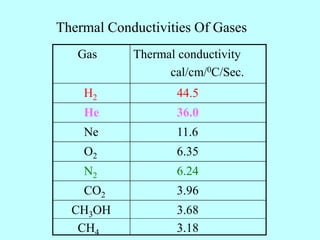
• In GC H2, He, and N2 are widely used as carrier
gas.
• Choice of Carrier Gas depends on sample to be
analyzed.
Thermal Conductivities Of Gases
3.68
3.18
CH3OH
CH4
3.96CO2
6.24N2
6.35O2
11.6Ne
36.0He
44.5H2
Thermal conductivity
cal/cm/0C/Sec.
Gas
SAMPLE INJECTION SYSTEM
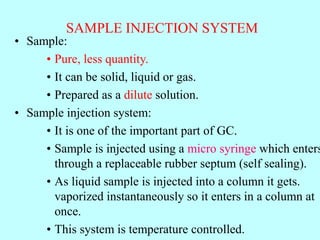
• Sample:
• Pure, less quantity.
• It can be solid, liquid or gas.
• Prepared as a dilute solution.
• Sample injection system:
• It is one of the important part of GC.
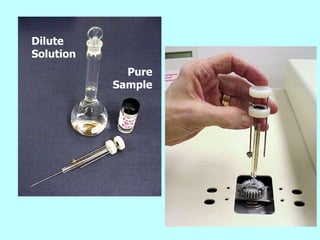
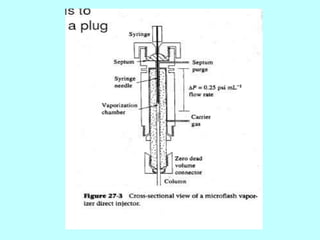
• Sample is injected using a micro syringe which enters
through a replaceable rubber septum (self sealing).
• As liquid sample is injected into a column it gets.
vaporized instantaneously so it enters in a column at
once.
• This system is temperature controlled.
Dilute
Solution
Pure
Sample
Column
• Columns are called as the brain of chromatograph.
• Generally used for the analytical purpose.
• Made up of glass or metal tube.
• Columns are usually placed in coiled form in a oven.
• There are two types of columns –
1) Packed column
2) Capillary columns
• Except columns all the components are same for
GLC and GSC.
Packed Columns
• Made up of glass or a metal tube having
– Diameter 1 to 8 mm.
– Length 2 to 20 meter.
• The number of theoretical plates are 20,000 or
more.
• Metal tube is packed with granular stationary phase.
• For GLC- Packing is prepared by coating a liquid
phase over an inert solid support.
• For GSC- Packed with size graded absorbent or a
porous polymer.
Efficiency of Chromatographic Column
• The efficiency of chromatographic column
is a measure of its ability to separate the
components of a mixture.
• The efficiency of chromatographic column
is expressed in terms of number of
Theoretical plates, a term borrowed from
distillation process.
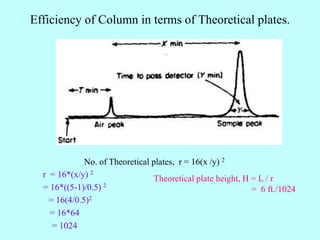
Efficiency of Column in terms of Theoretical plates.
No. of Theoretical plates, r = 16(x /y) 2
r = 16*(x/y) 2
= 16*((5-1)/0.5) 2
= 16(4/0.5)2
= 16*64
= 1024
Theoretical plate height, H = L / r
= 6 ft./1024
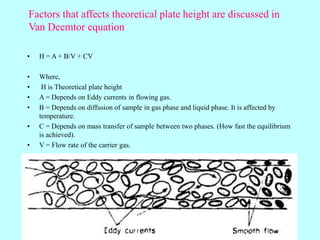
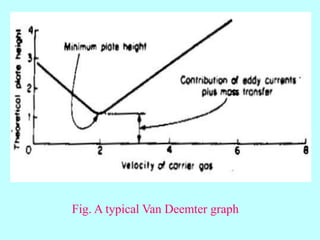
Factors that affects theoretical plate height are discussed in
Van Deemtor equation
• H = A + B/V + CV
• Where,
• H is Theoretical plate height
• A = Depends on Eddy currents in flowing gas.
• B = Depends on diffusion of sample in gas phase and liquid phase. It is affected by
temperature.
• C = Depends on mass transfer of sample between two phases. (How fast the equilibrium
is achieved).
• V = Flow rate of the carrier gas.
Fig. A typical Van Deemter graph
Stationary phase
In GLC, Support must satisfy the following properties-
• High surface area.
• Chemically inert.
• Material used as a support is crushed fire brick and used even in high
temperature furnaces for extended time periods.
• Surface of support is coated with liquid film, which is also chemically
inert and it’s vapor pressure must be low.
• Column packing is based on the type of the sample to be analyzed.
For Example,
• Carbowax 20 M (Polyethylene Glycol) is preferred for the
separation of alcohols, esters, pesticides and essence of oils.
• DEG adipate (Diethylene Glycol) column is used for the separation
of fatty acids, esters and pesticides.
Stationary phase
• For GSC, Use of porous polymer beads as a
packing material have certain advantages-
• Stable up to 250 0C and causes no base line drift
and hence allows the use of the highly sensitive
detectors.
• no adsorption of polar components such as
water, alcohols, acids and are eluted rapidly as a
sharp symmetrical peaks.
• Sample overload recovery is rapid and without
trailing.
• Polymer beads are mechanically strong.
• Retention data are highly reproducible.
• Some of the separation provided are unique.
Column packing
• It is important that the packing is evenly done and
contains no gaps. Following method is used for the
packing of column:
Column is left uncoiled and held vertically on a
suitable plane. The column material is slowly added
to it from the top. In this way every time small
quantity of material is added and column is well
shaken.
At this stage the ultrasonic vibrator is used to vibrate
the column.
After packing, both the ends are sealed by glass wool.
Then the column is bent into a coil so that it will be
more compact for handling.
Now the column is ready to use in the instrument.
Capillary column
• These are also called as the open tabular columns.
• Made up of stainless steel, copper or a glass etc.
but stainless steel is most popular.
– Diameter is 0.25 to 0.75 mm.
– Length is 30 to 90 meter.
• Inside walls are coated with liquid phase in the
form of thin (0.5 to 1 micron) and uniform film.
• Number of theoretical plates are about several
100 to several 1000.
• Disadvantage – low capacity of resolution.
• It is very delicate.
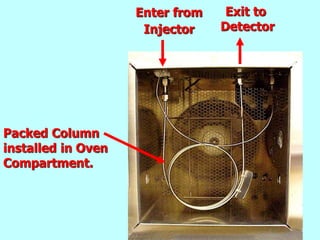
Exit to
Detector
Enter from
Injector
Packed Column
installed in Oven
Compartment.
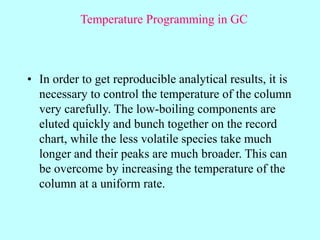
Temperature Programming in GC
• In order to get reproducible analytical results, it is
necessary to control the temperature of the column
very carefully. The low-boiling components are
eluted quickly and bunch together on the record
chart, while the less volatile species take much
longer and their peaks are much broader. This can
be overcome by increasing the temperature of the
column at a uniform rate.
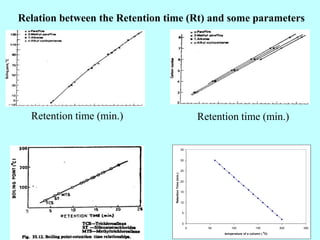
Relation between the Retention time (Rt) and some parameters
Retention time (min.) Retention time (min.)
0
5
10
15
20
25
30
35
0 50 100 150 200 250
temperature of a column ( 0
C)
RetentionTime(min.)
Qualitative analysis
• For a given column, if flow rate and temperature is
kept constant then the retention time data can be
highly reproducible and be used to identify the
compound.
• To check the quality of Product one has synthesized.
• To find the trace impurity if present in the sample.
Quantitative analysis
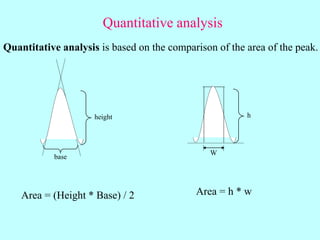
Quantitative analysis is based on the comparison of the area of the peak.
base
height h
W
Area = (Height * Base) / 2 Area = h * w
DETECTOR
• Function: To detect and measure different components
of sample as they emerge from column.
• Choice of detector depends upon type of analysis being
performed.
• Characteristics of an ideal detector :
• Rapid and reproducible response though quantity
of sample is less.
• Linear response over large concentration range.
• Good stability over entire temperature range.
• Uniform response to compounds of same
concentration having different chemical nature.
No single detector has all above characteristics.
• First family detectors:
• It responds to concentration
(in mole fraction) of solute.
• It do not destroys the
sample.
e.g Thermal conductivity
detector,
Electron capture detector,
Cross section detector,
Gas density balance,etc.
• Second family detectors :
• It responds to mass flow
rate of solute (in moles per
unit time).
• It destroys the sample.
e.g. Flame ionization detector,
Flame emission detector,
Microwave plasma detector,
Argon Ionization detector,
Helium Ionization detector
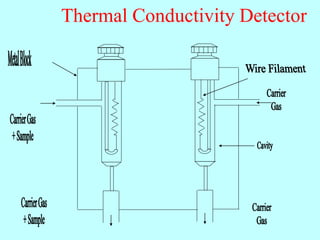
Thermal Conductivity Detector
• It belongs to first family detectors.
( Nondestructive detection technique)
• It is simple in construction.
• It is the most common.
• It is non selective i.e. Adequate sensitivity for many
compounds.
• It gives good linear range of signal.
• Signal is quite stable, provided carrier gas flow rate,
block temperature, and filament power are controlled.
• Principle : It is based on the difference between
the thermal conductivities of carrier gas and
sample.
Thermal Conductivity Detector
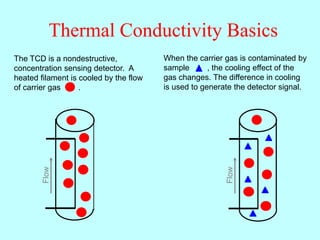
Thermal Conductivity Basics
When the carrier gas is contaminated by
sample , the cooling effect of the
gas changes. The difference in cooling
is used to generate the detector signal.
The TCD is a nondestructive,
concentration sensing detector. A
heated filament is cooled by the flow
of carrier gas .
Flow
Flow
Unequal loss of heat from filament
• When a compound elutes, the thermal
conductivity of the gaseous mixture of carrier gas
and compound gas is lowered, and the filament in
the sample column becomes hotter than the other
control column.
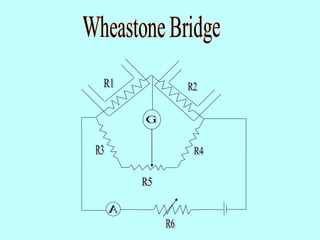
• Its resistance increased, and this imbalance
between control and sample filament resistances is
measured by a simple gadget and a signal is
recorded.
• For maximum sensitivity, change in resistivity
should be large. Hence carrier gas of high thermal
conductivity is used.
• H2, He has thermal conductivity 6 to 10 times
that of most organic compound. But they are
hazardous and costly.
• N2,Co2 has same order of thermal conductivity
as that of most organic compound. They are
cheap and non hazardous.
• TCD is not most sensitive but satisfactory for a
wide variety of analytical applications.
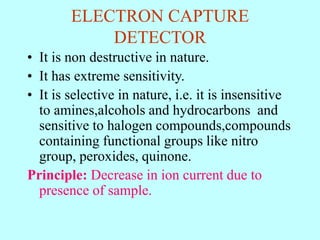
ELECTRON CAPTURE
DETECTOR
• It is non destructive in nature.
• It has extreme sensitivity.
• It is selective in nature, i.e. it is insensitive
to amines,alcohols and hydrocarbons and
sensitive to halogen compounds,compounds
containing functional groups like nitro
group, peroxides, quinone.
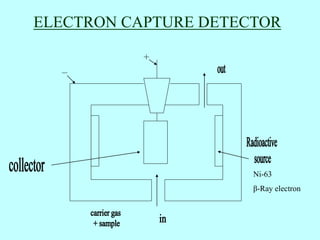
Principle: Decrease in ion current due to
presence of sample.
ELECTRON CAPTURE DETECTOR
Ni-63
β-Ray electron
Flame Ionization Detector
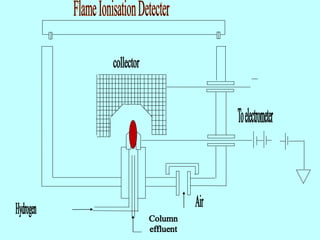
• It is destructive in nature.
• It is one of the most sensitive detector.
• It is 1000 times sensitive than TCD.
• It is sensitive to all hydrocarbons and hetero-organic
compounds.
• Insensitive to many inorganic compounds.
• It is superior for quantitative analysis.
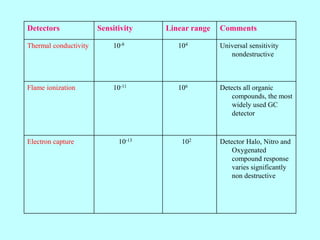
Detectors Sensitivity Linear range Comments
Thermal conductivity 10-8 104 Universal sensitivity
nondestructive
Flame ionization 10-11 106 Detects all organic
compounds, the most
widely used GC
detector
Electron capture 10-13 102 Detector Halo, Nitro and
Oxygenated
compound response
varies significantly
non destructive
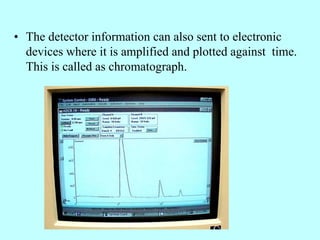
• The detector information can also sent to electronic
devices where it is amplified and plotted against time.
This is called as chromatograph.
Analysis of Data
• Each component of the mixture reaches the detector at
a different time and produces a signal at a
characteristic time called a retention time.
• In the printout of the chromatographic analysis:
• the number of peaks correlates with the number
of components in the sample,
• the area under each peak correlates with the
relative amount of that component in the sample,
• and if standard information is available, the
retention time under defined conditions can be
used to identify each component.
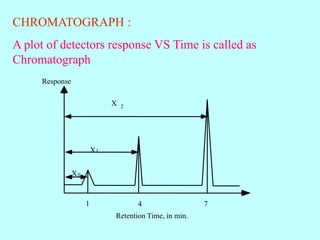
CHROMATOGRAPH :
A plot of detectors response VS Time is called as
Chromatograph
Response
Retention Time, in min.
X
X
X
1
2
1
0
4 7
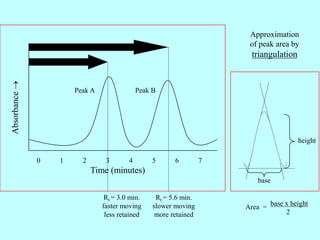
Rt = 3.0 min.
faster moving
less retained
Rt = 5.6 min.
slower moving
more retained
Approximation
of peak area by
triangulation
Area =
base x height
2
base
height
0 1 2 3 4 5 6 7
Time (minutes)
Absorbance
Peak A Peak B
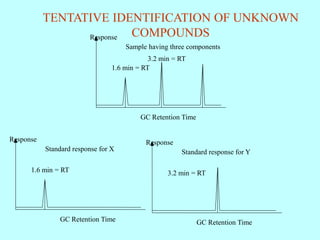
TENTATIVE IDENTIFICATION OF UNKNOWN
COMPOUNDS
Response
GC Retention Time
Standard response for X
1.6 min = RT
Response
GC Retention Time
Standard response for Y
3.2 min = RT
Response
GC Retention Time
Sample having three components
1.6 min = RT
3.2 min = RT
MAIN ADVANTAGES OF GC
• Strong separation power
• High sensitivity
• Good precision and accuracy
• Short time analysis
• Low cost and long life
• Easy to handle: does not require highly
qualified person.
THANK YOU
for hearing me patiently
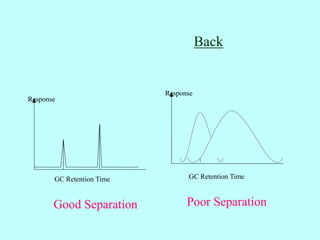
Response
GC Retention Time
Good Separation
Response
GC Retention Time
Poor Separation
Back
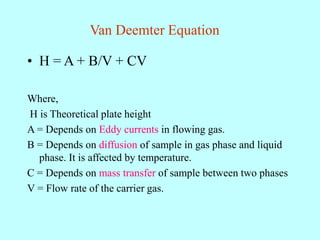
Van Deemter Equation
• H = A + B/V + CV
Where,
H is Theoretical plate height
A = Depends on Eddy currents in flowing gas.
B = Depends on diffusion of sample in gas phase and liquid
phase. It is affected by temperature.
C = Depends on mass transfer of sample between two phases
V = Flow rate of the carrier gas.
Rt = 3.75 min.
faster moving
less retained
Rt = 5 min.
slower moving
more retained
0 1 2 3 4 5 6 7
Time (minutes)
DetectorResponse
Gas C Gas B

GAS CHROMATOGRAPHY

  • 1.
  • 2.
    INTRODUCTION TO CHROMATOGRAPHY • Invention: •By M.Twsett in 1906 • ‘chroma’ means color and ‘graphy’ means writing • Definition : It is an instrumental method for separation and identification of chemical compounds. • Principle : This technique is based on the difference in the rate at which the components of a mixture move through a porous medium (stationary phase) under the influence of some solvent or gas (moving phase).
  • 4.
    T=0 T=2 min 6 ft.long tube Gas flow rate 3 ft. / min. Gas flow rate 2 ft. / min. T=0 T=3 min Sand filled tube has some properties of GC column
  • 5.
    Liquid “A” isnon volatile Dynamic Equilibrium Gas B spends 40 % time in liquid phase
  • 6.
    T=0 T=2 min 6 ft.long tube Gas flow rate 3 ft. / min. Gas flow rate 2 ft. / min. T=0 T=3 min T=0 T=5 min (60/100) * 2 ft. / min. = 1.2 ft. / min. will be the flow rate. • Gas B spend 60 % time in gaseous phase
  • 7.
    • Gas Cspend 80 % time in gaseous phase (80/100) * 2 ft. / min. = 1.6 ft. / min. will be the flow rate. T=0 T=3.75 min Rt = 3.75 min. faster moving less retained Rt = 5 min. slower moving more retained 0 1 2 3 4 5 6 7 Time (minutes) DetectorResponse Gas C Gas B
  • 8.
    T=10’ T=20’ T=0 Injector Detector Most Interactionwith Stationary Phase Least Flow of Mobile Phase
  • 9.
    CLASSIFICATION OF CHROMATOGRAPHIC METHODS Chromatography PartitionAdsorption (liquid stationary phase) (solid stationary phase) Mobile Mobile Liquid Gaseous Gaseous Liquid Mobile Mobile Phase Phase Phase Phase - GLC - HPLC -Column GSC -Ion Exchange -Thin layer -Paper
  • 10.
    PARTITION TYPE GLC (Gas-Liquidchromatography): The separation is achieved due to difference in solubilities and hence distribution of the solute between liquid(stationary phase) and gaseous phase(mobile phase). HPLC (High pressure liquid chromatography): In this high pressure is used to push a mobile phase solution. Ion Exchange: It involves the exchange of ions between the solution phase and inert solid material.
  • 11.
    ADSORPTION TYPE Column chromatography: Themixture is dissolved in a suitable solvent and passed through a tube containing adsorbent. Paper chromatography: The components of mixture are migrated at different rates and appear as spots on paper. Thin-Layer chromatography: In this a thin layer of solid adsorbent is coated on a glass or plastic plate.
  • 12.
    In GAS CHROMATOGRAPHY •The mobile phase is an inert carrier gas. • The stationary phase is a solid or a liquid coated on a solid contained in a coiled column.
  • 13.
    INSTRUMENTATION OF GAS CHROMATOGRAPHY •Operating principle of GC: A sample is, • Introduced into a injector port. • Passed through column with inert carrier gas. • Detected as a series of peaks by detector.
  • 14.
  • 15.
  • 16.
    CARRIER GAS • Itis stored in gas cylinder under pressure. • Its flow rate is controlled by two stage regulator. • carrier gas should have following properties : • Inert • Suitable for detector and sample. • Readily available in pure form. • Cheap • Best column performance with required speed of analysis. • Non explosive • In GC H2, He, and N2 are widely used as carrier gas. • Choice of Carrier Gas depends on sample to be analyzed.
  • 17.
    Thermal Conductivities OfGases 3.68 3.18 CH3OH CH4 3.96CO2 6.24N2 6.35O2 11.6Ne 36.0He 44.5H2 Thermal conductivity cal/cm/0C/Sec. Gas
  • 18.
    SAMPLE INJECTION SYSTEM •Sample: • Pure, less quantity. • It can be solid, liquid or gas. • Prepared as a dilute solution. • Sample injection system: • It is one of the important part of GC. • Sample is injected using a micro syringe which enters through a replaceable rubber septum (self sealing). • As liquid sample is injected into a column it gets. vaporized instantaneously so it enters in a column at once. • This system is temperature controlled.
  • 19.
  • 21.
    Column • Columns arecalled as the brain of chromatograph. • Generally used for the analytical purpose. • Made up of glass or metal tube. • Columns are usually placed in coiled form in a oven. • There are two types of columns – 1) Packed column 2) Capillary columns • Except columns all the components are same for GLC and GSC.
  • 22.
    Packed Columns • Madeup of glass or a metal tube having – Diameter 1 to 8 mm. – Length 2 to 20 meter. • The number of theoretical plates are 20,000 or more. • Metal tube is packed with granular stationary phase. • For GLC- Packing is prepared by coating a liquid phase over an inert solid support. • For GSC- Packed with size graded absorbent or a porous polymer.
  • 23.
    Efficiency of ChromatographicColumn • The efficiency of chromatographic column is a measure of its ability to separate the components of a mixture. • The efficiency of chromatographic column is expressed in terms of number of Theoretical plates, a term borrowed from distillation process.
  • 24.
    Efficiency of Columnin terms of Theoretical plates. No. of Theoretical plates, r = 16(x /y) 2 r = 16*(x/y) 2 = 16*((5-1)/0.5) 2 = 16(4/0.5)2 = 16*64 = 1024 Theoretical plate height, H = L / r = 6 ft./1024
  • 25.
    Factors that affectstheoretical plate height are discussed in Van Deemtor equation • H = A + B/V + CV • Where, • H is Theoretical plate height • A = Depends on Eddy currents in flowing gas. • B = Depends on diffusion of sample in gas phase and liquid phase. It is affected by temperature. • C = Depends on mass transfer of sample between two phases. (How fast the equilibrium is achieved). • V = Flow rate of the carrier gas.
  • 26.
    Fig. A typicalVan Deemter graph
  • 27.
    Stationary phase In GLC,Support must satisfy the following properties- • High surface area. • Chemically inert. • Material used as a support is crushed fire brick and used even in high temperature furnaces for extended time periods. • Surface of support is coated with liquid film, which is also chemically inert and it’s vapor pressure must be low. • Column packing is based on the type of the sample to be analyzed. For Example, • Carbowax 20 M (Polyethylene Glycol) is preferred for the separation of alcohols, esters, pesticides and essence of oils. • DEG adipate (Diethylene Glycol) column is used for the separation of fatty acids, esters and pesticides.
  • 29.
    Stationary phase • ForGSC, Use of porous polymer beads as a packing material have certain advantages- • Stable up to 250 0C and causes no base line drift and hence allows the use of the highly sensitive detectors. • no adsorption of polar components such as water, alcohols, acids and are eluted rapidly as a sharp symmetrical peaks. • Sample overload recovery is rapid and without trailing. • Polymer beads are mechanically strong. • Retention data are highly reproducible. • Some of the separation provided are unique.
  • 30.
    Column packing • Itis important that the packing is evenly done and contains no gaps. Following method is used for the packing of column: Column is left uncoiled and held vertically on a suitable plane. The column material is slowly added to it from the top. In this way every time small quantity of material is added and column is well shaken. At this stage the ultrasonic vibrator is used to vibrate the column. After packing, both the ends are sealed by glass wool. Then the column is bent into a coil so that it will be more compact for handling. Now the column is ready to use in the instrument.
  • 31.
    Capillary column • Theseare also called as the open tabular columns. • Made up of stainless steel, copper or a glass etc. but stainless steel is most popular. – Diameter is 0.25 to 0.75 mm. – Length is 30 to 90 meter. • Inside walls are coated with liquid phase in the form of thin (0.5 to 1 micron) and uniform film. • Number of theoretical plates are about several 100 to several 1000. • Disadvantage – low capacity of resolution. • It is very delicate.
  • 33.
    Exit to Detector Enter from Injector PackedColumn installed in Oven Compartment.
  • 34.
    Temperature Programming inGC • In order to get reproducible analytical results, it is necessary to control the temperature of the column very carefully. The low-boiling components are eluted quickly and bunch together on the record chart, while the less volatile species take much longer and their peaks are much broader. This can be overcome by increasing the temperature of the column at a uniform rate.
  • 35.
    Relation between theRetention time (Rt) and some parameters Retention time (min.) Retention time (min.) 0 5 10 15 20 25 30 35 0 50 100 150 200 250 temperature of a column ( 0 C) RetentionTime(min.)
  • 36.
    Qualitative analysis • Fora given column, if flow rate and temperature is kept constant then the retention time data can be highly reproducible and be used to identify the compound. • To check the quality of Product one has synthesized. • To find the trace impurity if present in the sample.
  • 37.
    Quantitative analysis Quantitative analysisis based on the comparison of the area of the peak. base height h W Area = (Height * Base) / 2 Area = h * w
  • 38.
    DETECTOR • Function: Todetect and measure different components of sample as they emerge from column. • Choice of detector depends upon type of analysis being performed. • Characteristics of an ideal detector : • Rapid and reproducible response though quantity of sample is less. • Linear response over large concentration range. • Good stability over entire temperature range. • Uniform response to compounds of same concentration having different chemical nature. No single detector has all above characteristics.
  • 39.
    • First familydetectors: • It responds to concentration (in mole fraction) of solute. • It do not destroys the sample. e.g Thermal conductivity detector, Electron capture detector, Cross section detector, Gas density balance,etc. • Second family detectors : • It responds to mass flow rate of solute (in moles per unit time). • It destroys the sample. e.g. Flame ionization detector, Flame emission detector, Microwave plasma detector, Argon Ionization detector, Helium Ionization detector
  • 40.
    Thermal Conductivity Detector •It belongs to first family detectors. ( Nondestructive detection technique) • It is simple in construction. • It is the most common. • It is non selective i.e. Adequate sensitivity for many compounds. • It gives good linear range of signal. • Signal is quite stable, provided carrier gas flow rate, block temperature, and filament power are controlled. • Principle : It is based on the difference between the thermal conductivities of carrier gas and sample.
  • 41.
  • 43.
    Thermal Conductivity Basics Whenthe carrier gas is contaminated by sample , the cooling effect of the gas changes. The difference in cooling is used to generate the detector signal. The TCD is a nondestructive, concentration sensing detector. A heated filament is cooled by the flow of carrier gas . Flow Flow
  • 44.
    Unequal loss ofheat from filament • When a compound elutes, the thermal conductivity of the gaseous mixture of carrier gas and compound gas is lowered, and the filament in the sample column becomes hotter than the other control column. • Its resistance increased, and this imbalance between control and sample filament resistances is measured by a simple gadget and a signal is recorded.
  • 45.
    • For maximumsensitivity, change in resistivity should be large. Hence carrier gas of high thermal conductivity is used. • H2, He has thermal conductivity 6 to 10 times that of most organic compound. But they are hazardous and costly. • N2,Co2 has same order of thermal conductivity as that of most organic compound. They are cheap and non hazardous. • TCD is not most sensitive but satisfactory for a wide variety of analytical applications.
  • 46.
    ELECTRON CAPTURE DETECTOR • Itis non destructive in nature. • It has extreme sensitivity. • It is selective in nature, i.e. it is insensitive to amines,alcohols and hydrocarbons and sensitive to halogen compounds,compounds containing functional groups like nitro group, peroxides, quinone. Principle: Decrease in ion current due to presence of sample.
  • 47.
  • 48.
    Flame Ionization Detector •It is destructive in nature. • It is one of the most sensitive detector. • It is 1000 times sensitive than TCD. • It is sensitive to all hydrocarbons and hetero-organic compounds. • Insensitive to many inorganic compounds. • It is superior for quantitative analysis.
  • 50.
    Detectors Sensitivity Linearrange Comments Thermal conductivity 10-8 104 Universal sensitivity nondestructive Flame ionization 10-11 106 Detects all organic compounds, the most widely used GC detector Electron capture 10-13 102 Detector Halo, Nitro and Oxygenated compound response varies significantly non destructive
  • 51.
    • The detectorinformation can also sent to electronic devices where it is amplified and plotted against time. This is called as chromatograph.
  • 52.
    Analysis of Data •Each component of the mixture reaches the detector at a different time and produces a signal at a characteristic time called a retention time. • In the printout of the chromatographic analysis: • the number of peaks correlates with the number of components in the sample, • the area under each peak correlates with the relative amount of that component in the sample, • and if standard information is available, the retention time under defined conditions can be used to identify each component.
  • 53.
    CHROMATOGRAPH : A plotof detectors response VS Time is called as Chromatograph Response Retention Time, in min. X X X 1 2 1 0 4 7
  • 54.
    Rt = 3.0min. faster moving less retained Rt = 5.6 min. slower moving more retained Approximation of peak area by triangulation Area = base x height 2 base height 0 1 2 3 4 5 6 7 Time (minutes) Absorbance Peak A Peak B
  • 55.
    TENTATIVE IDENTIFICATION OFUNKNOWN COMPOUNDS Response GC Retention Time Standard response for X 1.6 min = RT Response GC Retention Time Standard response for Y 3.2 min = RT Response GC Retention Time Sample having three components 1.6 min = RT 3.2 min = RT
  • 56.
    MAIN ADVANTAGES OFGC • Strong separation power • High sensitivity • Good precision and accuracy • Short time analysis • Low cost and long life • Easy to handle: does not require highly qualified person.
  • 57.
  • 59.
    Response GC Retention Time GoodSeparation Response GC Retention Time Poor Separation Back
  • 60.
    Van Deemter Equation •H = A + B/V + CV Where, H is Theoretical plate height A = Depends on Eddy currents in flowing gas. B = Depends on diffusion of sample in gas phase and liquid phase. It is affected by temperature. C = Depends on mass transfer of sample between two phases V = Flow rate of the carrier gas.
  • 61.
    Rt = 3.75min. faster moving less retained Rt = 5 min. slower moving more retained 0 1 2 3 4 5 6 7 Time (minutes) DetectorResponse Gas C Gas B