A seminar on

AUTOMOTIVE TEXTILES


                 Hitesh Choudhary
        www.facebook.com/hitesh.choudhary1
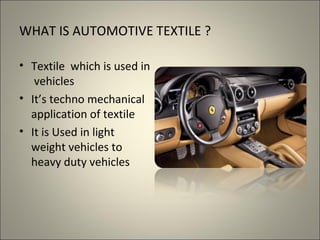
WHAT IS AUTOMOTIVE TEXTILE ?

• Textile which is used in
   vehicles
• It’s techno mechanical
  application of textile
• It is Used in light
  weight vehicles to
  heavy duty vehicles
FUNCTIONS:

• COMFORT

• DECORATIVE

• SAFETY PURPOSE

• FUNCTIONAL
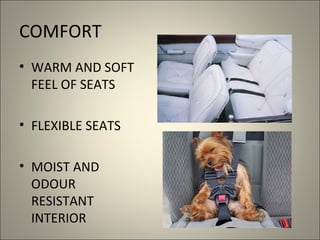
COMFORT
• WARM AND SOFT
  FEEL OF SEATS

• FLEXIBLE SEATS

• MOIST AND
  ODOUR
  RESISTANT
  INTERIOR
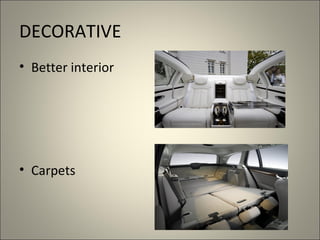
DECORATIVE
• Better interior


• Carpets
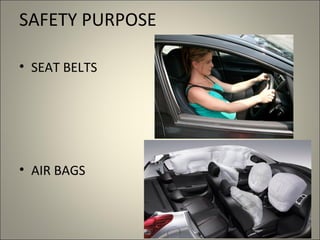
SAFETY PURPOSE

• SEAT BELTS


• AIR BAGS
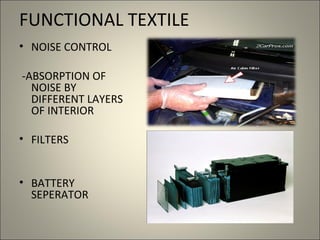
FUNCTIONAL TEXTILE
• NOISE CONTROL

-ABSORPTION OF
  NOISE BY
  DIFFERENT LAYERS
  OF INTERIOR

• FILTERS


• BATTERY
  SEPERATOR
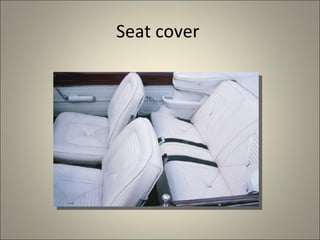
Seat cover
Seat cover
• Woven seat cover is one of the important
  contributors of technical textile in an
  automobile.
• With gradual improvement in vehicle
  models and increased emphasis on luxury
  and comfort, the seat cover market has
  witnessed uptrend in the market.
• Seat covers are made from cotton, vinyl,
  velvet and leather.
Seat cover
Product Characteristics:
• The fabric used for the manufacturing of seat covers is
  woven on looms.
• The desired product characteristics are durability, ultra-
  violet fade and wear resistance, water-proofing,
  flexibility and stretchability.
• The type of seat cover used varies based on the
  automobile model and desired styling of the upholstery.
• The yarn required for the seat covers is in the range of
  500 deniers to 1300 deniers.
• The fabric is further laminated to provide desired
  protection characteristics.
HELMET
HELMET

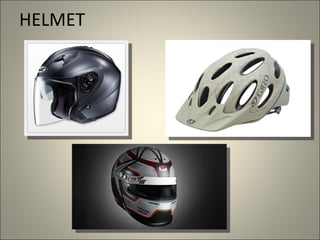
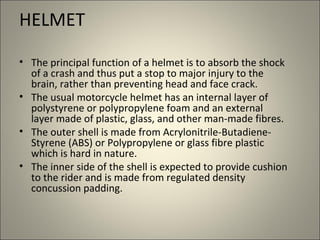
• The principal function of a helmet is to absorb the shock
  of a crash and thus put a stop to major injury to the
  brain, rather than preventing head and face crack.
• The usual motorcycle helmet has an internal layer of
  polystyrene or polypropylene foam and an external
  layer made of plastic, glass, and other man-made fibres.
• The outer shell is made from Acrylonitrile-Butadiene-
  Styrene (ABS) or Polypropylene or glass fibre plastic
  which is hard in nature.
• The inner side of the shell is expected to provide cushion
  to the rider and is made from regulated density
  concussion padding.
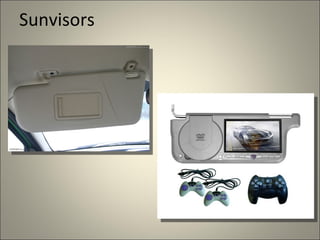
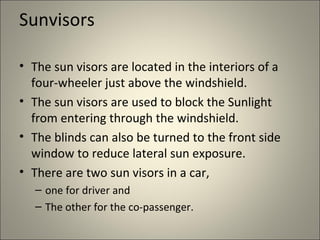
Sunvisors
Sunvisors

• The sun visors are located in the interiors of a
  four-wheeler just above the windshield.
• The sun visors are used to block the Sunlight
  from entering through the windshield.
• The blinds can also be turned to the front side
  window to reduce lateral sun exposure.
• There are two sun visors in a car,
   – one for driver and
   – The other for the co-passenger.
Sunvisors

Product Characteristics:

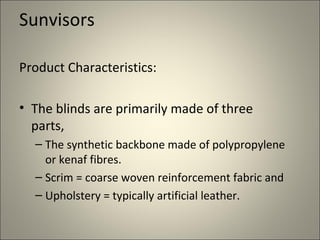
• The blinds are primarily made of three
  parts,
  – The synthetic backbone made of polypropylene
    or kenaf fibres.
  – Scrim = coarse woven reinforcement fabric and
  – Upholstery = typically artificial leather.
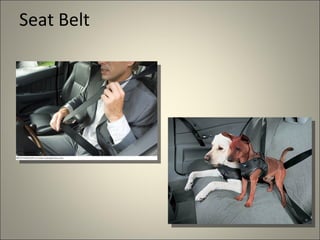
Seat Belt
Seat Belt

• Seat belts function as a safety harnesses
  which secure the passengers in a vehicle
  against harmful movements during collision
  or similar incidents.
• Seat belts are woven narrow fabric made
  from nylon filament yarns or high tensile
  polyester filament yarn.
• The load specification is an important
  criterion for usage in vehicles.
Seat Belt

Product Characteristics:
• Are made from nylon filament yarn or polyester filament yarn
   which is woven to produce the webbing pattern.
• The linear density of man-made yarns must be stuck between
   100dtex and 3000dtex, preferably 550-1800dtex.
• A typical seat belt is made of 320 ends of 1,100 dtex polyester
   each.
• The majority weft yarns prepared from polyester are 550dtex.
• The critical characteristics of the webbing are:
    – Abrasion resistance,
    – Resistance to light and heat,
    – Capable of being removed and put back in place easily and good
      retraction behavior.
    – The load bearing capacity of seat belts is 1500 kilograms.
Interior carpets
Interior carpets

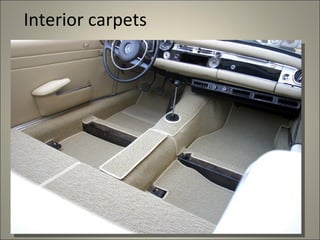
• The carpets are laid in the cabin and parcel
  shelf at the back.
• The carpets are primarily non-woven textile
  material.
• The usage of carpets varies based on the
  interior designs which vary across car
  models.
• Usage of carpets in buses and other
  M&HCVs is minimal.
Interior carpets
Product Characteristics:

•   The interior carpets are made primarily from polypropylene fibres.

•   The carpet is laid on the vehicle floor above which rubber mats are
    placed.

•   The desired characteristics of automobile interior carpets typically are as
    given below:
     –   High durability
     –   High abrasion resistance
     –   Tensile strength – warp around 50 KGF and weft around 45 KGF
     –   Low inflammability
     –   Good compression recovery

•   The fabric is around 500 GSM with a thickness of about 3mm.
Car Body covers
Car Body covers
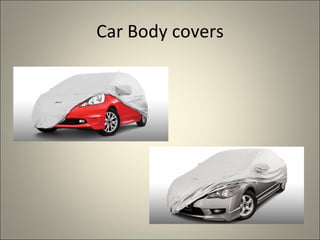
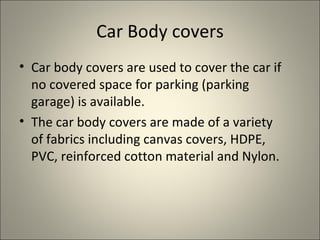
• Car body covers are used to cover the car if
  no covered space for parking (parking
  garage) is available.
• The car body covers are made of a variety
  of fabrics including canvas covers, HDPE,
  PVC, reinforced cotton material and Nylon.
Air Bags
Air Bags
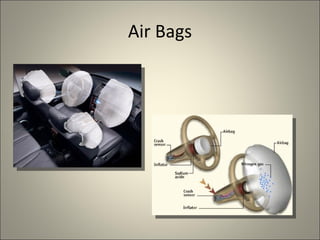
•   It is a safety device aimed at preventing or minimizing injury to passengers
    when such an accident occurs.

•   An airbag is an elastic bag or cushion like makeup which inflates and
    deflates quickly at some stage in certain types of car accidents.
•   Airbags have been efficient to put a stop to severe head and chest injuries
    in adults when automobile accidents have occurred.
•   Airbags can be located in both the front and Side of vehicles.
     – Frontal Airbags: The airbag component for the driver side is situated in the
       centre of the steering wheel, whereas the passenger side component (if
       equipped) can be found in the dashboard above the glove box.
     – Side Airbags : There are three different types of side air bag systems currently
       available:
         • Roof-mounted side airbags designed to protect the head and neck.
         • Door-mounted side airbags designed to protect the chest.
         • Seat-mounted airbags designed to protect the chest and head.
Air Bags
Product Characteristics:
• Nylon 6, 6 is used as a key raw material.
• The yarn / fabric are primarily nylon 66,
  lighter denier, and silicone coated.
• Approximately, 1.8 square meter of fabric is
  used per airbag module.
INSULATING FELTS
INSULATING FELTS

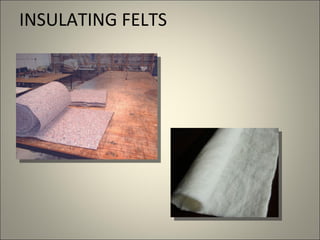
• Insulation felts, often known as NVH products
  (Noise, Vibration, and Harshness parts) are
  used for acoustic and thermal insulation in the
  automobiles
• These are Bonnet liner, Outer dash,
  Wheelhouse, and Outer floor under shield.
  These parts not only provide noise protection
  inside the car but also a reduction in the noise
  emission outside.
• Insulation felts are 100% polyester non-woven
  technical textile products.
INSULATING FELTS

Product characteristics
• The NVH products or insulation felts are
  100% polyester non-woven technical textile
  products.
• These products are classified based on the
  manufacturing process as needle-punched,
  phenolic resin bonded and thermoplastic.
• The felts are generally soft and used with or
  without harder backing.
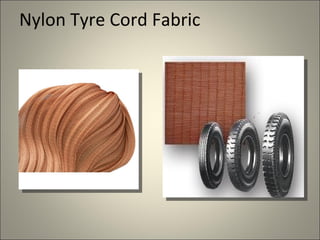
Nylon Tyre Cord Fabric

• Nylon tyre cord fabric provides strength to a tyre.
• Nylon tyre cord fabric gradually replaced the usage of
  rayon and polyester cords in the tyre industry.
• The nylon tyre cord is prepared from high tenacity
  continuous filament yarn by twisting and plying.
• There are two main types of nylons used as tyre cord,
  i.e.
   – Nylon-6 and
   – Nylon-6, 6.
• The types of nylon-6 tyre cord used in India are 840/2,
  1260/2, 1260/3, 1680/2 and 1890 / 2 where number
  indicates denier of ply / no. of plies in the cord. The
  denier per filament is 6.
Nylon Tyre Cord Fabric

Product characteristic :
• Nylon 6 grey and dipped tyre cord fabrics
  having
  –   High strength,
  –   Fatigue resistance,
  –   Impact resistance,
  –   High adhesion
• The tyre cords are generally available with the
  fabric characteristics of 930dtex, 1400dtex,
  1870dtex, 2100dtex.
Headliners
Headliners
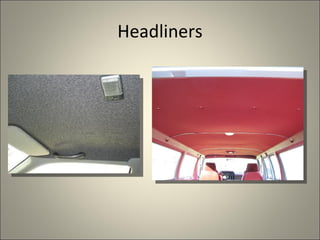
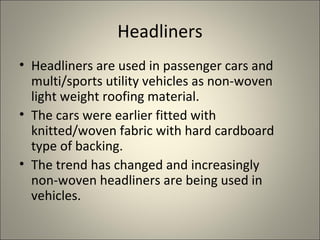
• Headliners are used in passenger cars and
  multi/sports utility vehicles as non-woven
  light weight roofing material.
• The cars were earlier fitted with
  knitted/woven fabric with hard cardboard
  type of backing.
• The trend has changed and increasingly
  non-woven headliners are being used in
  vehicles.
Headliners
Product Characteristics
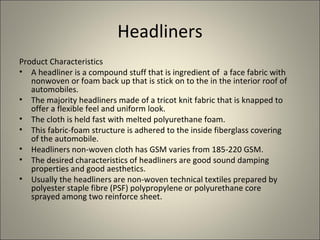
• A headliner is a compound stuff that is ingredient of a face fabric with
   nonwoven or foam back up that is stick on to the in the interior roof of
   automobiles.
• The majority headliners made of a tricot knit fabric that is knapped to
   offer a flexible feel and uniform look.
• The cloth is held fast with melted polyurethane foam.
• This fabric-foam structure is adhered to the inside fiberglass covering
   of the automobile.
• Headliners non-woven cloth has GSM varies from 185-220 GSM.
• The desired characteristics of headliners are good sound damping
   properties and good aesthetics.
• Usually the headliners are non-woven technical textiles prepared by
   polyester staple fibre (PSF) polypropylene or polyurethane core
   sprayed among two reinforce sheet.
Conclusions
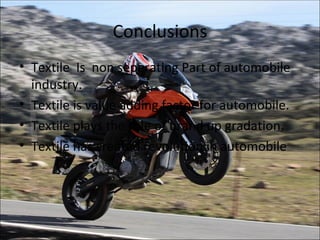
• Textile Is non seperating Part of automobile
  industry.
• Textile is value adding factor for automobile.
• Textile plays the role of brand up gradation.
• Textile has created revolution in automobile
References
• Hand book of technical textiles by A.R.
  Horrocks and S.C. Anand. Woodhead
  Publication.Ltd.England.
• Automotive Textiles, Textile progress, Vol.29,
  No.1/2 by S.K. Mukhopadhyay & J.F. Partridge,
  The textile Inst. Publication.
• Technicaltextile.net
TH AN K YO U

Automotive texile

  • 1.
    A seminar on AUTOMOTIVETEXTILES Hitesh Choudhary www.facebook.com/hitesh.choudhary1
  • 2.
    WHAT IS AUTOMOTIVETEXTILE ? • Textile which is used in vehicles • It’s techno mechanical application of textile • It is Used in light weight vehicles to heavy duty vehicles
  • 3.
    FUNCTIONS: • COMFORT • DECORATIVE •SAFETY PURPOSE • FUNCTIONAL
  • 4.
    COMFORT • WARM ANDSOFT FEEL OF SEATS • FLEXIBLE SEATS • MOIST AND ODOUR RESISTANT INTERIOR
  • 5.
  • 6.
    SAFETY PURPOSE • SEATBELTS • AIR BAGS
  • 7.
    FUNCTIONAL TEXTILE • NOISECONTROL -ABSORPTION OF NOISE BY DIFFERENT LAYERS OF INTERIOR • FILTERS • BATTERY SEPERATOR
  • 8.
  • 9.
    Seat cover • Wovenseat cover is one of the important contributors of technical textile in an automobile. • With gradual improvement in vehicle models and increased emphasis on luxury and comfort, the seat cover market has witnessed uptrend in the market. • Seat covers are made from cotton, vinyl, velvet and leather.
  • 10.
    Seat cover Product Characteristics: •The fabric used for the manufacturing of seat covers is woven on looms. • The desired product characteristics are durability, ultra- violet fade and wear resistance, water-proofing, flexibility and stretchability. • The type of seat cover used varies based on the automobile model and desired styling of the upholstery. • The yarn required for the seat covers is in the range of 500 deniers to 1300 deniers. • The fabric is further laminated to provide desired protection characteristics.
  • 11.
  • 12.
    HELMET • The principalfunction of a helmet is to absorb the shock of a crash and thus put a stop to major injury to the brain, rather than preventing head and face crack. • The usual motorcycle helmet has an internal layer of polystyrene or polypropylene foam and an external layer made of plastic, glass, and other man-made fibres. • The outer shell is made from Acrylonitrile-Butadiene- Styrene (ABS) or Polypropylene or glass fibre plastic which is hard in nature. • The inner side of the shell is expected to provide cushion to the rider and is made from regulated density concussion padding.
  • 13.
  • 14.
    Sunvisors • The sunvisors are located in the interiors of a four-wheeler just above the windshield. • The sun visors are used to block the Sunlight from entering through the windshield. • The blinds can also be turned to the front side window to reduce lateral sun exposure. • There are two sun visors in a car, – one for driver and – The other for the co-passenger.
  • 15.
    Sunvisors Product Characteristics: • Theblinds are primarily made of three parts, – The synthetic backbone made of polypropylene or kenaf fibres. – Scrim = coarse woven reinforcement fabric and – Upholstery = typically artificial leather.
  • 16.
  • 17.
    Seat Belt • Seatbelts function as a safety harnesses which secure the passengers in a vehicle against harmful movements during collision or similar incidents. • Seat belts are woven narrow fabric made from nylon filament yarns or high tensile polyester filament yarn. • The load specification is an important criterion for usage in vehicles.
  • 18.
    Seat Belt Product Characteristics: •Are made from nylon filament yarn or polyester filament yarn which is woven to produce the webbing pattern. • The linear density of man-made yarns must be stuck between 100dtex and 3000dtex, preferably 550-1800dtex. • A typical seat belt is made of 320 ends of 1,100 dtex polyester each. • The majority weft yarns prepared from polyester are 550dtex. • The critical characteristics of the webbing are: – Abrasion resistance, – Resistance to light and heat, – Capable of being removed and put back in place easily and good retraction behavior. – The load bearing capacity of seat belts is 1500 kilograms.
  • 19.
  • 20.
    Interior carpets • Thecarpets are laid in the cabin and parcel shelf at the back. • The carpets are primarily non-woven textile material. • The usage of carpets varies based on the interior designs which vary across car models. • Usage of carpets in buses and other M&HCVs is minimal.
  • 21.
    Interior carpets Product Characteristics: • The interior carpets are made primarily from polypropylene fibres. • The carpet is laid on the vehicle floor above which rubber mats are placed. • The desired characteristics of automobile interior carpets typically are as given below: – High durability – High abrasion resistance – Tensile strength – warp around 50 KGF and weft around 45 KGF – Low inflammability – Good compression recovery • The fabric is around 500 GSM with a thickness of about 3mm.
  • 22.
  • 23.
    Car Body covers •Car body covers are used to cover the car if no covered space for parking (parking garage) is available. • The car body covers are made of a variety of fabrics including canvas covers, HDPE, PVC, reinforced cotton material and Nylon.
  • 24.
  • 25.
    Air Bags • It is a safety device aimed at preventing or minimizing injury to passengers when such an accident occurs. • An airbag is an elastic bag or cushion like makeup which inflates and deflates quickly at some stage in certain types of car accidents. • Airbags have been efficient to put a stop to severe head and chest injuries in adults when automobile accidents have occurred. • Airbags can be located in both the front and Side of vehicles. – Frontal Airbags: The airbag component for the driver side is situated in the centre of the steering wheel, whereas the passenger side component (if equipped) can be found in the dashboard above the glove box. – Side Airbags : There are three different types of side air bag systems currently available: • Roof-mounted side airbags designed to protect the head and neck. • Door-mounted side airbags designed to protect the chest. • Seat-mounted airbags designed to protect the chest and head.
  • 26.
    Air Bags Product Characteristics: •Nylon 6, 6 is used as a key raw material. • The yarn / fabric are primarily nylon 66, lighter denier, and silicone coated. • Approximately, 1.8 square meter of fabric is used per airbag module.
  • 27.
  • 28.
    INSULATING FELTS • Insulationfelts, often known as NVH products (Noise, Vibration, and Harshness parts) are used for acoustic and thermal insulation in the automobiles • These are Bonnet liner, Outer dash, Wheelhouse, and Outer floor under shield. These parts not only provide noise protection inside the car but also a reduction in the noise emission outside. • Insulation felts are 100% polyester non-woven technical textile products.
  • 29.
    INSULATING FELTS Product characteristics •The NVH products or insulation felts are 100% polyester non-woven technical textile products. • These products are classified based on the manufacturing process as needle-punched, phenolic resin bonded and thermoplastic. • The felts are generally soft and used with or without harder backing.
  • 30.
  • 31.
    Nylon Tyre CordFabric • Nylon tyre cord fabric provides strength to a tyre. • Nylon tyre cord fabric gradually replaced the usage of rayon and polyester cords in the tyre industry. • The nylon tyre cord is prepared from high tenacity continuous filament yarn by twisting and plying. • There are two main types of nylons used as tyre cord, i.e. – Nylon-6 and – Nylon-6, 6. • The types of nylon-6 tyre cord used in India are 840/2, 1260/2, 1260/3, 1680/2 and 1890 / 2 where number indicates denier of ply / no. of plies in the cord. The denier per filament is 6.
  • 32.
    Nylon Tyre CordFabric Product characteristic : • Nylon 6 grey and dipped tyre cord fabrics having – High strength, – Fatigue resistance, – Impact resistance, – High adhesion • The tyre cords are generally available with the fabric characteristics of 930dtex, 1400dtex, 1870dtex, 2100dtex.
  • 33.
  • 34.
    Headliners • Headliners areused in passenger cars and multi/sports utility vehicles as non-woven light weight roofing material. • The cars were earlier fitted with knitted/woven fabric with hard cardboard type of backing. • The trend has changed and increasingly non-woven headliners are being used in vehicles.
  • 35.
    Headliners Product Characteristics • Aheadliner is a compound stuff that is ingredient of a face fabric with nonwoven or foam back up that is stick on to the in the interior roof of automobiles. • The majority headliners made of a tricot knit fabric that is knapped to offer a flexible feel and uniform look. • The cloth is held fast with melted polyurethane foam. • This fabric-foam structure is adhered to the inside fiberglass covering of the automobile. • Headliners non-woven cloth has GSM varies from 185-220 GSM. • The desired characteristics of headliners are good sound damping properties and good aesthetics. • Usually the headliners are non-woven technical textiles prepared by polyester staple fibre (PSF) polypropylene or polyurethane core sprayed among two reinforce sheet.
  • 36.
    Conclusions • Textile Isnon seperating Part of automobile industry. • Textile is value adding factor for automobile. • Textile plays the role of brand up gradation. • Textile has created revolution in automobile
  • 37.
    References • Hand bookof technical textiles by A.R. Horrocks and S.C. Anand. Woodhead Publication.Ltd.England. • Automotive Textiles, Textile progress, Vol.29, No.1/2 by S.K. Mukhopadhyay & J.F. Partridge, The textile Inst. Publication. • Technicaltextile.net
  • 38.
    TH AN KYO U