GLP
A quality system concerned with the organizational
process and conditions under which non-clinical health
and environmental safety studies are
- Planned
- Performed
- Monitored
- Recorded
- Archived
- Reported
History of GLP
• Introduced in New Zealand and Denmark in 1972
• The US in 1978 after Industrial Bio Test Labs (IBT) scandal
• IBT falsely claimed thousands of safety tests
• Cases of fraud generated by toxicology labs in data submitted to the FDA
• FDA investigated 40 toxicology labs & discovered fraudulent activities
• Tests which the investigators could not understand & correlate
Spread of GLP
• In 1979, the Environmental Protection Agency (EPA) encountered similar
problems and issued its own GLP regulations
• In 1981, the Organization for Economic Co-operation and Development
(OECD) produced GLP principles which became international standard
• In 1987, the European Council adopted GLP principles
• In 2004, the European Parliament harmonised laws regulating GLP
• In 2005, Ecolable established ecological criteria for sanitary facilities
Need for GLP
• Examples of some of these poor lab practices found were
- Equipment not calibrated to standard form
- Incorrect/inaccurate accounts of the actual lab study
- Inadequate test systems
- Missing steps of the analysis
- Results not validated
- Records not maintained properly
- Specimens/samples not archived for retrieval
Objective of GLP
• Quality
• Uniformity
• Consistency
• Reproducibility
• Traceability
• Reliability
• Integrity
Parameters of GLP
1. Organization and Personnel Management
2. Quality assurance program
3. Lab Facilities
4. Equipment & materials
5. Systems & protocols
6. Test & reference items
7. SOP’s & work instructions
8. Performance & conduct
9. Reporting of results
10. Storage & archival
GLP
• Test systems - physical/chemical, biological
• Test and reference items
• Standard operating procedures
• Performance – plan & conduct
• Reporting of results
• Archival - storage of records and reports
Klimisch Score
• Ranks reliability of toxicity studies for use by risk assessors
• Published in 1997, by BASF
• Widely used in chemical risk assessments
• Studies performed according to GLP are assigned the top
rank of 1
• Lower ranks typically require a new study to be performed
• When no GLP study is available for a particular endpoint, a
study with a rank of 2 is usually accepted
Responsibilities
• Knowledge of the GLP principles
• Access to the study plan and appropriate SOP’s
• Comply with the instructions of the SOP’s
• Record & retain raw data
• Ensure quality & uniformity of work
• Exercise health precautions to minimize risk
• Ensure the integrity of the study
Inspections
• Access to the updated study plans and SOP’s
• Documented verification of the compliance of study plan to
the GLP principles
– Study-based inspections
– Facility-based inspections
– Process-based inspections
• Final reports for accurate and full description
• Report the inspection results to the management
Facilities
• Suitable size, construction and location
• Adequate degree of separation of the different activities
• Isolation of test systems and individual projects
• Protection from biological hazards
• Suitable rooms for the diagnosis, treatment and control of diseases
• Storage rooms for record keeping
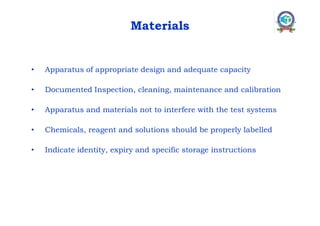
Materials
• Apparatus of appropriate design and adequate capacity
• Documented Inspection, cleaning, maintenance and calibration
• Apparatus and materials not to interfere with the test systems
• Chemicals, reagent and solutions should be properly labelled
• Indicate identity, expiry and specific storage instructions
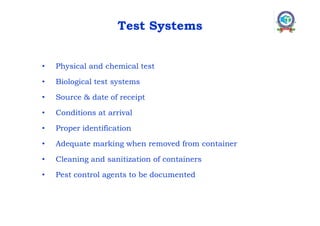
Test Systems
• Physical and chemical test
• Biological test systems
• Source & date of receipt
• Conditions at arrival
• Proper identification
• Adequate marking when removed from container
• Cleaning and sanitization of containers
• Pest control agents to be documented
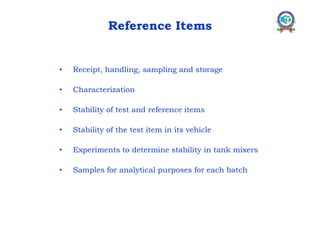
Reference Items
• Receipt, handling, sampling and storage
• Characterization
• Stability of test and reference items
• Stability of the test item in its vehicle
• Experiments to determine stability in tank mixers
• Samples for analytical purposes for each batch
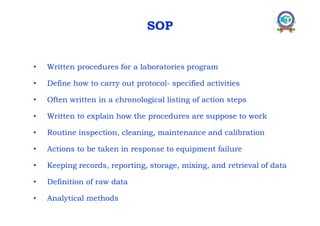
SOP
• Written procedures for a laboratories program
• Define how to carry out protocol- specified activities
• Often written in a chronological listing of action steps
• Written to explain how the procedures are suppose to work
• Routine inspection, cleaning, maintenance and calibration
• Actions to be taken in response to equipment failure
• Keeping records, reporting, storage, mixing, and retrieval of data
• Definition of raw data
• Analytical methods
Performance of the Study
• Prepare the Study plan
• Specify content of the study plan
• Identify aspects of the study
• Maintain records
• Adhere to timelines
• Reference to test methods
• Information concerning the sponsor and facility
• Conduct of the study
Reporting of Results
• Information on sponsor and test facility
• Experimental starting and completion dates
• Quality Assurance Program Statement
• Description of materials and test methods
• Results – summary & descriptive data
• Storage (samples, reference items, raw data, final reports) etc
Records
• Retention of Records and Materials
• The study plan, raw data, samples
• Inspection data and master schedules
• SOPs & work instructions
• Maintenance and calibration data
• Disposal/expiry -reason to be justified and documented
• Index of materials retained
Work Place
• Area should be free from smoke, smell, dust
• Ensure good ventilation, proper illumination and prefer natural light
• Air conditioned the lab with humidity control
• Enough space for measuring and testing instrument.
• Proper arrangement of testing
• Ensure safety points including proper earthing as well as fire safety
• Avoid uncleanable spots in floors, walls, ceiling
• Establish proper storage of incoming samples as well as tested material
• Allocate place for sample collection, packing and disposal
GLP Principles
• Keep the things at its location after use
• Store heavy things at bottom & if possible on Trollies
• Give name of location to everything
• Follow “Everything has the place & Everything at its place”
• Prepare location list & display it
• Put ladders for things stored on top
• Identify everything with its name/ purpose
• Follow “FIFO” to prevent old accumulation for chemicals
GLP Benefits
• Provides better analysis of data
• Details testing and measurement
• Improves maintenance of instruments
• Preserves test records
• Enhances image of company as a quality producer
CMP
• Compliance Monitoring Program
• Responsibilities for monitoring GLP
• Compliance of test facilities
• Inspections of GLP test facilities
• Audits of GLP studies
• Determine compliance with the OECD Principles

Good laboratory practices GLP

  • 1.
    GLP A quality systemconcerned with the organizational process and conditions under which non-clinical health and environmental safety studies are - Planned - Performed - Monitored - Recorded - Archived - Reported
  • 2.
    History of GLP •Introduced in New Zealand and Denmark in 1972 • The US in 1978 after Industrial Bio Test Labs (IBT) scandal • IBT falsely claimed thousands of safety tests • Cases of fraud generated by toxicology labs in data submitted to the FDA • FDA investigated 40 toxicology labs & discovered fraudulent activities • Tests which the investigators could not understand & correlate
  • 3.
    Spread of GLP •In 1979, the Environmental Protection Agency (EPA) encountered similar problems and issued its own GLP regulations • In 1981, the Organization for Economic Co-operation and Development (OECD) produced GLP principles which became international standard • In 1987, the European Council adopted GLP principles • In 2004, the European Parliament harmonised laws regulating GLP • In 2005, Ecolable established ecological criteria for sanitary facilities
  • 4.
    Need for GLP •Examples of some of these poor lab practices found were - Equipment not calibrated to standard form - Incorrect/inaccurate accounts of the actual lab study - Inadequate test systems - Missing steps of the analysis - Results not validated - Records not maintained properly - Specimens/samples not archived for retrieval
  • 5.
    Objective of GLP •Quality • Uniformity • Consistency • Reproducibility • Traceability • Reliability • Integrity
  • 6.
    Parameters of GLP 1.Organization and Personnel Management 2. Quality assurance program 3. Lab Facilities 4. Equipment & materials 5. Systems & protocols 6. Test & reference items 7. SOP’s & work instructions 8. Performance & conduct 9. Reporting of results 10. Storage & archival
  • 7.
    GLP • Test systems- physical/chemical, biological • Test and reference items • Standard operating procedures • Performance – plan & conduct • Reporting of results • Archival - storage of records and reports
  • 8.
    Klimisch Score • Ranksreliability of toxicity studies for use by risk assessors • Published in 1997, by BASF • Widely used in chemical risk assessments • Studies performed according to GLP are assigned the top rank of 1 • Lower ranks typically require a new study to be performed • When no GLP study is available for a particular endpoint, a study with a rank of 2 is usually accepted
  • 9.
    Responsibilities • Knowledge ofthe GLP principles • Access to the study plan and appropriate SOP’s • Comply with the instructions of the SOP’s • Record & retain raw data • Ensure quality & uniformity of work • Exercise health precautions to minimize risk • Ensure the integrity of the study
  • 10.
    Inspections • Access tothe updated study plans and SOP’s • Documented verification of the compliance of study plan to the GLP principles – Study-based inspections – Facility-based inspections – Process-based inspections • Final reports for accurate and full description • Report the inspection results to the management
  • 11.
    Facilities • Suitable size,construction and location • Adequate degree of separation of the different activities • Isolation of test systems and individual projects • Protection from biological hazards • Suitable rooms for the diagnosis, treatment and control of diseases • Storage rooms for record keeping
  • 12.
    Materials • Apparatus ofappropriate design and adequate capacity • Documented Inspection, cleaning, maintenance and calibration • Apparatus and materials not to interfere with the test systems • Chemicals, reagent and solutions should be properly labelled • Indicate identity, expiry and specific storage instructions
  • 13.
    Test Systems • Physicaland chemical test • Biological test systems • Source & date of receipt • Conditions at arrival • Proper identification • Adequate marking when removed from container • Cleaning and sanitization of containers • Pest control agents to be documented
  • 14.
    Reference Items • Receipt,handling, sampling and storage • Characterization • Stability of test and reference items • Stability of the test item in its vehicle • Experiments to determine stability in tank mixers • Samples for analytical purposes for each batch
  • 15.
    SOP • Written proceduresfor a laboratories program • Define how to carry out protocol- specified activities • Often written in a chronological listing of action steps • Written to explain how the procedures are suppose to work • Routine inspection, cleaning, maintenance and calibration • Actions to be taken in response to equipment failure • Keeping records, reporting, storage, mixing, and retrieval of data • Definition of raw data • Analytical methods
  • 16.
    Performance of theStudy • Prepare the Study plan • Specify content of the study plan • Identify aspects of the study • Maintain records • Adhere to timelines • Reference to test methods • Information concerning the sponsor and facility • Conduct of the study
  • 17.
    Reporting of Results •Information on sponsor and test facility • Experimental starting and completion dates • Quality Assurance Program Statement • Description of materials and test methods • Results – summary & descriptive data • Storage (samples, reference items, raw data, final reports) etc
  • 18.
    Records • Retention ofRecords and Materials • The study plan, raw data, samples • Inspection data and master schedules • SOPs & work instructions • Maintenance and calibration data • Disposal/expiry -reason to be justified and documented • Index of materials retained
  • 19.
    Work Place • Areashould be free from smoke, smell, dust • Ensure good ventilation, proper illumination and prefer natural light • Air conditioned the lab with humidity control • Enough space for measuring and testing instrument. • Proper arrangement of testing • Ensure safety points including proper earthing as well as fire safety • Avoid uncleanable spots in floors, walls, ceiling • Establish proper storage of incoming samples as well as tested material • Allocate place for sample collection, packing and disposal
  • 20.
    GLP Principles • Keepthe things at its location after use • Store heavy things at bottom & if possible on Trollies • Give name of location to everything • Follow “Everything has the place & Everything at its place” • Prepare location list & display it • Put ladders for things stored on top • Identify everything with its name/ purpose • Follow “FIFO” to prevent old accumulation for chemicals
  • 21.
    GLP Benefits • Providesbetter analysis of data • Details testing and measurement • Improves maintenance of instruments • Preserves test records • Enhances image of company as a quality producer
  • 22.
    CMP • Compliance MonitoringProgram • Responsibilities for monitoring GLP • Compliance of test facilities • Inspections of GLP test facilities • Audits of GLP studies • Determine compliance with the OECD Principles