Submitted By:-
MOHAMMAD MAYED RAHMAN
ID: 163345544
Batch: 34th
Program: BSTE
Submitted To:-
WAHIDUR RAHMAN BAIZID
ASSISTANT PROFESSOR
Department of Textile
City University of Bangladesh
Date of Submission: 13 / 07 /2019
Course Title: Yarn Manufacturing II
Course Code: YME
Comber is a machine by
which fiber are combed and the action
is called combing. The straightening
and parallelization of fibers and the
removal of short fibers and impurities
by using combs, knives, brushes and
rollers. One combed sliver is produced
from eight lap.
→To remove a certain length of short fiber so that combed
sliver is made by more long fiber.
→To remove neps and foreign material from carded fiber.
→To make fiber straight and parallel.
To produce finer or better yarn.
To produce uniform yarn.
To produce less thick, thin and
hairiness yarn.
Less twist for finer yarn but more twist
required in present of short fiber.
Long fiber yarn has less hairiness but
more luster.
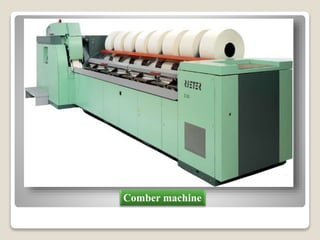
Comber machine
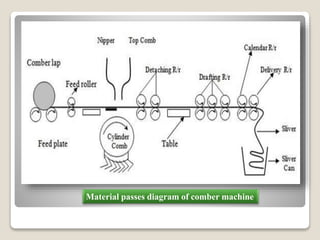
Material passes diagram of comber machine
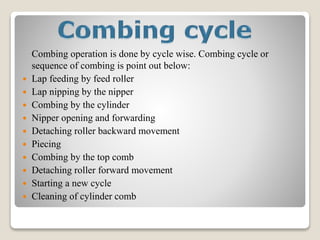
Combing operation is done by cycle wise. Combing cycle or
sequence of combing is point out below:
 Lap feeding by feed roller
 Lap nipping by the nipper
 Combing by the cylinder
 Nipper opening and forwarding
 Detaching roller backward movement
 Piecing
 Combing by the top comb
 Detaching roller forward movement
 Starting a new cycle
 Cleaning of cylinder comb
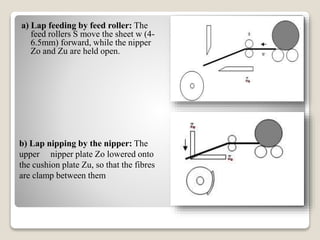
a) Lap feeding by feed roller: The
feed rollers S move the sheet w (4-
6.5mm) forward, while the nipper
Zo and Zu are held open.
b) Lap nipping by the nipper: The
upper nipper plate Zo lowered onto
the cushion plate Zu, so that the fibres
are clamp between them
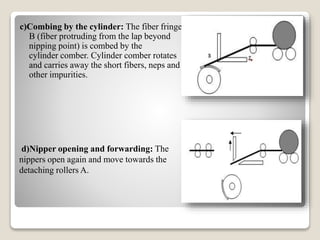
c)Combing by the cylinder: The fiber fringe
B (fiber protruding from the lap beyond
nipping point) is combed by the
cylinder comber. Cylinder comber rotates
and carries away the short fibers, neps and
other impurities.
d)Nipper opening and forwarding: The
nippers open again and move towards the
detaching rollers A.
e)Detaching roller backward
movement: Meanwhile, the detaching
rollers A have returned part of the
previously drawn off stock (web V) by
means of a reverse rotation (web return).
f)Piecing: In the course of forward
movement of the nippers, the projecting
fiber fringe B is placed upon the
returned web V.
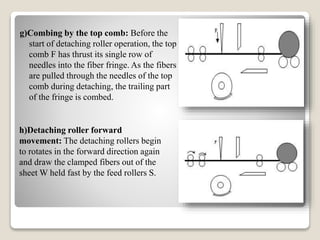
g)Combing by the top comb: Before the
start of detaching roller operation, the top
comb F has thrust its single row of
needles into the fiber fringe. As the fibers
are pulled through the needles of the top
comb during detaching, the trailing part
of the fringe is combed.
h)Detaching roller forward
movement: The detaching rollers begin
to rotates in the forward direction again
and draw the clamped fibers out of the
sheet W held fast by the feed rollers S.
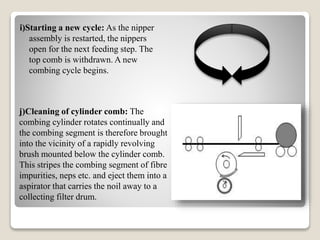
i)Starting a new cycle: As the nipper
assembly is restarted, the nippers
open for the next feeding step. The
top comb is withdrawn. A new
combing cycle begins.
j)Cleaning of cylinder comb: The
combing cylinder rotates continually and
the combing segment is therefore brought
into the vicinity of a rapidly revolving
brush mounted below the cylinder comb.
This stripes the combing segment of fibre
impurities, neps etc. and eject them into a
aspirator that carries the noil away to a
collecting filter drum.
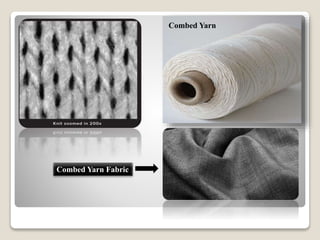
Combed Yarn
Combed Yarn Fabric
Short fibers below a certain pre-determined length
can be easily separated out by using comber.
Therefore, combing is commonly confined to high
grade, long staple natural fibers. In recent
years, combing has also been utilized for
upgrading the quality of medium staple fibers.
Comber

Comber

  • 2.
    Submitted By:- MOHAMMAD MAYEDRAHMAN ID: 163345544 Batch: 34th Program: BSTE Submitted To:- WAHIDUR RAHMAN BAIZID ASSISTANT PROFESSOR Department of Textile City University of Bangladesh Date of Submission: 13 / 07 /2019 Course Title: Yarn Manufacturing II Course Code: YME
  • 3.
    Comber is amachine by which fiber are combed and the action is called combing. The straightening and parallelization of fibers and the removal of short fibers and impurities by using combs, knives, brushes and rollers. One combed sliver is produced from eight lap.
  • 4.
    →To remove acertain length of short fiber so that combed sliver is made by more long fiber. →To remove neps and foreign material from carded fiber. →To make fiber straight and parallel.
  • 5.
    To produce fineror better yarn. To produce uniform yarn. To produce less thick, thin and hairiness yarn. Less twist for finer yarn but more twist required in present of short fiber. Long fiber yarn has less hairiness but more luster.
  • 6.
  • 7.
    Material passes diagramof comber machine
  • 8.
    Combing operation isdone by cycle wise. Combing cycle or sequence of combing is point out below:  Lap feeding by feed roller  Lap nipping by the nipper  Combing by the cylinder  Nipper opening and forwarding  Detaching roller backward movement  Piecing  Combing by the top comb  Detaching roller forward movement  Starting a new cycle  Cleaning of cylinder comb
  • 9.
    a) Lap feedingby feed roller: The feed rollers S move the sheet w (4- 6.5mm) forward, while the nipper Zo and Zu are held open. b) Lap nipping by the nipper: The upper nipper plate Zo lowered onto the cushion plate Zu, so that the fibres are clamp between them
  • 10.
    c)Combing by thecylinder: The fiber fringe B (fiber protruding from the lap beyond nipping point) is combed by the cylinder comber. Cylinder comber rotates and carries away the short fibers, neps and other impurities. d)Nipper opening and forwarding: The nippers open again and move towards the detaching rollers A.
  • 11.
    e)Detaching roller backward movement:Meanwhile, the detaching rollers A have returned part of the previously drawn off stock (web V) by means of a reverse rotation (web return). f)Piecing: In the course of forward movement of the nippers, the projecting fiber fringe B is placed upon the returned web V.
  • 12.
    g)Combing by thetop comb: Before the start of detaching roller operation, the top comb F has thrust its single row of needles into the fiber fringe. As the fibers are pulled through the needles of the top comb during detaching, the trailing part of the fringe is combed. h)Detaching roller forward movement: The detaching rollers begin to rotates in the forward direction again and draw the clamped fibers out of the sheet W held fast by the feed rollers S.
  • 13.
    i)Starting a newcycle: As the nipper assembly is restarted, the nippers open for the next feeding step. The top comb is withdrawn. A new combing cycle begins. j)Cleaning of cylinder comb: The combing cylinder rotates continually and the combing segment is therefore brought into the vicinity of a rapidly revolving brush mounted below the cylinder comb. This stripes the combing segment of fibre impurities, neps etc. and eject them into a aspirator that carries the noil away to a collecting filter drum.
  • 14.
  • 15.
    Short fibers belowa certain pre-determined length can be easily separated out by using comber. Therefore, combing is commonly confined to high grade, long staple natural fibers. In recent years, combing has also been utilized for upgrading the quality of medium staple fibers.