

Automotive Airbag Solution from Freescale
Introduction Purpose To   study   Airbag   solution   ad   its   interface   from   Freescale   Semiconductor Outline What   is   Airbag?   And   its   components,   its   working   principle Layout   of   its   main   components,   system   diagram MC33789:   Airbag   System   Basis   Chip   (SBC)   solution   from   Freescale   Freescale   Airbag   Portfolio   for   MCU,   Sensors,   PSI5   and   DSI   protocol Content 23   pages
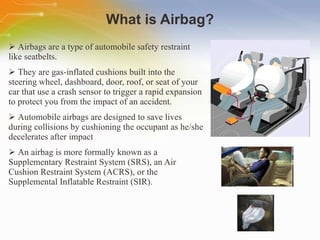
What is Airbag? Airbags are a type of automobile safety restraint like seatbelts.  They are gas-inflated cushions built into the steering wheel, dashboard, door, roof, or seat of your car that use a crash sensor to trigger a rapid expansion to protect you from the impact of an accident.  Automobile airbags are designed to save lives during collisions by cushioning the occupant as he/she decelerates after impact An airbag is more formally known as a Supplementary Restraint System (SRS), an Air Cushion Restraint System (ACRS), or the Supplemental Inflatable Restraint (SIR).
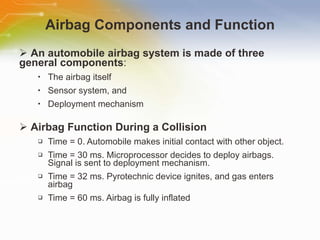
Airbag Components and Function An automobile airbag system is made of three general components : The airbag itself Sensor system, and Deployment mechanism Airbag Function During a Collision Time = 0. Automobile makes initial contact with other object. Time = 30 ms. Microprocessor decides to deploy airbags. Signal is sent to deployment mechanism. Time = 32 ms. Pyrotechnic device ignites, and gas enters airbag Time = 60 ms. Airbag is fully inflated
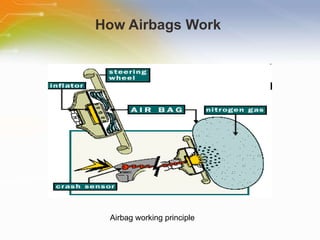
How Airbags Work  Airbag working principle
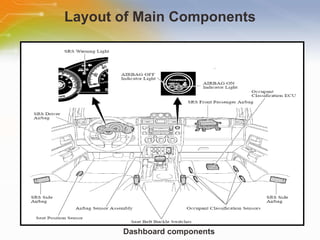
Layout of Main Components Dashboard components
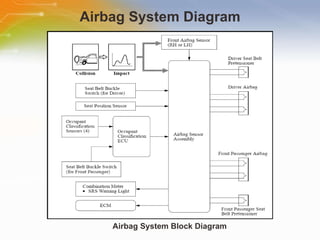
Airbag System Diagram Airbag System Block Diagram
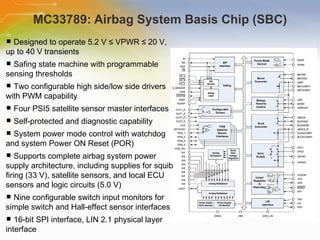
MC33789: Airbag System Basis Chip (SBC) Designed to operate 5.2 V ≤ VPWR ≤ 20 V, up to 40 V transients  Safing state machine with programmable sensing thresholds  Two configurable high side/low side drivers with PWM capability  Four PSI5 satellite sensor master interfaces  Self-protected and diagnostic capability  System power mode control with watchdog and system Power ON Reset (POR)  Supports complete airbag system power supply architecture, including supplies for squib firing (33 V), satellite sensors, and local ECU sensors and logic circuits (5.0 V)  Nine configurable switch input monitors for simple switch and Hall-effect sensor interfaces  16-bit SPI interface, LIN 2.1 physical layer interface
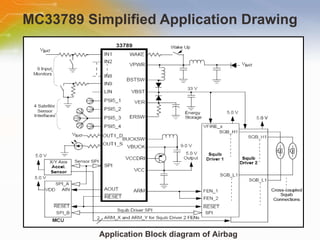
MC33789 Simplified Application Drawing Application Block diagram of Airbag
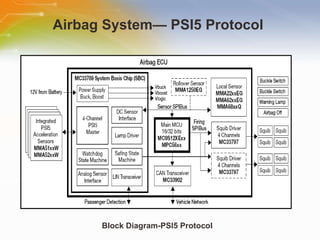
Airbag System— PSI5 Protocol  Block Diagram-PSI5 Protocol
Airbag System— DSI Protocol Block Diagram- DSI Protocol
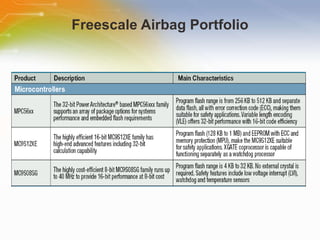
Freescale Airbag Portfolio
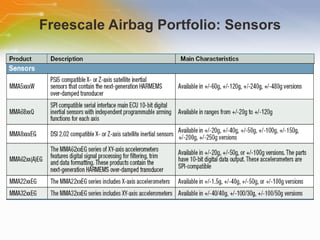
Freescale Airbag Portfolio: Sensors
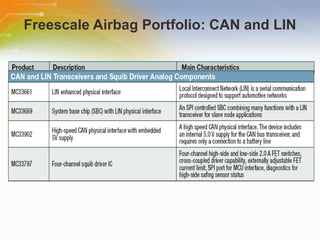
Freescale Airbag Portfolio: CAN and LIN
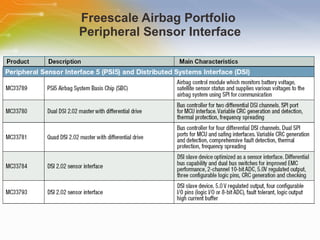
Freescale Airbag Portfolio  Peripheral Sensor Interface
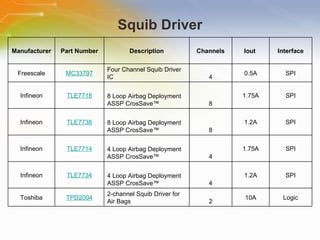
Squib Driver Manufacturer Part Number Description Channels Iout  Interface Freescale MC33797 Four Channel Squib Driver  IC 4 0.5A SPI Infineon TLE7718 8 Loop Airbag Deployment  ASSP CrosSave™  8 1.75A SPI Infineon TLE7738 8 Loop Airbag Deployment  ASSP CrosSave™ 8 1.2A SPI Infineon TLE7714 4 Loop Airbag Deployment  ASSP CrosSave™ 4 1.75A SPI Infineon TLE7734 4 Loop Airbag Deployment  ASSP CrosSave™ 4 1.2A SPI Toshiba TPD2004 2-channel Squib Driver for  Air Bags 2 10A Logic
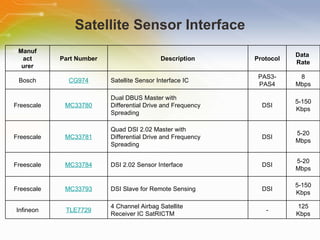
Satellite Sensor Interface Manuf act urer Part Number Description Protocol Data  Rate Bosch CG974 Satellite Sensor Interface IC PAS3- PAS4 8 Mbps Freescale MC33780 Dual DBUS Master with  Differential Drive and Frequency  Spreading DSI 5-150 Kbps Freescale MC33781 Quad DSI 2.02 Master with  Differential Drive and Frequency  Spreading DSI 5-20 Mbps Freescale MC33784 DSI 2.02 Sensor Interface DSI 5-20 Mbps Freescale MC33793 DSI Slave for Remote Sensing DSI 5-150 Kbps Infineon TLE7729 4 Channel Airbag Satellite Receiver IC SatRICTM - 125 Kbps
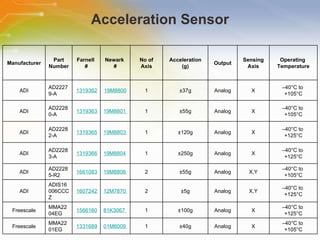
Acceleration Sensor Manufacturer Part Number Farnell  # Newark  # No of Axis Acceleration (g) Output Sensing Axis Operating  Temperature ADI AD22279-A 1319362 19M8800 1 ±37g Analog X – 40°C to  +105°C ADI AD22280-A 1319363 19M8801  1 ±55g Analog X – 40°C to  +105°C ADI AD22282-A 1319365 19M8803  1 ±120g Analog X – 40°C to  +125°C ADI AD22283-A 1319366 19M8804 1 ±250g Analog X – 40°C to  +125°C ADI AD22285-R2  1661083 19M8806  2 ±55g Analog X,Y – 40°C to  +105°C ADI ADIS16006CCCZ  1607242 12M7870  2 ±5g Analog X,Y – 40°C to  +125°C Freescale MMA2204EG 1566160 81K3067  1 ±100g Analog X – 40°C to  +125°C Freescale MMA2201EG  1331689 01M6009  1 ±40g Analog X – 40°C to  +105°C
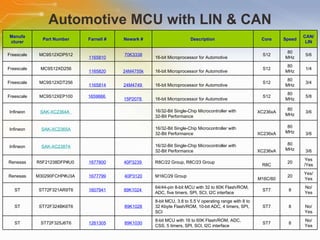
Automotive MCU with LIN & CAN Manufa cturer Part Number Farnell # Newark # Description Core Speed CAN/ LIN Freescale MC9S12XDP512 1165810 70K3338 16-bit Microprocessor for Automotive S12 80 MHz 5/6 Freescale MC9S12XD256 1165820 24M4755k 16-bit Microprocessor for Automotive S12 80 MHz 1/4 Freescale MC9S12XDT256 1165814 24M4749  16-bit Microprocessor for Automotive S12 80 MHz 3/4 Freescale MC9S12XEP100 1659666  15P2078  16-bit Microprocessor for Automotive S12 80 MHz 5/8 Infineon SAK-XC2364A       16/32-Bit Single-Chip Microcontroller with 32-Bit Performance XC236xA 80 MHz 3/6 Infineon SAK-XC2365A 16/32-Bit Single-Chip Microcontroller with 32-Bit Performance XC236xA 80 MHz 3/6 Infineon SAK-XC2387A 16/32-Bit Single-Chip Microcontroller with 32-Bit Performance XC236xA 80 MHz 3/6 Renesas R5F21238DFP#U0  1677800 40P3239  R8C/22 Group, R8C/23 Group R8C 20 Yes /Yes Renesas M30290FCHP#U3A  1677799 40P3120 M16C/29 Group M16C/60 20 Yes/ Yes ST ST72F321AR9T6 1607941 89K1024  64/44-pin 8-bit MCU with 32 to 60K Flash/ROM, ADC, five timers, SPI, SCI, I2C interface ST7 8 No/ Yes ST ST72F324BK6T6   89K1026 8-bit MCU, 3.8 to 5.5 V operating range with 8 to 32 Kbyte Flash/ROM, 10-bit ADC, 4 timers, SPI,  SCI ST7 8 No/ Yes ST ST72F325J6T6 1261305 89K1030 8-bit MCU with 16 to 60K Flash/ROM, ADC,  CSS, 5 timers, SPI, SCI, I2C interface ST7 8 No/ Yes
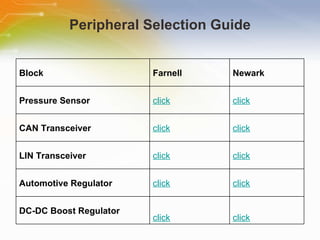
Peripheral Selection Guide Block Farnell Newark Pressure Sensor click click CAN Transceiver click click LIN Transceiver click click Automotive Regulator click click DC-DC Boost Regulator click click
Additional Resource For ordering Airbag Solution parts, please click the part list or Call our sales hotline For more product information go to http://www.element-14.com/community/docs/DOC-22434 Visit element14 to post your question   www.element-14.com For additional inquires contact our technical service hotline or even use our “Live Technical Chat” online facility Newark Farnell

Automotive Airbag Solution from Freescale

  • 1.
  • 2.
    Introduction Purpose To study Airbag solution ad its interface from Freescale Semiconductor Outline What is Airbag? And its components, its working principle Layout of its main components, system diagram MC33789: Airbag System Basis Chip (SBC) solution from Freescale Freescale Airbag Portfolio for MCU, Sensors, PSI5 and DSI protocol Content 23 pages
  • 3.
    What is Airbag?Airbags are a type of automobile safety restraint like seatbelts. They are gas-inflated cushions built into the steering wheel, dashboard, door, roof, or seat of your car that use a crash sensor to trigger a rapid expansion to protect you from the impact of an accident. Automobile airbags are designed to save lives during collisions by cushioning the occupant as he/she decelerates after impact An airbag is more formally known as a Supplementary Restraint System (SRS), an Air Cushion Restraint System (ACRS), or the Supplemental Inflatable Restraint (SIR).
  • 4.
    Airbag Components andFunction An automobile airbag system is made of three general components : The airbag itself Sensor system, and Deployment mechanism Airbag Function During a Collision Time = 0. Automobile makes initial contact with other object. Time = 30 ms. Microprocessor decides to deploy airbags. Signal is sent to deployment mechanism. Time = 32 ms. Pyrotechnic device ignites, and gas enters airbag Time = 60 ms. Airbag is fully inflated
  • 5.
    How Airbags Work Airbag working principle
  • 6.
    Layout of MainComponents Dashboard components
  • 7.
    Airbag System DiagramAirbag System Block Diagram
  • 8.
    MC33789: Airbag SystemBasis Chip (SBC) Designed to operate 5.2 V ≤ VPWR ≤ 20 V, up to 40 V transients Safing state machine with programmable sensing thresholds Two configurable high side/low side drivers with PWM capability Four PSI5 satellite sensor master interfaces Self-protected and diagnostic capability System power mode control with watchdog and system Power ON Reset (POR) Supports complete airbag system power supply architecture, including supplies for squib firing (33 V), satellite sensors, and local ECU sensors and logic circuits (5.0 V) Nine configurable switch input monitors for simple switch and Hall-effect sensor interfaces 16-bit SPI interface, LIN 2.1 physical layer interface
  • 9.
    MC33789 Simplified ApplicationDrawing Application Block diagram of Airbag
  • 10.
    Airbag System— PSI5Protocol Block Diagram-PSI5 Protocol
  • 11.
    Airbag System— DSIProtocol Block Diagram- DSI Protocol
  • 12.
  • 13.
  • 14.
  • 15.
    Freescale Airbag Portfolio Peripheral Sensor Interface
  • 16.
    Squib Driver ManufacturerPart Number Description Channels Iout Interface Freescale MC33797 Four Channel Squib Driver IC 4 0.5A SPI Infineon TLE7718 8 Loop Airbag Deployment ASSP CrosSave™ 8 1.75A SPI Infineon TLE7738 8 Loop Airbag Deployment ASSP CrosSave™ 8 1.2A SPI Infineon TLE7714 4 Loop Airbag Deployment ASSP CrosSave™ 4 1.75A SPI Infineon TLE7734 4 Loop Airbag Deployment ASSP CrosSave™ 4 1.2A SPI Toshiba TPD2004 2-channel Squib Driver for Air Bags 2 10A Logic
  • 17.
    Satellite Sensor InterfaceManuf act urer Part Number Description Protocol Data Rate Bosch CG974 Satellite Sensor Interface IC PAS3- PAS4 8 Mbps Freescale MC33780 Dual DBUS Master with Differential Drive and Frequency Spreading DSI 5-150 Kbps Freescale MC33781 Quad DSI 2.02 Master with Differential Drive and Frequency Spreading DSI 5-20 Mbps Freescale MC33784 DSI 2.02 Sensor Interface DSI 5-20 Mbps Freescale MC33793 DSI Slave for Remote Sensing DSI 5-150 Kbps Infineon TLE7729 4 Channel Airbag Satellite Receiver IC SatRICTM - 125 Kbps
  • 18.
    Acceleration Sensor ManufacturerPart Number Farnell # Newark # No of Axis Acceleration (g) Output Sensing Axis Operating Temperature ADI AD22279-A 1319362 19M8800 1 ±37g Analog X – 40°C to +105°C ADI AD22280-A 1319363 19M8801 1 ±55g Analog X – 40°C to +105°C ADI AD22282-A 1319365 19M8803 1 ±120g Analog X – 40°C to +125°C ADI AD22283-A 1319366 19M8804 1 ±250g Analog X – 40°C to +125°C ADI AD22285-R2 1661083 19M8806 2 ±55g Analog X,Y – 40°C to +105°C ADI ADIS16006CCCZ 1607242 12M7870 2 ±5g Analog X,Y – 40°C to +125°C Freescale MMA2204EG 1566160 81K3067 1 ±100g Analog X – 40°C to +125°C Freescale MMA2201EG 1331689 01M6009 1 ±40g Analog X – 40°C to +105°C
  • 19.
    Automotive MCU withLIN & CAN Manufa cturer Part Number Farnell # Newark # Description Core Speed CAN/ LIN Freescale MC9S12XDP512 1165810 70K3338 16-bit Microprocessor for Automotive S12 80 MHz 5/6 Freescale MC9S12XD256 1165820 24M4755k 16-bit Microprocessor for Automotive S12 80 MHz 1/4 Freescale MC9S12XDT256 1165814 24M4749 16-bit Microprocessor for Automotive S12 80 MHz 3/4 Freescale MC9S12XEP100 1659666 15P2078 16-bit Microprocessor for Automotive S12 80 MHz 5/8 Infineon SAK-XC2364A     16/32-Bit Single-Chip Microcontroller with 32-Bit Performance XC236xA 80 MHz 3/6 Infineon SAK-XC2365A 16/32-Bit Single-Chip Microcontroller with 32-Bit Performance XC236xA 80 MHz 3/6 Infineon SAK-XC2387A 16/32-Bit Single-Chip Microcontroller with 32-Bit Performance XC236xA 80 MHz 3/6 Renesas R5F21238DFP#U0 1677800 40P3239 R8C/22 Group, R8C/23 Group R8C 20 Yes /Yes Renesas M30290FCHP#U3A 1677799 40P3120 M16C/29 Group M16C/60 20 Yes/ Yes ST ST72F321AR9T6 1607941 89K1024 64/44-pin 8-bit MCU with 32 to 60K Flash/ROM, ADC, five timers, SPI, SCI, I2C interface ST7 8 No/ Yes ST ST72F324BK6T6   89K1026 8-bit MCU, 3.8 to 5.5 V operating range with 8 to 32 Kbyte Flash/ROM, 10-bit ADC, 4 timers, SPI, SCI ST7 8 No/ Yes ST ST72F325J6T6 1261305 89K1030 8-bit MCU with 16 to 60K Flash/ROM, ADC, CSS, 5 timers, SPI, SCI, I2C interface ST7 8 No/ Yes
  • 20.
    Peripheral Selection GuideBlock Farnell Newark Pressure Sensor click click CAN Transceiver click click LIN Transceiver click click Automotive Regulator click click DC-DC Boost Regulator click click
  • 21.
    Additional Resource Forordering Airbag Solution parts, please click the part list or Call our sales hotline For more product information go to http://www.element-14.com/community/docs/DOC-22434 Visit element14 to post your question www.element-14.com For additional inquires contact our technical service hotline or even use our “Live Technical Chat” online facility Newark Farnell

Editor's Notes

  • #3 Welcome to the training module on Study on Automotive Airbag solution. This training module gives solutions based on Freescale product. It also introduces a portfolio of supporting components.
  • #4 Airbags were originally installed to protect the driver from impacting the steering wheel or windshield during a collision, airbags are now standard on the driver and passengers' side for frontal impacts, and many vehicles have side curtain airbags to protect occupants during side impacts. Airbags use a combination of design, sensor, and chemical technologies to deploy successfully during a collision
  • #5 An automobile airbag system is made of three general components: the airbag itself, sensor system, and deployment mechanism. The airbag itself is constructed of a nylon fabric. Each airbag is specifically designed for the specific automobile and location. Airbags use a combination of precise design and sensitive components to provide a mechanism to reduce injuries and fatalities in automobile accidents
  • #6 Air bags are inflatable cushions built into the steering wheel or dashboard, designed to rapidly expand in a frontal crash When a sensor in the car detects a strong front-end collision, it sends an electric current through a wire. As the wire heats up, the charge in the inflator undergoes a chemical reaction, producing a gas at rapidly inflates the bag. As soon as the bag fully inflates, it starts deflating, cushioning the impact
  • #7 The SRS (Supplemental Restraint System) airbag system has the following equipment: Driver Airbag, Front Passenger Airbag, Side/Rear Side Collision, Curtain Shield Airbag. The SRS driver and front passenger airbags are used as supplements to the seat belts to help reduce shocks applied to the head and chest of the driver or front passenger in the event of a frontal impact collision
  • #8 There are two airbags for frontal collisions: driver and front passenger. These airbags deploy simultaneously. The driver and front passenger airbags use a dual-stage control. Airbag Sensor Assembly detects the information indicated below from various sources in order to control the dual stage activation. The driver and front passenger airbags each contain a set of two initiators and propellants. The Airbag Sensor Assembly helps optimize the airbag inflation output by controlling the inflation timing of these initiators. Front airbag sensor contains an electrical type deceleration sensor. Based on the deceleration of the vehicle during a front collision, a distortion is created in the sensor and converted into an electrical signal.
  • #9 The MC33789 is a mixed signal IC for airbag safety applications. The MC33789 provides a cost effective and flexible system IC solution across the range of airbag partitions used in cars and other vehicles. The MC33789 connects to the 12 V vehicle battery and supplies the multiple voltages of a typical airbag system. The MC33789 can detect switched input states, communicate with both local and remote crash sensors. It offers an industry standard interface (SPI) and four PSI5 master interfaces. The MC33789 has a dedicated safing state machine that complements the airbag’s MCU hardware/ software safing approach. Also included are a diagnostic - self protection capability and a programmable analog interface accessible by the system MCU.
  • #10 This slide shows a simplified applicationdrawing.
  • #11 The communication interface between a master device and the MMA51xx is established via a PSI5 compatible 2-wire interface, with parallel or serial (daisy-chain) connections to the satellite modules. The device uses a two wire interface for both its power supply (VCC), and data transmission. The PSI5 master supplies a preregulated voltage. Data transmissions and synchronization control from the PSI5 master to the device are accomplished via modulation of the supply voltage. Data transmissions from the device to the PSI5 master are accomplished via modulation of the current on the power supply line. The PSI5 master modulates the supply voltage in the positive direction to provide synchronization of the satellite sensor data.
  • #12 The typical signal for a DSI ballast is roughly a 9 Bit AC component of 12 Vp-p with a quiescent DC voltage of roughly 4V. The AC component (mark space ratios) determines the level of dimming for the ballast. The DSI ballast allows for Error Checking. The DSI output unit can only report error messages to the C-Bus software.
  • #13 This page gives Freescale’s Airbag Portfolio for list of MCU supported for this application, it includes MPC56XX, MC9S12XE and MC9S08SG family devices
  • #14 This page gives Freescale’s Airbag Portfolio for Sensors which includes PSI5 compatible X or Z axis satellite inertial sensor
  • #15 This page gives Freescale’s Airbag Portfolio for CAN and LIN Transceivers', Squib Driver details.
  • #16 This page gives Freescale’s Airbag Portfolio for Peripheral Sensor Interface.
  • #17 This page gives broad portfolio for Squib driver for Airbag solution available from Premier Farnell.
  • #18 This page gives broad portfolio for Satellite Sensor Interface for Airbag solution available from Premier Farnell.
  • #19 This page gives broad portfolio for Acceleration Sensor Interface for Airbag solution available from Premier Farnell.
  • #20 This page gives broad portfolio for Automotive MCU with LIN & CAN Interface for Airbag solution available from Premier Farnell.
  • #21 This page gives broad portfolio for Peripheral Selection Guide for Airbag solution available from Premier Farnell.
  • #22 Thank you for taking the time to view this presentation on “ Airbag Solution” . If you would like to learn more or go on to purchase some of these devices, you may either click on the part list link, or simply call our sales hotline. For more technical information you may either visit the Freescale site, or if you would prefer to speak to someone live, please call our hotline number, or even use our ‘live chat’ online facility. You may visit element14 e-community to post your questions.