A
PRESENTATION
ON
ADAPTIVE CRUISE CONTROL SYSTEM
Prepared by:-
Harshdeep Gautam
B.Tech(ME) 6th sem
SCHOOL OF ENGINEERING & TECHNOLOGY
IFTM UNIVERSITY, MORADABAD
SESSION:- 2019-2020
ABSTRACT
Cruise control is a new technological development
which incorporates a factor of comfort in driving.
Safety is only a small benefit of this system. In short,
cruise control can be said to be a system which uses the
principles of radar to determine the distances between
two consecutive moving vehicles in which either one or
both of them is incorporated with this system. The
electromagnetic rays from radar system are sensed by
sensors in the vehicle which in turn rely commands to
the throttle and brakes of the vehicle to perform
according to the adjacent vehicle’s distance. So cruise
control is a system which provides comfort to drivers
during long monotonous drives.
INTRODUCTION
 Every minute, on average, at least one person dies
in a car crash. If you read this article from start to
finish 30 or more deaths will have occurred across
the globe by the time you are done. Auto accidents
will also injure at least 10million people this year,
two or three million of them seriously. All told, the
hospital bills, damaged property and other cost
will add up to 1 – 3 % of the world’s gross domestic
product according to the paris based organisation
for economic cooperation and development. And,
of course, the losses that matter most is not even
captured by these statistics, because there is no
way to put a rupee / dollar value on them.
 Engineers have been chipping away at this staggering
numbers for long time. Many safety innovations in the
areas of banking systems, air bags, seat belts, body
structures, steering and suspension have had a beneficial
effect. Air bags and seat belts save tens of thousands of
people a year by preventing their head from crashing
into the wind shield. Supercomputers now let designers
create car frames and bodies that protect the people
inside by absorbing much of energy of crash as possible.
As a result, number of fatalities per million kilometers of
vehicle travel has decreased. But the ultimate solution
and the only thing that will save far more lives, limbs and
money are to keep out cars from smashing into each
other.
 That is exactly what engineers in united states, Europe,
Japan and India are trying to do. They are applying
advanced microprocessors, radar, high speed IC’s and
signal-processing chips and algorithm in R&D
programs that mark an about face in the automotive
industry: from safety system that kicks in after an
incident occurs, attempting to minimize injury and
damage, to ones that prevent collision altogether.
 The first collision avoidance features are already on the
road, as pricey cruise control option on a small group of
luxury cars. Over the next few years, these systems will
grow more capable and more widely available, until they
become standard equipment on luxury vehicles.
Meanwhile, researchers will bringing the first cooperative
systems to market. This will take active safety technology
to the next level, enabling vehicles to communicate and
coordinate response to avoid collisions. Note that to avoid
liability claims in the event of car companies that use them
are careful not to refer them as safety devices. Instead they
are being marketed as driver aids, convenience made
possible by latest innovative technology.
WHAT IS CRUISE CONTROL
 Cruise control is a system, which automatically
controls the speed of an automobile. The driver
sets the speed and the system will take over the
throttle of the car to maintain the speed. The
system is thereby improving driver comfort in
steady traffic conditions where speeds vary widely
these systems are no longer effective.
 Most cruise control systems don’t allow the use
cruise control below a certain speed. The use of
cruise control would be significantly increased if
the vehicle speed could automatically adapt to the
traffic flow. This features can be handy for long
drives along sparsely populated roads and usually
results in better fuel efficiency. It is also known in
some places as “poor man’s radar detector”, as by
cruise control, a driver who otherwise tends to
unconsciously increased speed over the highway
journey may avoid a speeding ticket.
 Blind inventor and mechanical engineer Ralph
teeter invented cruise control in 1945. His idea was
born out of the frustration of riding in a car driven
by his lawyer, who kept speeding up and slowly
down as he talked. The Chrysler corporation on
the 1958 chrysler imperial introduced first car with
cruise control systems.
How to set cruise control:-
 In modern design, the cruise control may or may not need to be turned on
before use – in some design it is always “on” but not always enabled. Most
designed have separate “on” switch as well as set, resume, accelerate and coast
functions. The system is operated with controls easily within the driver’s reach,
usually with two or more buttons on the steering wheel or on the windshield
wiper or turn signal stalk. The cruise switches of a latest ford car is shown in
figure.
 Driver should bring the Car speed to discourage Use in city driving. The Car
will maintain that speed by actuating the throttle. Most systems can be turned
off both explicitly or automatically, when the driver hits brake or clutch, when
the cruise control is in effect, the throttle can still be used to accelerate the car,
although the car will then slow down until it reaches the previously set speed.
Now let us see individual functions of each cruise switch
1. The on and off buttons really don’t do much. Some cruise control don’t have
these buttons; instead they turn off when the driver hits the brake, and turn
on when the driver hits the set button.
2. The set/accelerate button tells the car to maintain the speed you are
currently driving. If you hit the button at 45 km/hr, the car will maintain
your speed at 45 km/hr. Holding down the set/accelerate button will make
the car accelerate. On most cars, tapping it once will make the car go 1 km/hr
faster.
3. If recently disengaged the cruise control by hitting the brake or clutch pedal,
hitting the resume button will command the car to accelerate back to the
most recent speeding setting.
4. Holding down the coast button will cause the car to de-accelerate, just as if
you took your foot completely off the gas. On most cars, tapping the coast
button once will cause the car to slow down by 1 km/hr.
5. The brake pedal and clutch pedal each have a switch so you can disengage
the cruise control with a light tap on the brake or clutch.
ADAPTIVE CRUISE CONTROL
 There is a new type of cruise coming onto the
market called adaptive cruise control. Two
companies, TRW and Delphi automotive systems
are developing a more advance cruise control that
can automatically adjust a car’s speed to maintain
a safe following assistance.
 Adaptive cruise control is similar to conventional
cruise control in that it maintain the vehicles pre-
set speed. However, unlike conventional cruise
control, this new system can automatically adjust
speed in order to maintain a proper and safe
distance between vehicles in same lane.
 In may 1998, Toyota became the first to introduce an ACC system
on a production vehicle when it unveiled a laser-based system for
its progress compact luxury sedan, which it sold in Japan. Then
Nissan followed suit with a radar-based system, in the company’s
Cima 41LV-2, a luxury sedan also sold in japan. In September
1999, jaguar began offering an ACC for its XKR coupes and
convertible sold in germany and Britain Delphi Delco electronic
system supplies the radar sensing unit; TRW automotive
electronics, the brake control; and Siemens, the assembly that
manipulates the throttle. Last fall, Mercedes-Benz and Lexus
joined the adaptive cruise control movement. Lexus offers an
ACC option for its top-off the lineLS430; at the movement, it is
the only ACC system available in the united states. Mercedes’s
system is an option on its C-class and S-class models, which are
available in Europe.
 All of the ACC system available today are built
around sensor that detect the vehicle ahead
through the use of either radar or lidar(light
detecting and ranging, the laser based analog to
radar). The choice of sensor present classic design
tradeoffs. We will see the radar based system in
detail later. Lidar is less expensive to produce and
easier to package but perform poorly in rain and
snow. The light beams are narrower than water
droplets and snowflakes, pushing down the signal
to noise ratio in bad weather. Another problem is
that accumulation of mud, dust or snow on the car
can block lidar beams.
 At present, only the one automaker, Lexus, uses a laser-based
ACC system, in its LS430 luxury sedan. System engineers have
acknowledge lidar’s shortcoming and taken step to make the
system unavailable in situations where the weather may limit its
effectiveness. According to the LS430 owner’s manual, the
system will automatically shut itself off if the windshield wiper
are turned to a rapid setting, indicating heavy rain or snow; if
something activates the anti-lock braking system (which helps
the driver maintain a steering control and reduces stopping
distances during emergency braking situatuations); or if the
vehicle skid control system detects the slipping of tires on turns
that its common in wet weather.
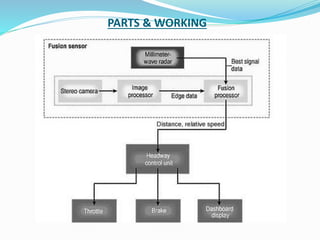
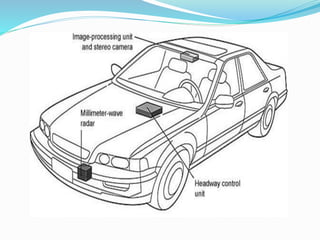
PARTS & WORKING
FUTURE ASPECTS
 Though conventional cruise control is still an expensively novelty, the next
generation, called co-operative cruise control, or CACC, is already being
tested in California and elsewhere. While ACC can only respond to a difference
between its own speed of the car ahead, cooperative systems will two or more
cars to communicate and work together to avoid collision. Ultimately,
experiments say, the technology may let cars fellow each other at intervals as
short as half a second at 100 km/hr, that would amount to a distance between
cars of less than 14 meters (roughly two car length).
 Meanwhile at fujitsu Ten Ltd, Japan engineers are working towards another
vision of the future of adaptive cruise control one targeted squarely at the
realities of driving on often-congested urban and sub-urban highways. Fujitsu
ten has demonstrated a prototype system for also called stop and go adaptive
cruise control. Ordinary ACC systems maintain a safe distance between cars
at speed above 40 km/hr, whereas fujitsu ten’s system will work primarily at
lower speed in heavy traffic. If the car in front stops, it will brings a vehicle to
complete stop. Afterward, it will not re-engage the throttle thats up to the
driver but as soon as the throttle is engaged, it will accelerate and de-accelerate
along with the leading car over any range of speeds between zero and the
cruising speed set by the driver. Within a decade or so, the drivers of the most
advanced cars will only have to steer. Eventually, people might not be even
entrusted with that task, at least on limited access highways.
DANGERS OF CRUISE CONTROL
 The only danger with cruise control is the use of
cruise control in wet and slippery roads. You
should turn off cruise control while driving
through such types of roads conditions. It is very
dangerous to use cruise control in any slippery
conditions like rain, snow, or ice as it takes the
complete control of the vehicle out of your hands.
 That is because most cruise control systems are
designed for normally dry conditions and can’t
sense weather the wheels are spinning uselessly. If
your car begins to caring out of control, cruise
control will continue to accelerate as it tries to
maintain a constant speed. It would put your car
into a sideway spin cause the vehicle to flip over.
SUMMARY
 This seminar has described about the cruise control
systems that are commonly seen in luxury cars nowadays.
Fully autonomous car is probably not viable in foreseen
future. The intelligent initiative in the united stated and
ertico program in Europe are among dozens of group
working on technologies that may ultimately lead to
vehicles that are wrapped in a cocoon of sensor, with a
360^0 view of their environment. Then nearby vehicle
would be in constant communication with each other and
act co-operatively, enabling groups of cars to race along like
train cars, almost bumper to bumper, at speeds above 100
km/hr.
 It will probably takes decades, but car accident may
eventually become almost as rare as plane crashes now. The
automobile, which transformed the developed world by
offering mobility and autonomy, will finally stop exacting
THE END
THANKS FOR WATCHING
MY PPT ON ADAPTIVE CRUISE CONTROL
SYSTEM
HARSHDEEP GAUTAM

Adaptive cruise control

  • 1.
    A PRESENTATION ON ADAPTIVE CRUISE CONTROLSYSTEM Prepared by:- Harshdeep Gautam B.Tech(ME) 6th sem SCHOOL OF ENGINEERING & TECHNOLOGY IFTM UNIVERSITY, MORADABAD SESSION:- 2019-2020
  • 2.
    ABSTRACT Cruise control isa new technological development which incorporates a factor of comfort in driving. Safety is only a small benefit of this system. In short, cruise control can be said to be a system which uses the principles of radar to determine the distances between two consecutive moving vehicles in which either one or both of them is incorporated with this system. The electromagnetic rays from radar system are sensed by sensors in the vehicle which in turn rely commands to the throttle and brakes of the vehicle to perform according to the adjacent vehicle’s distance. So cruise control is a system which provides comfort to drivers during long monotonous drives.
  • 3.
    INTRODUCTION  Every minute,on average, at least one person dies in a car crash. If you read this article from start to finish 30 or more deaths will have occurred across the globe by the time you are done. Auto accidents will also injure at least 10million people this year, two or three million of them seriously. All told, the hospital bills, damaged property and other cost will add up to 1 – 3 % of the world’s gross domestic product according to the paris based organisation for economic cooperation and development. And, of course, the losses that matter most is not even captured by these statistics, because there is no way to put a rupee / dollar value on them.
  • 4.
     Engineers havebeen chipping away at this staggering numbers for long time. Many safety innovations in the areas of banking systems, air bags, seat belts, body structures, steering and suspension have had a beneficial effect. Air bags and seat belts save tens of thousands of people a year by preventing their head from crashing into the wind shield. Supercomputers now let designers create car frames and bodies that protect the people inside by absorbing much of energy of crash as possible. As a result, number of fatalities per million kilometers of vehicle travel has decreased. But the ultimate solution and the only thing that will save far more lives, limbs and money are to keep out cars from smashing into each other.
  • 5.
     That isexactly what engineers in united states, Europe, Japan and India are trying to do. They are applying advanced microprocessors, radar, high speed IC’s and signal-processing chips and algorithm in R&D programs that mark an about face in the automotive industry: from safety system that kicks in after an incident occurs, attempting to minimize injury and damage, to ones that prevent collision altogether.
  • 6.
     The firstcollision avoidance features are already on the road, as pricey cruise control option on a small group of luxury cars. Over the next few years, these systems will grow more capable and more widely available, until they become standard equipment on luxury vehicles. Meanwhile, researchers will bringing the first cooperative systems to market. This will take active safety technology to the next level, enabling vehicles to communicate and coordinate response to avoid collisions. Note that to avoid liability claims in the event of car companies that use them are careful not to refer them as safety devices. Instead they are being marketed as driver aids, convenience made possible by latest innovative technology.
  • 7.
    WHAT IS CRUISECONTROL  Cruise control is a system, which automatically controls the speed of an automobile. The driver sets the speed and the system will take over the throttle of the car to maintain the speed. The system is thereby improving driver comfort in steady traffic conditions where speeds vary widely these systems are no longer effective.
  • 8.
     Most cruisecontrol systems don’t allow the use cruise control below a certain speed. The use of cruise control would be significantly increased if the vehicle speed could automatically adapt to the traffic flow. This features can be handy for long drives along sparsely populated roads and usually results in better fuel efficiency. It is also known in some places as “poor man’s radar detector”, as by cruise control, a driver who otherwise tends to unconsciously increased speed over the highway journey may avoid a speeding ticket.
  • 9.
     Blind inventorand mechanical engineer Ralph teeter invented cruise control in 1945. His idea was born out of the frustration of riding in a car driven by his lawyer, who kept speeding up and slowly down as he talked. The Chrysler corporation on the 1958 chrysler imperial introduced first car with cruise control systems.
  • 10.
    How to setcruise control:-  In modern design, the cruise control may or may not need to be turned on before use – in some design it is always “on” but not always enabled. Most designed have separate “on” switch as well as set, resume, accelerate and coast functions. The system is operated with controls easily within the driver’s reach, usually with two or more buttons on the steering wheel or on the windshield wiper or turn signal stalk. The cruise switches of a latest ford car is shown in figure.  Driver should bring the Car speed to discourage Use in city driving. The Car will maintain that speed by actuating the throttle. Most systems can be turned off both explicitly or automatically, when the driver hits brake or clutch, when the cruise control is in effect, the throttle can still be used to accelerate the car, although the car will then slow down until it reaches the previously set speed.
  • 11.
    Now let ussee individual functions of each cruise switch 1. The on and off buttons really don’t do much. Some cruise control don’t have these buttons; instead they turn off when the driver hits the brake, and turn on when the driver hits the set button. 2. The set/accelerate button tells the car to maintain the speed you are currently driving. If you hit the button at 45 km/hr, the car will maintain your speed at 45 km/hr. Holding down the set/accelerate button will make the car accelerate. On most cars, tapping it once will make the car go 1 km/hr faster. 3. If recently disengaged the cruise control by hitting the brake or clutch pedal, hitting the resume button will command the car to accelerate back to the most recent speeding setting. 4. Holding down the coast button will cause the car to de-accelerate, just as if you took your foot completely off the gas. On most cars, tapping the coast button once will cause the car to slow down by 1 km/hr. 5. The brake pedal and clutch pedal each have a switch so you can disengage the cruise control with a light tap on the brake or clutch.
  • 12.
    ADAPTIVE CRUISE CONTROL There is a new type of cruise coming onto the market called adaptive cruise control. Two companies, TRW and Delphi automotive systems are developing a more advance cruise control that can automatically adjust a car’s speed to maintain a safe following assistance.  Adaptive cruise control is similar to conventional cruise control in that it maintain the vehicles pre- set speed. However, unlike conventional cruise control, this new system can automatically adjust speed in order to maintain a proper and safe distance between vehicles in same lane.
  • 13.
     In may1998, Toyota became the first to introduce an ACC system on a production vehicle when it unveiled a laser-based system for its progress compact luxury sedan, which it sold in Japan. Then Nissan followed suit with a radar-based system, in the company’s Cima 41LV-2, a luxury sedan also sold in japan. In September 1999, jaguar began offering an ACC for its XKR coupes and convertible sold in germany and Britain Delphi Delco electronic system supplies the radar sensing unit; TRW automotive electronics, the brake control; and Siemens, the assembly that manipulates the throttle. Last fall, Mercedes-Benz and Lexus joined the adaptive cruise control movement. Lexus offers an ACC option for its top-off the lineLS430; at the movement, it is the only ACC system available in the united states. Mercedes’s system is an option on its C-class and S-class models, which are available in Europe.
  • 14.
     All ofthe ACC system available today are built around sensor that detect the vehicle ahead through the use of either radar or lidar(light detecting and ranging, the laser based analog to radar). The choice of sensor present classic design tradeoffs. We will see the radar based system in detail later. Lidar is less expensive to produce and easier to package but perform poorly in rain and snow. The light beams are narrower than water droplets and snowflakes, pushing down the signal to noise ratio in bad weather. Another problem is that accumulation of mud, dust or snow on the car can block lidar beams.
  • 15.
     At present,only the one automaker, Lexus, uses a laser-based ACC system, in its LS430 luxury sedan. System engineers have acknowledge lidar’s shortcoming and taken step to make the system unavailable in situations where the weather may limit its effectiveness. According to the LS430 owner’s manual, the system will automatically shut itself off if the windshield wiper are turned to a rapid setting, indicating heavy rain or snow; if something activates the anti-lock braking system (which helps the driver maintain a steering control and reduces stopping distances during emergency braking situatuations); or if the vehicle skid control system detects the slipping of tires on turns that its common in wet weather.
  • 16.
  • 18.
    FUTURE ASPECTS  Thoughconventional cruise control is still an expensively novelty, the next generation, called co-operative cruise control, or CACC, is already being tested in California and elsewhere. While ACC can only respond to a difference between its own speed of the car ahead, cooperative systems will two or more cars to communicate and work together to avoid collision. Ultimately, experiments say, the technology may let cars fellow each other at intervals as short as half a second at 100 km/hr, that would amount to a distance between cars of less than 14 meters (roughly two car length).  Meanwhile at fujitsu Ten Ltd, Japan engineers are working towards another vision of the future of adaptive cruise control one targeted squarely at the realities of driving on often-congested urban and sub-urban highways. Fujitsu ten has demonstrated a prototype system for also called stop and go adaptive cruise control. Ordinary ACC systems maintain a safe distance between cars at speed above 40 km/hr, whereas fujitsu ten’s system will work primarily at lower speed in heavy traffic. If the car in front stops, it will brings a vehicle to complete stop. Afterward, it will not re-engage the throttle thats up to the driver but as soon as the throttle is engaged, it will accelerate and de-accelerate along with the leading car over any range of speeds between zero and the cruising speed set by the driver. Within a decade or so, the drivers of the most advanced cars will only have to steer. Eventually, people might not be even entrusted with that task, at least on limited access highways.
  • 19.
    DANGERS OF CRUISECONTROL  The only danger with cruise control is the use of cruise control in wet and slippery roads. You should turn off cruise control while driving through such types of roads conditions. It is very dangerous to use cruise control in any slippery conditions like rain, snow, or ice as it takes the complete control of the vehicle out of your hands.  That is because most cruise control systems are designed for normally dry conditions and can’t sense weather the wheels are spinning uselessly. If your car begins to caring out of control, cruise control will continue to accelerate as it tries to maintain a constant speed. It would put your car into a sideway spin cause the vehicle to flip over.
  • 20.
    SUMMARY  This seminarhas described about the cruise control systems that are commonly seen in luxury cars nowadays. Fully autonomous car is probably not viable in foreseen future. The intelligent initiative in the united stated and ertico program in Europe are among dozens of group working on technologies that may ultimately lead to vehicles that are wrapped in a cocoon of sensor, with a 360^0 view of their environment. Then nearby vehicle would be in constant communication with each other and act co-operatively, enabling groups of cars to race along like train cars, almost bumper to bumper, at speeds above 100 km/hr.  It will probably takes decades, but car accident may eventually become almost as rare as plane crashes now. The automobile, which transformed the developed world by offering mobility and autonomy, will finally stop exacting
  • 21.
    THE END THANKS FORWATCHING MY PPT ON ADAPTIVE CRUISE CONTROL SYSTEM HARSHDEEP GAUTAM