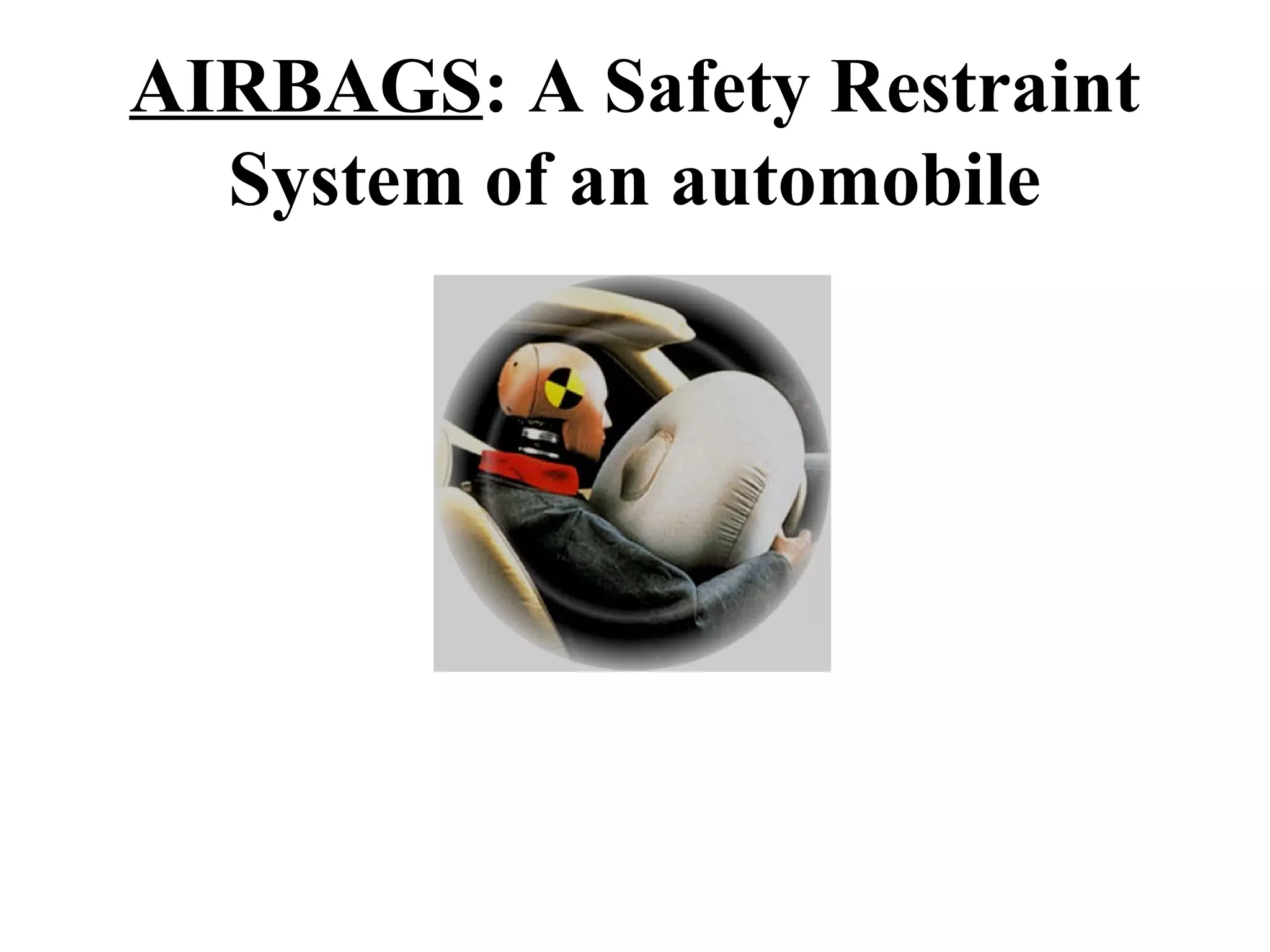
AIRBAGS: A Safety Restraint
System of an automobile
INTRODUCTION
Seat belts provided the sole form of safety in
cars.
Airbags were developed.
A soft pillow to land against in a crash.
They are gas-inflated cushions.
The first patent on an inflatable crash landing
device was filed during World War II.
Airbags are the subject of serious scientific
research and tests.
BASICS OF AIRBAGS
Newton’s second law of motion.
If objects aren’t restrained they will continue
moving at the speed of the moving car even if
the car is stopped by a collision.
All airbags need to do is slow down the
passengers speed to zero.
MAIN PARTS OF AN AIRBAG
 Bag
Made of thin nylon fabric,folded into a steering wheel
or dashboard or more recently the door or seat.
 Sensor
Tells the bag to inflate
 Inflation system
The rapid pulse of hot nitrogen gas to inflate the bag.
WORKING
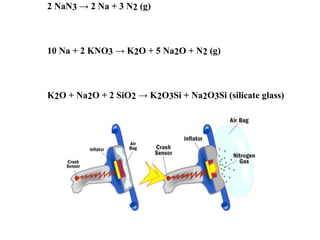
 During collision, a mechanical switch is flipped
and an electrical contact takes place.
 Sensors send an electric current to the inflation
system.
 Inflation system contains sodium azide and
potassium nitrate.
 Electric current heats the filament which ignites
the capsule containing Nitrogen gas.
 The gas expands quickly and inflation of air
bags takes place, which literally bursts from its
storage site in the steering wheel.
2 NaN3 → 2 Na + 3 N2 (g)
10 Na + 2 KNO3 → K2O + 5 Na2O + N2 (g)
K2O + Na2O + 2 SiO2 → K2O3Si + Na2O3Si (silicate glass)
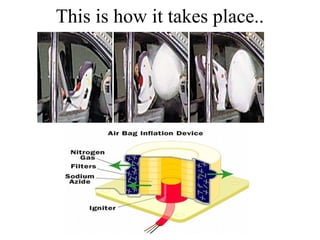
This is how it takes place..
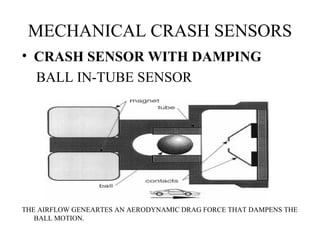
MECHANICAL CRASH SENSORS
• CRASH SENSOR WITH DAMPING
BALL IN-TUBE SENSOR
THE AIRFLOW GENEARTES AN AERODYNAMIC DRAG FORCE THAT DAMPENS THE
BALL MOTION.
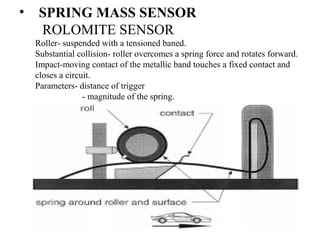
• SPRING MASS SENSOR
ROLOMITE SENSOR
Roller- suspended with a tensioned baned.
Substantial collision- roller overcomes a spring force and rotates forward.
Impact-moving contact of the metallic band touches a fixed contact and
closes a circuit.
Parameters- distance of trigger
- magnitude of the spring.
Future of airbags

Smart Restraint Systems
Adapts its geometry, performance or behavior
to suit various impacts and occupant position.
Includes weight sensors.
Determine type of occupant in the seat. i.e
child or adult.
Detect the distance of passenger from airbags.
MODERN TYPES OF AIRBAGS

Side air bag
Cars that currently offer side airbags represent
the new wave of occupant protection.
Provides protection during side collisons.
This prevents the airbag on the undamaged
side of the car from inflating.

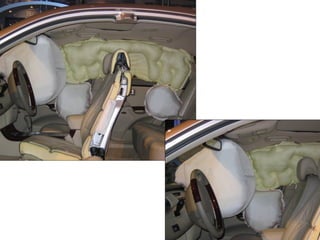
Curtain airbags
Inflates in front of windows to provide
passengers better head and neck protection.
 More efficient at tipping and side impacts.

Door air bag
The door has more space, allowing for a
bigger bag that provides more coverage.
Developed by Ford and Renault.
Door-mounted side air bags must begin
deploying in mere 5 or 6 milliseconds!
Airbag checks
Turn the key and look at the dashboard to find
the airbag light on for 7-10 sec. & then it goes
off.
Problems occur when
• 1. Light does not come on.
• 2. If light does not go off after the period.
• 3. If light comes while driving.
CONCLUSIONS
Since safety of human life is of high priority,
Air bags are of greater importance in the
present vehicles.
Safety bags must be implemented for safe
riding and for saving precious lives.
Let’s hope every automobile manufacturer
implements the same.
References
[1] A Safety Restraint System of an Automobile.
Tasnim N. Shaikh et al. Int. Journal of Engineering Research and Applications www.ijera.com
Vol. 3, Issue 5, Sep-Oct 2013, pp.615-621
[2] A Treatise on crash sensing for automotive airbag systems IEEE /ASME transactions on
Mechatronics, Vol. 7, No. 2, JUNE 2002 by Ching-Yao Chan .
THANK YOU

Airbags ppt

  • 1.
    AIRBAGS: A SafetyRestraint System of an automobile
  • 2.
    INTRODUCTION Seat belts providedthe sole form of safety in cars. Airbags were developed. A soft pillow to land against in a crash. They are gas-inflated cushions. The first patent on an inflatable crash landing device was filed during World War II. Airbags are the subject of serious scientific research and tests.
  • 3.
    BASICS OF AIRBAGS Newton’ssecond law of motion. If objects aren’t restrained they will continue moving at the speed of the moving car even if the car is stopped by a collision. All airbags need to do is slow down the passengers speed to zero.
  • 4.
    MAIN PARTS OFAN AIRBAG  Bag Made of thin nylon fabric,folded into a steering wheel or dashboard or more recently the door or seat.  Sensor Tells the bag to inflate  Inflation system The rapid pulse of hot nitrogen gas to inflate the bag.
  • 5.
    WORKING  During collision,a mechanical switch is flipped and an electrical contact takes place.  Sensors send an electric current to the inflation system.  Inflation system contains sodium azide and potassium nitrate.  Electric current heats the filament which ignites the capsule containing Nitrogen gas.  The gas expands quickly and inflation of air bags takes place, which literally bursts from its storage site in the steering wheel.
  • 6.
    2 NaN3 →2 Na + 3 N2 (g) 10 Na + 2 KNO3 → K2O + 5 Na2O + N2 (g) K2O + Na2O + 2 SiO2 → K2O3Si + Na2O3Si (silicate glass)
  • 7.
    This is howit takes place..
  • 8.
    MECHANICAL CRASH SENSORS •CRASH SENSOR WITH DAMPING BALL IN-TUBE SENSOR THE AIRFLOW GENEARTES AN AERODYNAMIC DRAG FORCE THAT DAMPENS THE BALL MOTION.
  • 9.
    • SPRING MASSSENSOR ROLOMITE SENSOR Roller- suspended with a tensioned baned. Substantial collision- roller overcomes a spring force and rotates forward. Impact-moving contact of the metallic band touches a fixed contact and closes a circuit. Parameters- distance of trigger - magnitude of the spring.
  • 10.
    Future of airbags  SmartRestraint Systems Adapts its geometry, performance or behavior to suit various impacts and occupant position. Includes weight sensors. Determine type of occupant in the seat. i.e child or adult. Detect the distance of passenger from airbags.
  • 11.
    MODERN TYPES OFAIRBAGS  Side air bag Cars that currently offer side airbags represent the new wave of occupant protection. Provides protection during side collisons. This prevents the airbag on the undamaged side of the car from inflating.
  • 12.
     Curtain airbags Inflates infront of windows to provide passengers better head and neck protection.  More efficient at tipping and side impacts.  Door air bag The door has more space, allowing for a bigger bag that provides more coverage. Developed by Ford and Renault. Door-mounted side air bags must begin deploying in mere 5 or 6 milliseconds!
  • 14.
    Airbag checks Turn thekey and look at the dashboard to find the airbag light on for 7-10 sec. & then it goes off. Problems occur when • 1. Light does not come on. • 2. If light does not go off after the period. • 3. If light comes while driving.
  • 15.
    CONCLUSIONS Since safety ofhuman life is of high priority, Air bags are of greater importance in the present vehicles. Safety bags must be implemented for safe riding and for saving precious lives. Let’s hope every automobile manufacturer implements the same.
  • 16.
    References [1] A SafetyRestraint System of an Automobile. Tasnim N. Shaikh et al. Int. Journal of Engineering Research and Applications www.ijera.com Vol. 3, Issue 5, Sep-Oct 2013, pp.615-621 [2] A Treatise on crash sensing for automotive airbag systems IEEE /ASME transactions on Mechatronics, Vol. 7, No. 2, JUNE 2002 by Ching-Yao Chan .
  • 17.