INTRODUCTION
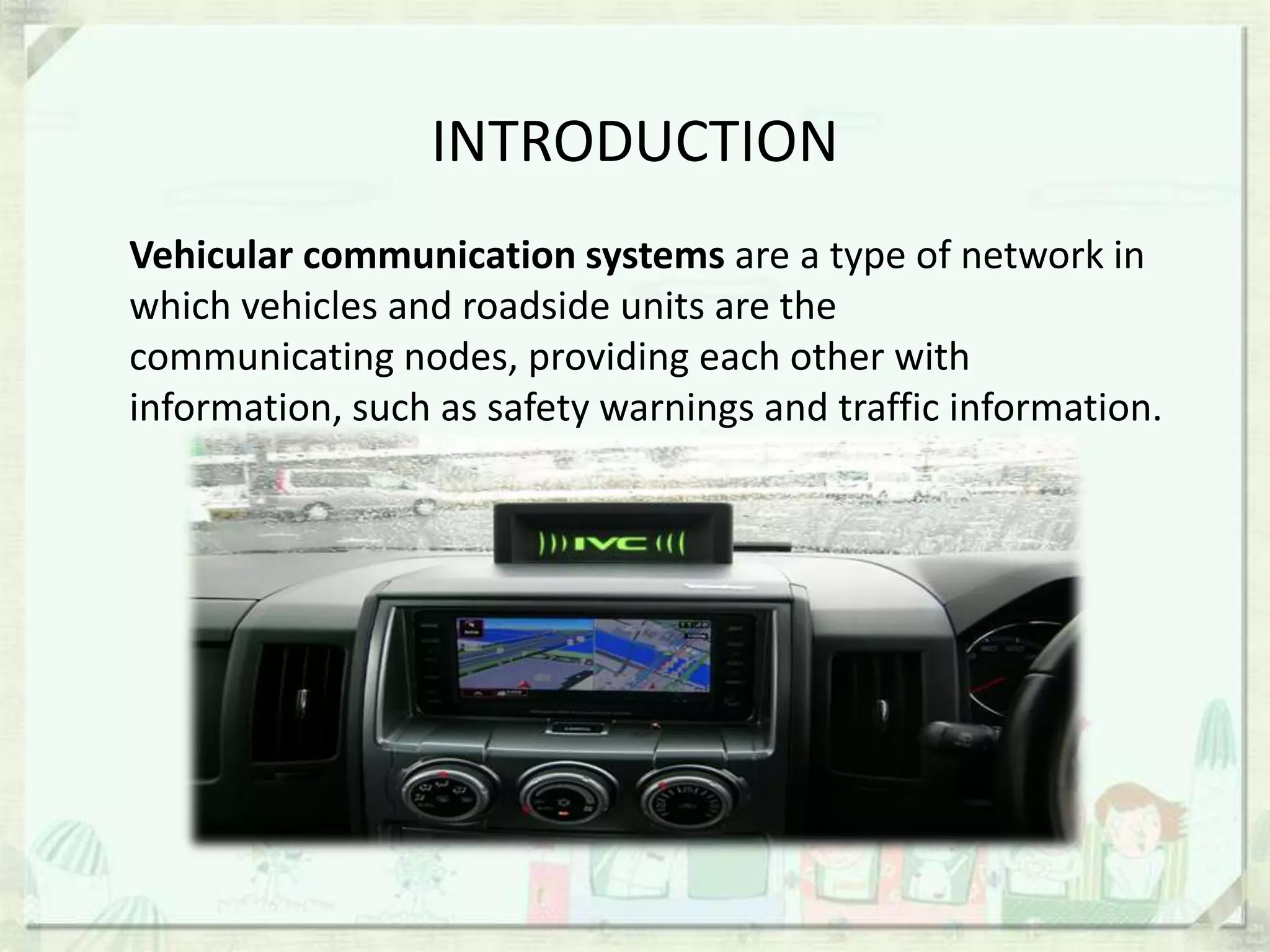
Vehicular communication systems are a type of network in
which vehicles and roadside units are the
communicating nodes, providing each other with
information, such as safety warnings and traffic information.
Forward radar
Computing platform
Event data recorder (EDR)
Positioning system
Rear radar
Communication
facility
Display
Over view of smart vehicle
Communicating vehicles can use both infrared
and radio waves
Radio waves include VHF, micro, and millimeter
waves
Bluetooth operates at 2.4 GHz , and is reliable up
to a speed of 80 km/h and range of 80meters.
It can take up to 3 seconds to establish the
communication.
Radio Bands
Vehicles Parameter
There are two types of parameters: Static and Dynamic
Static Parameters:
 The static parameter indicates the size of the vehicle and the
location of its GPS receiver within itself.
Dynamic Parameters:
 The dynamic parameters are vehicle’s position (Xn,Yn), speed
acceleration, direction and the status of the brakes, steering
wheel, gas paddle, turn signal etc.
Classes of Information
Flow chart of IVC
Vehicle-to-Roadside
Communication
Information is also available from roadside
sources. Car to roadside communications
use the 63 GHz band. This very high
frequency provides a very high bandwidth
link with roadside beacons.
The vehicle drivers and passengers are
thus able to receive traffic information,
browse the web while on the move, shop
online, and even participate in video-
conferences .
Another application that takes advantage
of vehicle-to-roadside communication
technologies is Electronic Toll Collection
(ETC).
Hazard Warning
Information sharing between vehicles
Vulnerabilities in IVC
 In Transit Traffic Tempering:- Nodes acting as a relay can disrupt
communication of other nodes
 Impersonation:- An attacker masquerading an emergency vehicle to
mislead other vehicles
Jamming:- The Jammer deliberately generates interfering
transmissions that prevents communication
Forgery:- Fast contamination of large portions of the
vehicular network coverage area with false information
Attacks on IVC
Attack 1: Bogus Traffic Information
Traffic
jam
ahead
Attack 3: Cheating with Identity, Position or Speed
I was not
there!
Attack 2:Disruption of Network Operation
SLOW
DOWN
The way
is clear
Challenges in IVC
 Liability Vs Privacy:- Accountability and liability of the vehicles is
required and context specific information such as coordinates, time
intervals should be possible to extract but such requirements raise
privacy concerns
 Real Time Communication:- Driver assistance applications are time
sensitive therefore security protocols should impose low processing
overhead
 Vehicular Network Scale:- With roughly billion vehicles,
the design of a facility that provides cryptographic keys is big
challenge
Components of Security Architecture
 Event Data Recorder:- The EDR will be responsible for recording the vehicles critical
data such as position, time, speed etc. EDR will also record
all the received safety messages
 Tamper Proof Device:- The TPD will store all the cryptographic materials and perform
cryptographic operations like signing and verifying safety
messages
 Vehicular Public Key Infrastructure:- In VPKI infrastructure Certificate Authorities will
issue certified public/private key pairs to vehicles
 Authentication:- Vehicles will sign each message with their private key and attach
corresponding certificate. Thus when another vehicle receives the
message it verifies key used to sign the message and then it
verifies the message.
 Privacy:- To conceal vehicles identity , set of anonymous keys that changes
frequently can be used. This keys are preloaded into vehicles Tamper Proof
Device for long duration
Application of IVC
 Information and Warning Functions:-
Dissemination of road information to vehicles distant from the subjected site
 Communication based longitudinal control:-
Exploiting the look through capacity to avoid accidents, platooning vehicles
etc.
 Co-operative Assistant Systems:-
Coordinating vehicles at critical points
 Added Value Applications:-
Internet Access, Location based services, Multiplayer games
Future developments
Use of radar, laser, ultrasonic sensors have certain limitations and will
not offer communication between large number of vehicles, such as
vehicles at a junction, etc. So, GPS and Wi-Fi are the two methods by
which any type of communication can be achieved in all types of
conditions. Automatically analyzing the traffic signs and signals is also
possible by incorporation if cameras onto the vehicles or emission of
warning signals directly from the traffic boards which can be read by
the receivers in the vehicles
Conclusion
 Design of communication protocols in IVC is extremely challenging
 Protocols have potential to support many new innovative
applications
 These technologies can greatly enhance the infotainment, safety,
comfort, communication and convenience value of new vehicles.
 As vehicles become “smarter”, security and privacy gain importance

inter vehicle communication

  • 2.
    INTRODUCTION Vehicular communication systemsare a type of network in which vehicles and roadside units are the communicating nodes, providing each other with information, such as safety warnings and traffic information.
  • 3.
    Forward radar Computing platform Eventdata recorder (EDR) Positioning system Rear radar Communication facility Display Over view of smart vehicle
  • 4.
    Communicating vehicles canuse both infrared and radio waves Radio waves include VHF, micro, and millimeter waves Bluetooth operates at 2.4 GHz , and is reliable up to a speed of 80 km/h and range of 80meters. It can take up to 3 seconds to establish the communication. Radio Bands
  • 5.
    Vehicles Parameter There aretwo types of parameters: Static and Dynamic Static Parameters:  The static parameter indicates the size of the vehicle and the location of its GPS receiver within itself. Dynamic Parameters:  The dynamic parameters are vehicle’s position (Xn,Yn), speed acceleration, direction and the status of the brakes, steering wheel, gas paddle, turn signal etc.
  • 6.
  • 7.
  • 8.
    Vehicle-to-Roadside Communication Information is alsoavailable from roadside sources. Car to roadside communications use the 63 GHz band. This very high frequency provides a very high bandwidth link with roadside beacons. The vehicle drivers and passengers are thus able to receive traffic information, browse the web while on the move, shop online, and even participate in video- conferences . Another application that takes advantage of vehicle-to-roadside communication technologies is Electronic Toll Collection (ETC).
  • 9.
  • 10.
  • 12.
    Vulnerabilities in IVC In Transit Traffic Tempering:- Nodes acting as a relay can disrupt communication of other nodes  Impersonation:- An attacker masquerading an emergency vehicle to mislead other vehicles
  • 13.
    Jamming:- The Jammerdeliberately generates interfering transmissions that prevents communication
  • 14.
    Forgery:- Fast contaminationof large portions of the vehicular network coverage area with false information
  • 15.
    Attacks on IVC Attack1: Bogus Traffic Information Traffic jam ahead
  • 16.
    Attack 3: Cheatingwith Identity, Position or Speed I was not there!
  • 17.
    Attack 2:Disruption ofNetwork Operation SLOW DOWN The way is clear
  • 18.
    Challenges in IVC Liability Vs Privacy:- Accountability and liability of the vehicles is required and context specific information such as coordinates, time intervals should be possible to extract but such requirements raise privacy concerns  Real Time Communication:- Driver assistance applications are time sensitive therefore security protocols should impose low processing overhead  Vehicular Network Scale:- With roughly billion vehicles, the design of a facility that provides cryptographic keys is big challenge
  • 19.
    Components of SecurityArchitecture  Event Data Recorder:- The EDR will be responsible for recording the vehicles critical data such as position, time, speed etc. EDR will also record all the received safety messages  Tamper Proof Device:- The TPD will store all the cryptographic materials and perform cryptographic operations like signing and verifying safety messages  Vehicular Public Key Infrastructure:- In VPKI infrastructure Certificate Authorities will issue certified public/private key pairs to vehicles  Authentication:- Vehicles will sign each message with their private key and attach corresponding certificate. Thus when another vehicle receives the message it verifies key used to sign the message and then it verifies the message.  Privacy:- To conceal vehicles identity , set of anonymous keys that changes frequently can be used. This keys are preloaded into vehicles Tamper Proof Device for long duration
  • 20.
    Application of IVC Information and Warning Functions:- Dissemination of road information to vehicles distant from the subjected site  Communication based longitudinal control:- Exploiting the look through capacity to avoid accidents, platooning vehicles etc.  Co-operative Assistant Systems:- Coordinating vehicles at critical points  Added Value Applications:- Internet Access, Location based services, Multiplayer games
  • 21.
    Future developments Use ofradar, laser, ultrasonic sensors have certain limitations and will not offer communication between large number of vehicles, such as vehicles at a junction, etc. So, GPS and Wi-Fi are the two methods by which any type of communication can be achieved in all types of conditions. Automatically analyzing the traffic signs and signals is also possible by incorporation if cameras onto the vehicles or emission of warning signals directly from the traffic boards which can be read by the receivers in the vehicles
  • 22.
    Conclusion  Design ofcommunication protocols in IVC is extremely challenging  Protocols have potential to support many new innovative applications  These technologies can greatly enhance the infotainment, safety, comfort, communication and convenience value of new vehicles.  As vehicles become “smarter”, security and privacy gain importance