Automated Perimetry
Dr.Vikram.S.Nakhate
Dr.Vijay.Shetty
 Automated way of mapping the visual field
 Important diagnostic test in glaucoma
 Diagnosing and monitoring progression of other
disease
 Traquair described it as a field of vision in a sea of
darkness
 It has a shape of a hill
 Peak representing fovea
 2 slopes representing nasal and temporal field of
vision
Kinetic perimetry
 Stimuli is moved from a non seeeing area to a seeing
area along a set meridian
 Aim is to find points in the visual field of equal retinal
sensitivity
 Lister perimetry
 Campimetry
 Goldman perimetry
Static perimetry
 Intensity of the stimuli at the same pre determined
spot is varied
 Find out threshold at those locations
 More accurate than kinetic perimetry
 Gives a 3D picture of the hill of vision
 Picks up field defects more accurately
 Apostlib is an absolute measure of luminance and is
equal to 0.3183 candela m2 or 0.1 mililambert
 Decibel is a measure of sensitivity of retina
 Inversely proportional
 It is a relative measure varies from machine to
machine
Testing strategy
 Full threshold
 Threshold
 Suprathreshold
Full threshold strategy
 Staircase method (4-2 bracketing strategy)
 Used to detect threshold
4-2 bracketing
 Intensity of stimulus is decreased in 4-db step till
stimulus is no longer seen
 Increasing the stimulus in 2-db step till stimulus is
seen again
Threshold perimetry
 Threshold found at predetermined points
 Time consuming process
Suprathreshold perimetry
 Intensity of stimulus shown at a spot much higher
than threshold at that spot
 Mainly for screening
 Picks up gross visual defects
Newer threshold strategy
 Fastpac:
 Decreases the test time by 40%
 3-db increment instead of 4-db
 Threshold crossed only once
 Sita standard:
 Takes half time than full threshold method
 Sita fast:
 Takes half time than fast pac threshold method
30-2
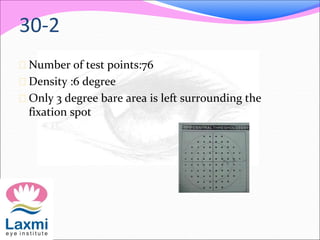
 Number of test points:76
 Density :6 degree
 Only 3 degree bare area is left surrounding the
fixation spot
24-2
 Number of test points:54
 Density: 6 degree
 Only 3 degree bare area is left surrounding the
fixation spot
10-2 central threshold test
 Number of test points: 68
 Density: 2 degree
 Only 1 degree bare area is left surrounding the fixation
spot
Macular programme
 Number of test points: 16
 Density: 2 degree
 Only 1 degree bare area is left surrounding the fixation
spot
Reliabilty indices
 Fixation losses:
 Indicates steadiness of gaze
 Presenting stimuli at blind spot
 loss.>20% is unreliable
 False positives
 Trigger happy patients
 Responds to an audible stimuli when no target is
presented
 >33% is unrelible
 False negative:
 Fails to respond to a suprathreshold stimuli
 Indicates fatigue,inattentiveness
 >33% is unreliable
Zone 1
 Colour of the stimulus
 Background illumination: 31.5 asb
 Stimulus size: III
 Testing strategy
Zone 3
Zone 4 total deviation
 Depicts difference between patients threshold fom
that of age matched normals
 Reveals generalised depression
 Cannot confirm scotoma
Zone 5 pattern deviation
 Reveals focal defects after adjusting for overall
depression
 Confirms scotoma
Global indices
 Mean deviation:
 Indicates overall deviation of the visual field from
normal
 Positive number indicates an elevated field
 Negative number indicates a depressed field
 Cannot confirm scotoma
Psd
 Derived from total deviation
 Indicates the degree to which the numbers differ from
each other
 Highlights pot-holes in hill of vision
 Calls attention for scotoma
Short term fluctuation
 Measure of intra-test variability
 Threshold at 10 pre selected points is tested
 Difference between 1 & 2 measurement noted
 Cpsd is psd corrected for sf
 If sf is due to unreliability
 Then cpsd is better
 If sf is due to pathology
 Then psd is better
GHT
 5 set of points above horizontal meridian
 Compared to mirror image below horizontal meridian
Zone 8
 Numerical display:
 Gives the threshold for all points checked
 Value in () indicates that the point has been tested
twice
 Never rely on first report
 Always correlate clinically
 Correct any significant refractive error before
proceeding
Sources of error
 Miosis:
decreases the threshold sensitivity in peripheral field
Increases the variability in central field
 Uncorrected refractive errors:
Threshold sensitivity appears less
 Hyperopic patient with contact lens:
Defect gets magnified & vice versa
 Spectacles can cause rim scotomas
 Ptosis :
Suppression of superior visual field
Principle
 Is there a field defect ?
 Is it due to glaucoma ?
 Is the defect progressing ?
 Compare to selected baseline
 Discard learning fields from baseline
 Recognise false progression
False progression
 Learning curve
 Long term fluctuation
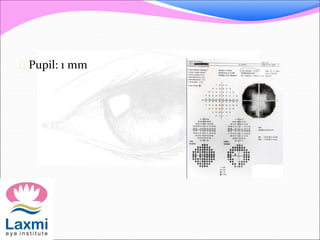
 Pupil size
 Pupil: 1 mm
 Pupil: 2.5 mm
Andersons criteria
 1. pattern deviation plot:
 3 non-edge points with p<5%
 One point with p<1%
 Cluster in arcuate area
 2.cpsd
 Abnormal with p<5% on 2 consecutive occasion
 3.abnormal GHT
CATARACT
GLAUCOMA
CATARACT & GLAUCOMA
Detecting progression
 Overview printout
 Glaucoma change probability analysis
Overview print out
 Sequential series of field of same patient over a period
of time
 Displays gray scales,total &pattern deviation
 Statistical analysis is however not provided
 This patient developed cataract,which was extracted
later
 Pattern deviation plot remained clear
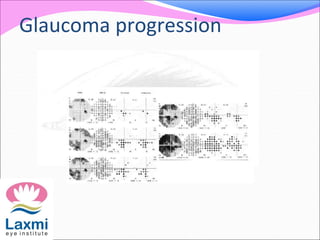
Glaucoma progression
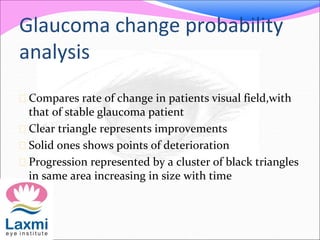
Glaucoma change probability
analysis
 Compares rate of change in patients visual field,with
that of stable glaucoma patient
 Clear triangle represents improvements
 Solid ones shows points of deterioration
 Progression represented by a cluster of black triangles
in same area increasing in size with time
 2 or more points deteriorate on 2 consecutive test
 3 or more points deteriorate on 3 consecutive test
Advanced field defects
 Why pattern deviation plot not showing defect
 Not enough points with sensitivity to produce pattern
deviation plot
Follow up with 10-2
 Enough sensitive points to produce pattern deviation
 Advanced defect f/u with a size V target(64mm2)
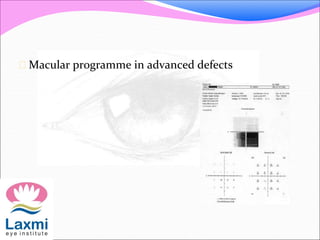
 Macular programme in advanced defects
Size V target:macular split
 Macular split (0 db) next to fovea may indicate wipe
out
 Thank you

Automated perimetry

  • 1.
  • 2.
     Automated wayof mapping the visual field  Important diagnostic test in glaucoma  Diagnosing and monitoring progression of other disease
  • 3.
     Traquair describedit as a field of vision in a sea of darkness  It has a shape of a hill  Peak representing fovea  2 slopes representing nasal and temporal field of vision
  • 6.
    Kinetic perimetry  Stimuliis moved from a non seeeing area to a seeing area along a set meridian  Aim is to find points in the visual field of equal retinal sensitivity  Lister perimetry  Campimetry  Goldman perimetry
  • 7.
    Static perimetry  Intensityof the stimuli at the same pre determined spot is varied  Find out threshold at those locations  More accurate than kinetic perimetry  Gives a 3D picture of the hill of vision  Picks up field defects more accurately
  • 8.
     Apostlib isan absolute measure of luminance and is equal to 0.3183 candela m2 or 0.1 mililambert  Decibel is a measure of sensitivity of retina  Inversely proportional  It is a relative measure varies from machine to machine
  • 9.
    Testing strategy  Fullthreshold  Threshold  Suprathreshold
  • 10.
    Full threshold strategy Staircase method (4-2 bracketing strategy)  Used to detect threshold
  • 11.
    4-2 bracketing  Intensityof stimulus is decreased in 4-db step till stimulus is no longer seen  Increasing the stimulus in 2-db step till stimulus is seen again
  • 12.
    Threshold perimetry  Thresholdfound at predetermined points  Time consuming process
  • 13.
    Suprathreshold perimetry  Intensityof stimulus shown at a spot much higher than threshold at that spot  Mainly for screening  Picks up gross visual defects
  • 14.
    Newer threshold strategy Fastpac:  Decreases the test time by 40%  3-db increment instead of 4-db  Threshold crossed only once
  • 15.
     Sita standard: Takes half time than full threshold method  Sita fast:  Takes half time than fast pac threshold method
  • 16.
    30-2  Number oftest points:76  Density :6 degree  Only 3 degree bare area is left surrounding the fixation spot
  • 17.
    24-2  Number oftest points:54  Density: 6 degree  Only 3 degree bare area is left surrounding the fixation spot
  • 18.
    10-2 central thresholdtest  Number of test points: 68  Density: 2 degree  Only 1 degree bare area is left surrounding the fixation spot
  • 19.
    Macular programme  Numberof test points: 16  Density: 2 degree  Only 1 degree bare area is left surrounding the fixation spot
  • 20.
    Reliabilty indices  Fixationlosses:  Indicates steadiness of gaze  Presenting stimuli at blind spot  loss.>20% is unreliable
  • 21.
     False positives Trigger happy patients  Responds to an audible stimuli when no target is presented  >33% is unrelible
  • 23.
     False negative: Fails to respond to a suprathreshold stimuli  Indicates fatigue,inattentiveness  >33% is unreliable
  • 26.
    Zone 1  Colourof the stimulus  Background illumination: 31.5 asb  Stimulus size: III  Testing strategy
  • 28.
  • 29.
    Zone 4 totaldeviation  Depicts difference between patients threshold fom that of age matched normals  Reveals generalised depression  Cannot confirm scotoma
  • 30.
    Zone 5 patterndeviation  Reveals focal defects after adjusting for overall depression  Confirms scotoma
  • 37.
    Global indices  Meandeviation:  Indicates overall deviation of the visual field from normal  Positive number indicates an elevated field  Negative number indicates a depressed field  Cannot confirm scotoma
  • 38.
    Psd  Derived fromtotal deviation  Indicates the degree to which the numbers differ from each other  Highlights pot-holes in hill of vision  Calls attention for scotoma
  • 39.
    Short term fluctuation Measure of intra-test variability  Threshold at 10 pre selected points is tested  Difference between 1 & 2 measurement noted
  • 40.
     Cpsd ispsd corrected for sf  If sf is due to unreliability  Then cpsd is better  If sf is due to pathology  Then psd is better
  • 42.
    GHT  5 setof points above horizontal meridian  Compared to mirror image below horizontal meridian
  • 44.
    Zone 8  Numericaldisplay:  Gives the threshold for all points checked  Value in () indicates that the point has been tested twice
  • 45.
     Never relyon first report  Always correlate clinically  Correct any significant refractive error before proceeding
  • 46.
    Sources of error Miosis: decreases the threshold sensitivity in peripheral field Increases the variability in central field  Uncorrected refractive errors: Threshold sensitivity appears less  Hyperopic patient with contact lens: Defect gets magnified & vice versa
  • 47.
     Spectacles cancause rim scotomas  Ptosis : Suppression of superior visual field
  • 48.
    Principle  Is therea field defect ?  Is it due to glaucoma ?  Is the defect progressing ?  Compare to selected baseline  Discard learning fields from baseline  Recognise false progression
  • 49.
    False progression  Learningcurve  Long term fluctuation  Pupil size
  • 50.
  • 51.
  • 52.
    Andersons criteria  1.pattern deviation plot:  3 non-edge points with p<5%  One point with p<1%  Cluster in arcuate area  2.cpsd  Abnormal with p<5% on 2 consecutive occasion  3.abnormal GHT
  • 53.
  • 54.
  • 55.
  • 56.
    Detecting progression  Overviewprintout  Glaucoma change probability analysis
  • 57.
    Overview print out Sequential series of field of same patient over a period of time  Displays gray scales,total &pattern deviation  Statistical analysis is however not provided
  • 58.
     This patientdeveloped cataract,which was extracted later  Pattern deviation plot remained clear
  • 60.
  • 61.
    Glaucoma change probability analysis Compares rate of change in patients visual field,with that of stable glaucoma patient  Clear triangle represents improvements  Solid ones shows points of deterioration  Progression represented by a cluster of black triangles in same area increasing in size with time
  • 64.
     2 ormore points deteriorate on 2 consecutive test
  • 65.
     3 ormore points deteriorate on 3 consecutive test
  • 66.
    Advanced field defects Why pattern deviation plot not showing defect
  • 67.
     Not enoughpoints with sensitivity to produce pattern deviation plot
  • 68.
    Follow up with10-2  Enough sensitive points to produce pattern deviation
  • 69.
     Advanced defectf/u with a size V target(64mm2)
  • 70.
     Macular programmein advanced defects
  • 71.
    Size V target:macularsplit  Macular split (0 db) next to fovea may indicate wipe out
  • 72.