Visual Field
Testing and Interpretation
Raman P Shah
Optometrist
B. P. Koirala Lions Center for Ophthalmic Studies
References and recommended readings
• Walsh TJ. Visual fields Examination and
Interpretation, Ophthalmology monographs, AAO
• J Boyd Eskridge. Clinical procedures in Optometry.
Mosby
• Automated Perimetry; Visual Field Digest: 5th
edition
• David O. Harrington, Michael V. Drake. The visual
fields .7th
edition
Presentation layout
• Introduction on Visual field
• Normal limits of Visual field
• Short overview on history of VF
• Terminologies related to VF
• Visual field testing methods
– Kinetic, static
• Interpretation of VF reports
Introduction
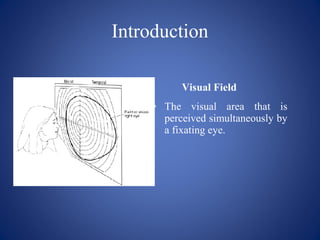
Visual Field
• The visual area that is
perceived simultaneously by
a fixating eye.
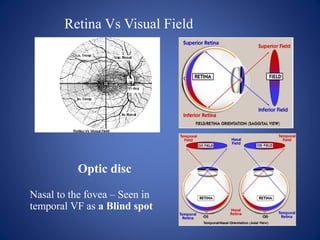
Retina Vs Visual Field
Optic disc
Nasal to the fovea – Seen in
temporal VF as a Blind spot
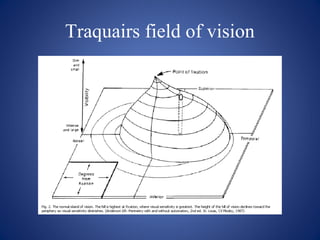
Traquairs field of vision
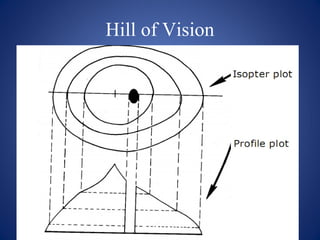
Hill of Vision
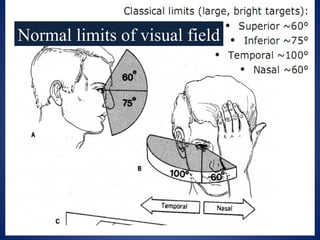
Normal limits of visual field
Short History of Visual Field
• In B.C 150, Ptolemy: used some form of
perimetric device to measure extend of VF
• First clinical investigation of VF defect –
Hippocrates in 5th
century, hemianopic field
defect
• Finally in 1604 Kepler explained the principle of
sight in term of an inverted retinal image –
– an stage for modern investigation of VF
History….
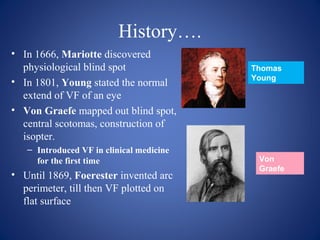
• In 1666, Mariotte discovered
physiological blind spot
• In 1801, Young stated the normal
extend of VF of an eye
• Von Graefe mapped out blind spot,
central scotomas, construction of
isopter.
– Introduced VF in clinical medicine
for the first time
• Until 1869, Foerester invented arc
perimeter, till then VF plotted on
flat surface
Thomas
Young
Von
Graefe
History……
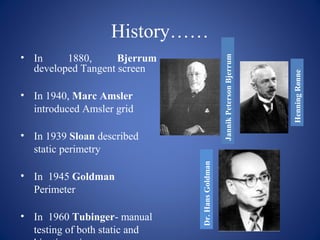
• In 1880, Bjerrum
developed Tangent screen
• In 1940, Marc Amsler
introduced Amsler grid
• In 1939 Sloan described
static perimetry
• In 1945 Goldman
Perimeter
• In 1960 Tubinger- manual
testing of both static and JannikPetersonBjerrum
HenningRønne
Dr.HansGoldman
Few Terminologies
• Threshold: The weakest test stimulus that is just
visible in a particular location under the specific
testing condition.
– Varies across the visual field.
• Sensitivity: most subtle characteristics of a
stimulus that is visible at a specific point in space.
• Fixation: that part of visual field corresponding
to fovea centralis.
Terminologies…
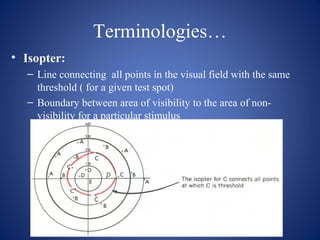
• Isopter:
– Line connecting all points in the visual field with the same
threshold ( for a given test spot)
– Boundary between area of visibility to the area of non-
visibility for a particular stimulus
Terminologies…
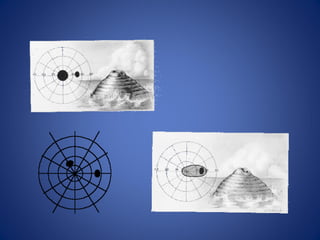
• Scotoma: Localized defectsdepressions surrounded by
normal visual field.
– Absolute: defect that persists when the maximum stimulus is
used e. g blind spot.
– Relative : defect that is present to weaker stimulus but
disappears with brighter stimulus.
Location of Visual field defects
• Central
– 5 degrees or less from the point of fixation
• Paracentral
– >5 degress – 30 degrees
– Ceacal, paraceacal, periceacal
– Centrocecal
• Peripheral
– >30 degrees
Descriptive components of VF
defects
• Monocular descriptions
– Density
• Absolute (no visual sensation) or relative (depressed visual sensation)
– Area
• General or local
– Shape
• Sectorial (hemianopic) or non-sectorial (regular or
irregular)
– Extent
• Total or Partial
– Position
• Rt. Or Lt. . Temporal, nasal, superior, inferior
Descriptive components of VF
defects
•Binocular description
• Laterality
•Unilateral or bilateral (homonymous/heteronymous)
•Equalness
•Congruous or incongruous
•Additional description
•Awareness
•Positive (defect perceived) or negative (defect not perceived)
Significance of Visual field testing
• Find out the extent of VF
• To diagnose and detect diseases as well as
extent of damage caused in VF by the disease
• To locate possible lesion in neurological
disorder
• To find out the progression of diseases
Visual field testing methods/tools
• Central
– Amsler Grid: 200
– Tangent (Bjerrum screen): 300
– Goldmann
– Automated (Octopus / Humphery) :300
• Peripheral
– Confrontation
– Goldmann
– Automated 900
programme
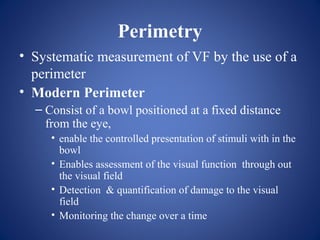
Perimetry
• Systematic measurement of VF by the use of a
perimeter
• Modern Perimeter
– Consist of a bowl positioned at a fixed distance
from the eye,
• enable the controlled presentation of stimuli with in the
bowl
• Enables assessment of the visual function through out
the visual field
• Detection & quantification of damage to the visual
field
• Monitoring the change over a time
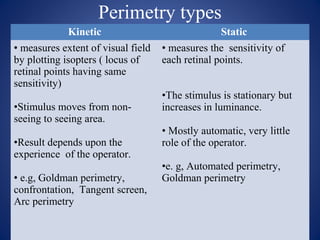
Perimetry types
Kinetic Static
• measures extent of visual field
by plotting isopters ( locus of
retinal points having same
sensitivity)
•Stimulus moves from non-
seeing to seeing area.
•Result depends upon the
experience of the operator.
• e.g, Goldman perimetry,
confrontation, Tangent screen,
Arc perimetry
• measures the sensitivity of
each retinal points.
•The stimulus is stationary but
increases in luminance.
• Mostly automatic, very little
role of the operator.
•e. g, Automated perimetry,
Goldman perimetry
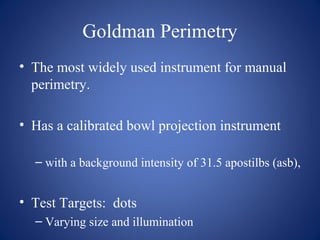
Goldman Perimetry
• The most widely used instrument for manual
perimetry.
• Has a calibrated bowl projection instrument
– with a background intensity of 31.5 apostilbs (asb),
• Test Targets: dots
– Varying size and illumination
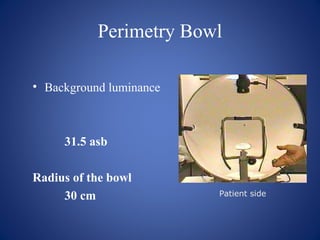
Perimetry Bowl
• Background luminance
31.5 asb
Radius of the bowl
30 cm Patient side
Goldmann Targets
• The stimuli (Dot) used to plot an isopter
denoted by
– Roman numeral, a number, and a letter.
• Roman Numerals = 0 to V (Size)
• Number = 1 to 5 (Luminance) use of Filter
• Alphabet = a to e ( ‘’) use of filter
V4e , I4e, IV3e
Goldmann Perimetry: Roman numeral
• Sizes of Stimuli [0...V scale]
• Each size increment equals
• a twofold increase in diameter and a fourfold
increase in area.
Diameter (mm) Area (mm2
)
0 0.28 1/16
I 0.56 ¼
II 1.13 1
III 2.26 4
IV 4.51 16
V 9.03 64
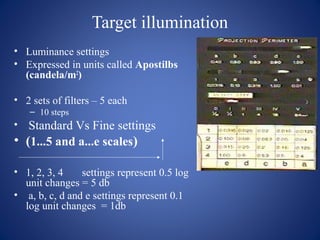
Target illumination
• Luminance settings
• Expressed in units called Apostilbs
(candela/m2
)
• 2 sets of filters – 5 each
– 10 steps
• Standard Vs Fine settings
• (1...5 and a...e scales)
• 1, 2, 3, 4 settings represent 0.5 log
unit changes = 5 db
• a, b, c, d and e settings represent 0.1
log unit changes = 1db
Target Range in Goldmann
• More than 100 combinations of size and intensity
of test targets are Possible
– but only a few isopter are needed to define the visual
field.
• Size “0” generally is omitted
– because results of the plots are inconsistent.
• The fine-intensity filter is usually set to the letter “e”
– which eliminates the small-increment light filters.
– Test target : Denoted by – Size + (Std. + fine)
Luminance
• Eg: V4e, I4e, II3e
Some interesting facts
• A change of one number of intensity
– is roughly equivalent to a change of one Roman
numeral of size i.e. III4e = IV3e
• Isopter plotted with Targets of equal Sum of
– Roman Numerals (size) & Number (Intensity)
• are considered equivalent.
– For example,
• the I4e isopter is roughly equivalent to the II3e isopter.
• I + 4 = 5, II + 3 = 5
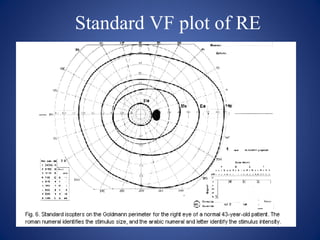
Standard VF plot of RE
Required Equipment for VF mapping
• Goldmann bowl perimeter
• Lens holder
• Recording paper
• Colored markers
• Patch for monocular testing
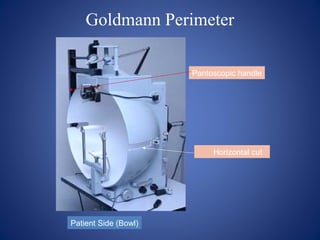
Goldmann Perimeter
Pantoscopic handle
Horizontal cut
Patient Side (Bowl)
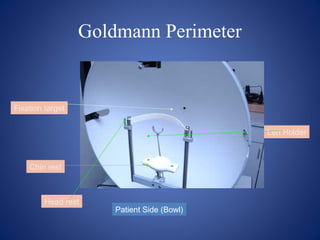
Goldmann Perimeter
Patient Side (Bowl)
Fixation target
Chin rest
Head rest
Len Holder
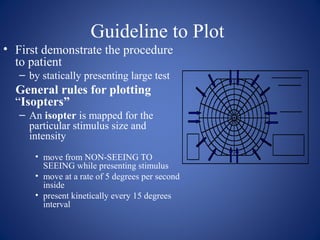
Guideline to Plot
• First demonstrate the procedure
to patient
– by statically presenting large test
General rules for plotting
“Isopters”
– An isopter is mapped for the
particular stimulus size and
intensity
• move from NON-SEEING TO
SEEING while presenting stimulus
• move at a rate of 5 degrees per second
inside
• present kinetically every 15 degrees
interval
Guidelines for plotting
• Begin in the far periphery and kinetic plot isopter in
all meridians
–Use a V4e, I-3e , I-2e or target (depending
upon age
–Plot the Blindspot
• only 4 meridians are required( more if irregular or
Large)
– Use the I-4e for the blind spot
• within isopter of I-2e or I-3e
Guidelines
• Central static test with I-2e
– Explore for any scotomas
• Kinetic plot with I-3e stimulus only in suspected defect
area
• Static test between I-3e and I-2e isopters with the
I-3e stimulus (scotoma search)
Guidelines
• Special case plots
– Glaucoma suspects
– Plot more points along the nasal edge of the isopter
– Plot approximately
• every 3-5 degrees,
• 15 degrees above and below the horizontal raphe
Repeat for central, intermediate and peripheral plots
• Suspected neurological lesions
– Plot more points on either side of the vertical meridian
– Repeat for central, intermediate and peripheral plots
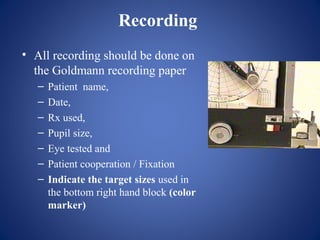
Recording
• All recording should be done on
the Goldmann recording paper
– Patient name,
– Date,
– Rx used,
– Pupil size,
– Eye tested and
– Patient cooperation / Fixation
– Indicate the target sizes used in
the bottom right hand block (color
marker)
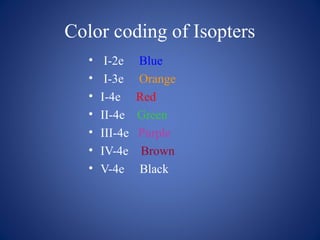
Color coding of Isopters
• I-2e Blue
• I-3e Orange
• I-4e Red
• II-4e Green
• III-4e Purple
• IV-4e Brown
• V-4e Black
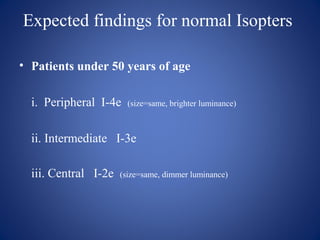
Expected findings for normal Isopters
• Patients under 50 years of age
i. Peripheral I-4e (size=same, brighter luminance)
ii. Intermediate I-3e
iii. Central I-2e (size=same, dimmer luminance)
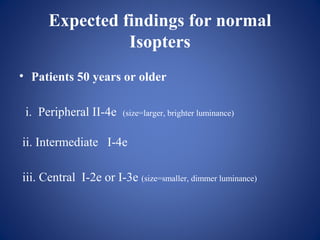
Expected findings for normal
Isopters
• Patients 50 years or older
i. Peripheral II-4e (size=larger, brighter luminance)
ii. Intermediate I-4e
iii. Central I-2e or I-3e (size=smaller, dimmer luminance)
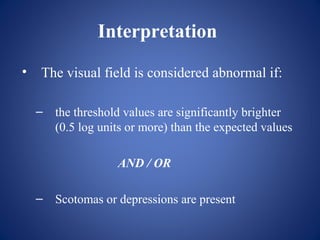
Interpretation
• The visual field is considered abnormal if:
– the threshold values are significantly brighter
(0.5 log units or more) than the expected values
AND / OR
– Scotomas or depressions are present
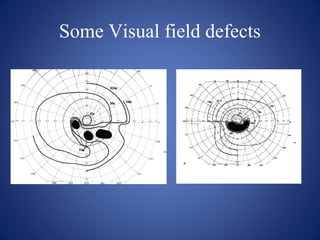
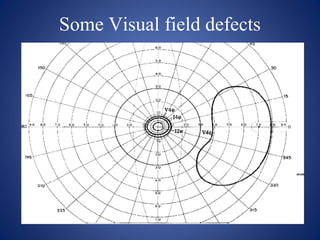
Some Visual field defects
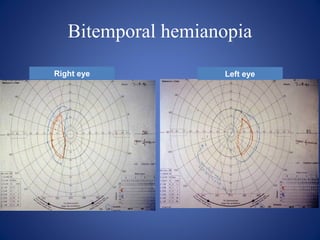
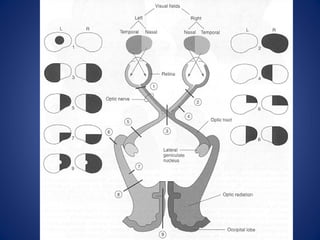
Bitemporal hemianopia
Right eye Left eye
Automated Perimetry ( Static)
• Machine constructed along the basic lines of
a Goldman perimeter + sophisticated software
programs.
• Key reason for increased interest in automated
perimetry has been due to the standardization
automated perimetry allows.
Automated Perimetry
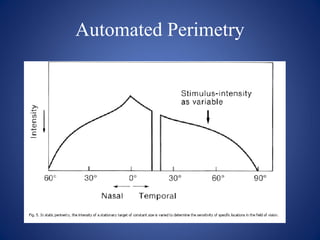
• Visual threshold is measured at a series of
fixed points in the visual field.
• The brightness of the test spot is varied, but
not its location.
• Threshold is usually plotted relative to normal
fields, to reveal defects
Automated Perimetry
Automated Perimetry
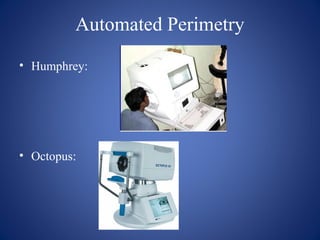
• Humphrey:
• Octopus:
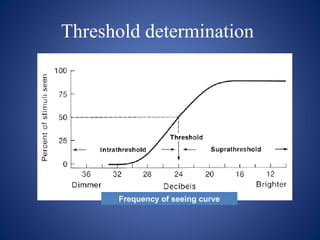
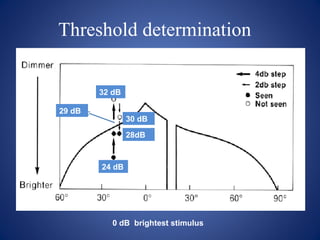
Threshold determination
Frequency of seeing curve
Threshold determination
28dB
24 dB
32 dB
30 dB
29 dB
0 dB brightest stimulus
Threshold determination
• Age matched normal data are used to compare
patient’s data
• Normal range determined by
– Sensitivity of each retinal points 10,000
individuals
– Upper 95% as normal
– Lower 5% as abnormal
Testing strategies
• Octopus
– Normal
– Dynamic
– TOP ( Tendency oriented perimetry)
• Humphrey
– SITA (Swedish Interactive threshold algorithm)
– SITA fast
– Full threshold
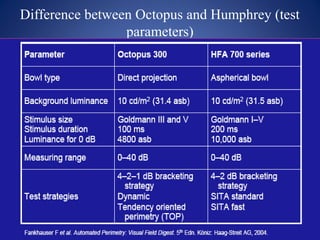
Difference between Octopus and Humphrey (test
parameters)
Factors affecting Automated
Perimetry
• Background luminance
• Stimulus size
• Fixation control
• Refractive errors
• Cataracts and other media opacities
• Miosis
• Facial structure
• Fatigue
• Experience of a perimeter
Validity of the test
• False positive response
– > 20% unreliable
• False negative
– >20% unreliable
• Short term fluctuation
– 1-3 dB normal fluctuation
• Fixation loss
– >33% unreliable
Choosing an appropriate program
Examination procedure
Test program(G1, G2, 32, M2)
+
Test strategy (Normal, dynamic, top)
+
Perimetry method( W/W, flicker, B/Y, kinetic)
Programs
G1/G2
• Central 30 degree
• Glaucoma screening
• 59 points
• Locations more closely with topography of
retina (in areas of concern of glaucoma)
• 2.8 deg spacing
Programs
32 ( general examination)= 30-2 in Humphrey
• introduced with early automated perimetry
• 76 test locations
• Wide spacing (6 degrees) ( not appropriate for
glaucoma)
Programs
Macula program(M2)
• Central and paracentral visual defects in
neurological and macular problems
• Central 10 deg
• 56 test locations
• spacing 2 degrees
• 0.7deg spacing in the macula
Programs
LVC (central low vision)
• To test how much sensitivity is remained in
the central foveal area.
• 77 locations
• 30 degrees
• End stage glaucoma
Strategies
• Normal strategy
– Standard
– 4-2-1 bracketing procedure
– 10-15 min
– Early and shallow defects
– Younger patients ( good condition in answering
the question till the end of a long program)
Strategies
• Dynamic strategy
– One threshold crossing
– Small steps in regions with Normal sensitivity and
large towards depressed field
– Test duration reduced by two
– Especially when focal defects are expected
Strategies
• TOP ( tendency oriented perimetry)
– Light sensitivity of the retinal is interrelated rather
than having an individual value
– 2 minutes
– For patients with depressed fields, for children,
elderly ones who are not capable of finishing a
longer examination
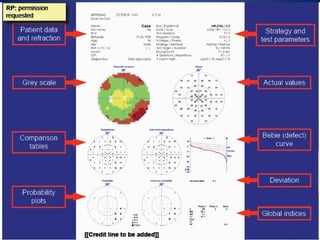
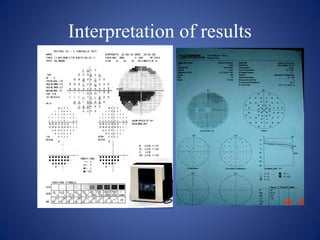
Interpretation of results
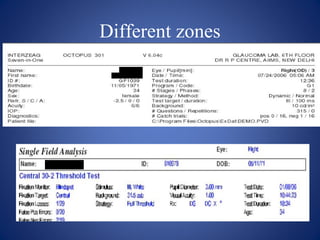
Different zones
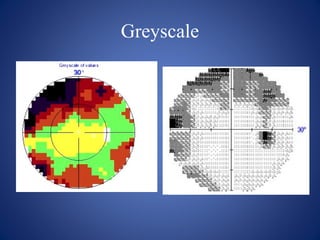
Greyscale
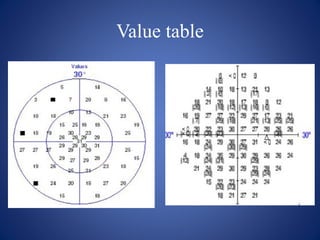
Value table
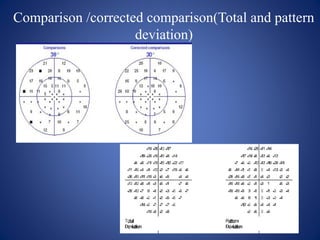
Comparison /corrected comparison(Total and pattern
deviation)
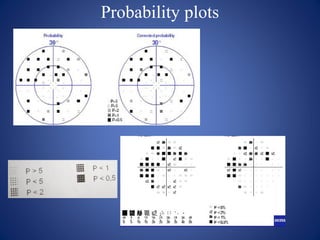
Probability plots
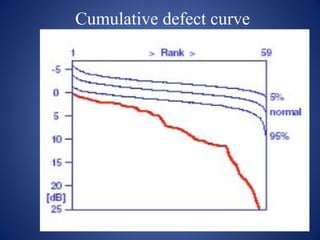
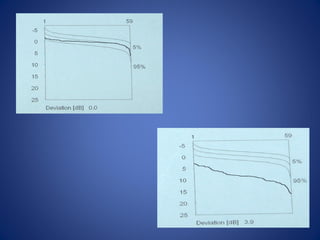
Cumulative defect curve
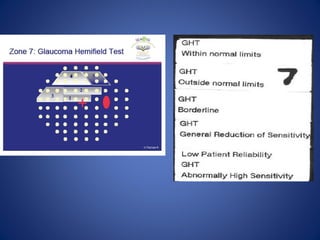
Glaucoma Hemifield test
• 5 sectors in the upper field are compared to
five mirror images in the lower
• If value in two sectors differ to an extent that
found in
– <0.5% of the normal population ( highly sensitive)
– <1% of normal population (outside normal limit)
– <3% of the normal population (Boderline)
– <5% of the normal population ( can be a normal
plot)
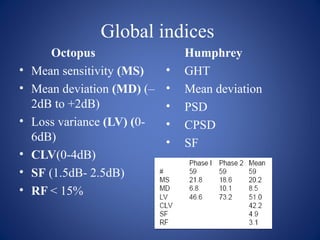
Global indices
Octopus
• Mean sensitivity (MS)
• Mean deviation (MD) (–
2dB to +2dB)
• Loss variance (LV) (0-
6dB)
• CLV(0-4dB)
• SF (1.5dB- 2.5dB)
• RF < 15%
Humphrey
• GHT
• Mean deviation
• PSD
• CPSD
• SF
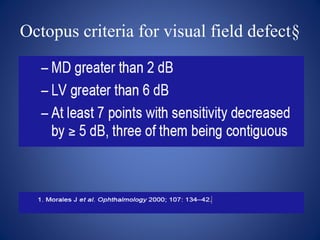
Octopus criteria for visual field defect§
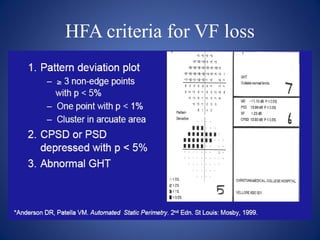
HFA criteria for VF loss
• Pattern deviation plot
Recent advances in automated
perimetry
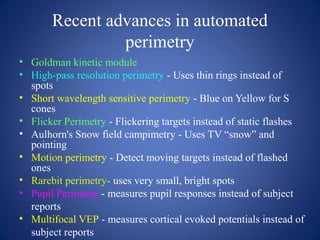
• Goldman kinetic module
• High-pass resolution perimetry - Uses thin rings instead of
spots
• Short wavelength sensitive perimetry - Blue on Yellow for S
cones
• Flicker Perimetry - Flickering targets instead of static flashes
• Aulhorn's Snow field campimetry - Uses TV “snow” and
pointing
• Motion perimetry - Detect moving targets instead of flashed
ones
• Rarebit perimetry- uses very small, bright spots
• Pupil Perimetry - measures pupil responses instead of subject
reports
• Multifocal VEP - measures cortical evoked potentials instead of
subject reports
Summary
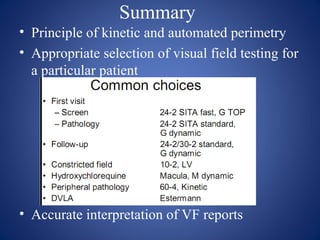
• Principle of kinetic and automated perimetry
• Appropriate selection of visual field testing for
a particular patient
• Accurate interpretation of VF reports
Visual field testing and interpretation

Visual field testing and interpretation

  • 1.
    Visual Field Testing andInterpretation Raman P Shah Optometrist B. P. Koirala Lions Center for Ophthalmic Studies
  • 2.
    References and recommendedreadings • Walsh TJ. Visual fields Examination and Interpretation, Ophthalmology monographs, AAO • J Boyd Eskridge. Clinical procedures in Optometry. Mosby • Automated Perimetry; Visual Field Digest: 5th edition • David O. Harrington, Michael V. Drake. The visual fields .7th edition
  • 3.
    Presentation layout • Introductionon Visual field • Normal limits of Visual field • Short overview on history of VF • Terminologies related to VF • Visual field testing methods – Kinetic, static • Interpretation of VF reports
  • 4.
    Introduction Visual Field • Thevisual area that is perceived simultaneously by a fixating eye.
  • 5.
    Retina Vs VisualField Optic disc Nasal to the fovea – Seen in temporal VF as a Blind spot
  • 6.
  • 7.
  • 8.
    Normal limits ofvisual field
  • 9.
    Short History ofVisual Field • In B.C 150, Ptolemy: used some form of perimetric device to measure extend of VF • First clinical investigation of VF defect – Hippocrates in 5th century, hemianopic field defect • Finally in 1604 Kepler explained the principle of sight in term of an inverted retinal image – – an stage for modern investigation of VF
  • 10.
    History…. • In 1666,Mariotte discovered physiological blind spot • In 1801, Young stated the normal extend of VF of an eye • Von Graefe mapped out blind spot, central scotomas, construction of isopter. – Introduced VF in clinical medicine for the first time • Until 1869, Foerester invented arc perimeter, till then VF plotted on flat surface Thomas Young Von Graefe
  • 11.
    History…… • In 1880,Bjerrum developed Tangent screen • In 1940, Marc Amsler introduced Amsler grid • In 1939 Sloan described static perimetry • In 1945 Goldman Perimeter • In 1960 Tubinger- manual testing of both static and JannikPetersonBjerrum HenningRønne Dr.HansGoldman
  • 12.
    Few Terminologies • Threshold:The weakest test stimulus that is just visible in a particular location under the specific testing condition. – Varies across the visual field. • Sensitivity: most subtle characteristics of a stimulus that is visible at a specific point in space. • Fixation: that part of visual field corresponding to fovea centralis.
  • 13.
    Terminologies… • Isopter: – Lineconnecting all points in the visual field with the same threshold ( for a given test spot) – Boundary between area of visibility to the area of non- visibility for a particular stimulus
  • 14.
    Terminologies… • Scotoma: Localizeddefectsdepressions surrounded by normal visual field. – Absolute: defect that persists when the maximum stimulus is used e. g blind spot. – Relative : defect that is present to weaker stimulus but disappears with brighter stimulus.
  • 15.
    Location of Visualfield defects • Central – 5 degrees or less from the point of fixation • Paracentral – >5 degress – 30 degrees – Ceacal, paraceacal, periceacal – Centrocecal • Peripheral – >30 degrees
  • 17.
    Descriptive components ofVF defects • Monocular descriptions – Density • Absolute (no visual sensation) or relative (depressed visual sensation) – Area • General or local – Shape • Sectorial (hemianopic) or non-sectorial (regular or irregular) – Extent • Total or Partial – Position • Rt. Or Lt. . Temporal, nasal, superior, inferior
  • 18.
    Descriptive components ofVF defects •Binocular description • Laterality •Unilateral or bilateral (homonymous/heteronymous) •Equalness •Congruous or incongruous •Additional description •Awareness •Positive (defect perceived) or negative (defect not perceived)
  • 20.
    Significance of Visualfield testing • Find out the extent of VF • To diagnose and detect diseases as well as extent of damage caused in VF by the disease • To locate possible lesion in neurological disorder • To find out the progression of diseases
  • 21.
    Visual field testingmethods/tools • Central – Amsler Grid: 200 – Tangent (Bjerrum screen): 300 – Goldmann – Automated (Octopus / Humphery) :300 • Peripheral – Confrontation – Goldmann – Automated 900 programme
  • 22.
    Perimetry • Systematic measurementof VF by the use of a perimeter • Modern Perimeter – Consist of a bowl positioned at a fixed distance from the eye, • enable the controlled presentation of stimuli with in the bowl • Enables assessment of the visual function through out the visual field • Detection & quantification of damage to the visual field • Monitoring the change over a time
  • 23.
    Perimetry types Kinetic Static •measures extent of visual field by plotting isopters ( locus of retinal points having same sensitivity) •Stimulus moves from non- seeing to seeing area. •Result depends upon the experience of the operator. • e.g, Goldman perimetry, confrontation, Tangent screen, Arc perimetry • measures the sensitivity of each retinal points. •The stimulus is stationary but increases in luminance. • Mostly automatic, very little role of the operator. •e. g, Automated perimetry, Goldman perimetry
  • 24.
    Goldman Perimetry • Themost widely used instrument for manual perimetry. • Has a calibrated bowl projection instrument – with a background intensity of 31.5 apostilbs (asb), • Test Targets: dots – Varying size and illumination
  • 25.
    Perimetry Bowl • Backgroundluminance 31.5 asb Radius of the bowl 30 cm Patient side
  • 26.
    Goldmann Targets • Thestimuli (Dot) used to plot an isopter denoted by – Roman numeral, a number, and a letter. • Roman Numerals = 0 to V (Size) • Number = 1 to 5 (Luminance) use of Filter • Alphabet = a to e ( ‘’) use of filter V4e , I4e, IV3e
  • 27.
    Goldmann Perimetry: Romannumeral • Sizes of Stimuli [0...V scale] • Each size increment equals • a twofold increase in diameter and a fourfold increase in area. Diameter (mm) Area (mm2 ) 0 0.28 1/16 I 0.56 ¼ II 1.13 1 III 2.26 4 IV 4.51 16 V 9.03 64
  • 28.
    Target illumination • Luminancesettings • Expressed in units called Apostilbs (candela/m2 ) • 2 sets of filters – 5 each – 10 steps • Standard Vs Fine settings • (1...5 and a...e scales) • 1, 2, 3, 4 settings represent 0.5 log unit changes = 5 db • a, b, c, d and e settings represent 0.1 log unit changes = 1db
  • 29.
    Target Range inGoldmann • More than 100 combinations of size and intensity of test targets are Possible – but only a few isopter are needed to define the visual field. • Size “0” generally is omitted – because results of the plots are inconsistent. • The fine-intensity filter is usually set to the letter “e” – which eliminates the small-increment light filters. – Test target : Denoted by – Size + (Std. + fine) Luminance • Eg: V4e, I4e, II3e
  • 30.
    Some interesting facts •A change of one number of intensity – is roughly equivalent to a change of one Roman numeral of size i.e. III4e = IV3e • Isopter plotted with Targets of equal Sum of – Roman Numerals (size) & Number (Intensity) • are considered equivalent. – For example, • the I4e isopter is roughly equivalent to the II3e isopter. • I + 4 = 5, II + 3 = 5
  • 31.
  • 32.
    Required Equipment forVF mapping • Goldmann bowl perimeter • Lens holder • Recording paper • Colored markers • Patch for monocular testing
  • 33.
  • 34.
    Goldmann Perimeter Patient Side(Bowl) Fixation target Chin rest Head rest Len Holder
  • 35.
    Guideline to Plot •First demonstrate the procedure to patient – by statically presenting large test General rules for plotting “Isopters” – An isopter is mapped for the particular stimulus size and intensity • move from NON-SEEING TO SEEING while presenting stimulus • move at a rate of 5 degrees per second inside • present kinetically every 15 degrees interval
  • 36.
    Guidelines for plotting •Begin in the far periphery and kinetic plot isopter in all meridians –Use a V4e, I-3e , I-2e or target (depending upon age –Plot the Blindspot • only 4 meridians are required( more if irregular or Large) – Use the I-4e for the blind spot • within isopter of I-2e or I-3e
  • 37.
    Guidelines • Central statictest with I-2e – Explore for any scotomas • Kinetic plot with I-3e stimulus only in suspected defect area • Static test between I-3e and I-2e isopters with the I-3e stimulus (scotoma search)
  • 38.
    Guidelines • Special caseplots – Glaucoma suspects – Plot more points along the nasal edge of the isopter – Plot approximately • every 3-5 degrees, • 15 degrees above and below the horizontal raphe Repeat for central, intermediate and peripheral plots • Suspected neurological lesions – Plot more points on either side of the vertical meridian – Repeat for central, intermediate and peripheral plots
  • 39.
    Recording • All recordingshould be done on the Goldmann recording paper – Patient name, – Date, – Rx used, – Pupil size, – Eye tested and – Patient cooperation / Fixation – Indicate the target sizes used in the bottom right hand block (color marker)
  • 40.
    Color coding ofIsopters • I-2e Blue • I-3e Orange • I-4e Red • II-4e Green • III-4e Purple • IV-4e Brown • V-4e Black
  • 41.
    Expected findings fornormal Isopters • Patients under 50 years of age i. Peripheral I-4e (size=same, brighter luminance) ii. Intermediate I-3e iii. Central I-2e (size=same, dimmer luminance)
  • 42.
    Expected findings fornormal Isopters • Patients 50 years or older i. Peripheral II-4e (size=larger, brighter luminance) ii. Intermediate I-4e iii. Central I-2e or I-3e (size=smaller, dimmer luminance)
  • 43.
    Interpretation • The visualfield is considered abnormal if: – the threshold values are significantly brighter (0.5 log units or more) than the expected values AND / OR – Scotomas or depressions are present
  • 44.
  • 45.
  • 46.
  • 47.
    Automated Perimetry (Static) • Machine constructed along the basic lines of a Goldman perimeter + sophisticated software programs. • Key reason for increased interest in automated perimetry has been due to the standardization automated perimetry allows.
  • 48.
    Automated Perimetry • Visualthreshold is measured at a series of fixed points in the visual field. • The brightness of the test spot is varied, but not its location. • Threshold is usually plotted relative to normal fields, to reveal defects
  • 49.
  • 50.
  • 51.
  • 52.
    Threshold determination 28dB 24 dB 32dB 30 dB 29 dB 0 dB brightest stimulus
  • 53.
    Threshold determination • Agematched normal data are used to compare patient’s data • Normal range determined by – Sensitivity of each retinal points 10,000 individuals – Upper 95% as normal – Lower 5% as abnormal
  • 54.
    Testing strategies • Octopus –Normal – Dynamic – TOP ( Tendency oriented perimetry) • Humphrey – SITA (Swedish Interactive threshold algorithm) – SITA fast – Full threshold
  • 55.
    Difference between Octopusand Humphrey (test parameters)
  • 56.
    Factors affecting Automated Perimetry •Background luminance • Stimulus size • Fixation control • Refractive errors • Cataracts and other media opacities • Miosis • Facial structure • Fatigue • Experience of a perimeter
  • 57.
    Validity of thetest • False positive response – > 20% unreliable • False negative – >20% unreliable • Short term fluctuation – 1-3 dB normal fluctuation • Fixation loss – >33% unreliable
  • 58.
    Choosing an appropriateprogram Examination procedure Test program(G1, G2, 32, M2) + Test strategy (Normal, dynamic, top) + Perimetry method( W/W, flicker, B/Y, kinetic)
  • 59.
    Programs G1/G2 • Central 30degree • Glaucoma screening • 59 points • Locations more closely with topography of retina (in areas of concern of glaucoma) • 2.8 deg spacing
  • 60.
    Programs 32 ( generalexamination)= 30-2 in Humphrey • introduced with early automated perimetry • 76 test locations • Wide spacing (6 degrees) ( not appropriate for glaucoma)
  • 61.
    Programs Macula program(M2) • Centraland paracentral visual defects in neurological and macular problems • Central 10 deg • 56 test locations • spacing 2 degrees • 0.7deg spacing in the macula
  • 62.
    Programs LVC (central lowvision) • To test how much sensitivity is remained in the central foveal area. • 77 locations • 30 degrees • End stage glaucoma
  • 63.
    Strategies • Normal strategy –Standard – 4-2-1 bracketing procedure – 10-15 min – Early and shallow defects – Younger patients ( good condition in answering the question till the end of a long program)
  • 64.
    Strategies • Dynamic strategy –One threshold crossing – Small steps in regions with Normal sensitivity and large towards depressed field – Test duration reduced by two – Especially when focal defects are expected
  • 65.
    Strategies • TOP (tendency oriented perimetry) – Light sensitivity of the retinal is interrelated rather than having an individual value – 2 minutes – For patients with depressed fields, for children, elderly ones who are not capable of finishing a longer examination
  • 66.
  • 68.
  • 69.
  • 70.
  • 71.
  • 73.
  • 74.
  • 76.
    Glaucoma Hemifield test •5 sectors in the upper field are compared to five mirror images in the lower • If value in two sectors differ to an extent that found in – <0.5% of the normal population ( highly sensitive) – <1% of normal population (outside normal limit) – <3% of the normal population (Boderline) – <5% of the normal population ( can be a normal plot)
  • 78.
    Global indices Octopus • Meansensitivity (MS) • Mean deviation (MD) (– 2dB to +2dB) • Loss variance (LV) (0- 6dB) • CLV(0-4dB) • SF (1.5dB- 2.5dB) • RF < 15% Humphrey • GHT • Mean deviation • PSD • CPSD • SF
  • 79.
    Octopus criteria forvisual field defect§
  • 80.
    HFA criteria forVF loss • Pattern deviation plot
  • 82.
    Recent advances inautomated perimetry • Goldman kinetic module • High-pass resolution perimetry - Uses thin rings instead of spots • Short wavelength sensitive perimetry - Blue on Yellow for S cones • Flicker Perimetry - Flickering targets instead of static flashes • Aulhorn's Snow field campimetry - Uses TV “snow” and pointing • Motion perimetry - Detect moving targets instead of flashed ones • Rarebit perimetry- uses very small, bright spots • Pupil Perimetry - measures pupil responses instead of subject reports • Multifocal VEP - measures cortical evoked potentials instead of subject reports
  • 83.
    Summary • Principle ofkinetic and automated perimetry • Appropriate selection of visual field testing for a particular patient • Accurate interpretation of VF reports