
RGP LENS
PRESENTED BY;
SNEHA XAVIER
CONTACT LENS
• Contact lens is a thin lens placed on the surface
of the eye to correct vision,for cosmetic or
therapeutic reasons instead of wearing glasses.
• It is of two types on the basis of material
i. Soft contact lens
ii. RGP or Hard CL
 Rigid gas permeable contact lenses are rigid
lenses made up of durable plastic that transmits
oxygen.
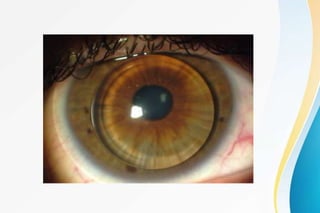
• Rigid Gas Permeable lenses are those lenses
made up of materials which are permeable to
oxygen.
• They have inherent rigidity similar to PMMA , but
due to their oxygen permeability they have
become popular by name semi soft lenses.
• Made up of polymers e.g. silicone resin ,
polystyrene…
Advantages of RGP lenses;
• Provide clearer vision than soft contact lenses.
• More durable
• Less expensive than soft contact lenses.
• It is used to perform orthokeratology , where
contact lenses are worn during sleep to reshape
the cornea and improve vision.
Disadvantages ;
• Need time for adaptation
• Increased possibility of dislodging
• Vulnerability to sand and dust
The desirable properties of RGP lenses;
1. Optimal design.
2. Material:
wettability
deposit resistance
stability
high Dk
DESIRED FITTING
 Moderate edge width and clearance
 central and mid-peripheral alignment
 Smooth movement
 centration
• Comfortable
• Clear vision
• Adequate wearing time
• Minimal ocular response
• Normal facial appearance
DESIRED PERFORMANCE
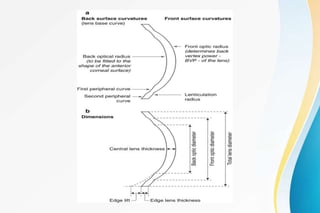
KEY DESIGN FEATURES
• Back surface design
• Back optic zone diameter
• Front surface design
• Lens thickness
• Edge configuration
• Lens diameter
BACK SURFACE DESIGN
• Controls Lens/Cornea Interaction
• This interaction largely controls the lens fit and
affects
centration of lens
movement of lens
BACK SURFACE DESIGN FREEDOM
Back surface design is somewhat limited by the
fact that it must be related to the corneal shape in
a acceptable way.
Possiblities for the final overall shapes are;
• Aspherical or Spherical shape
• Single or multiple curves
continuation....
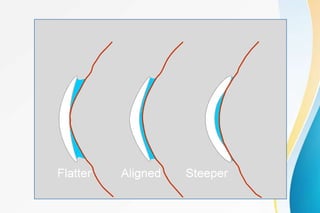
fitting relationship broadly fall into falling
categories;
steeper than cornea
Aligned with the cornea
Flatter than cornea
BACK SURFACE DESIGN CLINICAL
CONSIDERATIONS
• Central fluorescein pattern: The use of fluorescein
is a sensitive technique for comparing corneal
shape to that of the CL.
• Corneal curvature changes.
BACK SURFACE DESIGN FLUORESCEIN
PATTERN
BOZD
Ideal
Aspheric
Spherical
BOZD
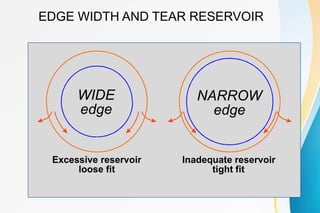
Excessive reservoir
loose fit
Inadequate reservoir
tight fit
WIDE
edge
NARROW
edge
EDGE WIDTH AND TEAR RESERVOIR
Edge configuration affects:
• Comfort
• Durability
• Tear meniscus
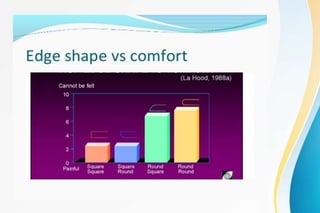
EDGE SHAPE vs COMFORT
• RGP lenses with rounded and square posterior
edge profiles are more comfortable
• Comfort is determined by interaction of lens edge
with the lid
LENS THICKNESS
Determined by:
• Rigidity of the material
• Permeability
• Back vertex power(BVP)
FRONT SURFACE DESIGN
Controlled by:
• BVP
Design Freedom:
• FOZD
• Front peripheral curves
• Their radii and widths
Front surface design affects:
• Vision
• Lid interaction
- comfort
- movement
- centration
LENTICULATION
Lenticulation defines the FOZR of a lens.
Affects:
• Centre thickness
• Lens mass
• O2 transmission
• Comfort
LENS DIAMETER
Determined by:
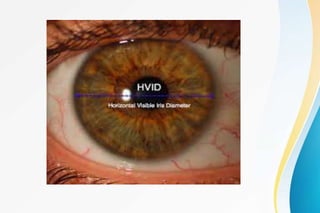
• Corneal diameter of population
• HVID of patient
• Inter- palpebral aperture
• Lens power (minus/plus)
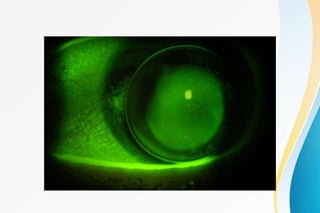
Lens diameter affects:
• Centre of gravity
• Stability
• Option to have larger BOZD/FOZD
• Comfort
• 3 & 9 staining
LENS DIAMETER and COMFORT
APPLICATIONS OF RGP LENS
• Astigmatism correction.
• Children and teenagers.
• Presbyopia – bifocal correction.
• Irregular cornea – keratoconus
• orthokeratology
Rgp lens

Rgp lens

  • 1.
  • 2.
    CONTACT LENS • Contactlens is a thin lens placed on the surface of the eye to correct vision,for cosmetic or therapeutic reasons instead of wearing glasses. • It is of two types on the basis of material i. Soft contact lens ii. RGP or Hard CL  Rigid gas permeable contact lenses are rigid lenses made up of durable plastic that transmits oxygen.
  • 3.
    • Rigid GasPermeable lenses are those lenses made up of materials which are permeable to oxygen. • They have inherent rigidity similar to PMMA , but due to their oxygen permeability they have become popular by name semi soft lenses. • Made up of polymers e.g. silicone resin , polystyrene…
  • 5.
    Advantages of RGPlenses; • Provide clearer vision than soft contact lenses. • More durable • Less expensive than soft contact lenses. • It is used to perform orthokeratology , where contact lenses are worn during sleep to reshape the cornea and improve vision.
  • 6.
    Disadvantages ; • Needtime for adaptation • Increased possibility of dislodging • Vulnerability to sand and dust
  • 7.
    The desirable propertiesof RGP lenses; 1. Optimal design. 2. Material: wettability deposit resistance stability high Dk
  • 8.
    DESIRED FITTING  Moderateedge width and clearance  central and mid-peripheral alignment  Smooth movement  centration
  • 9.
    • Comfortable • Clearvision • Adequate wearing time • Minimal ocular response • Normal facial appearance DESIRED PERFORMANCE
  • 10.
    KEY DESIGN FEATURES •Back surface design • Back optic zone diameter • Front surface design • Lens thickness • Edge configuration • Lens diameter
  • 12.
    BACK SURFACE DESIGN •Controls Lens/Cornea Interaction • This interaction largely controls the lens fit and affects centration of lens movement of lens
  • 13.
    BACK SURFACE DESIGNFREEDOM Back surface design is somewhat limited by the fact that it must be related to the corneal shape in a acceptable way. Possiblities for the final overall shapes are; • Aspherical or Spherical shape • Single or multiple curves
  • 14.
    continuation.... fitting relationship broadlyfall into falling categories; steeper than cornea Aligned with the cornea Flatter than cornea
  • 15.
    BACK SURFACE DESIGNCLINICAL CONSIDERATIONS • Central fluorescein pattern: The use of fluorescein is a sensitive technique for comparing corneal shape to that of the CL. • Corneal curvature changes.
  • 16.
    BACK SURFACE DESIGNFLUORESCEIN PATTERN BOZD Ideal Aspheric Spherical BOZD
  • 18.
    Excessive reservoir loose fit Inadequatereservoir tight fit WIDE edge NARROW edge EDGE WIDTH AND TEAR RESERVOIR
  • 19.
    Edge configuration affects: •Comfort • Durability • Tear meniscus
  • 20.
    EDGE SHAPE vsCOMFORT • RGP lenses with rounded and square posterior edge profiles are more comfortable • Comfort is determined by interaction of lens edge with the lid
  • 22.
    LENS THICKNESS Determined by: •Rigidity of the material • Permeability • Back vertex power(BVP)
  • 23.
    FRONT SURFACE DESIGN Controlledby: • BVP Design Freedom: • FOZD • Front peripheral curves • Their radii and widths
  • 24.
    Front surface designaffects: • Vision • Lid interaction - comfort - movement - centration
  • 25.
    LENTICULATION Lenticulation defines theFOZR of a lens. Affects: • Centre thickness • Lens mass • O2 transmission • Comfort
  • 26.
    LENS DIAMETER Determined by: •Corneal diameter of population • HVID of patient • Inter- palpebral aperture • Lens power (minus/plus)
  • 28.
    Lens diameter affects: •Centre of gravity • Stability • Option to have larger BOZD/FOZD • Comfort • 3 & 9 staining
  • 30.
  • 31.
    APPLICATIONS OF RGPLENS • Astigmatism correction. • Children and teenagers. • Presbyopia – bifocal correction. • Irregular cornea – keratoconus • orthokeratology