Biometry Instruments 
& Equipment 
Dr Devdutta Nayak 
Fellow Ant. Segment 
Biratnagar Eye Hospital
Several values are required to 
calculate IOL Power 
• · Accurate Corneal power 
• · Actual axial length 
• · Accurate prediction of estimated lens 
position 
(half a mm shift in lens position can have 
a 
dramatic effect on final vision) 
• · Desired post op refraction 
• · A good understanding of the various IOL 
power calculation formulas is also required.
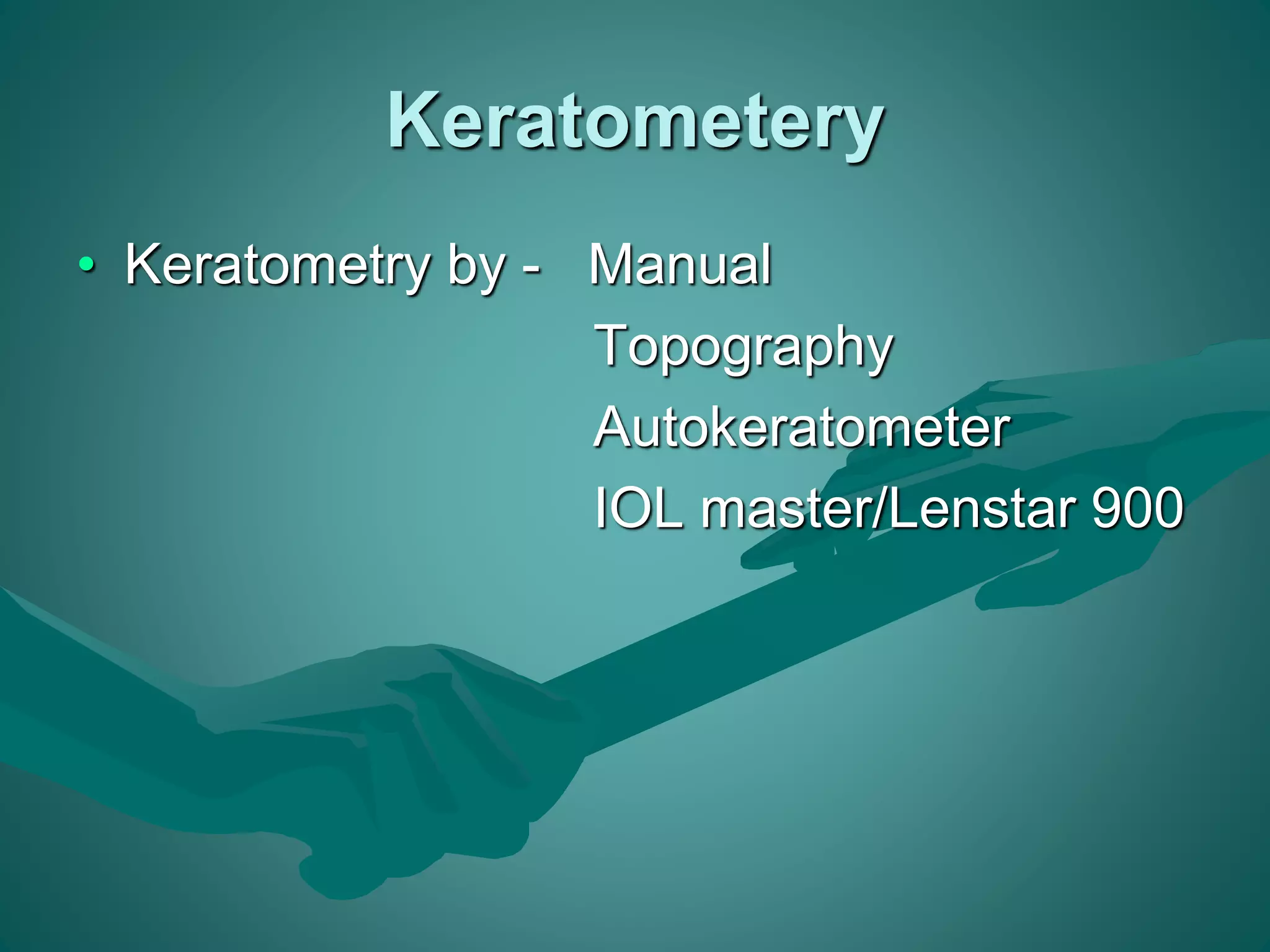
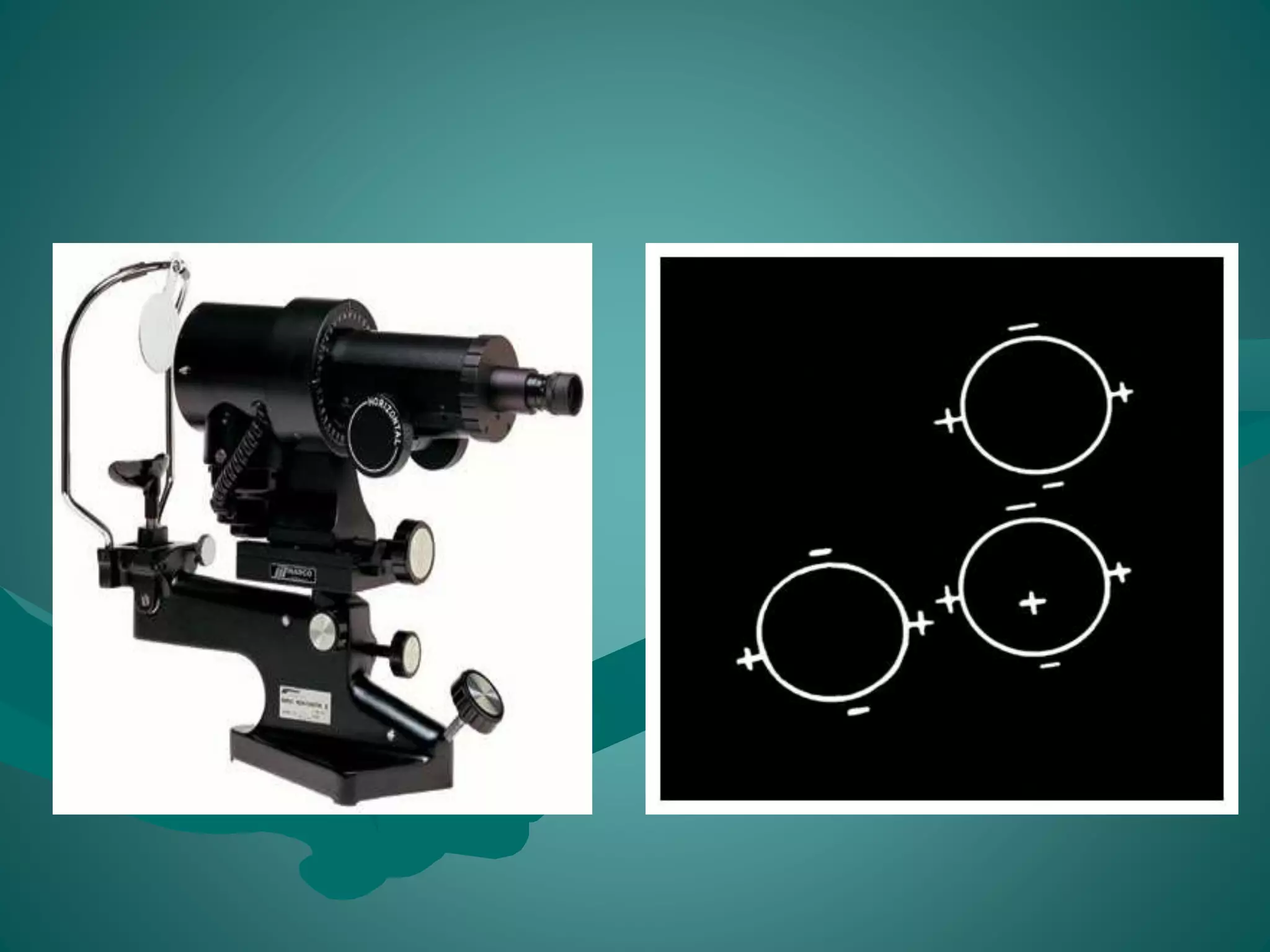
Keratometery 
• Keratometry by - Manual 
Topography 
Autokeratometer 
IOL master/Lenstar 900
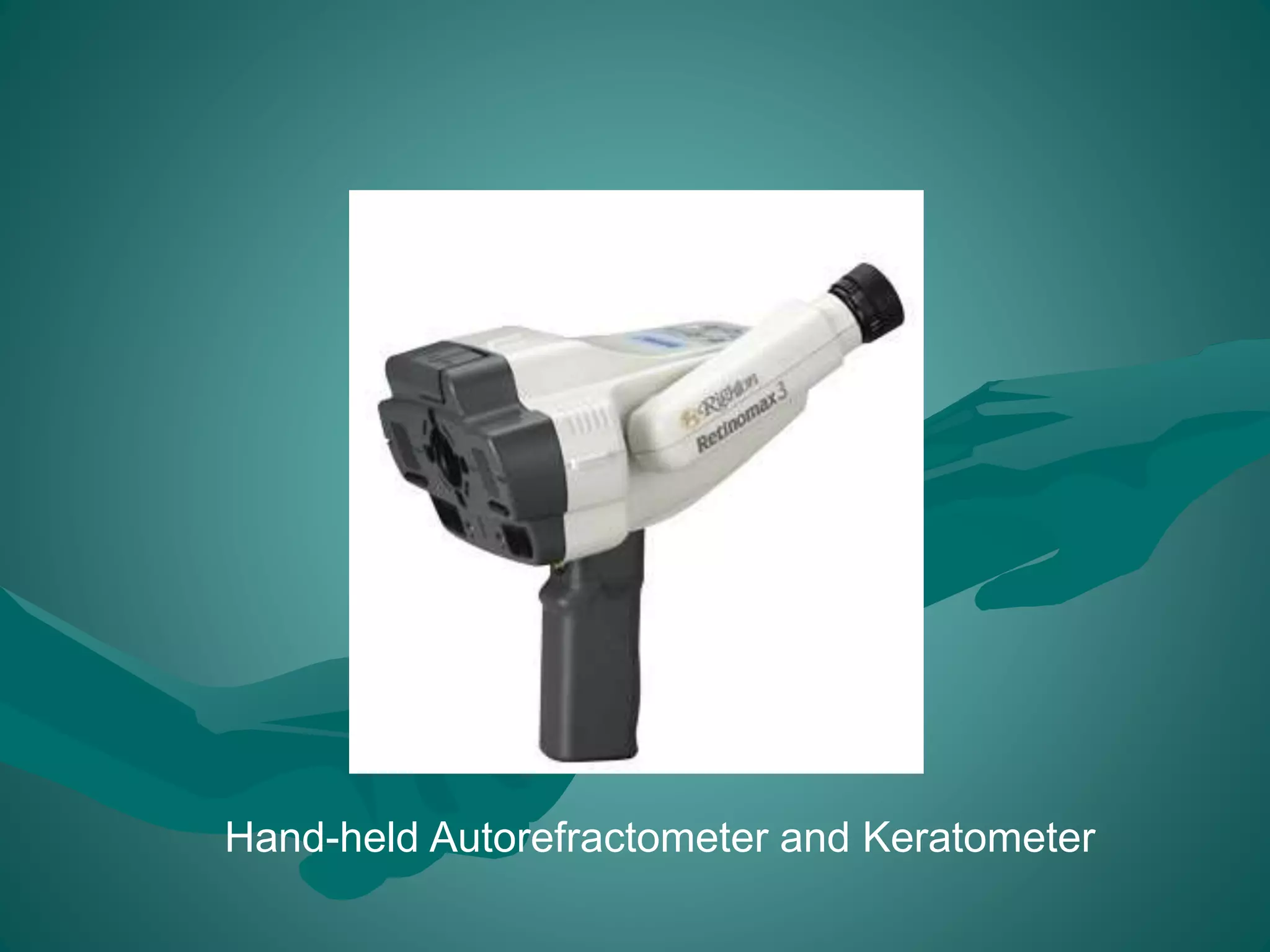
Hand-held Autorefractometer and Keratometer
Source of keratometry errors 
• Unfocused eye piece 
• Failure to calibrate unit 
• Poor patient fixation 
• Dry eye 
• Drooping eye lids 
• Irregular cornea
Repeat Keratometery If 
• Corneal curvature more than 47D or less 
than 40D. 
• The difference in corneal cylinder is more 
than one diopter between eyes. 
• The average keratometry (K) → 43.0- 
44.0D, with one eye typically within 1D of 
each other.
Difficult Situations 
• Post Refractive Surgery 
• Corneal Transplantation 
• Corneal Scar 
• Keratoconus etc.
A-Scan biometry/laser 
interferometry 
• A-Scan ultrasound 
by applanation method 
by immersion method 
• Laser interferometry 
IOL Master (Zeiss) 
Lenstar LS 900 (Haag- 
Streit)
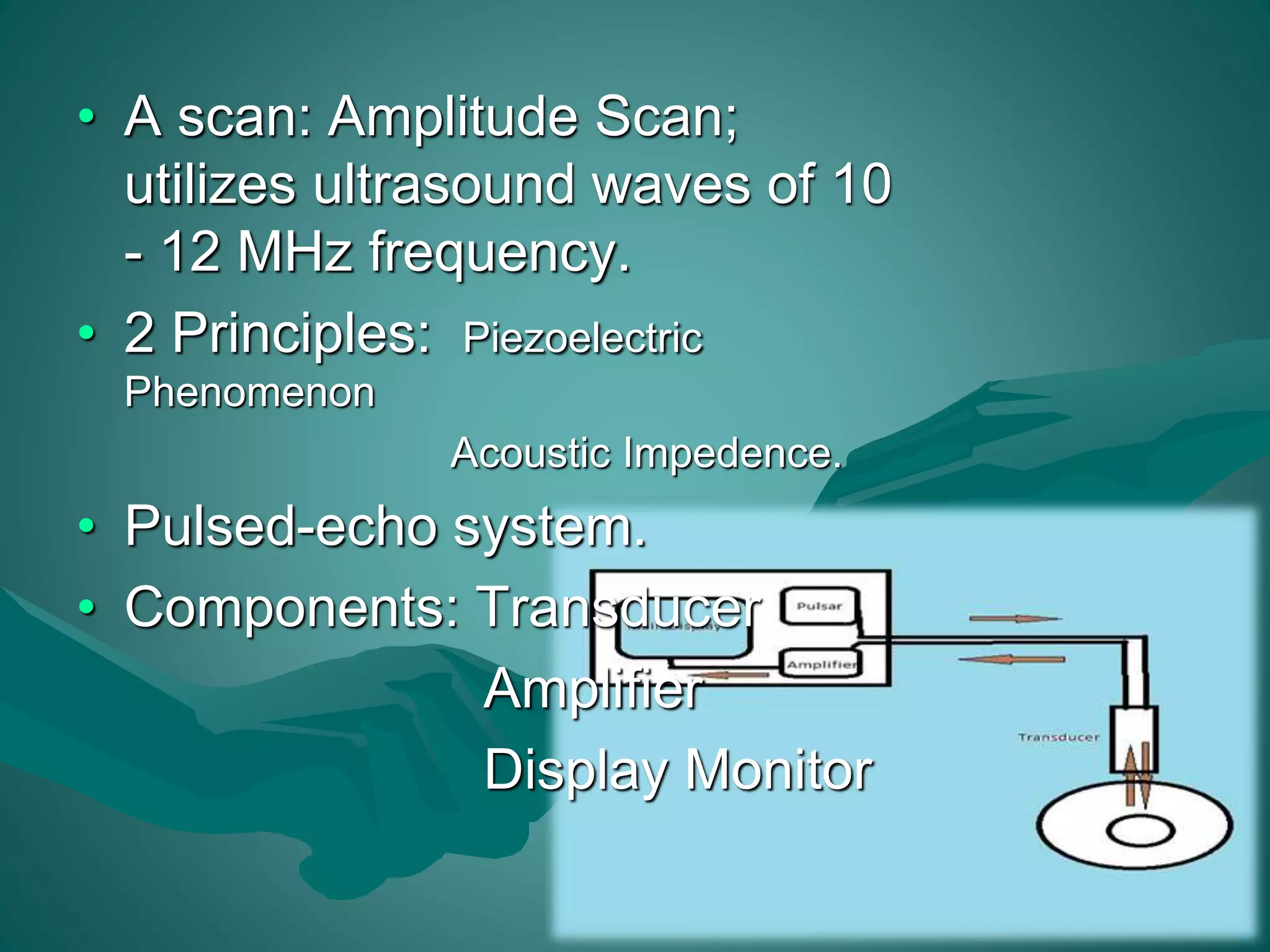
• A scan: Amplitude Scan; 
utilizes ultrasound waves of 10 
- 12 MHz frequency. 
• 2 Principles: Piezoelectric 
Phenomenon 
Acoustic Impedence. 
• Pulsed-echo system. 
• Components: Transducer 
Amplifier 
Display Monitor
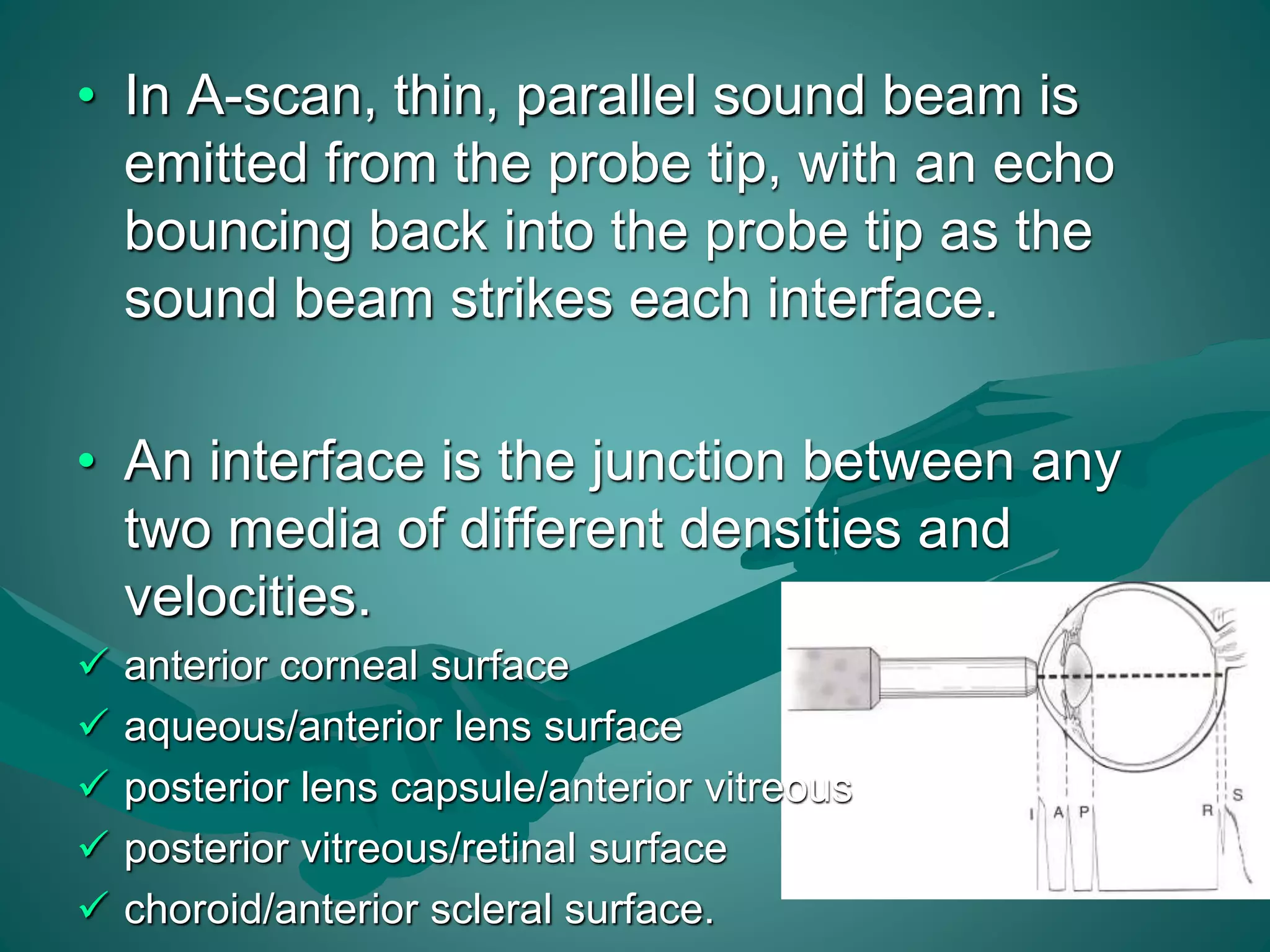
• In A-scan, thin, parallel sound beam is 
emitted from the probe tip, with an echo 
bouncing back into the probe tip as the 
sound beam strikes each interface. 
• An interface is the junction between any 
two media of different densities and 
velocities. 
 anterior corneal surface 
 aqueous/anterior lens surface 
 posterior lens capsule/anterior vitreous 
 posterior vitreous/retinal surface 
 choroid/anterior scleral surface.
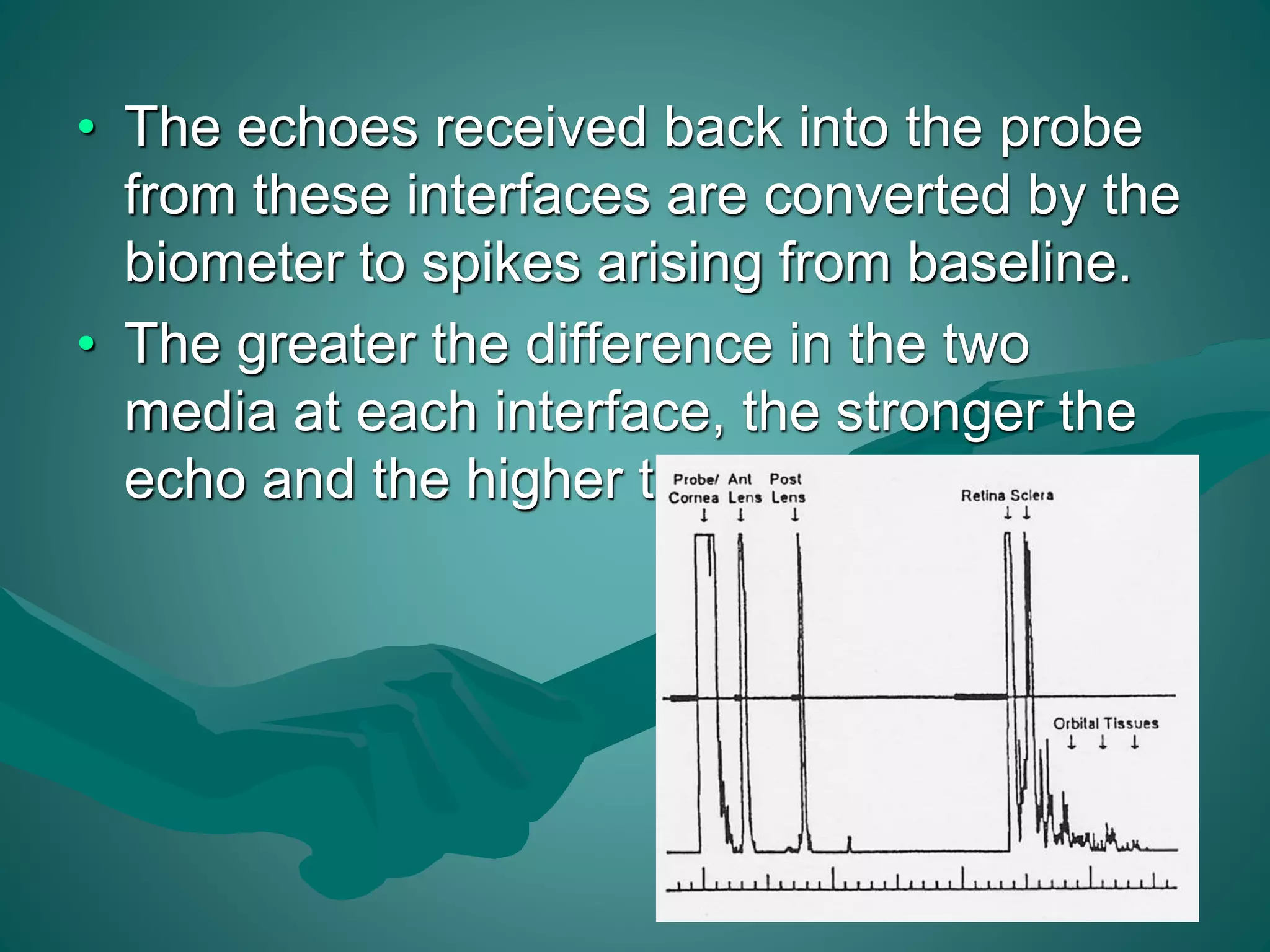
• The echoes received back into the probe 
from these interfaces are converted by the 
biometer to spikes arising from baseline. 
• The greater the difference in the two 
media at each interface, the stronger the 
echo and the higher the spike.
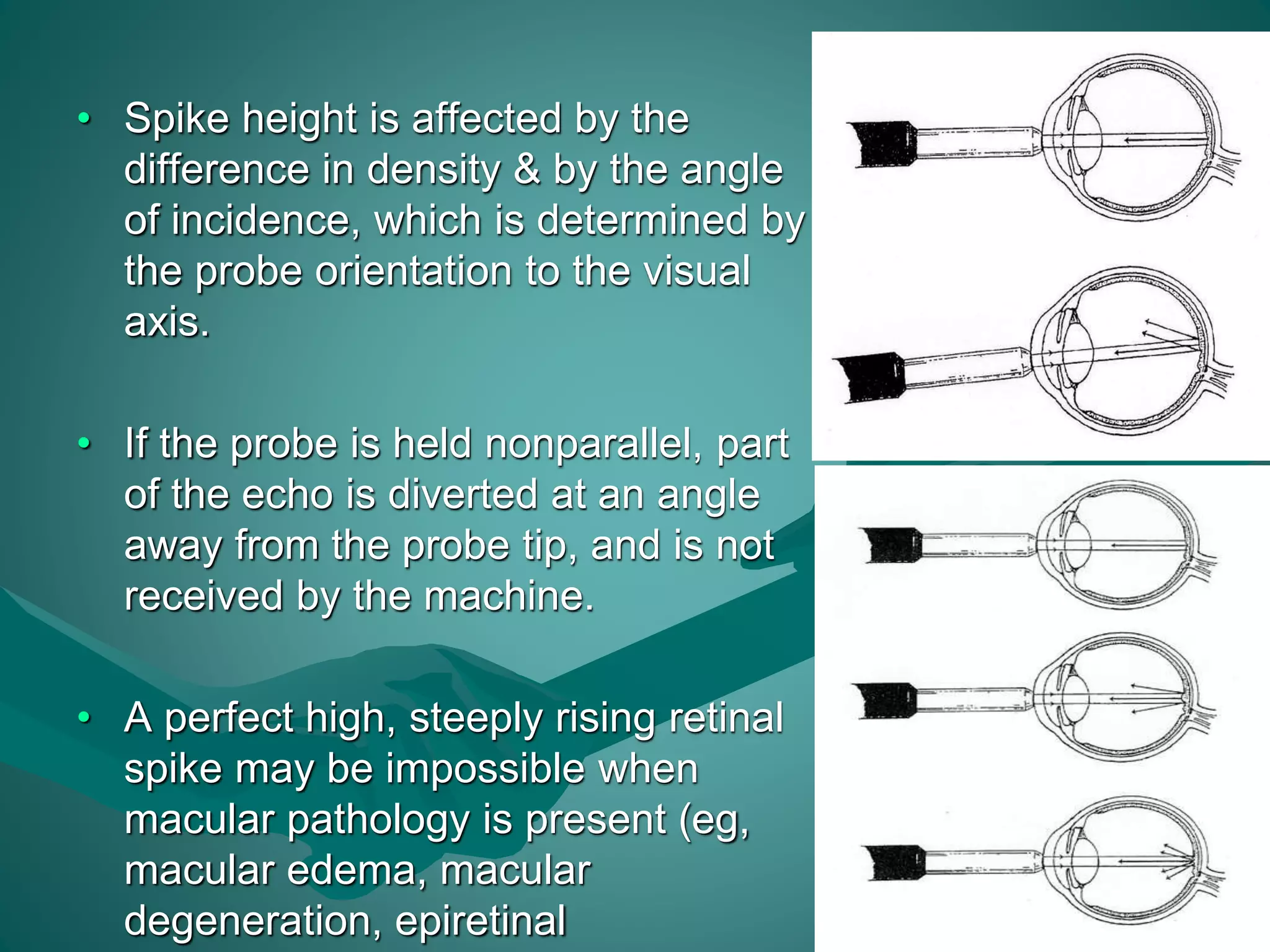
• Spike height is affected by the 
difference in density & by the angle 
of incidence, which is determined by 
the probe orientation to the visual 
axis. 
• If the probe is held nonparallel, part 
of the echo is diverted at an angle 
away from the probe tip, and is not 
received by the machine. 
• A perfect high, steeply rising retinal 
spike may be impossible when 
macular pathology is present (eg, 
macular edema, macular 
degeneration, epiretinal
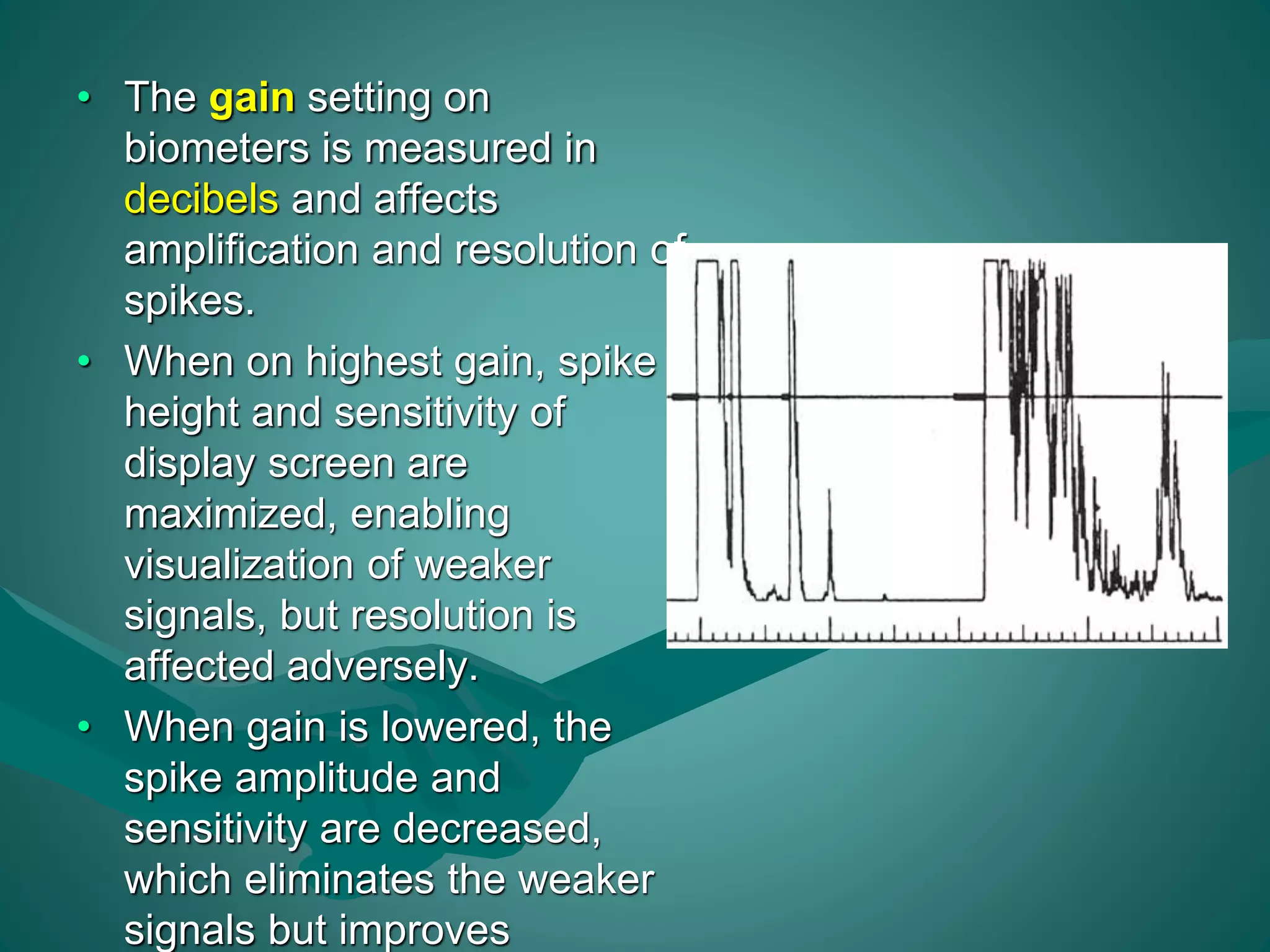
• The gain setting on 
biometers is measured in 
decibels and affects 
amplification and resolution of 
spikes. 
• When on highest gain, spike 
height and sensitivity of 
display screen are 
maximized, enabling 
visualization of weaker 
signals, but resolution is 
affected adversely. 
• When gain is lowered, the 
spike amplitude and 
sensitivity are decreased, 
which eliminates the weaker 
signals but improves
• Resolution: ability to display two 
interfaces that lie in close proximity, one 
directly behind the other, as separate 
echoes or spikes. 
• The more dense the cataract, the higher 
the necessary gain. 
• Gain setting may vary not only from 
patient to patient but from one eye to the 
next in the same patient, depending on 
cataract density.
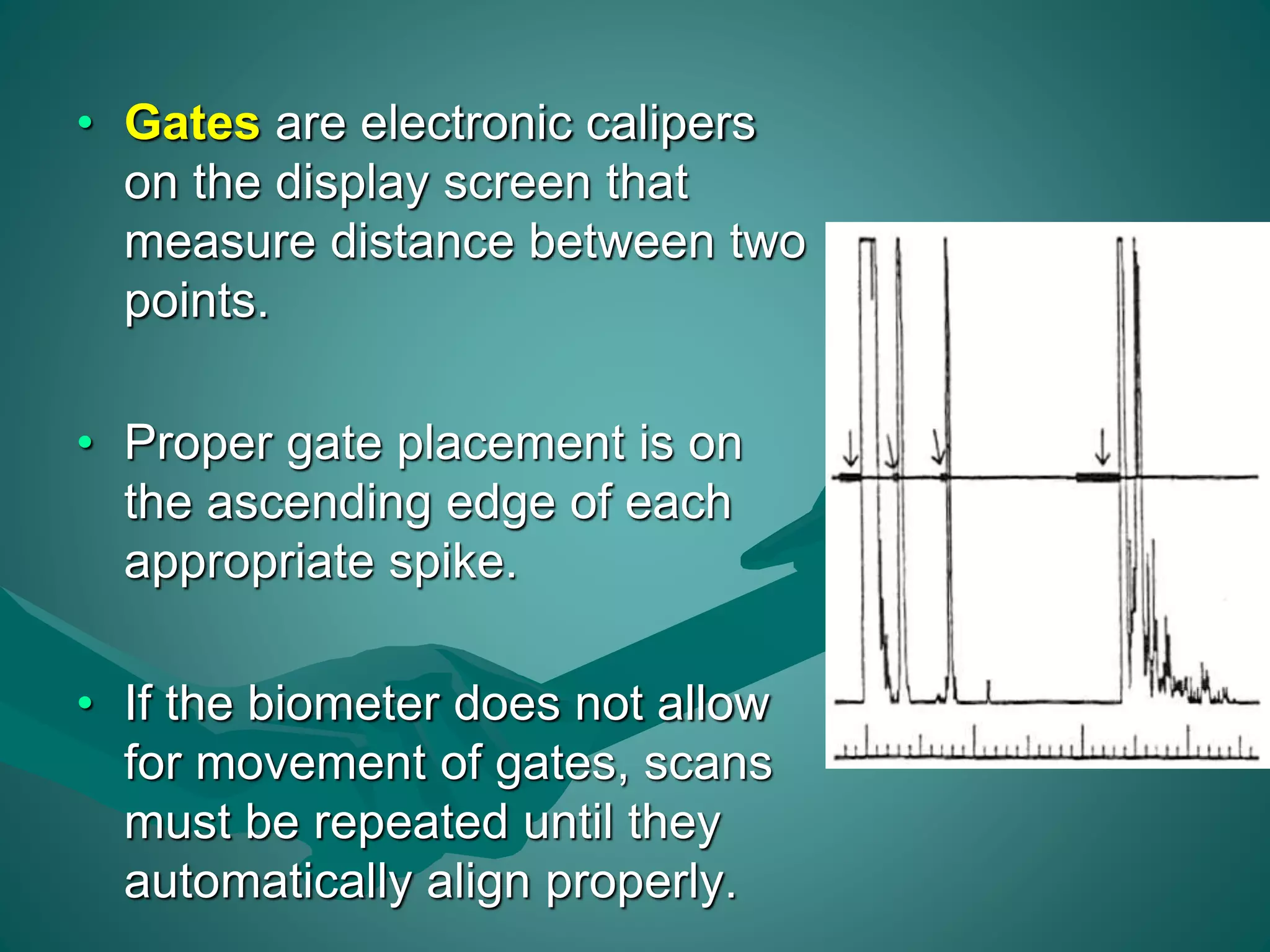
• Gates are electronic calipers 
on the display screen that 
measure distance between two 
points. 
• Proper gate placement is on 
the ascending edge of each 
appropriate spike. 
• If the biometer does not allow 
for movement of gates, scans 
must be repeated until they 
automatically align properly.
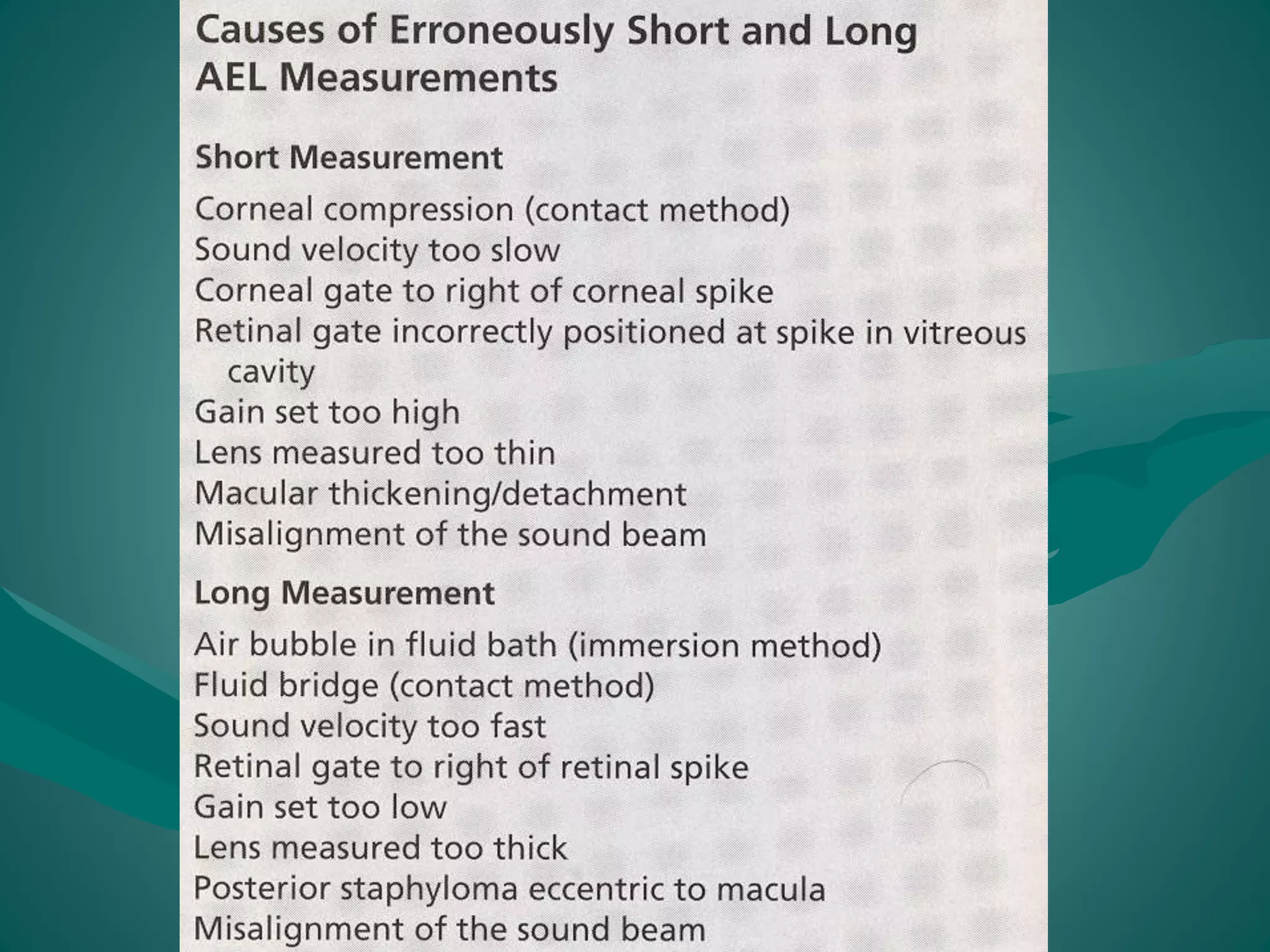
• Ultrasound biometry machines use the formula 
Distance = Velocity x Time. 
• Sound velocity through different media: 
 Phakic – 1550 m/s 
 Aphakic – 1532 m/s 
 Pseudophakic – 1532 + Correction factor for IOL 
• Velocity through PMMA is 2718 m/s, through 
acrylic is 2120 m/s, and through silicone is 980- 
1107 m/s. 
• Correction factor is +0.4 mm for PMMA, +0.2
• Biometry of pseudophakic eye performed: 
- To compare to the fellow phakic eye for accuracy 
- IOL exchange 
- Checking an unwanted postoperative refractive error. 
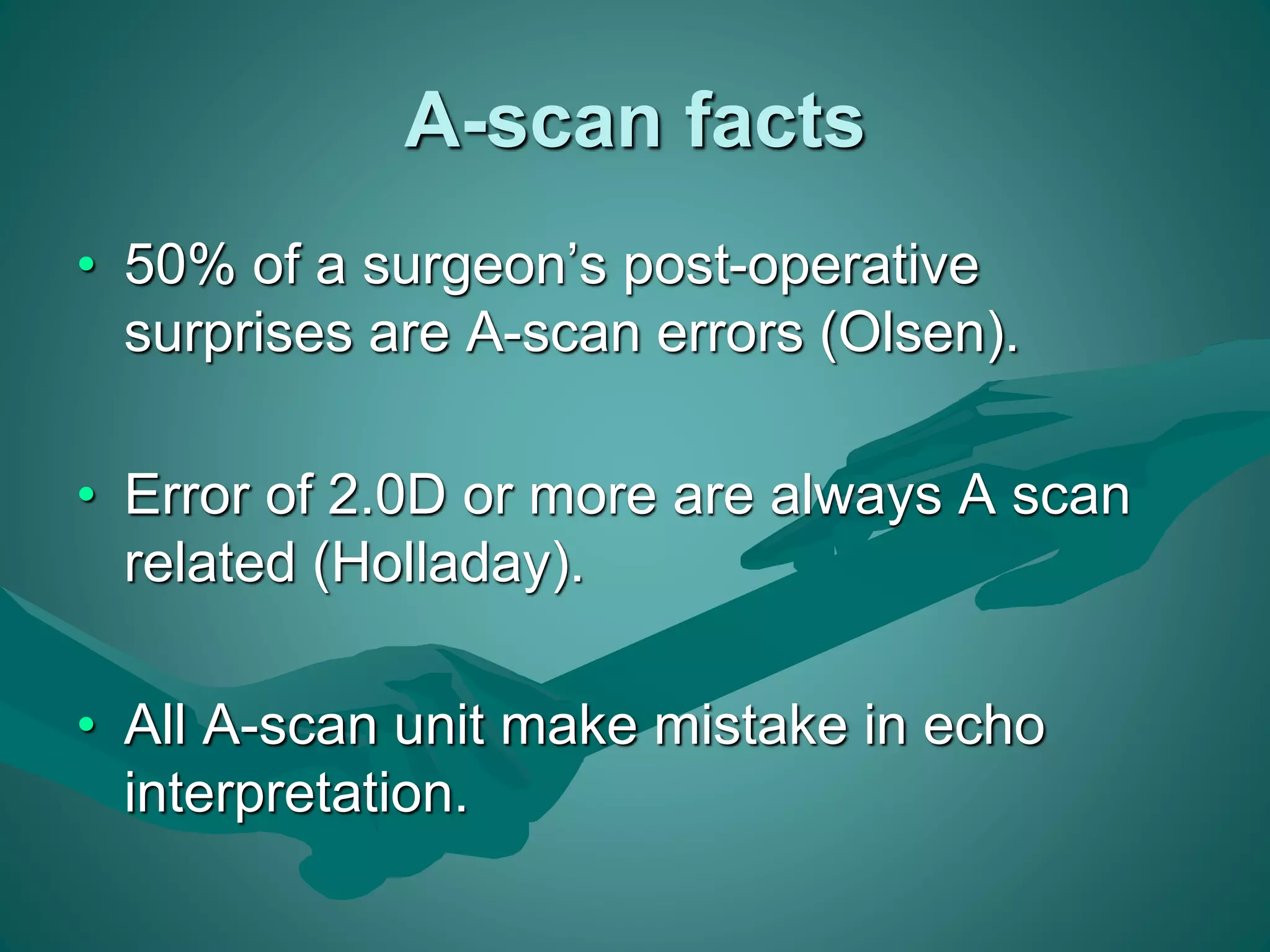
• A scan of pseudophakic eye → multiple reverberation 
echoes in the vitreous cavity that tend to decrease in 
amplitude from left to right. 
• Decreasing the gain in pseudophakic eye is helpful.
A-scan facts 
• 50% of a surgeon’s post-operative 
surprises are A-scan errors (Olsen). 
• Error of 2.0D or more are always A scan 
related (Holladay). 
• All A-scan unit make mistake in echo 
interpretation.
Applanation A-scan Biometry 
• A-scan biometry by applanation requires that the 
ultrasound probe be placed directly on the 
corneal surface. This can either be done at the 
slit lamp, or by holding the ultrasound probe by 
hand. 
• Even in the most experienced hands, some 
compression of the cornea is unavoidable; this 
typically being 0.14 mm - 0.28 mm.
Applanation A-scan Biometry. 
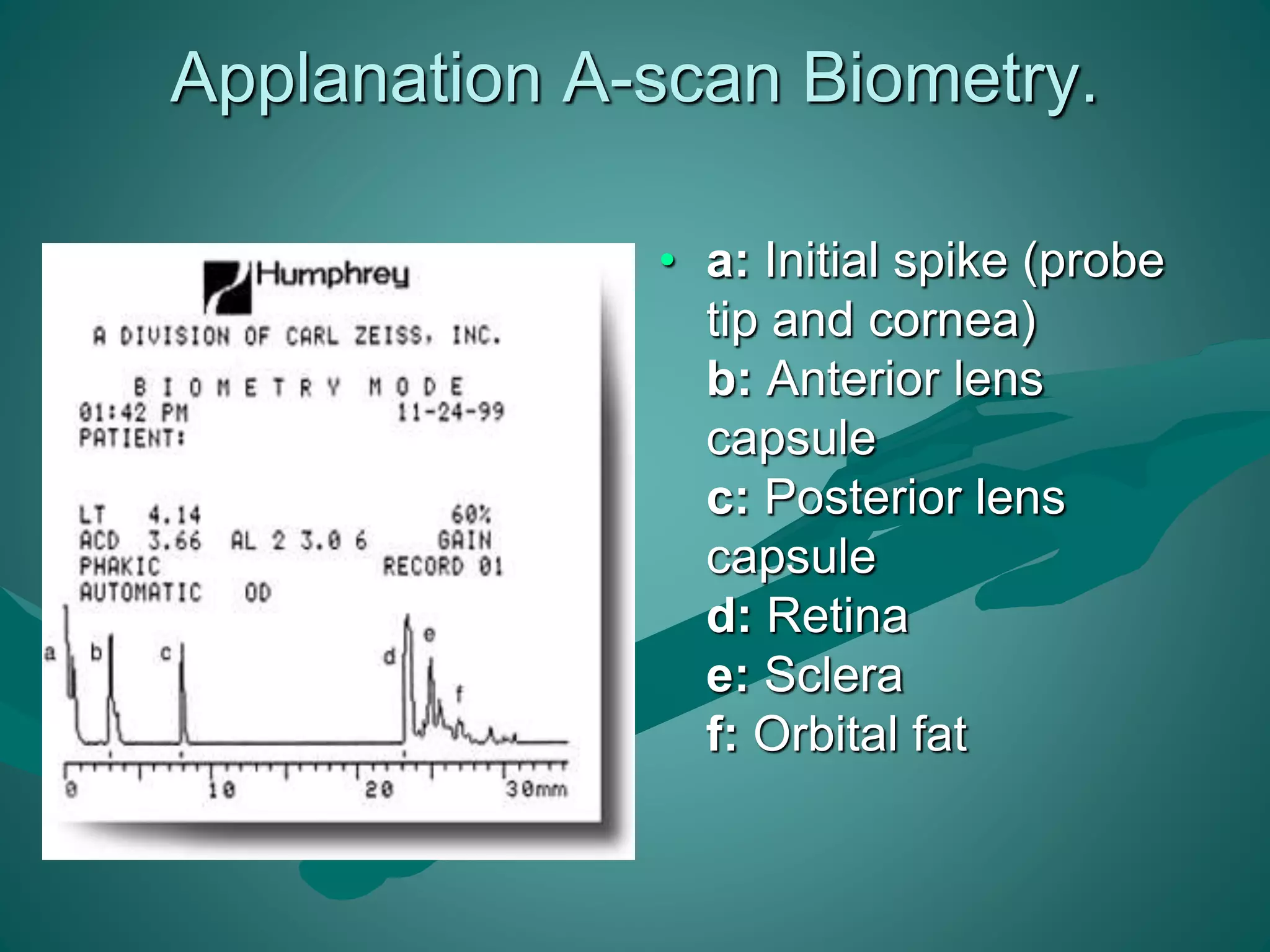
• a: Initial spike (probe 
tip and cornea) 
b: Anterior lens 
capsule 
c: Posterior lens 
capsule 
d: Retina 
e: Sclera 
f: Orbital fat
Applanation A-scan Biometry 
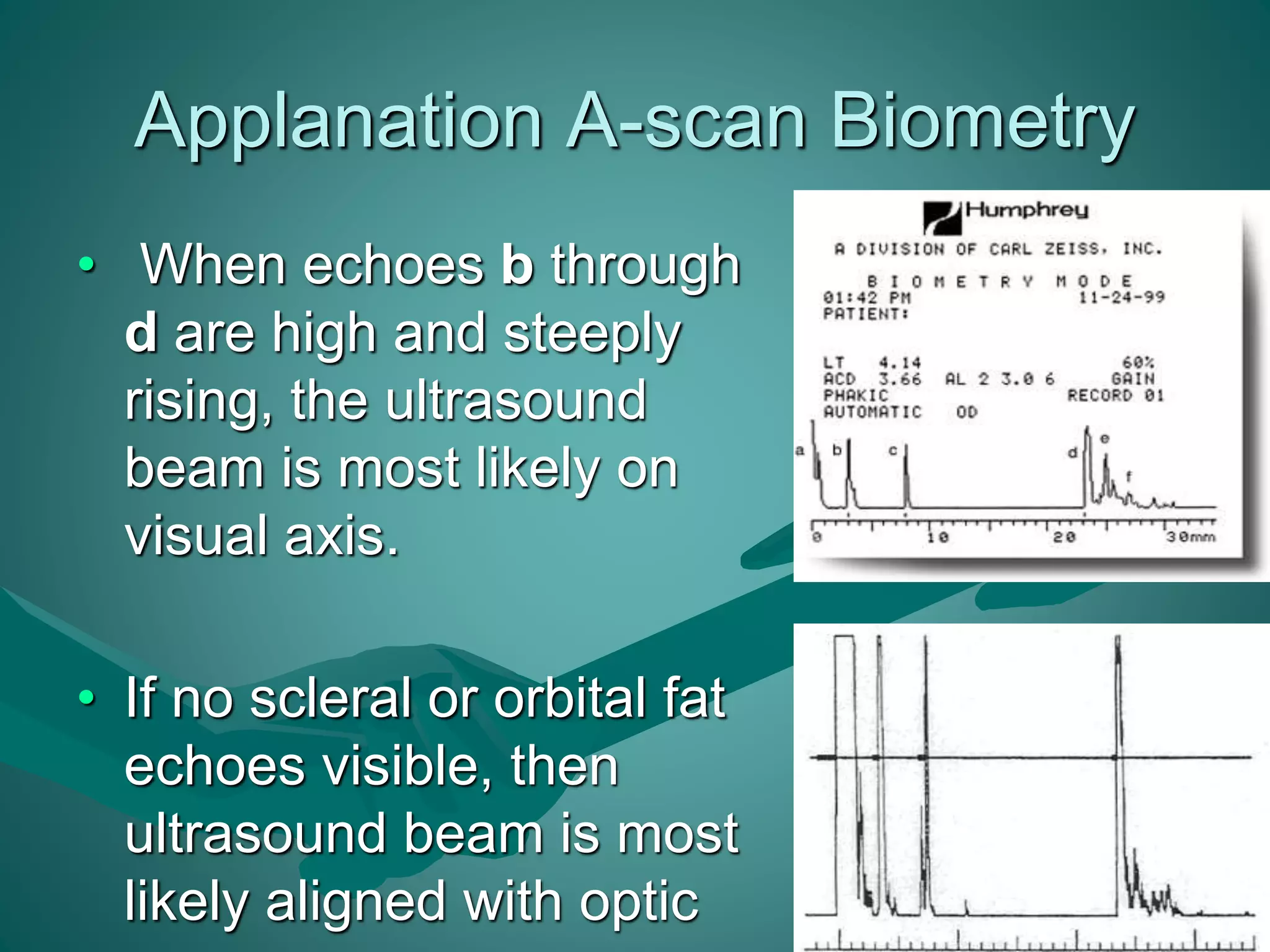
• When echoes b through 
d are high and steeply 
rising, the ultrasound 
beam is most likely on 
visual axis. 
• If no scleral or orbital fat 
echoes visible, then 
ultrasound beam is most 
likely aligned with optic 
nerve.
The five basic limitations of 
applanation A-scan biometry are: 
1. Variable corneal compression. 
2. Broad sound beam without precise 
localization 
3. Limited resolution. 
4. Incorrect assumptions regarding sound 
velocity. 
5. Potential for incorrect measurement 
distance.
Immersion A-scan Biometry 
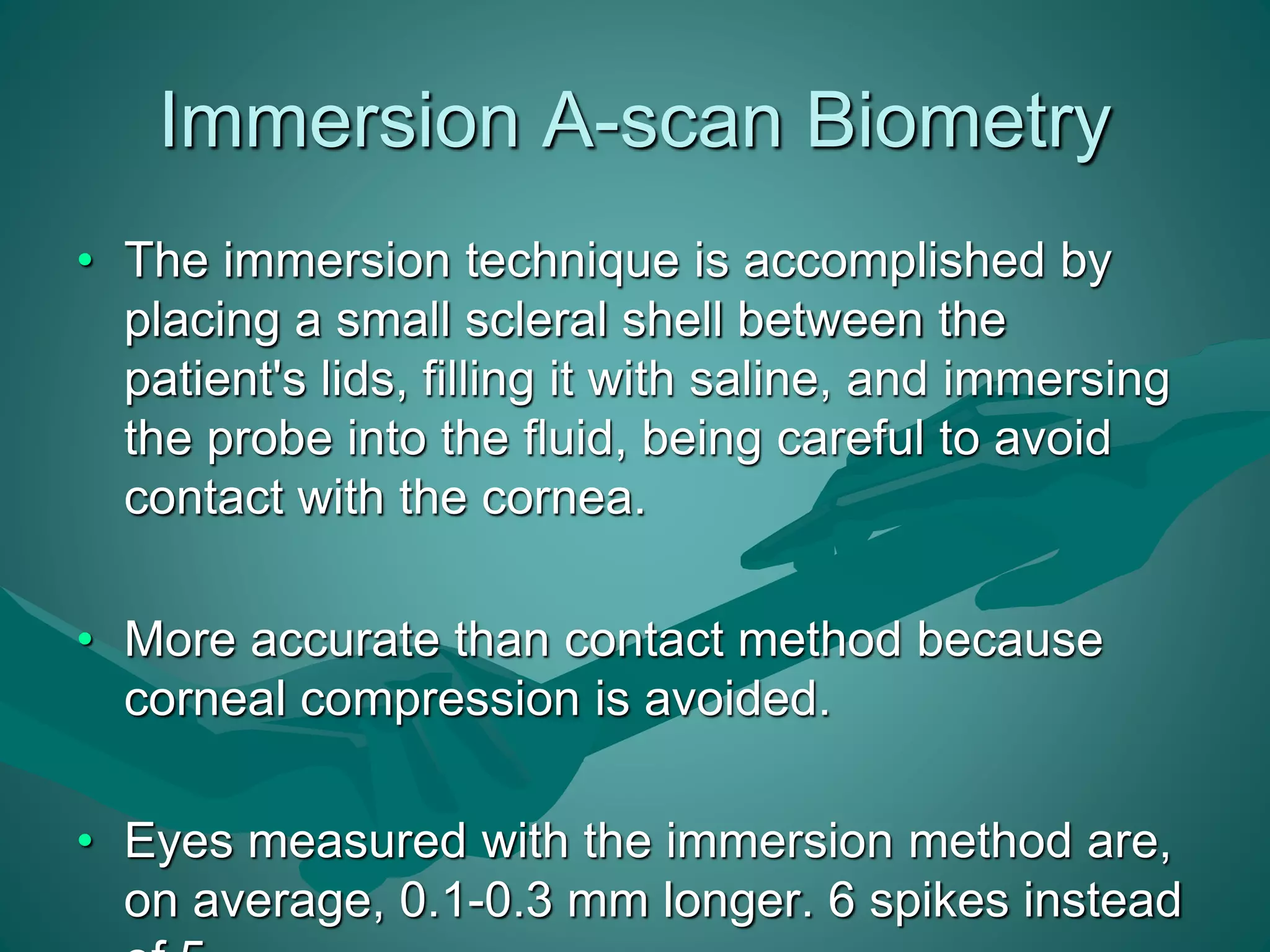
• The immersion technique is accomplished by 
placing a small scleral shell between the 
patient's lids, filling it with saline, and immersing 
the probe into the fluid, being careful to avoid 
contact with the cornea. 
• More accurate than contact method because 
corneal compression is avoided. 
• Eyes measured with the immersion method are, 
on average, 0.1-0.3 mm longer. 6 spikes instead 
of 5.
Immersion A-scan Biometry 
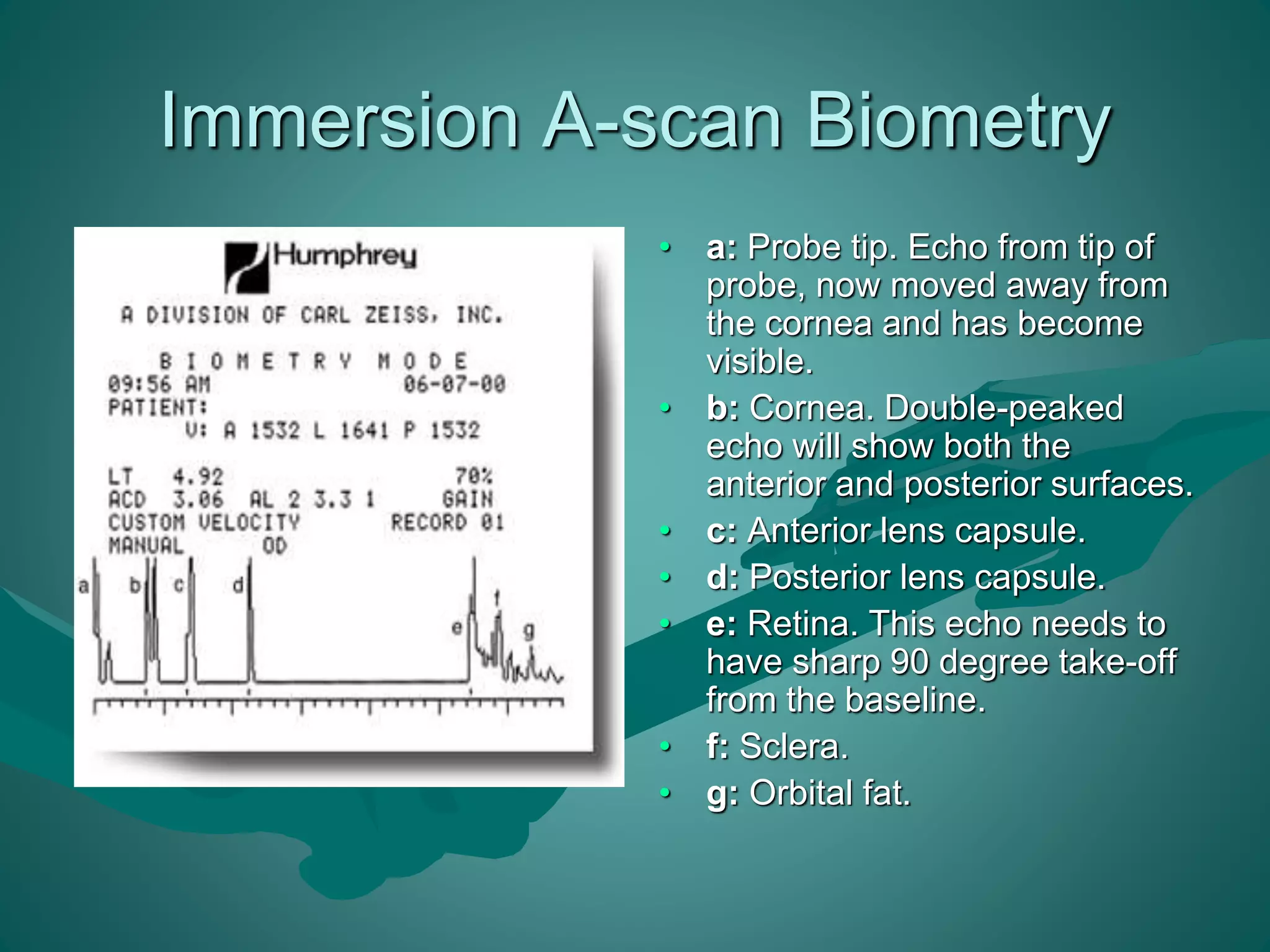
• . • a: Probe tip. Echo from tip of 
probe, now moved away from 
the cornea and has become 
visible. 
• b: Cornea. Double-peaked 
echo will show both the 
anterior and posterior surfaces. 
• c: Anterior lens capsule. 
• d: Posterior lens capsule. 
• e: Retina. This echo needs to 
have sharp 90 degree take-off 
from the baseline. 
• f: Sclera. 
• g: Orbital fat.
Immersion A-scan Biometry 
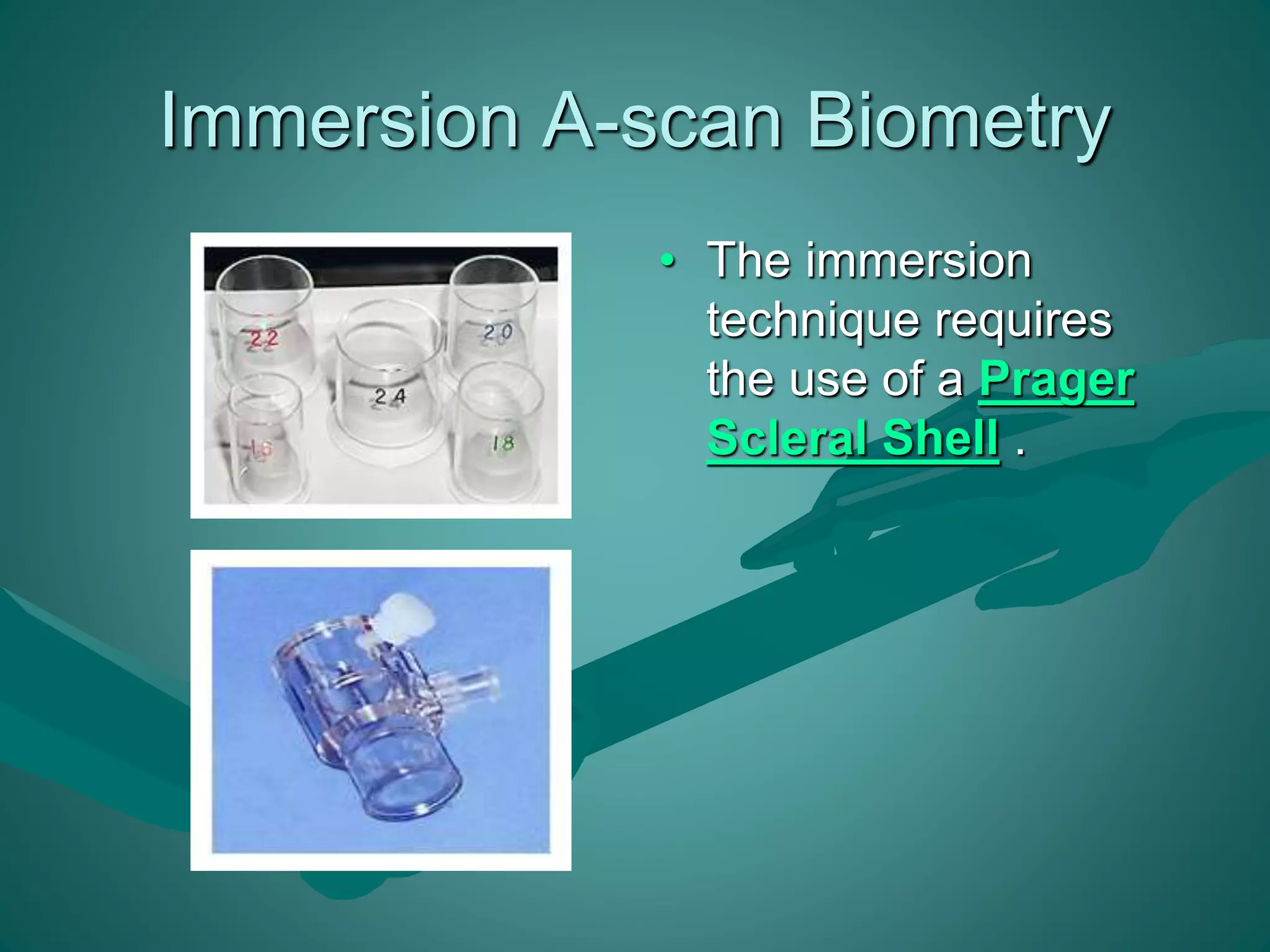
• The immersion 
technique requires 
the use of a Prager 
Scleral Shell .
Immersion A-scan Biometry 
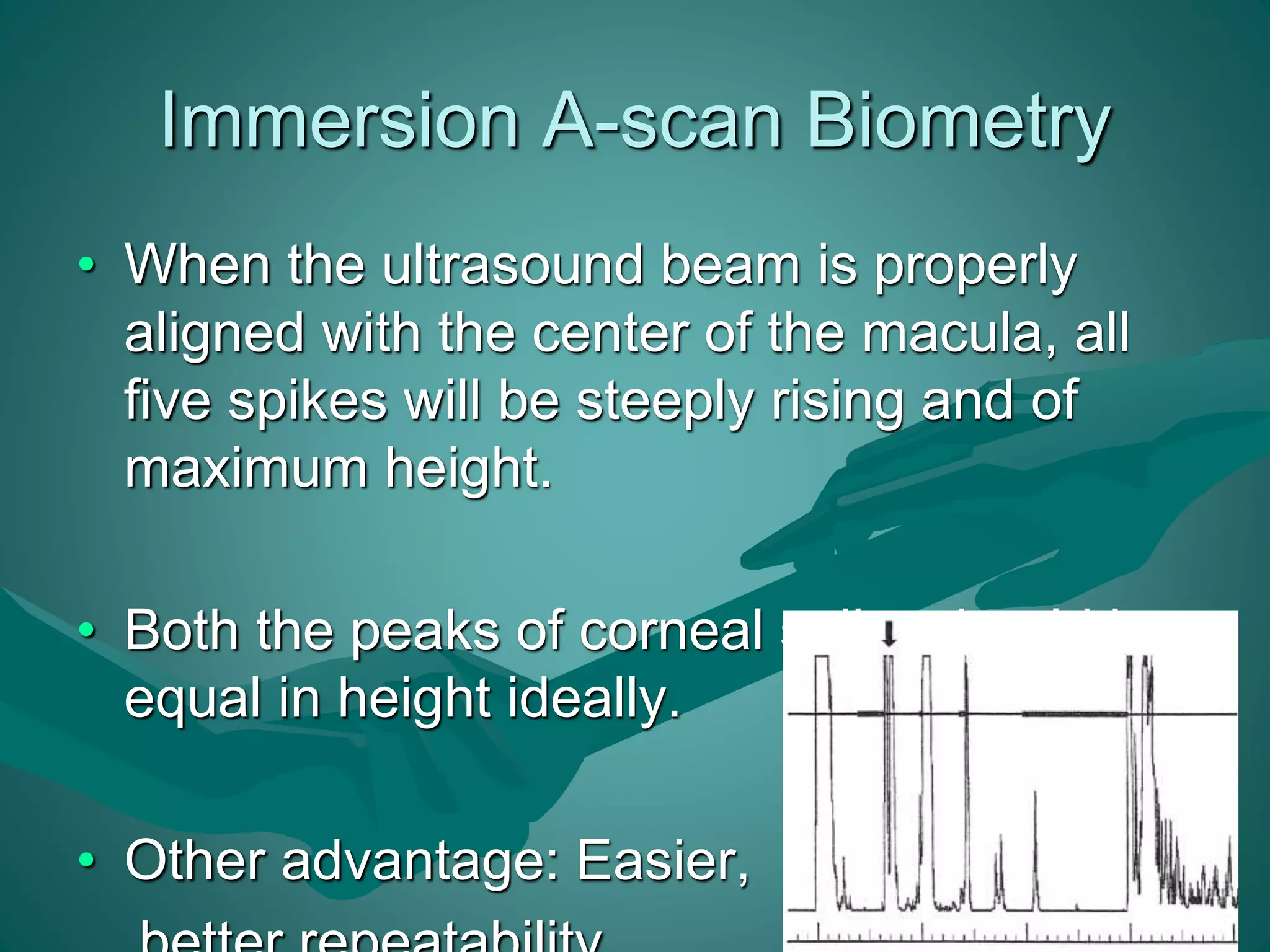
• When the ultrasound beam is properly 
aligned with the center of the macula, all 
five spikes will be steeply rising and of 
maximum height. 
• Both the peaks of corneal spike should be 
equal in height ideally. 
• Other advantage: Easier, 
better repeatability.
NON CONTACT 
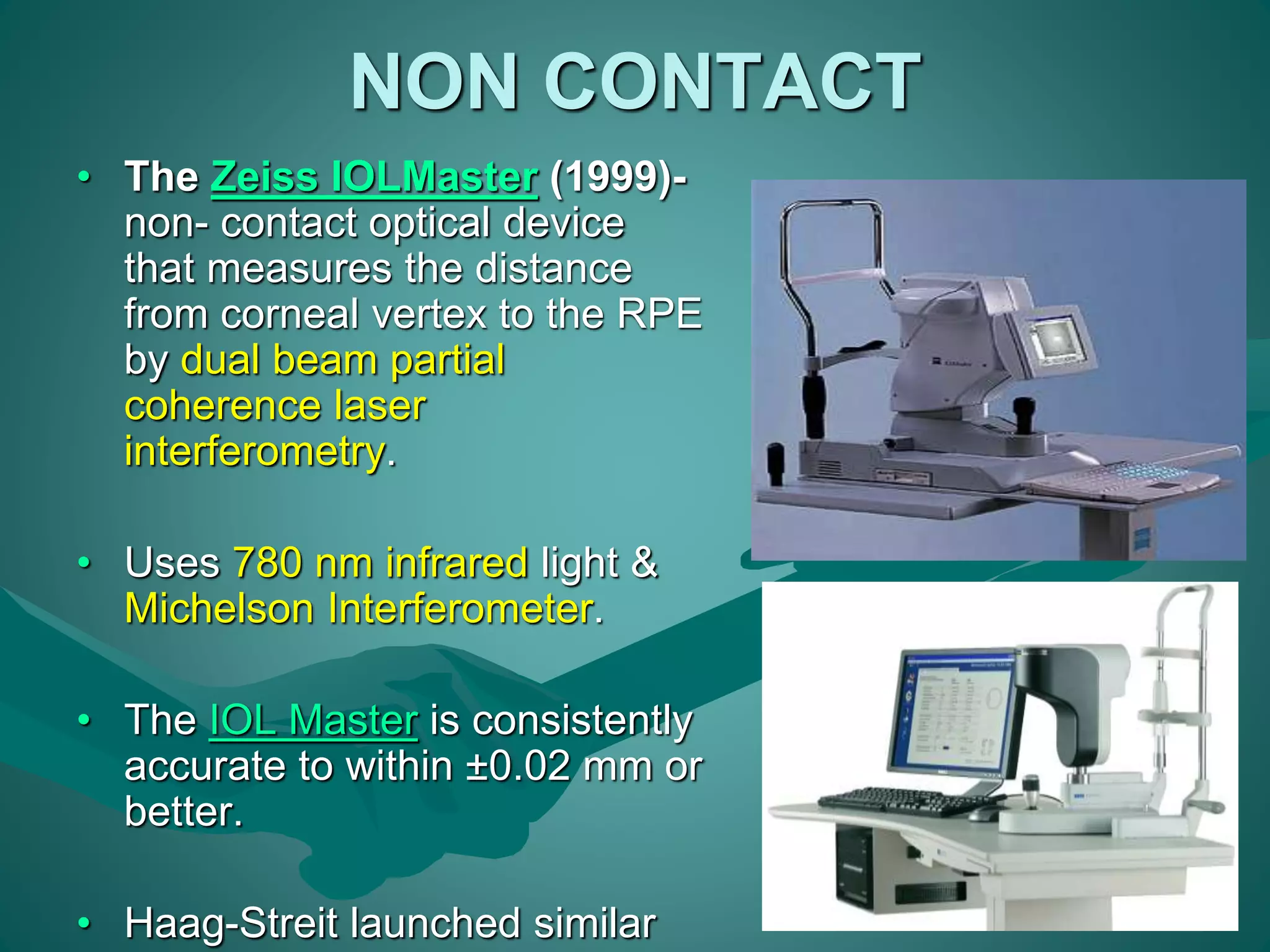
• The Zeiss IOLMaster (1999)- 
non- contact optical device 
that measures the distance 
from corneal vertex to the RPE 
by dual beam partial 
coherence laser 
interferometry. 
• Uses 780 nm infrared light & 
Michelson Interferometer. 
• The IOL Master is consistently 
accurate to within ±0.02 mm or 
better. 
• Haag-Streit launched similar
• IOL Master provides following measurements: 
 AC depth 
 Lens thickness 
 Axial Length 
 Keratometry 
 White to white distance 
• In-built IOL power calculation by diff. formula: 
SRK II, SRK – T, Holladay II, Hoffer Q, Haigis L. 
• This method cannot be used in significant media 
opacity (eg. dense cataracts or corneal or vitreal 
opacity) due to absorption of light or inability of 
the patient to fixate on target.
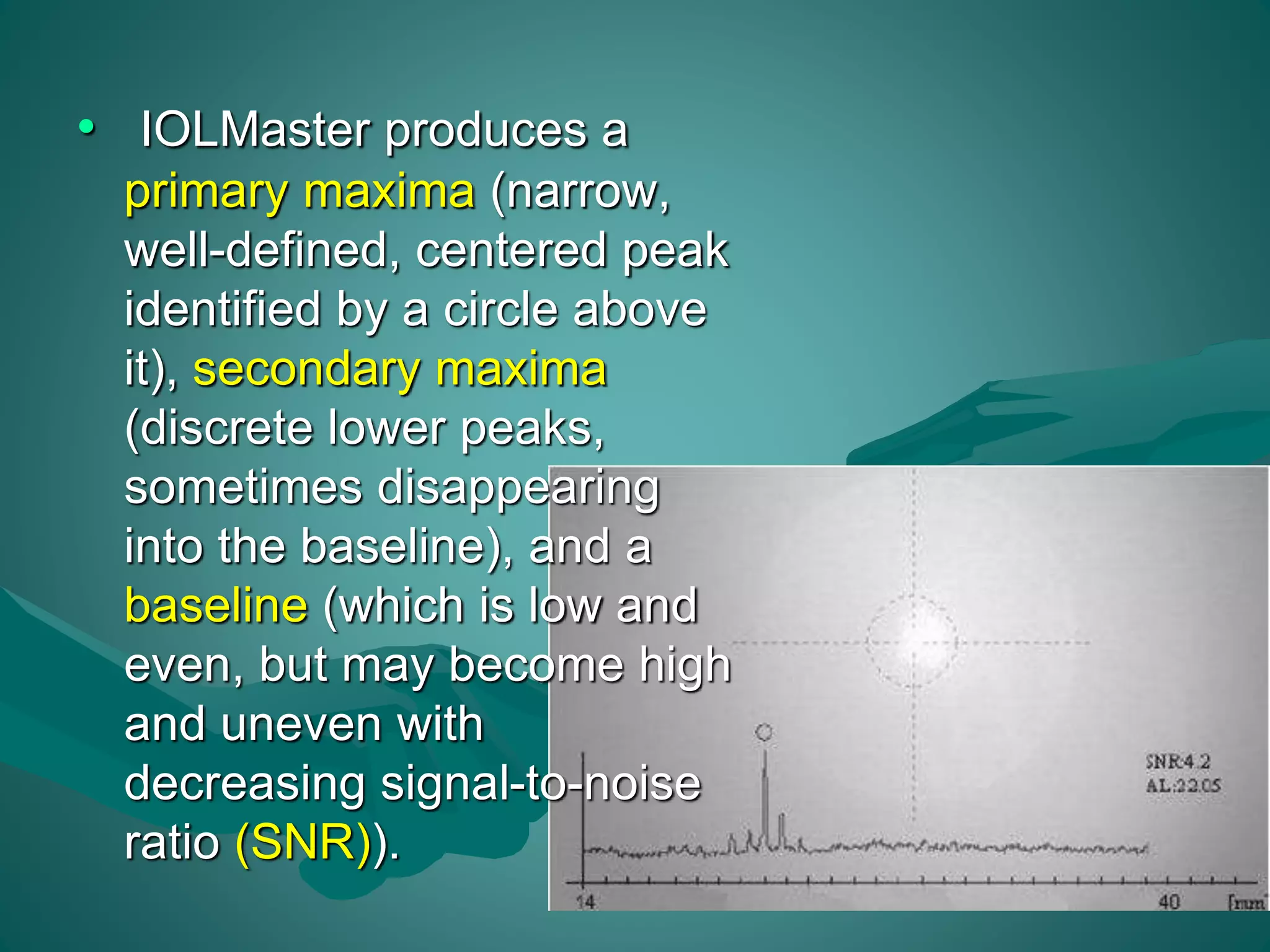
• IOLMaster produces a 
primary maxima (narrow, 
well-defined, centered peak 
identified by a circle above 
it), secondary maxima 
(discrete lower peaks, 
sometimes disappearing 
into the baseline), and a 
baseline (which is low and 
even, but may become high 
and uneven with 
decreasing signal-to-noise 
ratio (SNR)).
• SNR is a measure of accuracy and 
decreases with increasing cataract 
density. 
• SNR > 2.0 is valid and good if repeatable, 
SNR between 1.6-2.0 is borderline but 
usable if repeatable, and SNR < 1.6 is not 
usable. 
• However, a proper waveform is more 
important than the SNR value.
Advantages of IOLMaster 
• Easy & technician independent 
• Noncontact 
• No water bath is needed 
• Can measure through glasses 
• Accurate for silicone oil filled eyes and posterior 
staphyloma. 
• Accurate (Holladay II) 
• Haigis L formula incorporated for post-LVC pts. 
• For Piggyback IOLs
• Lenstar LS 900 measures CCT, ACD, 
Lens thickness, Retinal thickness, AL, 
Keratometry, White to white distance, 
Pupillometry & eccentricity of optical axis. 
• Lenstar measures keratometry & ACD 
more accurately than IOL Master.
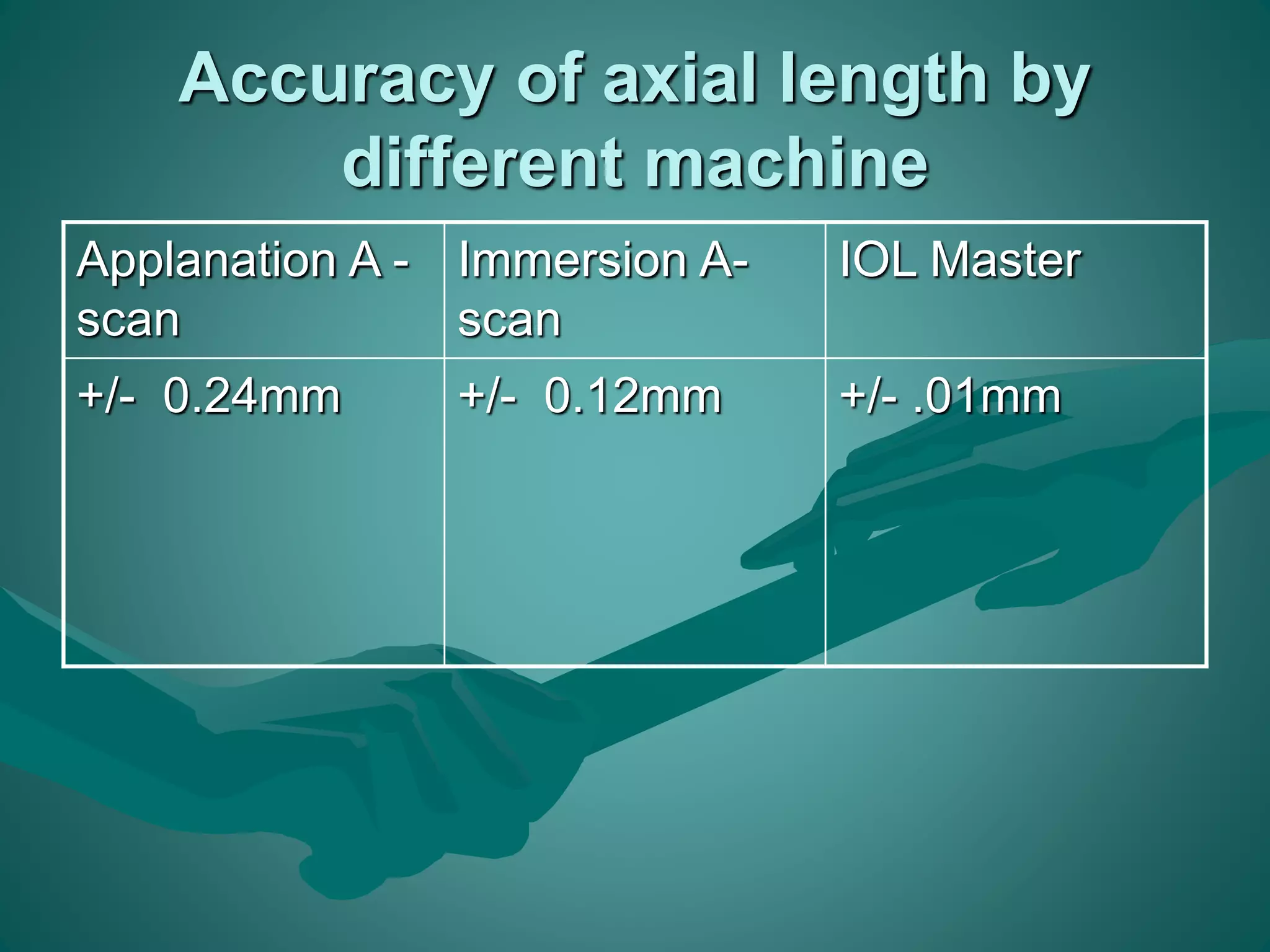
Accuracy of axial length by 
different machine 
Applanation A - 
scan 
Immersion A-scan 
IOL Master 
+/- 0.24mm +/- 0.12mm +/- .01mm
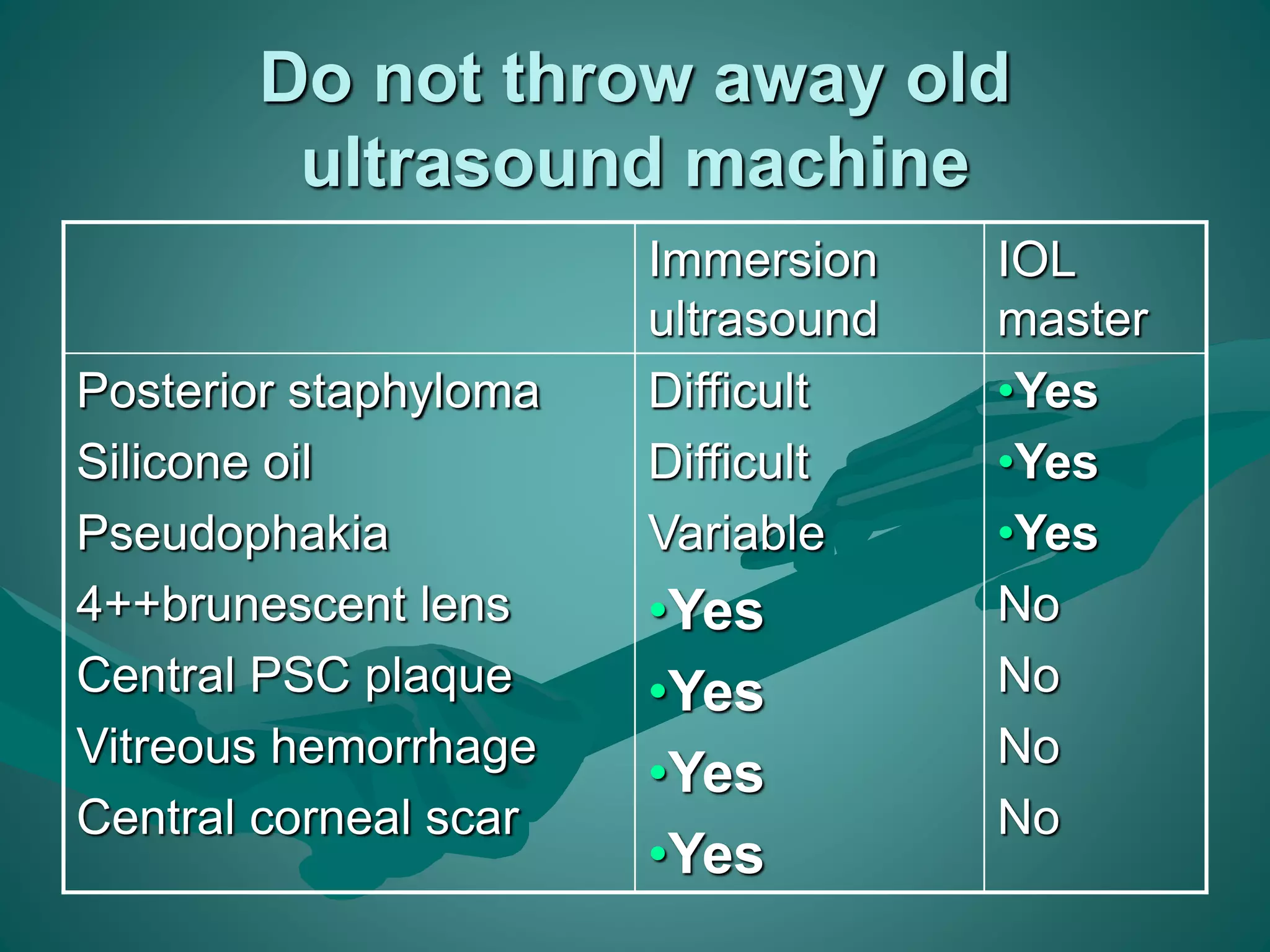
Do not throw away old 
ultrasound machine 
Immersion 
ultrasound 
IOL 
master 
Posterior staphyloma 
Silicone oil 
Pseudophakia 
4++brunescent lens 
Central PSC plaque 
Vitreous hemorrhage 
Central corneal scar 
Difficult 
Difficult 
Variable 
•Yes 
•Yes 
•Yes 
•Yes 
•Yes 
•Yes 
•Yes 
No 
No 
No 
No
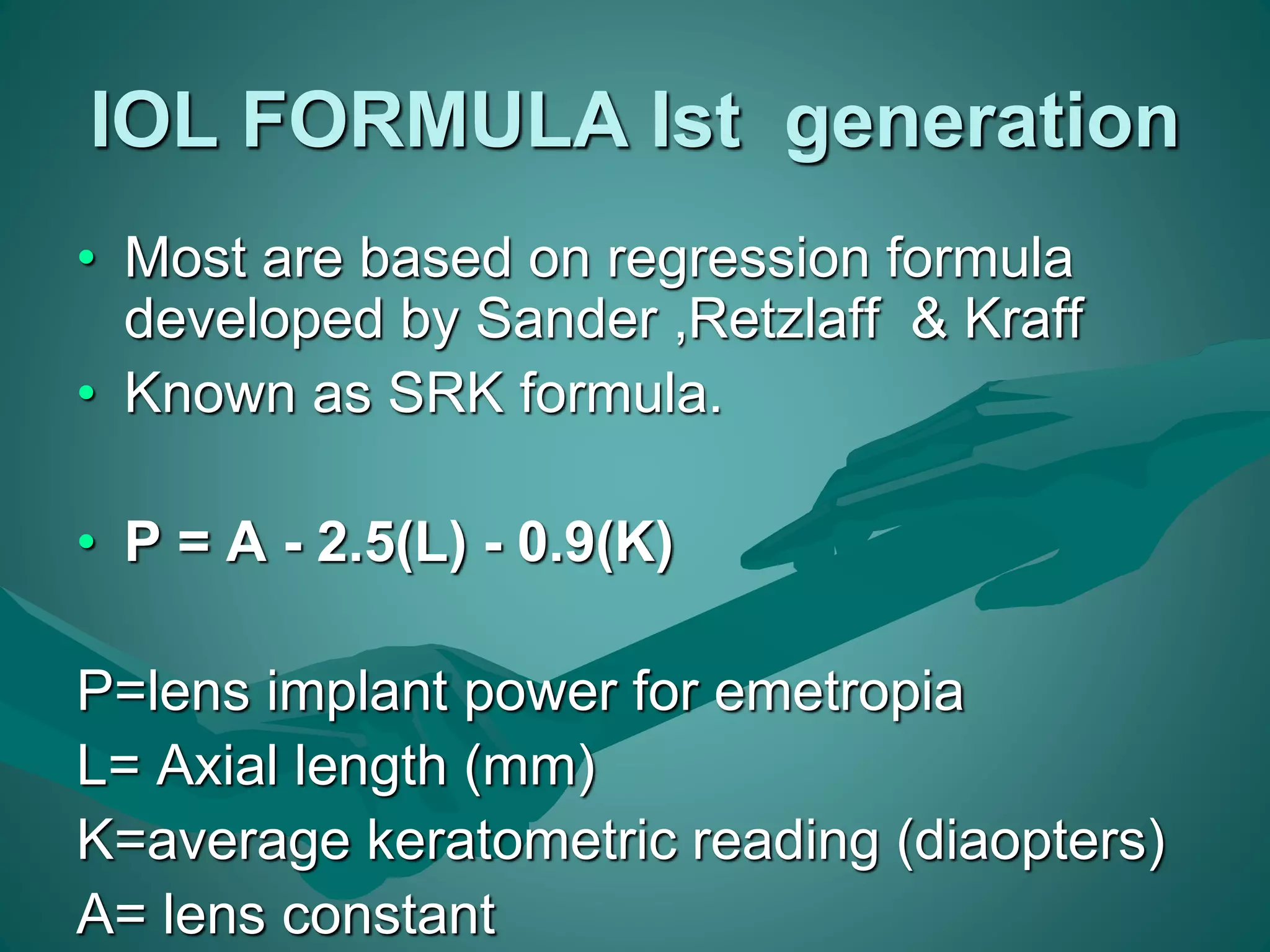
IOL FORMULA Ist generation 
• Most are based on regression formula 
developed by Sander ,Retzlaff & Kraff 
• Known as SRK formula. 
• P = A - 2.5(L) - 0.9(K) 
P=lens implant power for emetropia 
L= Axial length (mm) 
K=average keratometric reading (diaopters) 
A= lens constant
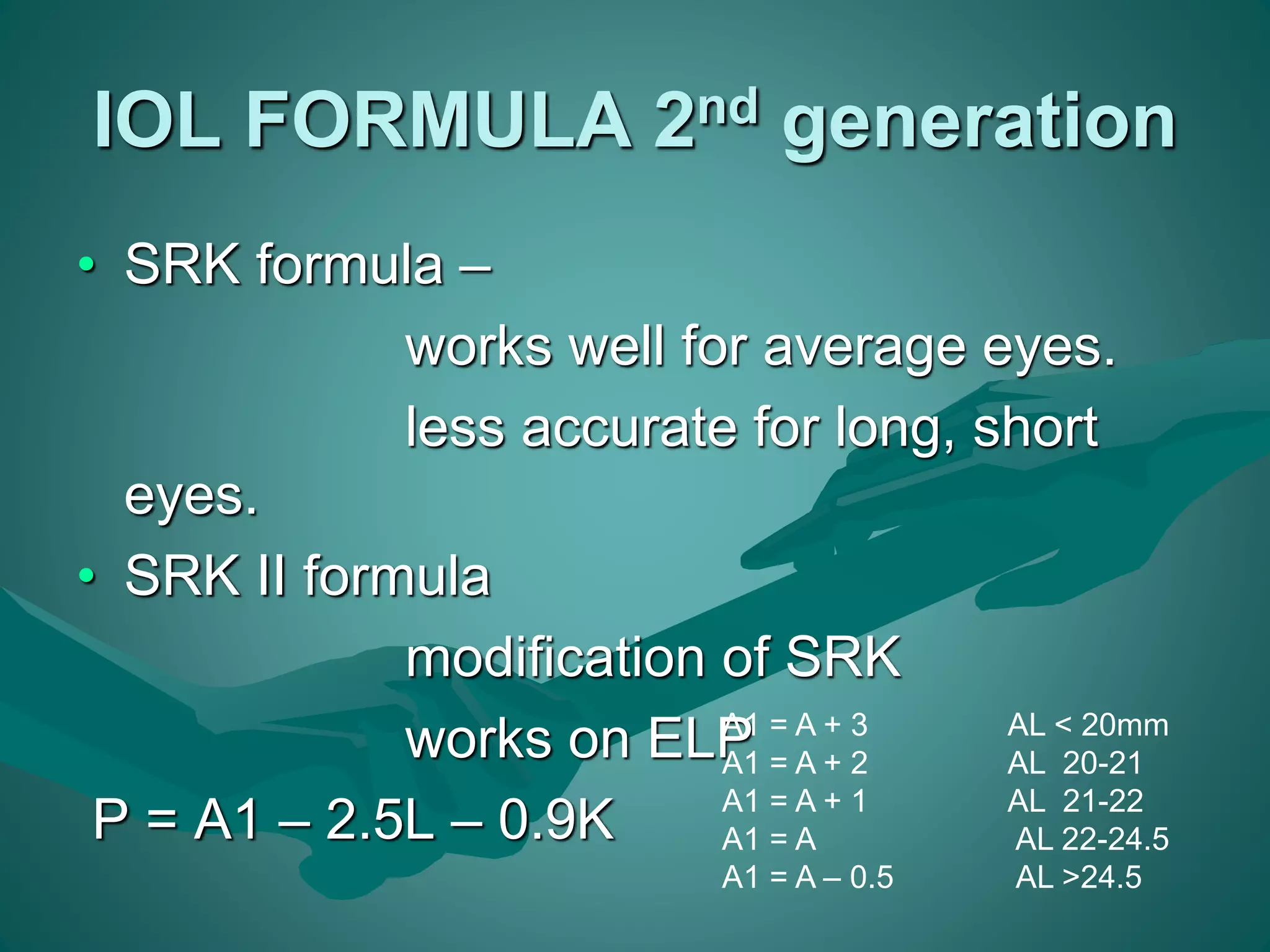
IOL FORMULA 2nd generation 
• SRK formula – 
works well for average eyes. 
less accurate for long, short 
eyes. 
• SRK II formula 
modification of SRK 
works on ELP 
P = A1 – 2.5L – 0.9K 
A1 = A + 3 AL < 20mm 
A1 = A + 2 AL 20-21 
A1 = A + 1 AL 21-22 
A1 = A AL 22-24.5 
A1 = A – 0.5 AL >24.5
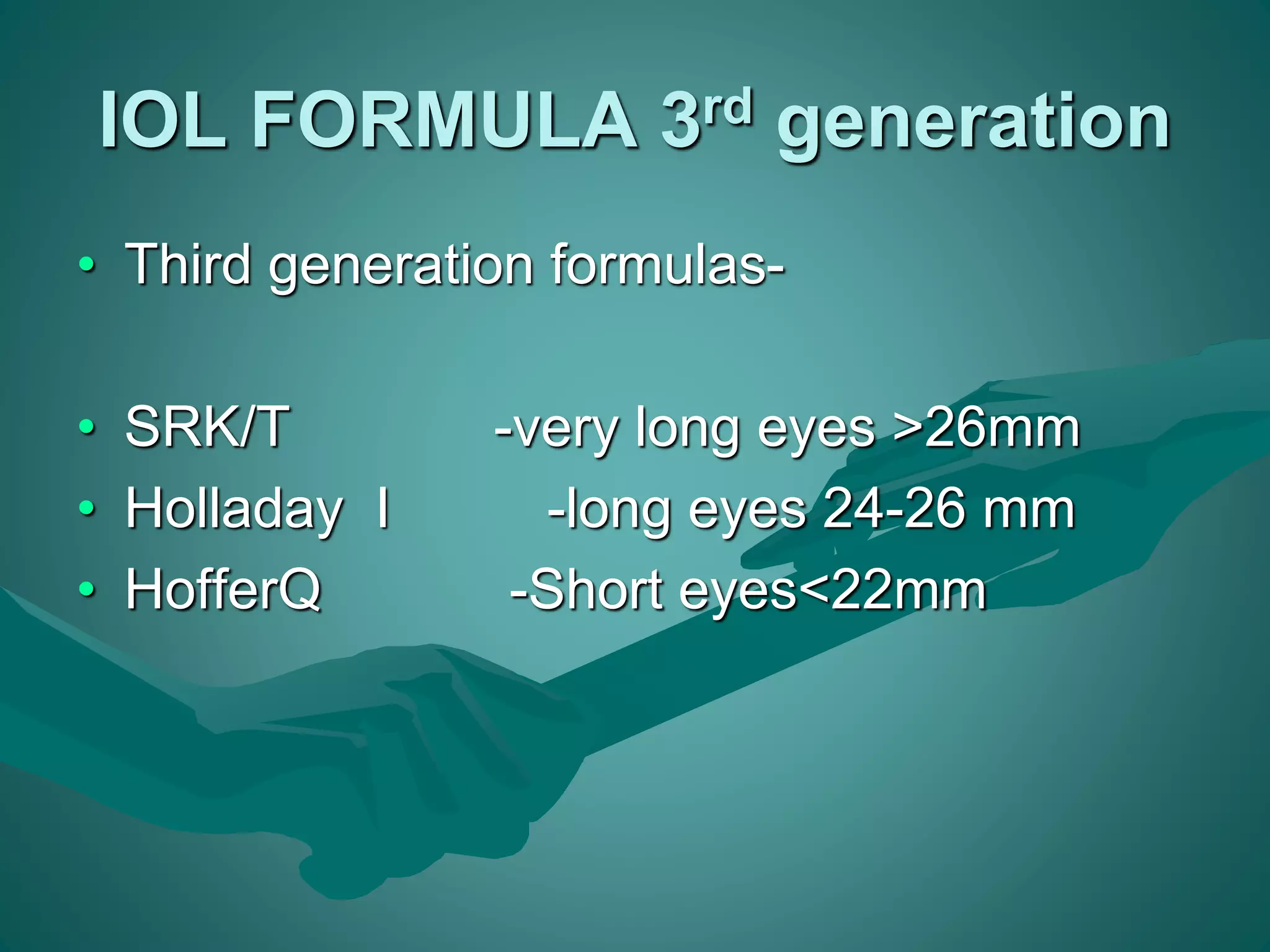
IOL FORMULA 3rd generation 
• Third generation formulas- 
• SRK/T -very long eyes >26mm 
• Holladay I -long eyes 24-26 mm 
• HofferQ -Short eyes<22mm
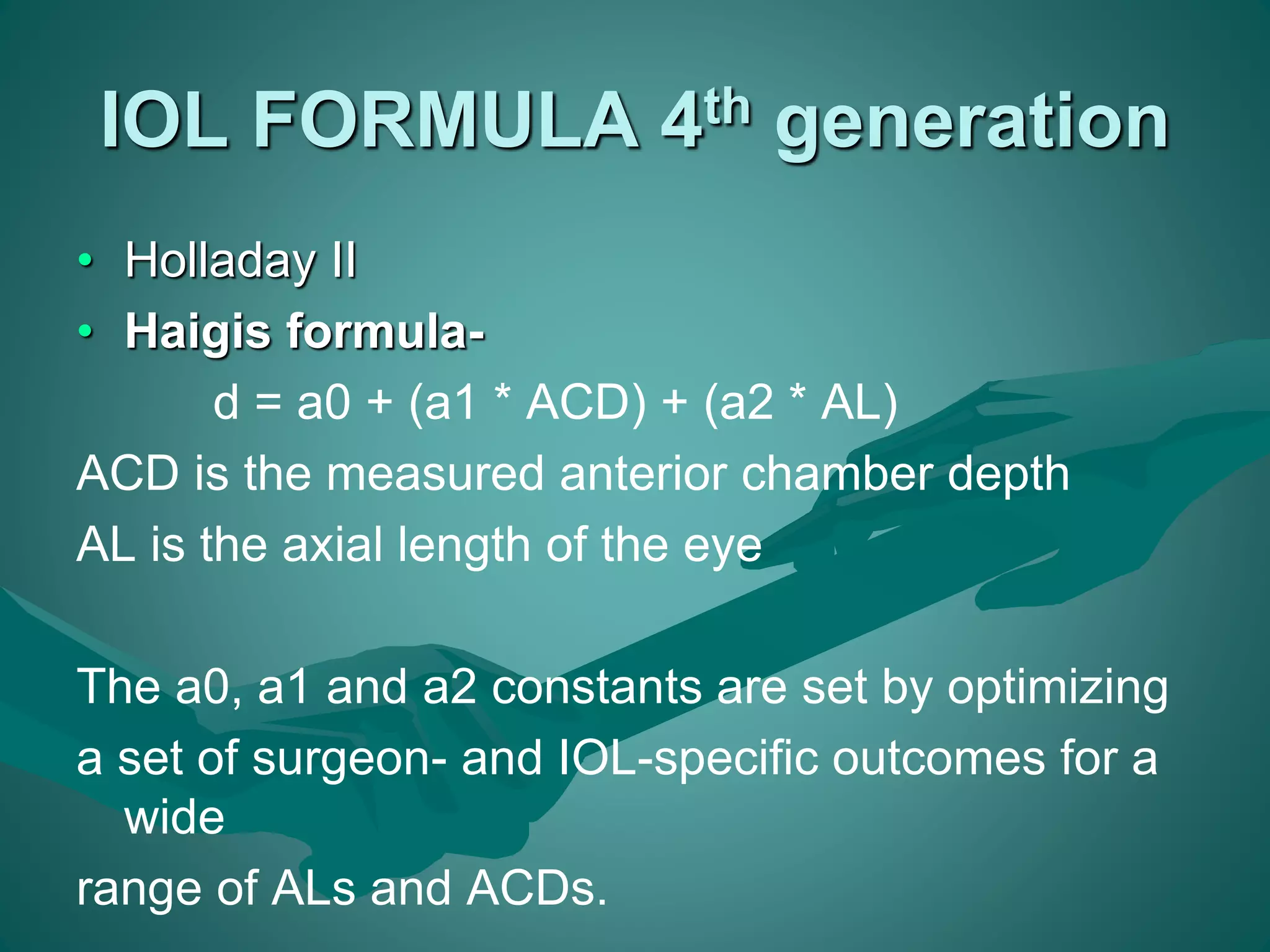
IOL FORMULA 4th generation 
• Holladay II 
• Haigis formula-d 
= a0 + (a1 * ACD) + (a2 * AL) 
ACD is the measured anterior chamber depth 
AL is the axial length of the eye 
The a0, a1 and a2 constants are set by optimizing 
a set of surgeon- and IOL-specific outcomes for a 
wide 
range of ALs and ACDs.
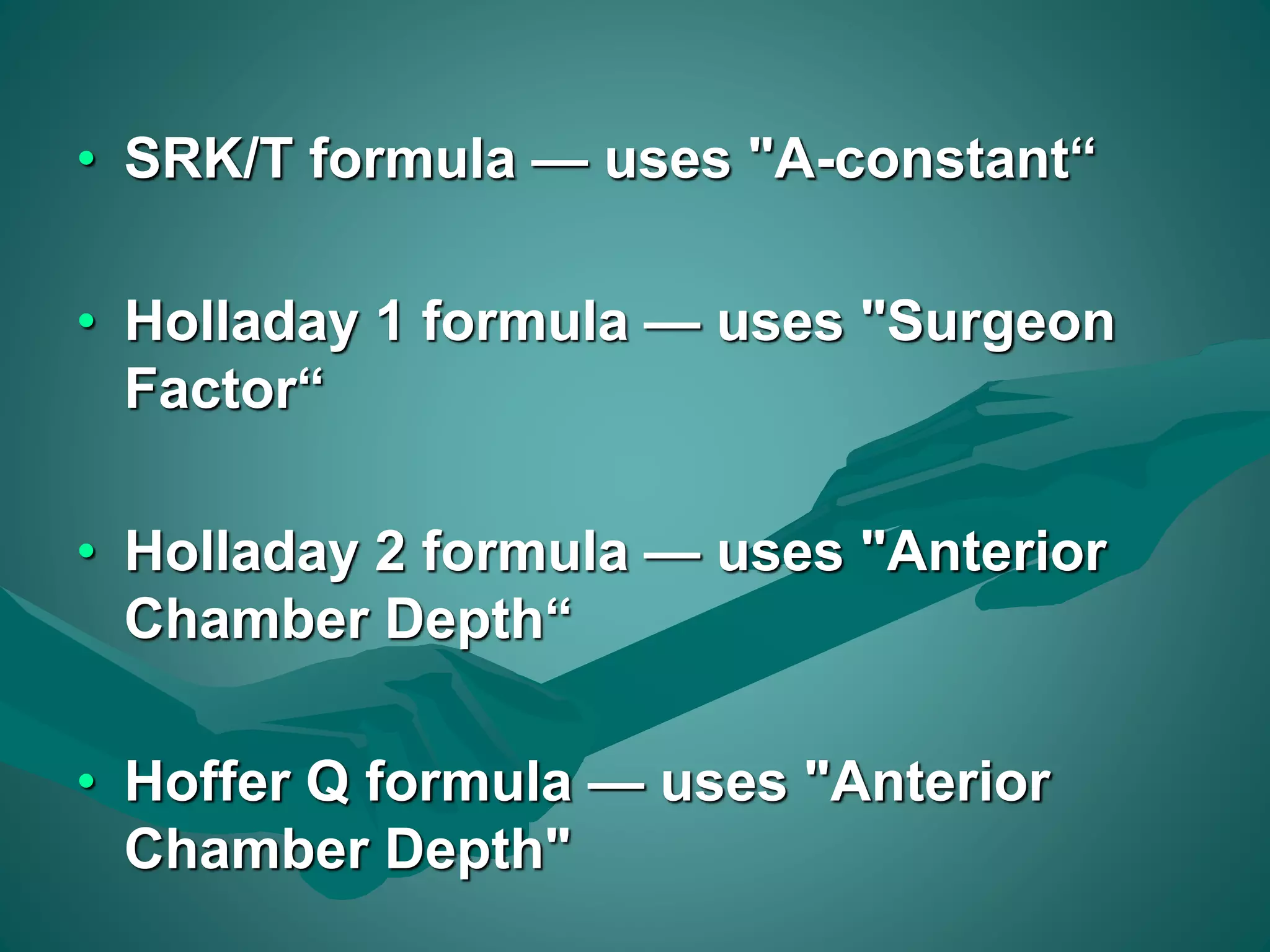
• SRK/T formula — uses "A-constant“ 
• Holladay 1 formula — uses "Surgeon 
Factor“ 
• Holladay 2 formula — uses "Anterior 
Chamber Depth“ 
• Hoffer Q formula — uses "Anterior 
Chamber Depth"
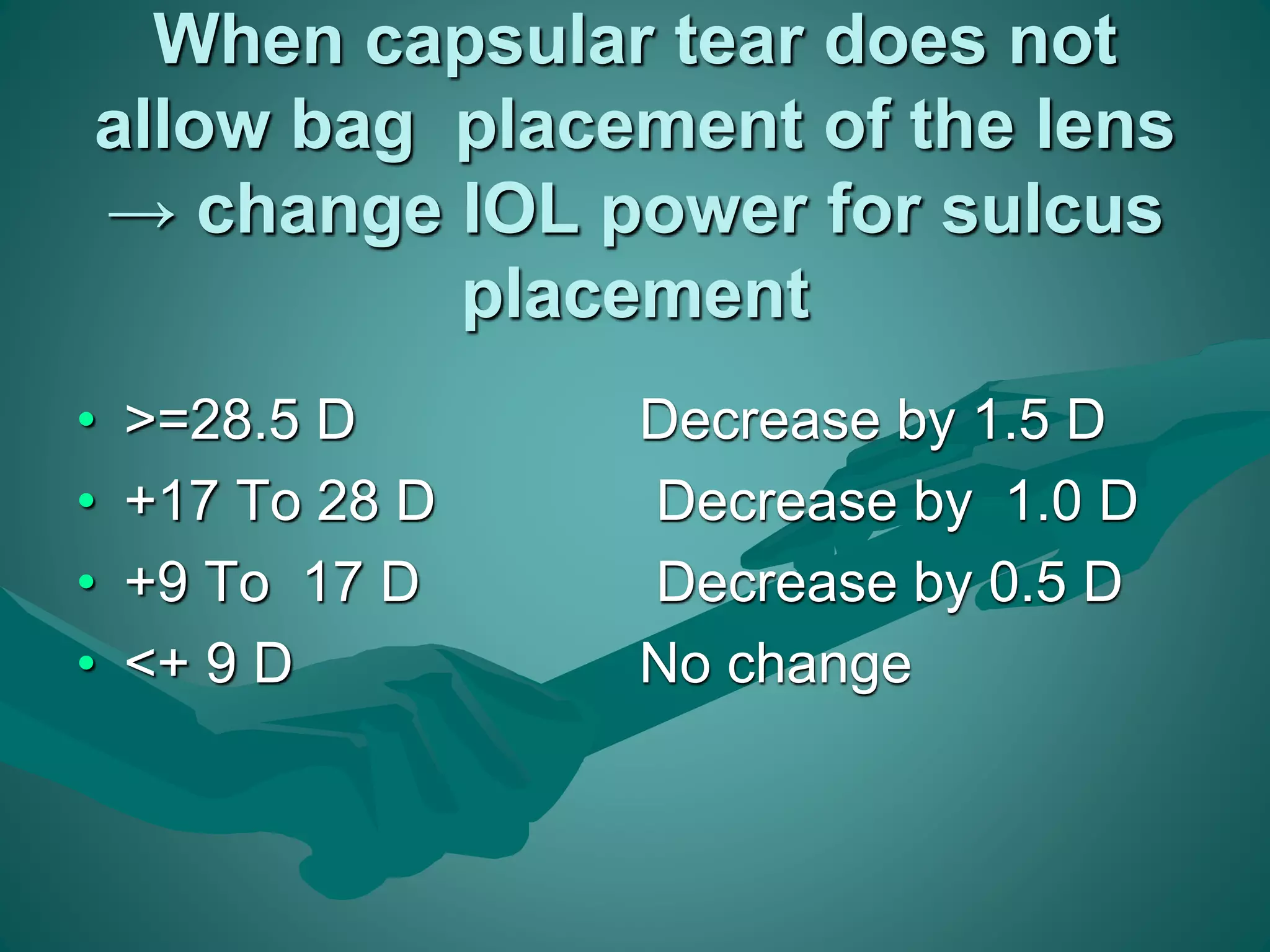
When capsular tear does not 
allow bag placement of the lens 
→ change IOL power for sulcus 
placement 
• >=28.5 D Decrease by 1.5 D 
• +17 To 28 D Decrease by 1.0 D 
• +9 To 17 D Decrease by 0.5 D 
• <+ 9 D No change
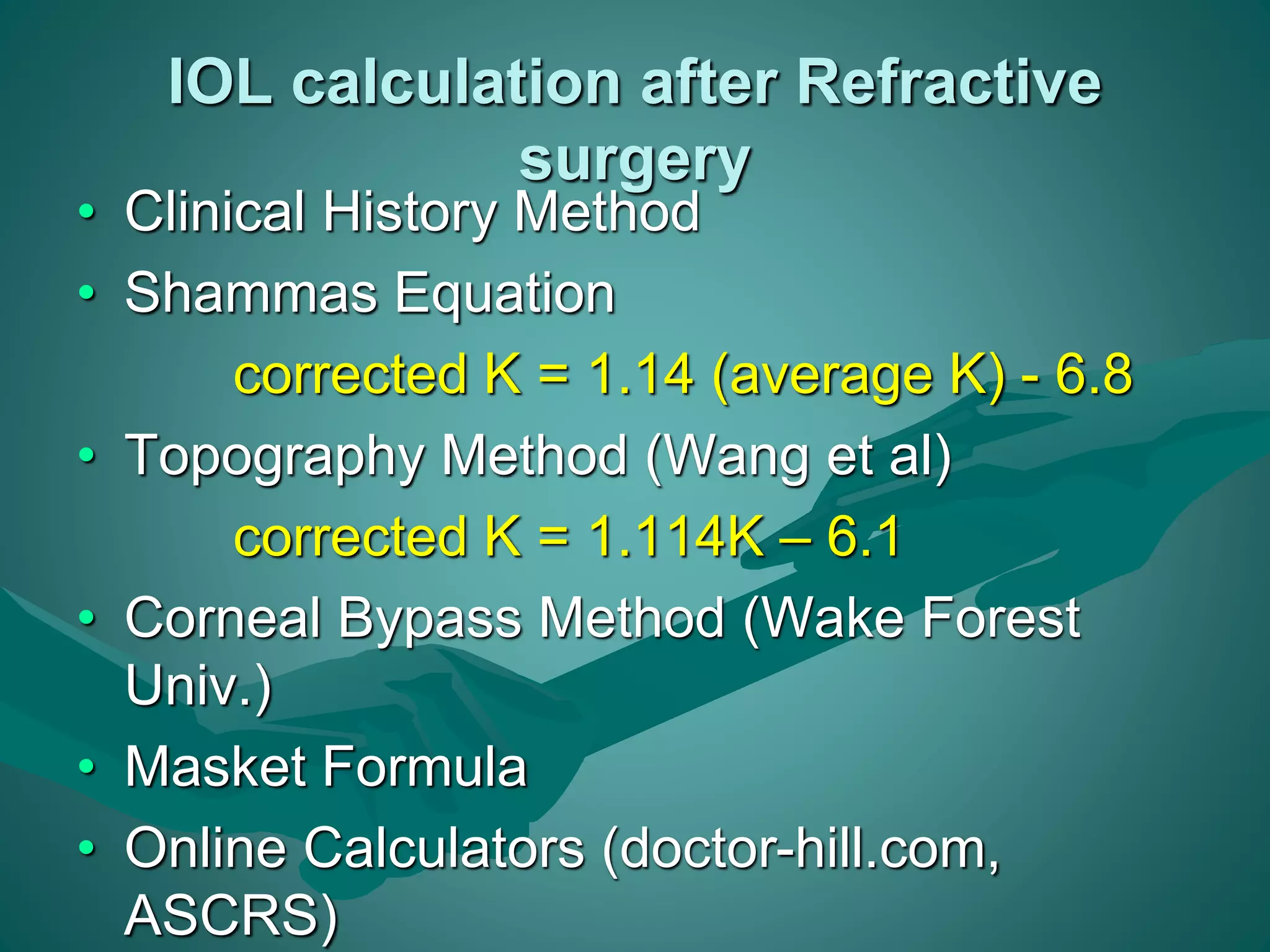
IOL calculation after Refractive 
surgery 
• Clinical History Method 
• Shammas Equation 
corrected K = 1.14 (average K) - 6.8 
• Topography Method (Wang et al) 
corrected K = 1.114K – 6.1 
• Corneal Bypass Method (Wake Forest 
Univ.) 
• Masket Formula 
• Online Calculators (doctor-hill.com, 
ASCRS)
Summary 
• Use IOL master or immersion ultrasound 
for most accurate axial length 
measurement. 
• Use fourth generation IOL formulas. 
• Examine and reevaluate your result 
periodically.
THANK YOU

Biometry instruments & equipment

  • 1.
    Biometry Instruments &Equipment Dr Devdutta Nayak Fellow Ant. Segment Biratnagar Eye Hospital
  • 2.
    Several values arerequired to calculate IOL Power • · Accurate Corneal power • · Actual axial length • · Accurate prediction of estimated lens position (half a mm shift in lens position can have a dramatic effect on final vision) • · Desired post op refraction • · A good understanding of the various IOL power calculation formulas is also required.
  • 3.
    Keratometery • Keratometryby - Manual Topography Autokeratometer IOL master/Lenstar 900
  • 5.
  • 6.
    Source of keratometryerrors • Unfocused eye piece • Failure to calibrate unit • Poor patient fixation • Dry eye • Drooping eye lids • Irregular cornea
  • 7.
    Repeat Keratometery If • Corneal curvature more than 47D or less than 40D. • The difference in corneal cylinder is more than one diopter between eyes. • The average keratometry (K) → 43.0- 44.0D, with one eye typically within 1D of each other.
  • 8.
    Difficult Situations •Post Refractive Surgery • Corneal Transplantation • Corneal Scar • Keratoconus etc.
  • 9.
    A-Scan biometry/laser interferometry • A-Scan ultrasound by applanation method by immersion method • Laser interferometry IOL Master (Zeiss) Lenstar LS 900 (Haag- Streit)
  • 10.
    • A scan:Amplitude Scan; utilizes ultrasound waves of 10 - 12 MHz frequency. • 2 Principles: Piezoelectric Phenomenon Acoustic Impedence. • Pulsed-echo system. • Components: Transducer Amplifier Display Monitor
  • 11.
    • In A-scan,thin, parallel sound beam is emitted from the probe tip, with an echo bouncing back into the probe tip as the sound beam strikes each interface. • An interface is the junction between any two media of different densities and velocities.  anterior corneal surface  aqueous/anterior lens surface  posterior lens capsule/anterior vitreous  posterior vitreous/retinal surface  choroid/anterior scleral surface.
  • 12.
    • The echoesreceived back into the probe from these interfaces are converted by the biometer to spikes arising from baseline. • The greater the difference in the two media at each interface, the stronger the echo and the higher the spike.
  • 13.
    • Spike heightis affected by the difference in density & by the angle of incidence, which is determined by the probe orientation to the visual axis. • If the probe is held nonparallel, part of the echo is diverted at an angle away from the probe tip, and is not received by the machine. • A perfect high, steeply rising retinal spike may be impossible when macular pathology is present (eg, macular edema, macular degeneration, epiretinal
  • 14.
    • The gainsetting on biometers is measured in decibels and affects amplification and resolution of spikes. • When on highest gain, spike height and sensitivity of display screen are maximized, enabling visualization of weaker signals, but resolution is affected adversely. • When gain is lowered, the spike amplitude and sensitivity are decreased, which eliminates the weaker signals but improves
  • 15.
    • Resolution: abilityto display two interfaces that lie in close proximity, one directly behind the other, as separate echoes or spikes. • The more dense the cataract, the higher the necessary gain. • Gain setting may vary not only from patient to patient but from one eye to the next in the same patient, depending on cataract density.
  • 16.
    • Gates areelectronic calipers on the display screen that measure distance between two points. • Proper gate placement is on the ascending edge of each appropriate spike. • If the biometer does not allow for movement of gates, scans must be repeated until they automatically align properly.
  • 17.
    • Ultrasound biometrymachines use the formula Distance = Velocity x Time. • Sound velocity through different media:  Phakic – 1550 m/s  Aphakic – 1532 m/s  Pseudophakic – 1532 + Correction factor for IOL • Velocity through PMMA is 2718 m/s, through acrylic is 2120 m/s, and through silicone is 980- 1107 m/s. • Correction factor is +0.4 mm for PMMA, +0.2
  • 18.
    • Biometry ofpseudophakic eye performed: - To compare to the fellow phakic eye for accuracy - IOL exchange - Checking an unwanted postoperative refractive error. • A scan of pseudophakic eye → multiple reverberation echoes in the vitreous cavity that tend to decrease in amplitude from left to right. • Decreasing the gain in pseudophakic eye is helpful.
  • 19.
    A-scan facts •50% of a surgeon’s post-operative surprises are A-scan errors (Olsen). • Error of 2.0D or more are always A scan related (Holladay). • All A-scan unit make mistake in echo interpretation.
  • 20.
    Applanation A-scan Biometry • A-scan biometry by applanation requires that the ultrasound probe be placed directly on the corneal surface. This can either be done at the slit lamp, or by holding the ultrasound probe by hand. • Even in the most experienced hands, some compression of the cornea is unavoidable; this typically being 0.14 mm - 0.28 mm.
  • 21.
    Applanation A-scan Biometry. • a: Initial spike (probe tip and cornea) b: Anterior lens capsule c: Posterior lens capsule d: Retina e: Sclera f: Orbital fat
  • 22.
    Applanation A-scan Biometry • When echoes b through d are high and steeply rising, the ultrasound beam is most likely on visual axis. • If no scleral or orbital fat echoes visible, then ultrasound beam is most likely aligned with optic nerve.
  • 23.
    The five basiclimitations of applanation A-scan biometry are: 1. Variable corneal compression. 2. Broad sound beam without precise localization 3. Limited resolution. 4. Incorrect assumptions regarding sound velocity. 5. Potential for incorrect measurement distance.
  • 24.
    Immersion A-scan Biometry • The immersion technique is accomplished by placing a small scleral shell between the patient's lids, filling it with saline, and immersing the probe into the fluid, being careful to avoid contact with the cornea. • More accurate than contact method because corneal compression is avoided. • Eyes measured with the immersion method are, on average, 0.1-0.3 mm longer. 6 spikes instead of 5.
  • 25.
    Immersion A-scan Biometry • . • a: Probe tip. Echo from tip of probe, now moved away from the cornea and has become visible. • b: Cornea. Double-peaked echo will show both the anterior and posterior surfaces. • c: Anterior lens capsule. • d: Posterior lens capsule. • e: Retina. This echo needs to have sharp 90 degree take-off from the baseline. • f: Sclera. • g: Orbital fat.
  • 26.
    Immersion A-scan Biometry • The immersion technique requires the use of a Prager Scleral Shell .
  • 27.
    Immersion A-scan Biometry • When the ultrasound beam is properly aligned with the center of the macula, all five spikes will be steeply rising and of maximum height. • Both the peaks of corneal spike should be equal in height ideally. • Other advantage: Easier, better repeatability.
  • 29.
    NON CONTACT •The Zeiss IOLMaster (1999)- non- contact optical device that measures the distance from corneal vertex to the RPE by dual beam partial coherence laser interferometry. • Uses 780 nm infrared light & Michelson Interferometer. • The IOL Master is consistently accurate to within ±0.02 mm or better. • Haag-Streit launched similar
  • 30.
    • IOL Masterprovides following measurements:  AC depth  Lens thickness  Axial Length  Keratometry  White to white distance • In-built IOL power calculation by diff. formula: SRK II, SRK – T, Holladay II, Hoffer Q, Haigis L. • This method cannot be used in significant media opacity (eg. dense cataracts or corneal or vitreal opacity) due to absorption of light or inability of the patient to fixate on target.
  • 31.
    • IOLMaster producesa primary maxima (narrow, well-defined, centered peak identified by a circle above it), secondary maxima (discrete lower peaks, sometimes disappearing into the baseline), and a baseline (which is low and even, but may become high and uneven with decreasing signal-to-noise ratio (SNR)).
  • 32.
    • SNR isa measure of accuracy and decreases with increasing cataract density. • SNR > 2.0 is valid and good if repeatable, SNR between 1.6-2.0 is borderline but usable if repeatable, and SNR < 1.6 is not usable. • However, a proper waveform is more important than the SNR value.
  • 33.
    Advantages of IOLMaster • Easy & technician independent • Noncontact • No water bath is needed • Can measure through glasses • Accurate for silicone oil filled eyes and posterior staphyloma. • Accurate (Holladay II) • Haigis L formula incorporated for post-LVC pts. • For Piggyback IOLs
  • 34.
    • Lenstar LS900 measures CCT, ACD, Lens thickness, Retinal thickness, AL, Keratometry, White to white distance, Pupillometry & eccentricity of optical axis. • Lenstar measures keratometry & ACD more accurately than IOL Master.
  • 35.
    Accuracy of axiallength by different machine Applanation A - scan Immersion A-scan IOL Master +/- 0.24mm +/- 0.12mm +/- .01mm
  • 36.
    Do not throwaway old ultrasound machine Immersion ultrasound IOL master Posterior staphyloma Silicone oil Pseudophakia 4++brunescent lens Central PSC plaque Vitreous hemorrhage Central corneal scar Difficult Difficult Variable •Yes •Yes •Yes •Yes •Yes •Yes •Yes No No No No
  • 37.
    IOL FORMULA Istgeneration • Most are based on regression formula developed by Sander ,Retzlaff & Kraff • Known as SRK formula. • P = A - 2.5(L) - 0.9(K) P=lens implant power for emetropia L= Axial length (mm) K=average keratometric reading (diaopters) A= lens constant
  • 38.
    IOL FORMULA 2ndgeneration • SRK formula – works well for average eyes. less accurate for long, short eyes. • SRK II formula modification of SRK works on ELP P = A1 – 2.5L – 0.9K A1 = A + 3 AL < 20mm A1 = A + 2 AL 20-21 A1 = A + 1 AL 21-22 A1 = A AL 22-24.5 A1 = A – 0.5 AL >24.5
  • 39.
    IOL FORMULA 3rdgeneration • Third generation formulas- • SRK/T -very long eyes >26mm • Holladay I -long eyes 24-26 mm • HofferQ -Short eyes<22mm
  • 40.
    IOL FORMULA 4thgeneration • Holladay II • Haigis formula-d = a0 + (a1 * ACD) + (a2 * AL) ACD is the measured anterior chamber depth AL is the axial length of the eye The a0, a1 and a2 constants are set by optimizing a set of surgeon- and IOL-specific outcomes for a wide range of ALs and ACDs.
  • 41.
    • SRK/T formula— uses "A-constant“ • Holladay 1 formula — uses "Surgeon Factor“ • Holladay 2 formula — uses "Anterior Chamber Depth“ • Hoffer Q formula — uses "Anterior Chamber Depth"
  • 42.
    When capsular teardoes not allow bag placement of the lens → change IOL power for sulcus placement • >=28.5 D Decrease by 1.5 D • +17 To 28 D Decrease by 1.0 D • +9 To 17 D Decrease by 0.5 D • <+ 9 D No change
  • 43.
    IOL calculation afterRefractive surgery • Clinical History Method • Shammas Equation corrected K = 1.14 (average K) - 6.8 • Topography Method (Wang et al) corrected K = 1.114K – 6.1 • Corneal Bypass Method (Wake Forest Univ.) • Masket Formula • Online Calculators (doctor-hill.com, ASCRS)
  • 44.
    Summary • UseIOL master or immersion ultrasound for most accurate axial length measurement. • Use fourth generation IOL formulas. • Examine and reevaluate your result periodically.
  • 45.