ASTRONOMICAL
SURVEYING
PON.RATHNAVEL
SYLLABUS
• Celestial Sphere
• Astronomical Terms & Definitions
• Motion of Suns & Stars
• Celestial Co-ordinate Systems
• Different Time Systems
• Use of Nautical Almanac
• Star Constellations
BASICS
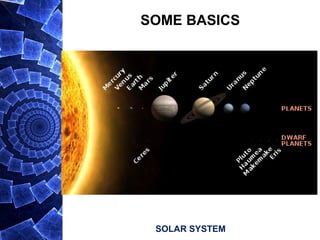
SOME BASICS
ASTRONOMY - Study of celestial/astronomic/universal
objects/bodies and the phenomenon surrounding them.
CELESTIAL OBJECTS
Stars
Planets
Comets
Asteroids
VIRGO>LOCAL GROUP>MILKY WAY>SOLAR
SYSTEM>EARTH
ASTRONOMICAL SURVEY / FIELD ASTRONOMY helps in
determination of latitude & longitude
determination of distances for satellite communication
determination of route for space ships & shuttles
SOME BASICS
SOLAR SYSTEM
SOME BASICS
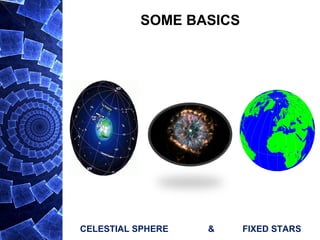
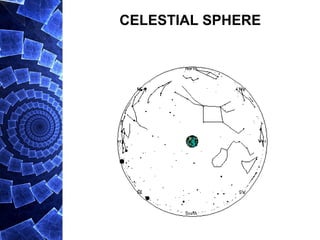
CELESTIAL SPHERE & FIXED STARS
CELESTIAL SPHERE
CELESTIAL SPHERE
CELESTIAL SPHERE
CELESTIAL SPHERE
FIXED STAR
They are celestial objects that do not seem to move
in relation to the other stars of the night sky
CELESTIAL SPHERE
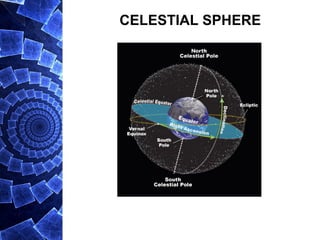
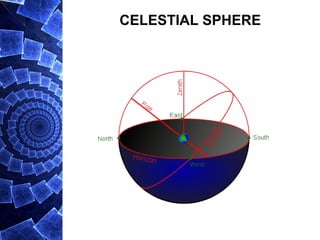
To make it easier to understand the motions of
objects in our skies, astronomers often depict the
space as a sphere concentric to the earth,
surrounding the Earth with the earth as centre and a
fixed star as a point in the circumference of sphere.
CELESTIAL SPHERE - DEFINITION
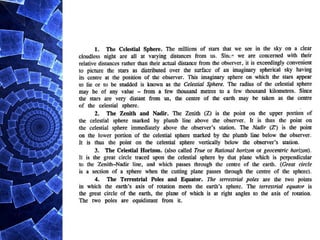
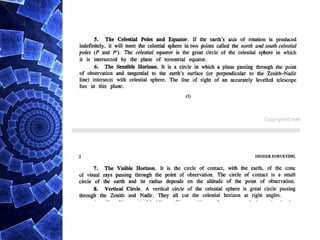
It is defined as an imaginary sphere upon the
surface of which all stars in the sky appear to be
studded to an observer stationed at its centre.
CELESTIAL BODY & OBSERVER
CELESTIAL SPHERE
CELESTIAL SPHERE
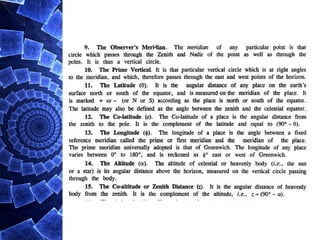
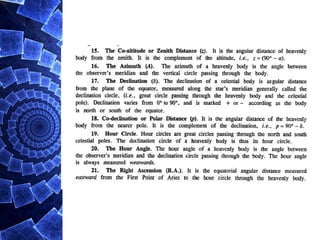
ASTRONOMICAL TERMS
& DEFINITIONS
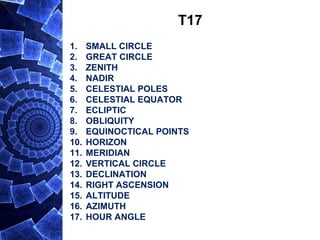
T17
1. SMALL CIRCLE
2. GREAT CIRCLE
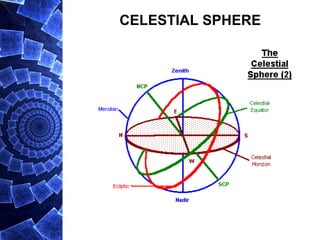
3. ZENITH
4. NADIR
5. CELESTIAL POLES
6. CELESTIAL EQUATOR
7. ECLIPTIC
8. OBLIQUITY
9. EQUINOCTICAL POINTS
10. HORIZON
11. MERIDIAN
12. VERTICAL CIRCLE
13. DECLINATION
14. RIGHT ASCENSION
15. ALTITUDE
16. AZIMUTH
17. HOUR ANGLE
MOTION OF SUNS &
STARS
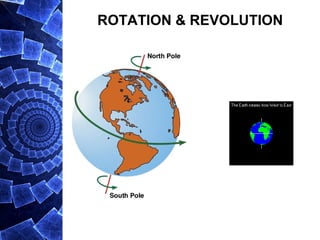
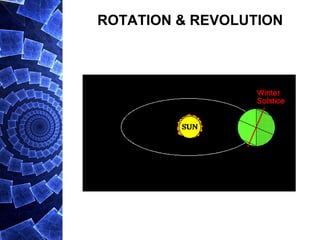
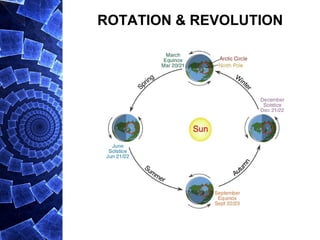
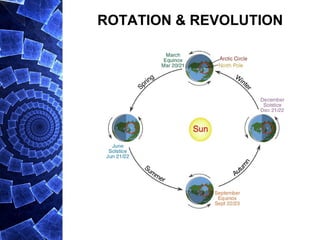
ROTATION & REVOLUTION
TRACKING THE MOVEMENTS
EARTH – SUN
MOON – EARTH
SUN – STARS
STARS – EACH OTHER
MOVEMENT OF SUN
MOVEMENT OF SUN
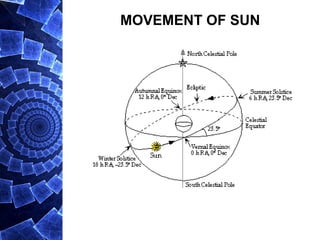
Although the stars are fixed relative to each other, the Sun moves
relative to the stars.
Once a year, the Sun traces out a circle on the celestial sphere
called the ecliptic, which is tilted at an obliquity of 23.5° with
respect to the celestial equator.
The Sun crosses the celestial equator at exactly two points, called
equinoxes, from the Latin for "equal nights“
The equinox where the Sun ascends from the southern to the
northern hemisphere is called the spring or vernal equinox
because the Sun is there on March 21. The vernal equinox is
chosen to be 0 h R.A.
The Sun again crosses the celestial equator halfway around, at 12 h
R.A. This position is called the autumnal equinox because the Sun
is there on September 23.
MOVEMENT OF SUN
The positions where the Sun reaches its highest and lowest points
are called solstices, from the Latin for "the Sun stops" as it
changes direction.
The Sun is highest in the sky (in the northern hemisphere) when it is
at 6 h R.A. This position is called the summer solstice because the
Sun is there on June 21. The Sun then has a declination of +23.5°.
The Sun is lowest in the sky (in the northern hemisphere) when it is
at 18 h R.A. This position is called the winter solstice because the
Sun is there on December 21. The Sun then has a declination of
-23.5°.
MOVEMENT OF STARS
PROPER MOTION
DIURNAL MOTION
CELESTIAL CO-ORDINATE
SYSTEMS
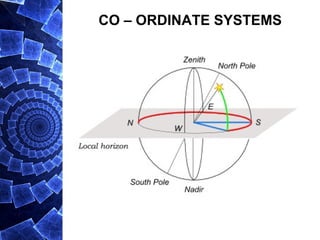
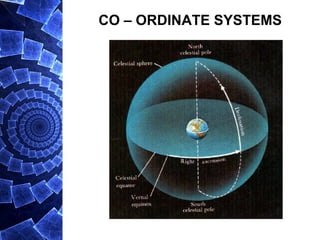
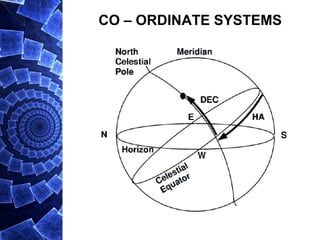
CO – ORDINATE SYSTEMS
1. ALTITUDE & AZIMUTH SYSTEM (HORIZONTAL SYSTEM)
2. DECLINATION RIGHT ASCENSION SYSTEM (INDEPENDENT
EQUATORIAL SYSTEM)
3. DECLINATION HOUR ANGLE SYSTEM (DEPENDENT
EQUATORIAL SYSTEM)
CO – ORDINATE SYSTEMS
DIFFERENT TIME SYSTEMS
TIME SYSTEMS
SIDEREAL TIME
MEAN ASTRONOMICAL TIME
MEAN SOLAR TIME
STANDARD TIME

Astronomical surveying

  • 1.
  • 2.
    SYLLABUS • Celestial Sphere •Astronomical Terms & Definitions • Motion of Suns & Stars • Celestial Co-ordinate Systems • Different Time Systems • Use of Nautical Almanac • Star Constellations
  • 3.
  • 4.
    SOME BASICS ASTRONOMY -Study of celestial/astronomic/universal objects/bodies and the phenomenon surrounding them. CELESTIAL OBJECTS Stars Planets Comets Asteroids VIRGO>LOCAL GROUP>MILKY WAY>SOLAR SYSTEM>EARTH ASTRONOMICAL SURVEY / FIELD ASTRONOMY helps in determination of latitude & longitude determination of distances for satellite communication determination of route for space ships & shuttles
  • 5.
  • 6.
  • 7.
  • 8.
  • 9.
  • 10.
    CELESTIAL SPHERE FIXED STAR Theyare celestial objects that do not seem to move in relation to the other stars of the night sky CELESTIAL SPHERE To make it easier to understand the motions of objects in our skies, astronomers often depict the space as a sphere concentric to the earth, surrounding the Earth with the earth as centre and a fixed star as a point in the circumference of sphere. CELESTIAL SPHERE - DEFINITION It is defined as an imaginary sphere upon the surface of which all stars in the sky appear to be studded to an observer stationed at its centre. CELESTIAL BODY & OBSERVER
  • 11.
  • 12.
  • 13.
  • 14.
    T17 1. SMALL CIRCLE 2.GREAT CIRCLE 3. ZENITH 4. NADIR 5. CELESTIAL POLES 6. CELESTIAL EQUATOR 7. ECLIPTIC 8. OBLIQUITY 9. EQUINOCTICAL POINTS 10. HORIZON 11. MERIDIAN 12. VERTICAL CIRCLE 13. DECLINATION 14. RIGHT ASCENSION 15. ALTITUDE 16. AZIMUTH 17. HOUR ANGLE
  • 19.
  • 20.
  • 21.
  • 22.
  • 23.
  • 24.
    TRACKING THE MOVEMENTS EARTH– SUN MOON – EARTH SUN – STARS STARS – EACH OTHER
  • 25.
  • 26.
    MOVEMENT OF SUN Althoughthe stars are fixed relative to each other, the Sun moves relative to the stars. Once a year, the Sun traces out a circle on the celestial sphere called the ecliptic, which is tilted at an obliquity of 23.5° with respect to the celestial equator. The Sun crosses the celestial equator at exactly two points, called equinoxes, from the Latin for "equal nights“ The equinox where the Sun ascends from the southern to the northern hemisphere is called the spring or vernal equinox because the Sun is there on March 21. The vernal equinox is chosen to be 0 h R.A. The Sun again crosses the celestial equator halfway around, at 12 h R.A. This position is called the autumnal equinox because the Sun is there on September 23.
  • 27.
    MOVEMENT OF SUN Thepositions where the Sun reaches its highest and lowest points are called solstices, from the Latin for "the Sun stops" as it changes direction. The Sun is highest in the sky (in the northern hemisphere) when it is at 6 h R.A. This position is called the summer solstice because the Sun is there on June 21. The Sun then has a declination of +23.5°. The Sun is lowest in the sky (in the northern hemisphere) when it is at 18 h R.A. This position is called the winter solstice because the Sun is there on December 21. The Sun then has a declination of -23.5°.
  • 28.
    MOVEMENT OF STARS PROPERMOTION DIURNAL MOTION
  • 29.
  • 30.
    CO – ORDINATESYSTEMS 1. ALTITUDE & AZIMUTH SYSTEM (HORIZONTAL SYSTEM) 2. DECLINATION RIGHT ASCENSION SYSTEM (INDEPENDENT EQUATORIAL SYSTEM) 3. DECLINATION HOUR ANGLE SYSTEM (DEPENDENT EQUATORIAL SYSTEM)
  • 31.
  • 32.
  • 33.
  • 34.
  • 35.
    TIME SYSTEMS SIDEREAL TIME MEANASTRONOMICAL TIME MEAN SOLAR TIME STANDARD TIME