INTRODUCTION TO EARTH
SOME FACTS ABOUT THE EARTH Earth is the only planet to be named in English. The word ‘Earth’ is Old English word for "land“ Earth belongs to the Milky Way Galaxy, Local Group Cluster and Virgo Super Cluster Earth is the only planet to sustain life Earth is believed to be existent for 450 million years & evidences are from 225 million years
SOME FACTS ABOUT THE EARTH
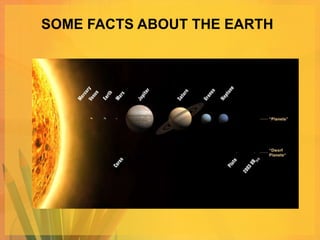
SOME FACTS ABOUT THE EARTH Earth is the third planet from the sun Earth is the fifth largest planet in the universe The distance of the earth from the sun is 149,600,000 km The diameter of the sun is 100 times the diameter of the earth The mass of the earth is 5.972 x 10 24  kg The Surface area of earth is 510,072,000 km²
SOME FACTS ABOUT THE EARTH Before 500 BC, people thought that earth was flat. But thanks to scientists like Aristotle and Pythagoras, people know that the shape of the earth is spherical. However Sir Isaac Newton showed that the earth was not a perfect sphere, but a compressed spheroid.  The correct technical term to use will be oblate spheroid, a type of ellipsoid solid formed when an ellipse is rotated about its minor axis.  The study of size and shape of earth is called geodesy. The diameter of earth at poles is 12715 km (minor axis) The diameter of earth at equator is 12763 km (major axis)
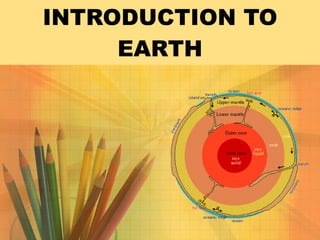
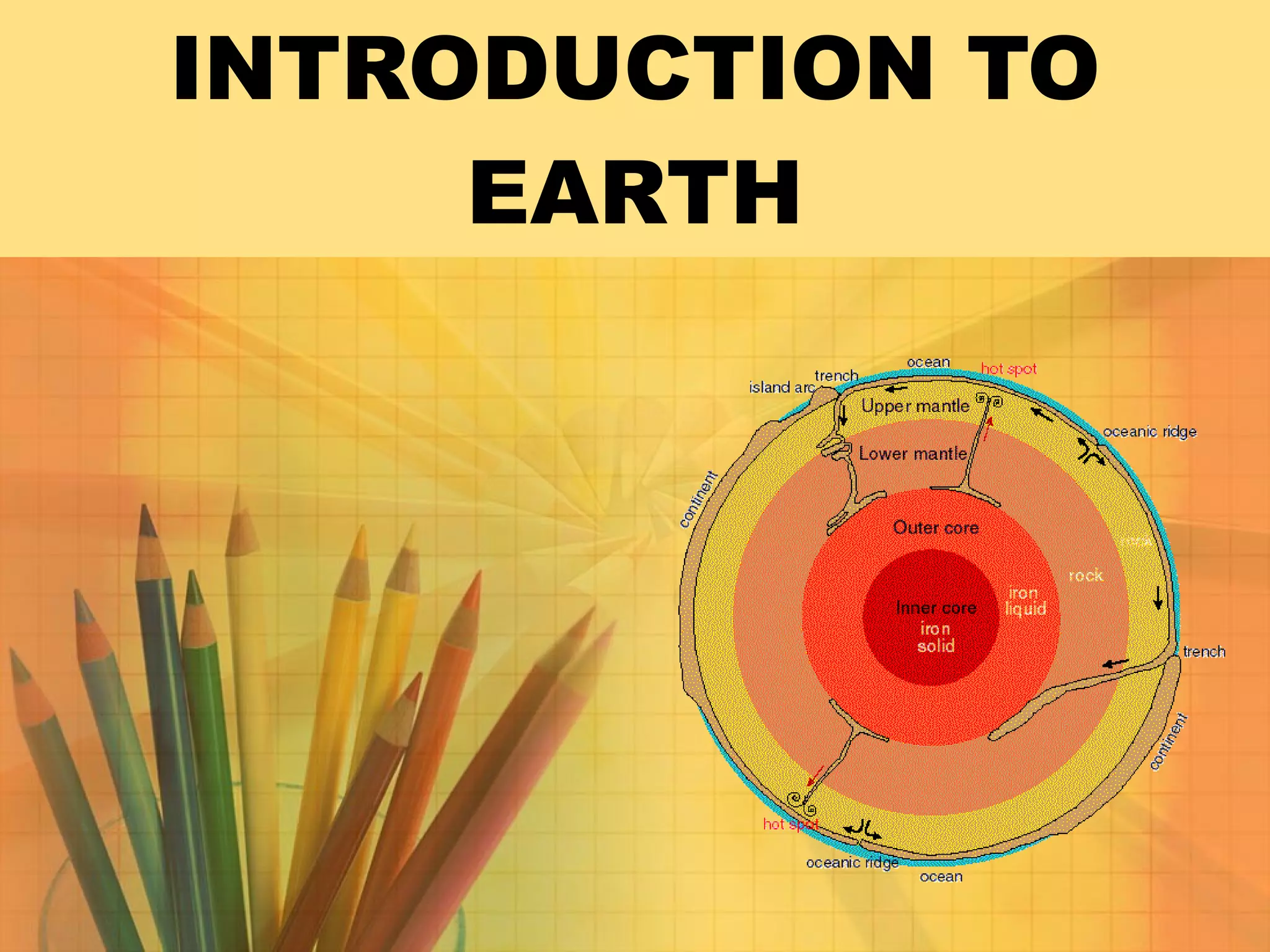
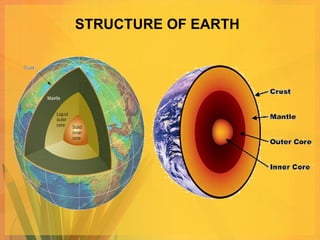
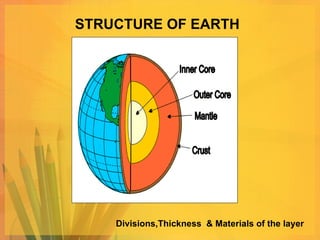
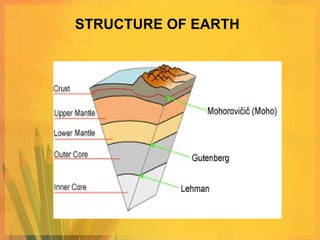
STRUCTURE OF EARTH The structure of earth (also referred as cross–section) is divided into  mainly four layers namely Crust, Mantle, Inner Core and Outer Core .
STRUCTURE OF EARTH
STRUCTURE OF EARTH Divisions,Thickness  & Materials of the layer
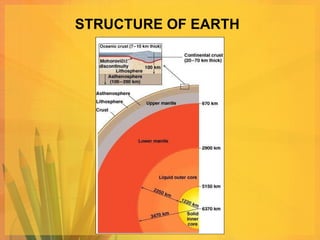
STRUCTURE OF EARTH The outermost layer of the Earth is the crust. It is also the surface of the earth. This comprises the continents and ocean basins and therefore it has been classified into  continental crust and oceanic crust .  The oceanic crust extends up to a distance of  0-10 kms  (5-12 taken as average) whereas the continental crust would extend up to  0-75 kms  (20-70 taken as average).  The oceanic crust is mainly composed of basaltic igneous rocks, mainly of silica and magnesium and therefore also called  SIMA layer .  The continental crust is composed of crystalline and granitic rocks mainly of silica and aluminum and therefore also called  SIAL layer. CRUST
STRUCTURE OF EARTH The next layer is the mantle, which is composed mainly of iron and magnesium silicates. It is been referred as  FeMa layer .  Mantle is also where most of the internal heat of the Earth is located. It is about 2900 km thick.  It can be subdivided into four layers namely  (1) Lithosphere (70 – 100 kms) (2) Asthenosphere (100 - 350 kms) (3) Upper Mantle (350 – 670 kms) (4) Lower Mantle (670 – 2900 kms) Mohorovičić discontinuity , usually referred to as the Moho is the transition boundary between the Earth's crust and the mantle. MANTLE
STRUCTURE OF EARTH The  lithosphere  is the outermost part of the mantle  immediately below the Mohorovičić discontinuity.  It has a part of the  tectonic plates  that cover surface of Earth.  Asthenosphere  is a low seismic velocity zone where  rocks are at or near melting point . It also has a part of tectonic plates. The  lower mantle is probably mostly silicon, magnesium and oxygen  with some iron, calcium and aluminum.  The  upper mantle  is made up of mostly  olivine and pyroxene  (iron/magnesium silicates), calcium and aluminum MANTLE
STRUCTURE OF EARTH The third layer is outer core. The outer core is a  hot and liquid layer  comprising mainly of Nickel and (liquid) Iron. Therefore it is referred as  NiFe Layer . The outer core may also contain lighter elements such as Si, S, C, or O.  The outer core ranges  from 2900 kms to 5150 kms  and is 2300 km thick.  The  Earth's magnetic field  is believed to be controlled by the liquid outer core. It is also believed to be the responsible force of  earth’s rotation and electric currents .  The transition space between outer core and mantle is called Gutenberg discontinuity OUTER CORE
STRUCTURE OF EARTH The fourth layer is inner core.  This  layer stretches from 5150km to 6370  km and is nearly 1200 km thick. The inner core is  mostly made of solid iron  and has little amounts of nickel.  It is unattached to the mantle and is suspended in the molten outer core.  The inner core is believed to have the  extreme temperature and pressure conditions.  The transition region between outer core and inner core is called  Lehmann discontinuity INNER CORE
STRUCTURE OF EARTH
STRUCTURE OF EARTH
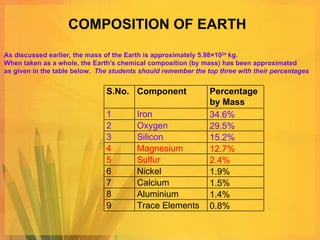
COMPOSITION OF EARTH As discussed earlier, the mass of the Earth is approximately 5.98×10 24  kg.  When taken as a whole, the Earth's chemical composition (by mass) has been approximated  as given in the table below.  The students should remember the top three with their percentages S.No. Component Percentage by Mass 1 Iron 34.6% 2 Oxygen 29.5% 3 Silicon 15.2% 4 Magnesium 12.7% 5 Sulfur 2.4% 6 Nickel 1.9% 7 Calcium 1.5% 8 Aluminium 1.4% 9 Trace Elements 0.8%

Introduction to Earth

  • 1.
  • 2.
    SOME FACTS ABOUTTHE EARTH Earth is the only planet to be named in English. The word ‘Earth’ is Old English word for "land“ Earth belongs to the Milky Way Galaxy, Local Group Cluster and Virgo Super Cluster Earth is the only planet to sustain life Earth is believed to be existent for 450 million years & evidences are from 225 million years
  • 3.
  • 4.
    SOME FACTS ABOUTTHE EARTH Earth is the third planet from the sun Earth is the fifth largest planet in the universe The distance of the earth from the sun is 149,600,000 km The diameter of the sun is 100 times the diameter of the earth The mass of the earth is 5.972 x 10 24 kg The Surface area of earth is 510,072,000 km²
  • 5.
    SOME FACTS ABOUTTHE EARTH Before 500 BC, people thought that earth was flat. But thanks to scientists like Aristotle and Pythagoras, people know that the shape of the earth is spherical. However Sir Isaac Newton showed that the earth was not a perfect sphere, but a compressed spheroid. The correct technical term to use will be oblate spheroid, a type of ellipsoid solid formed when an ellipse is rotated about its minor axis. The study of size and shape of earth is called geodesy. The diameter of earth at poles is 12715 km (minor axis) The diameter of earth at equator is 12763 km (major axis)
  • 6.
    STRUCTURE OF EARTHThe structure of earth (also referred as cross–section) is divided into mainly four layers namely Crust, Mantle, Inner Core and Outer Core .
  • 7.
  • 8.
    STRUCTURE OF EARTHDivisions,Thickness & Materials of the layer
  • 9.
    STRUCTURE OF EARTHThe outermost layer of the Earth is the crust. It is also the surface of the earth. This comprises the continents and ocean basins and therefore it has been classified into continental crust and oceanic crust . The oceanic crust extends up to a distance of 0-10 kms (5-12 taken as average) whereas the continental crust would extend up to 0-75 kms (20-70 taken as average). The oceanic crust is mainly composed of basaltic igneous rocks, mainly of silica and magnesium and therefore also called SIMA layer . The continental crust is composed of crystalline and granitic rocks mainly of silica and aluminum and therefore also called SIAL layer. CRUST
  • 10.
    STRUCTURE OF EARTHThe next layer is the mantle, which is composed mainly of iron and magnesium silicates. It is been referred as FeMa layer . Mantle is also where most of the internal heat of the Earth is located. It is about 2900 km thick. It can be subdivided into four layers namely (1) Lithosphere (70 – 100 kms) (2) Asthenosphere (100 - 350 kms) (3) Upper Mantle (350 – 670 kms) (4) Lower Mantle (670 – 2900 kms) Mohorovičić discontinuity , usually referred to as the Moho is the transition boundary between the Earth's crust and the mantle. MANTLE
  • 11.
    STRUCTURE OF EARTHThe lithosphere is the outermost part of the mantle immediately below the Mohorovičić discontinuity. It has a part of the tectonic plates that cover surface of Earth. Asthenosphere is a low seismic velocity zone where rocks are at or near melting point . It also has a part of tectonic plates. The lower mantle is probably mostly silicon, magnesium and oxygen with some iron, calcium and aluminum. The upper mantle is made up of mostly olivine and pyroxene (iron/magnesium silicates), calcium and aluminum MANTLE
  • 12.
    STRUCTURE OF EARTHThe third layer is outer core. The outer core is a hot and liquid layer comprising mainly of Nickel and (liquid) Iron. Therefore it is referred as NiFe Layer . The outer core may also contain lighter elements such as Si, S, C, or O. The outer core ranges from 2900 kms to 5150 kms and is 2300 km thick. The Earth's magnetic field is believed to be controlled by the liquid outer core. It is also believed to be the responsible force of earth’s rotation and electric currents . The transition space between outer core and mantle is called Gutenberg discontinuity OUTER CORE
  • 13.
    STRUCTURE OF EARTHThe fourth layer is inner core. This layer stretches from 5150km to 6370 km and is nearly 1200 km thick. The inner core is mostly made of solid iron and has little amounts of nickel. It is unattached to the mantle and is suspended in the molten outer core. The inner core is believed to have the extreme temperature and pressure conditions. The transition region between outer core and inner core is called Lehmann discontinuity INNER CORE
  • 14.
  • 15.
  • 16.
    COMPOSITION OF EARTHAs discussed earlier, the mass of the Earth is approximately 5.98×10 24 kg. When taken as a whole, the Earth's chemical composition (by mass) has been approximated as given in the table below. The students should remember the top three with their percentages S.No. Component Percentage by Mass 1 Iron 34.6% 2 Oxygen 29.5% 3 Silicon 15.2% 4 Magnesium 12.7% 5 Sulfur 2.4% 6 Nickel 1.9% 7 Calcium 1.5% 8 Aluminium 1.4% 9 Trace Elements 0.8%