

© Grunt Productions 2000
The Sky
A brief by Lance GrindleyA brief by Lance Grindley
© Grunt Productions 2000
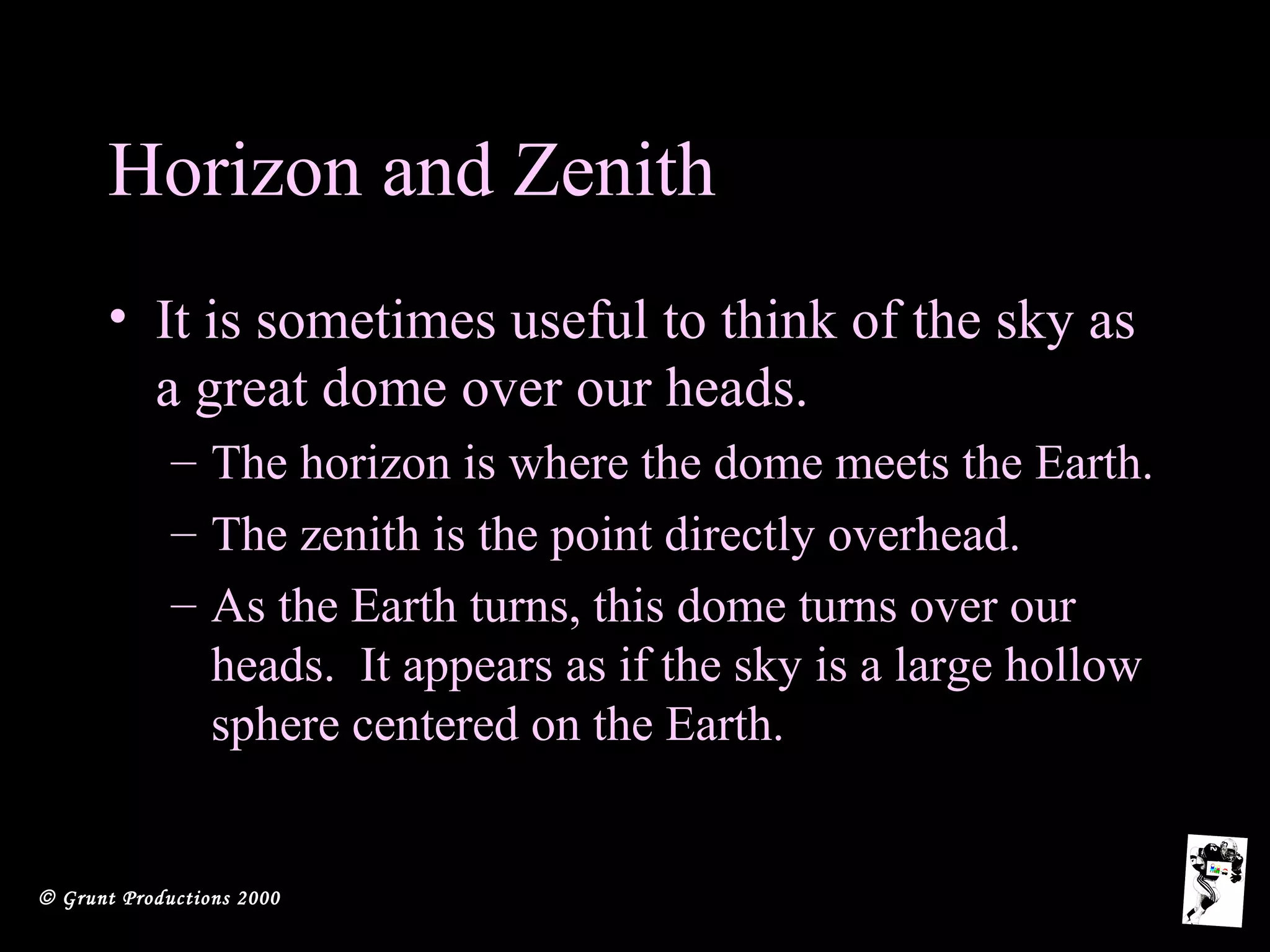
Horizon and Zenith
• It is sometimes useful to think of the sky as
a great dome over our heads.
– The horizon is where the dome meets the Earth.
– The zenith is the point directly overhead.
– As the Earth turns, this dome turns over our
heads. It appears as if the sky is a large hollow
sphere centered on the Earth.
© Grunt Productions 2000
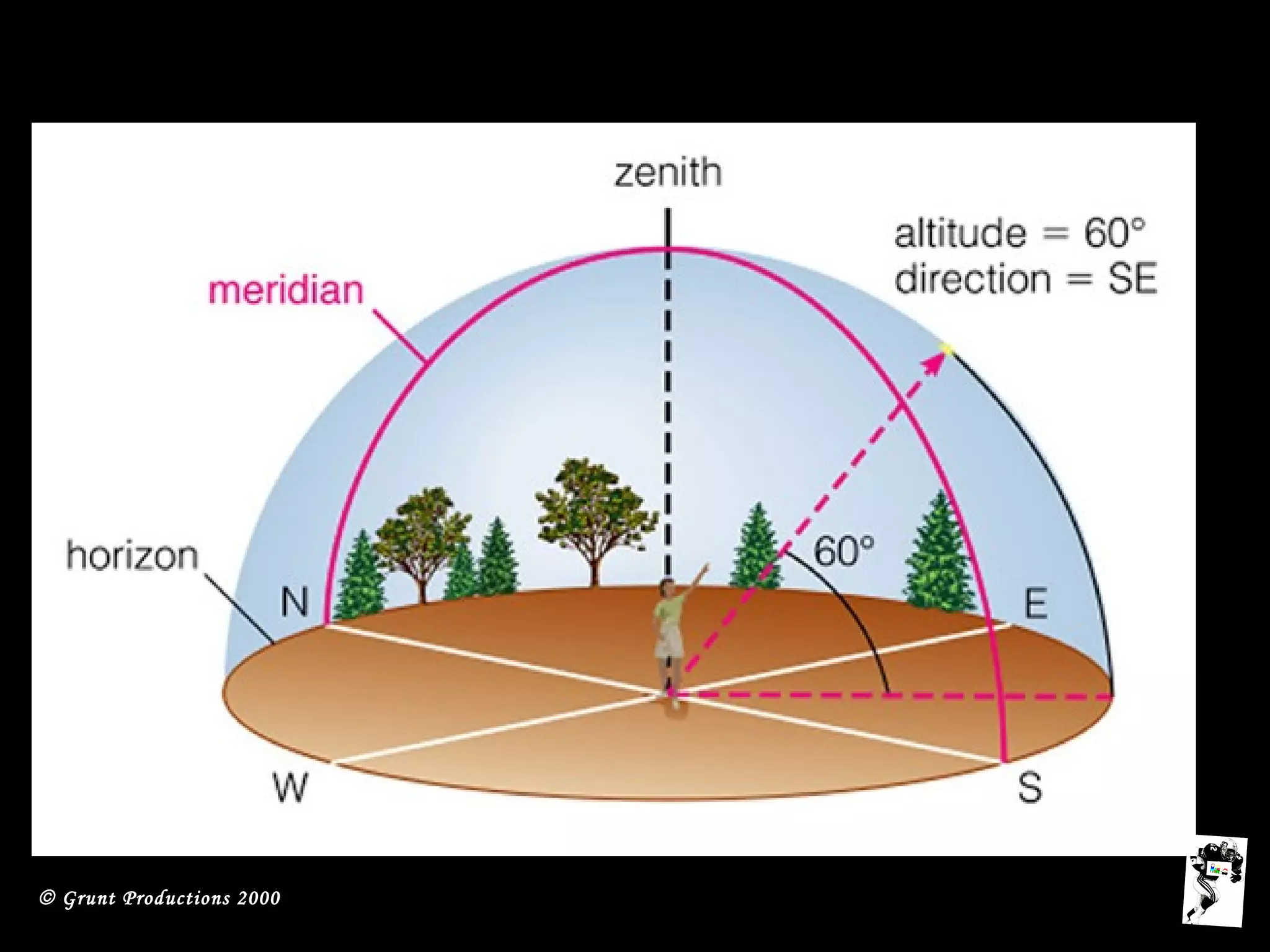
Horizon and Zenith
© Grunt Productions 2000
Altitude and Azimuth
• The height of a star above the horizon is called the
altitude.
• The direction to the star as measured from true
north is called the azimuth.
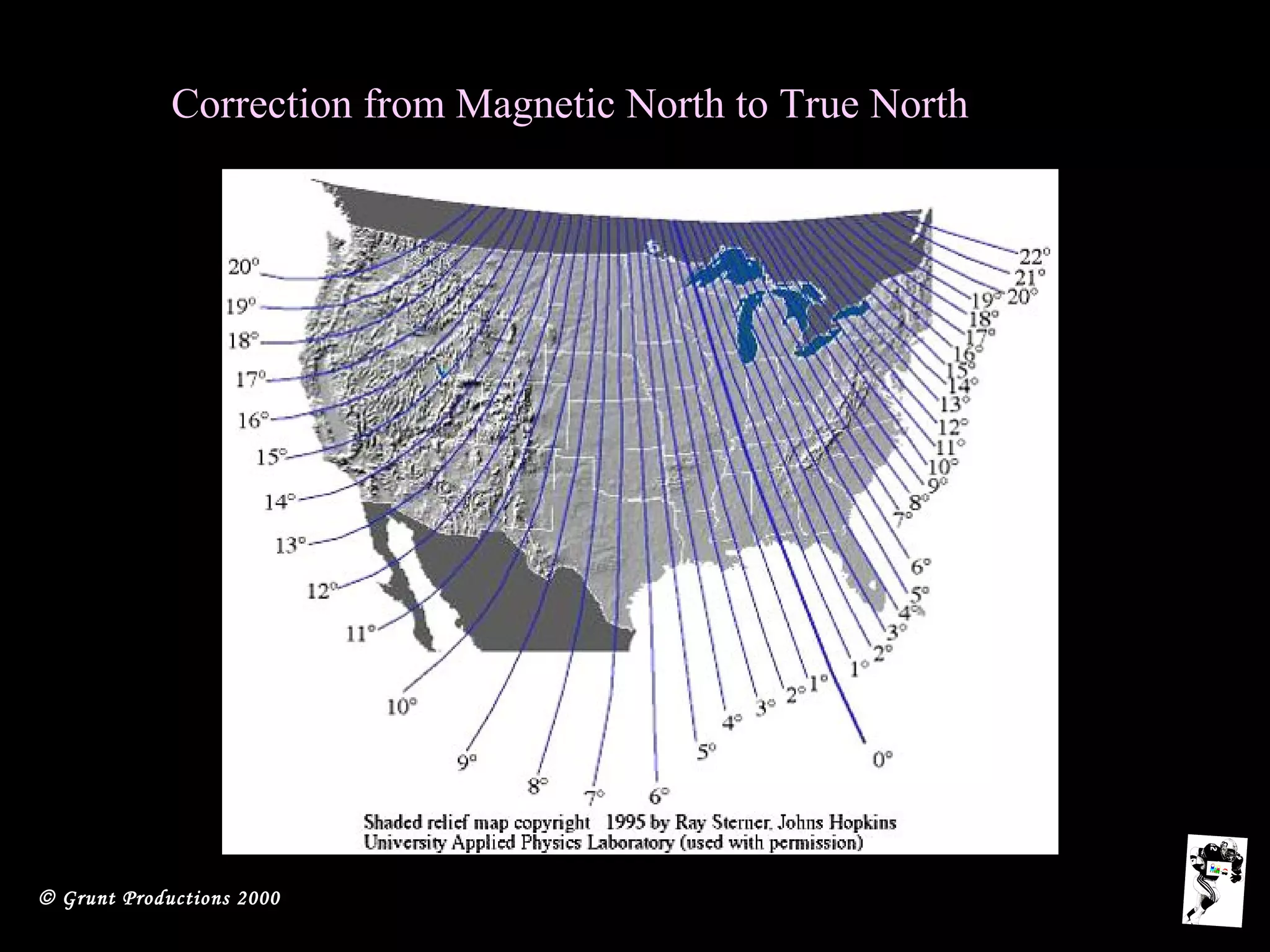
– Note: True north is not the same as magnetic north.
The magnetic north pole is not located in the same
place as the true north pole.
• On maps, the legend will show you how to correct from
magnetic north, as measured by a compass, to true north.
© Grunt Productions 2000
Altitude and Azimuth
© Grunt Productions 2000
Magnetic North Pole
© Grunt Productions 2000
Magnetic North
© Grunt Productions 2000
Correction from Magnetic North to True North
© Grunt Productions 2000
Altitude and Azimuth
• The altitude and azimuth of a star change
during the course of night as the star rises
and sets.
• Angles are measured using degrees, minutes
of arc, and seconds of arc.
© Grunt Productions 2000
Measuring Angles in the Sky
© Grunt Productions 2000
Measuring Angles
• Angles in astronomy are measured in
degrees, arc minutes and arc seconds.
– 1 degree = 60 arc minutes
– 1 arc minute = 60 arc seconds
– 1 degree = 3600 arc seconds
– 1 arc second is the size of a 50p as seen from 5
km (3 miles) or a penny as seen from 2.2 miles.
© Grunt Productions 2000
Measuring Angles
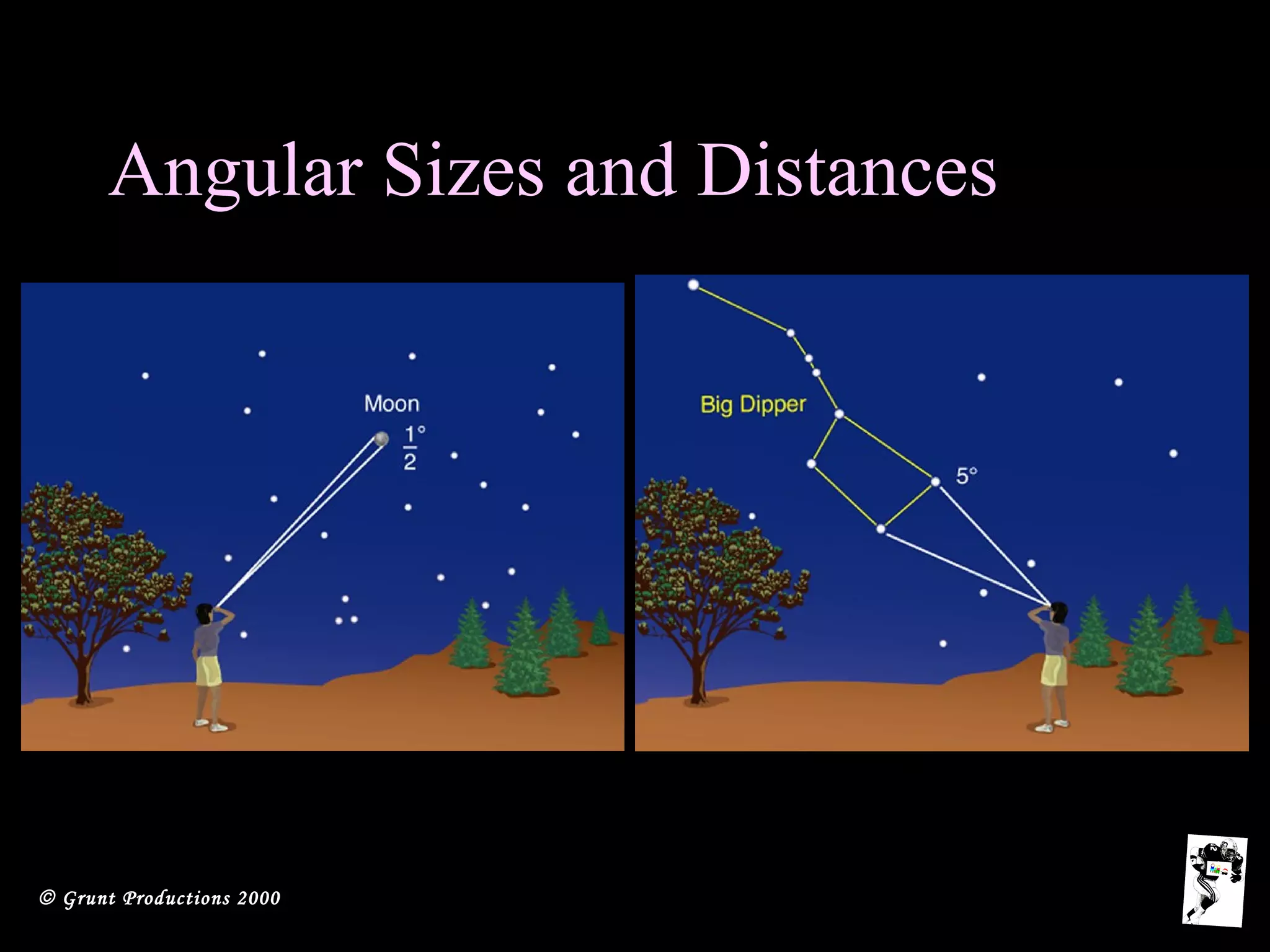
– The Sun and Moon appear to be about ½ degree
in size.
– Your finger held at arms length is about one
degree across.
– Your fist at arms length is about 10 degrees.
– Your outstretched hand at arms length is about
20 degrees across.
© Grunt Productions 2000
Angular Sizes and Distances
© Grunt Productions 2000
The
Celestial
Sphere
© Grunt Productions 2000
The
Celestial
Sphere
© Grunt Productions 2000
The Celestial Sphere
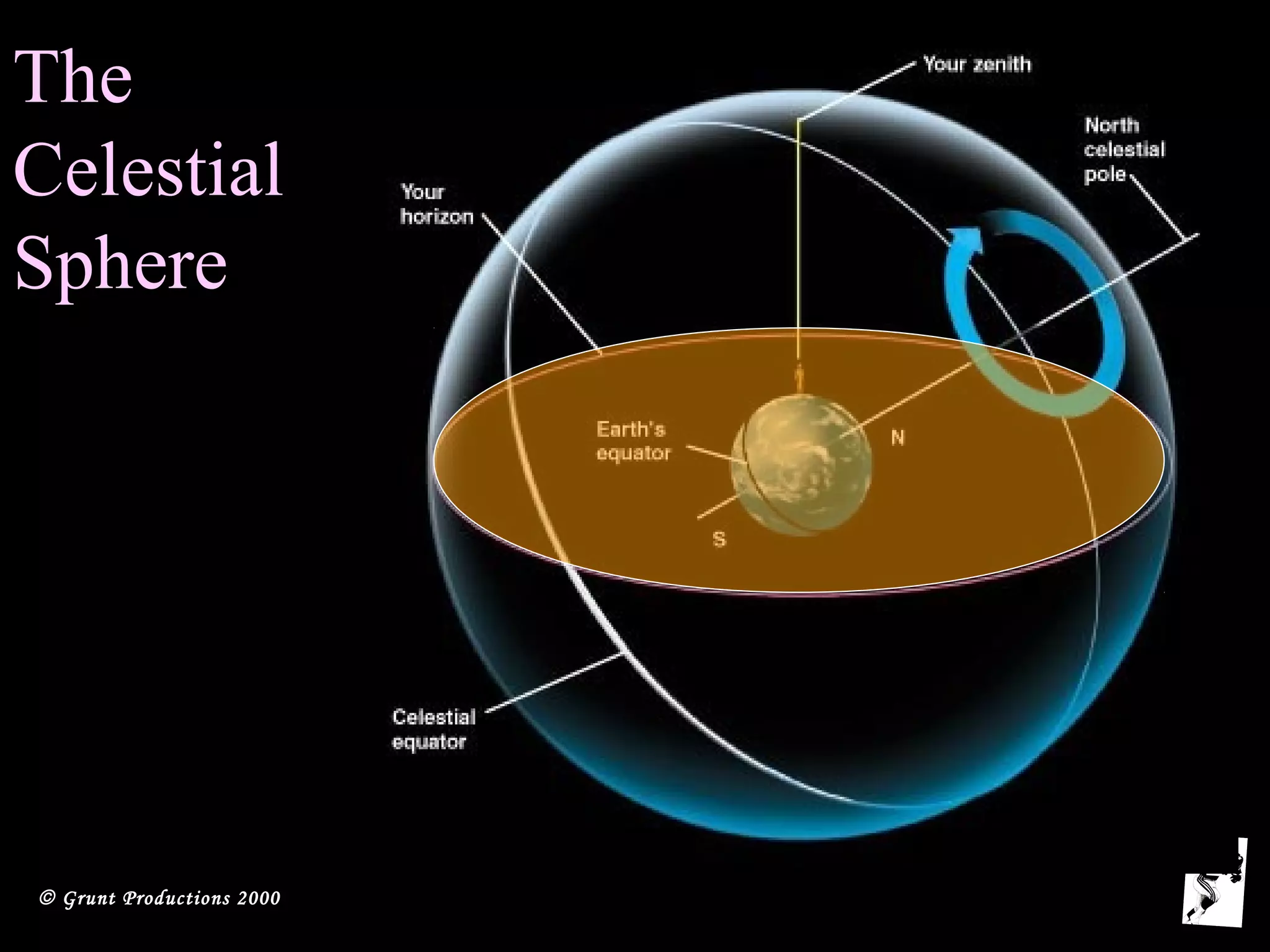
• North Celestial Pole: The point directly over the
Earth’s true north pole.
– The north star, Polaris, is near the North Celestial Pole,
but not exactly at the pole. It is currently about 1
degree away from the pole.
• South Celestial Pole: The point directly over the
Earth’s true south pole.
• Celestial Equator: The equator of the Earth
projected onto the celestial sphere.
• Meridian: A line from due north to due south that
passes straight overhead.
© Grunt Productions 2000
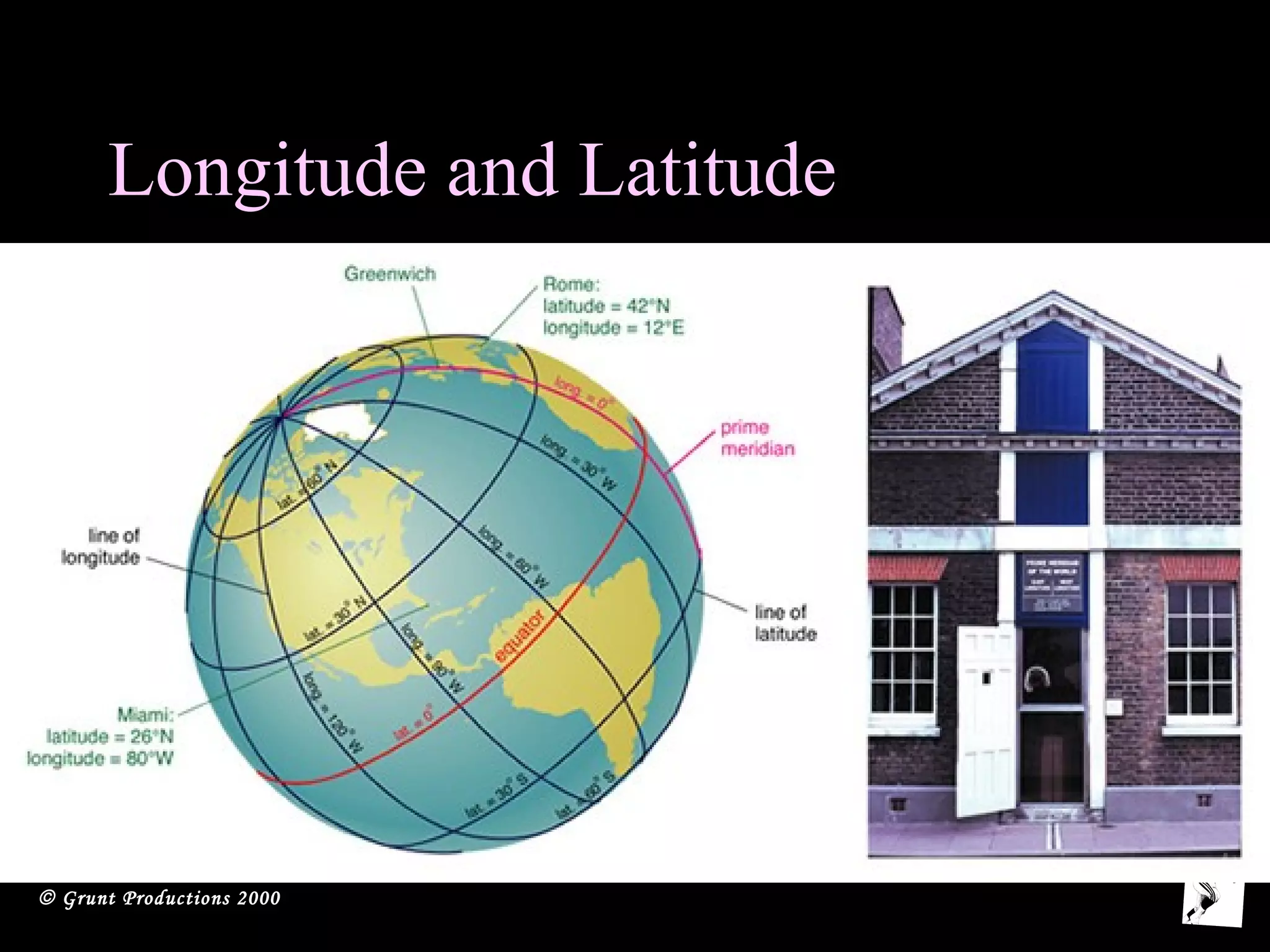
Longitude and Latitude
© Grunt Productions 2000
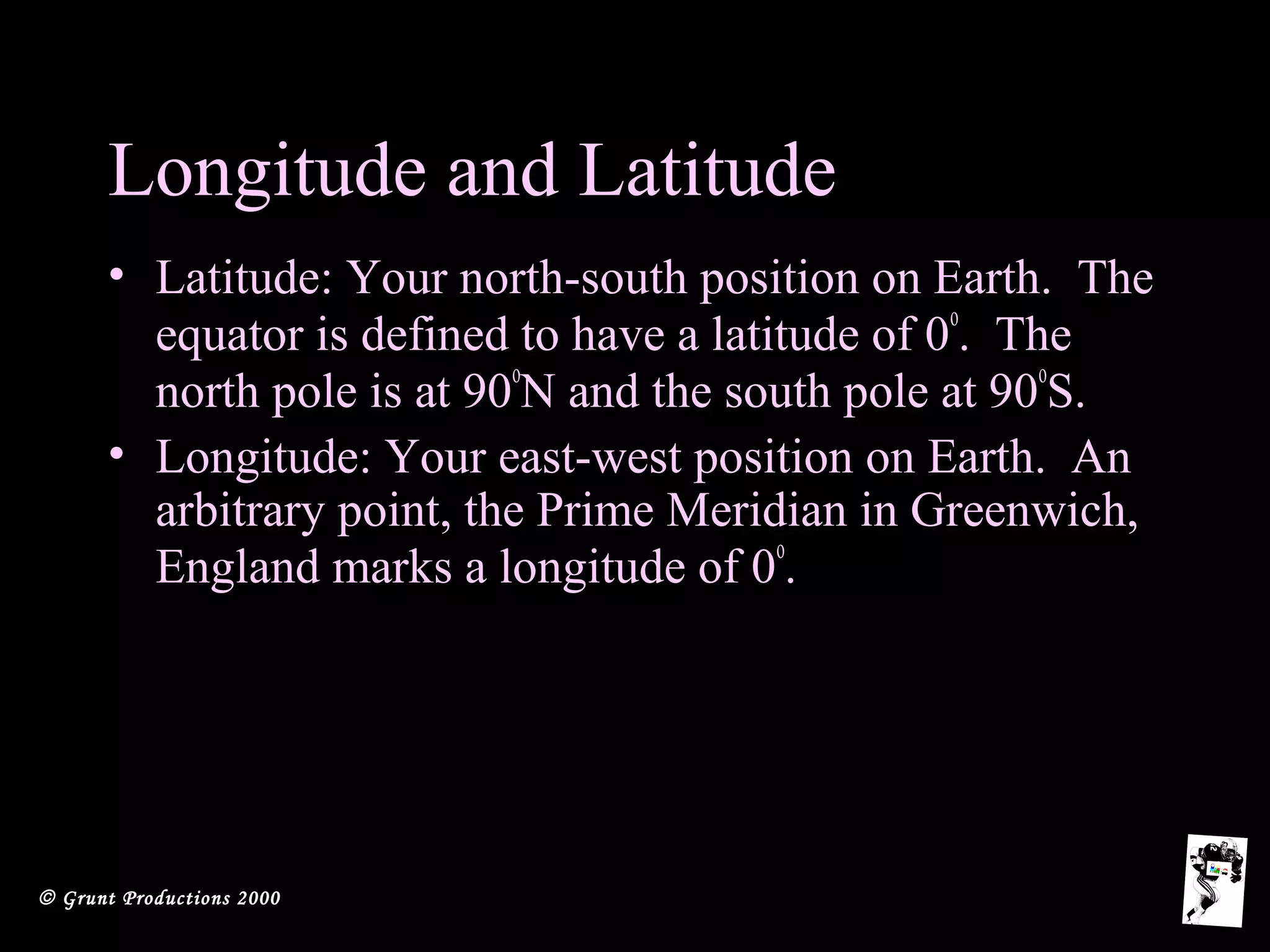
Longitude and Latitude
• Latitude: Your north-south position on Earth. The
equator is defined to have a latitude of 0
o
. The
north pole is at 90
o
N and the south pole at 90
o
S.
• Longitude: Your east-west position on Earth. An
arbitrary point, the Prime Meridian in Greenwich,
England marks a longitude of 0
o
.
© Grunt Productions 2000
Rotation of
the Earth
© Grunt Productions 2000
The stars move
from east to west
because the earth
rotates from west
to east.
© Grunt Productions 2000
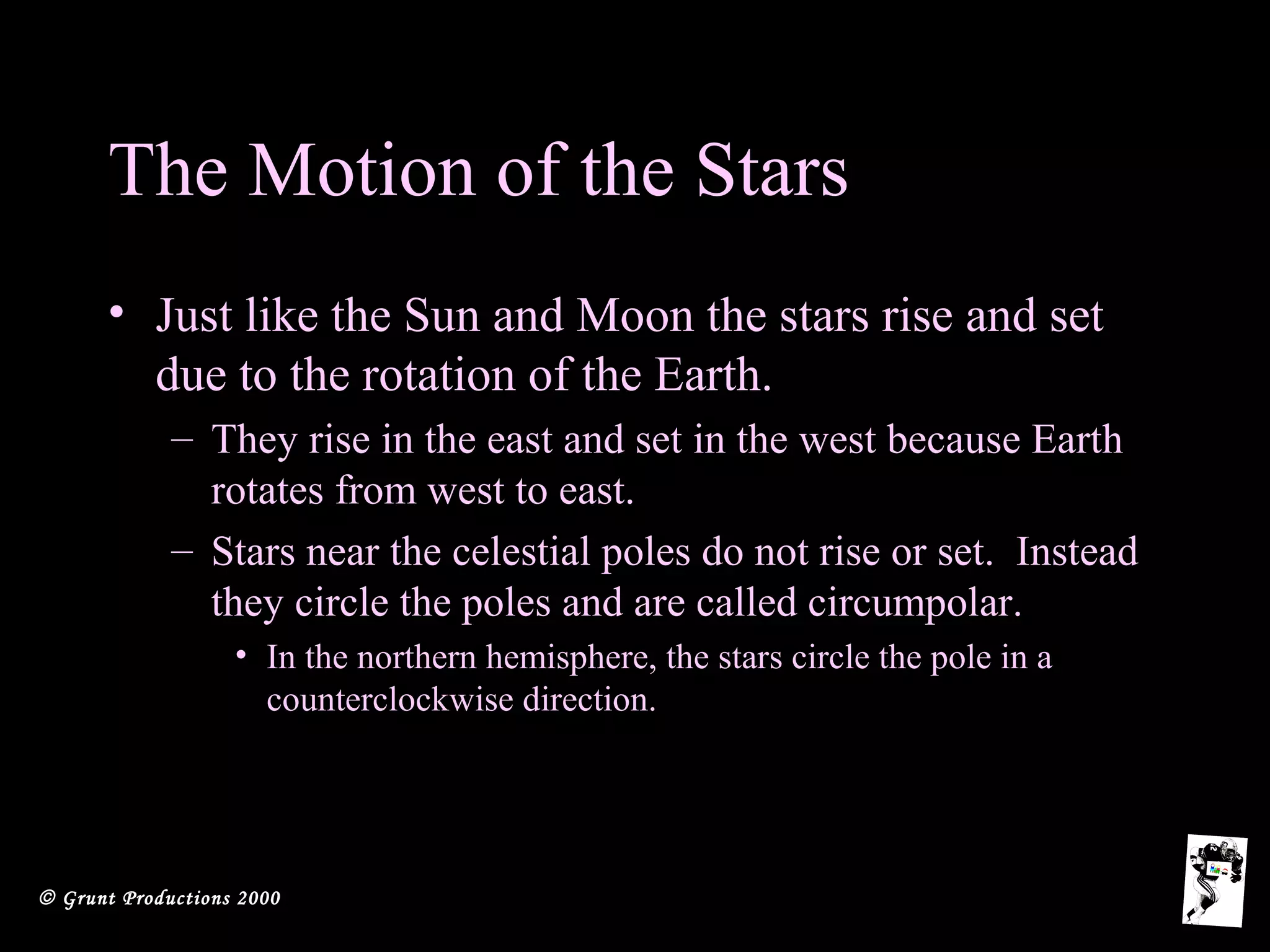
The Motion of the Stars
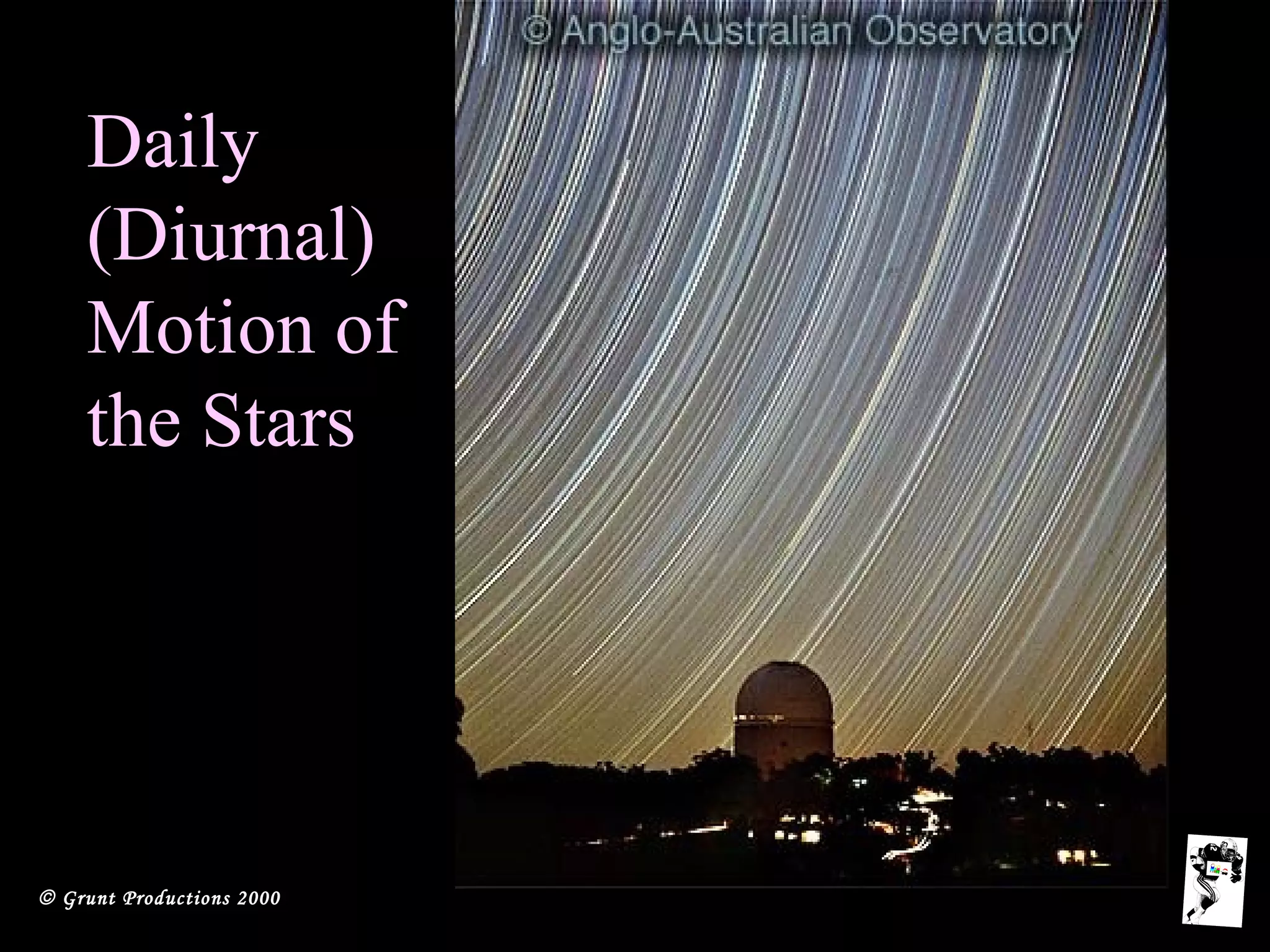
• Just like the Sun and Moon the stars rise and set
due to the rotation of the Earth.
– They rise in the east and set in the west because Earth
rotates from west to east.
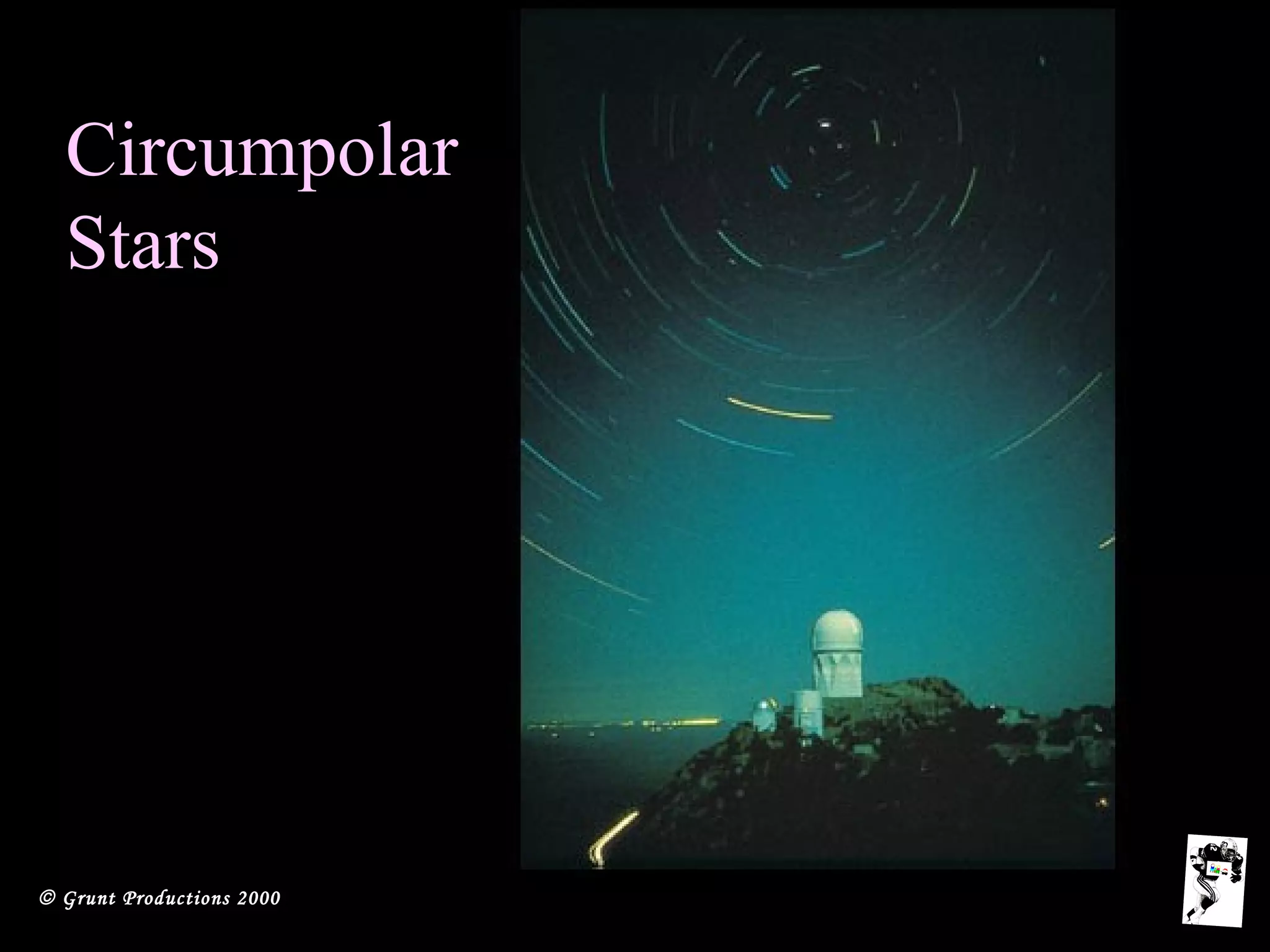
– Stars near the celestial poles do not rise or set. Instead
they circle the poles and are called circumpolar.
• In the northern hemisphere, the stars circle the pole in a
counterclockwise direction.
© Grunt Productions 2000
Daily
(Diurnal)
Motion of
the Stars
© Grunt Productions 2000
Circumpolar
Stars
© Grunt Productions 2000
Diurnal Paths of Stars
© Grunt Productions 2000
Diurnal Paths
of Stars at
Intermediate
Latitude
© Grunt Productions 2000
Celestial Poles
© Grunt Productions 2000
North Celestial Pole
• In the northern hemisphere, the altitude of the
north celestial pole is equal to your latitude on
Earth.
• This is useful for navigation.
– If you measure the altitude of the north celestial pole,
you can determine your latitude on Earth.
• In the southern hemisphere, it is difficult, but not
impossible, to find the location of the south
celestial pole.
© Grunt Productions 2000
Celestial Sphere
• To find due north, drop straight down from
the North Celestial Pole to the horizon.
• The celestial equator meets the horizon at
due east and due west.
© Grunt Productions 2000
Diurnal Paths of Stars
© Grunt Productions 2000
Celestial Sphere Movie
http://brahms.phy.vanderbilt.edu/~rknop/astromovies/
© Grunt Productions 2000
Celestial Coordinates
• Just as Earth has lines of longitude and latitude,
the celestial sphere has a system of celestial
coordinates:
• Declination (dec): The north-south position of a star on the
celestial sphere. Declination is measured in degrees, arc
minutes, and arc seconds. The celestial equator is defined
to have a declination of 0
o
.
• Right Ascension (RA): The east-west coordinates of an
object on the celestial sphere. R.A. is measured in hours,
minutes, and seconds of time. The vernal equinox is
defined to be 0
h
.
© Grunt Productions 2000
Celestial Coordinates
© Grunt Productions 2000
Celestial Coordinates
Vega
RA 18h
35m
DEC +38o
44’
© Grunt Productions 2000
Celestial
Coordinates
© Grunt Productions 2000
Celestial Coordinates
© Grunt Productions 2000
Celestial Coordinates
© Grunt Productions 2000
Exercise
• Find Orion in the night sky. Is it on the
equator, the ecliptic, both, or neither.
• How long is Orion above the horizon each
day?
• Find Sagittarius. Is it north or south of the
equator?
• How long is Sagittarius above the horizon
each day?
© Grunt Productions 2000

The sky lrg

  • 1.
    © Grunt Productions2000 The Sky A brief by Lance GrindleyA brief by Lance Grindley
  • 2.
    © Grunt Productions2000 Horizon and Zenith • It is sometimes useful to think of the sky as a great dome over our heads. – The horizon is where the dome meets the Earth. – The zenith is the point directly overhead. – As the Earth turns, this dome turns over our heads. It appears as if the sky is a large hollow sphere centered on the Earth.
  • 3.
    © Grunt Productions2000 Horizon and Zenith
  • 4.
    © Grunt Productions2000 Altitude and Azimuth • The height of a star above the horizon is called the altitude. • The direction to the star as measured from true north is called the azimuth. – Note: True north is not the same as magnetic north. The magnetic north pole is not located in the same place as the true north pole. • On maps, the legend will show you how to correct from magnetic north, as measured by a compass, to true north.
  • 5.
  • 6.
    © Grunt Productions2000 Altitude and Azimuth
  • 7.
    © Grunt Productions2000 Magnetic North Pole
  • 8.
    © Grunt Productions2000 Magnetic North
  • 9.
    © Grunt Productions2000 Correction from Magnetic North to True North
  • 10.
    © Grunt Productions2000 Altitude and Azimuth • The altitude and azimuth of a star change during the course of night as the star rises and sets. • Angles are measured using degrees, minutes of arc, and seconds of arc.
  • 11.
    © Grunt Productions2000 Measuring Angles in the Sky
  • 12.
    © Grunt Productions2000 Measuring Angles • Angles in astronomy are measured in degrees, arc minutes and arc seconds. – 1 degree = 60 arc minutes – 1 arc minute = 60 arc seconds – 1 degree = 3600 arc seconds – 1 arc second is the size of a 50p as seen from 5 km (3 miles) or a penny as seen from 2.2 miles.
  • 13.
    © Grunt Productions2000 Measuring Angles – The Sun and Moon appear to be about ½ degree in size. – Your finger held at arms length is about one degree across. – Your fist at arms length is about 10 degrees. – Your outstretched hand at arms length is about 20 degrees across.
  • 14.
    © Grunt Productions2000 Angular Sizes and Distances
  • 15.
  • 16.
    © Grunt Productions2000 The Celestial Sphere
  • 17.
    © Grunt Productions2000 The Celestial Sphere
  • 18.
    © Grunt Productions2000 The Celestial Sphere • North Celestial Pole: The point directly over the Earth’s true north pole. – The north star, Polaris, is near the North Celestial Pole, but not exactly at the pole. It is currently about 1 degree away from the pole. • South Celestial Pole: The point directly over the Earth’s true south pole. • Celestial Equator: The equator of the Earth projected onto the celestial sphere. • Meridian: A line from due north to due south that passes straight overhead.
  • 19.
  • 20.
    © Grunt Productions2000 Longitude and Latitude
  • 21.
    © Grunt Productions2000 Longitude and Latitude • Latitude: Your north-south position on Earth. The equator is defined to have a latitude of 0 o . The north pole is at 90 o N and the south pole at 90 o S. • Longitude: Your east-west position on Earth. An arbitrary point, the Prime Meridian in Greenwich, England marks a longitude of 0 o .
  • 22.
    © Grunt Productions2000 Rotation of the Earth
  • 23.
    © Grunt Productions2000 The stars move from east to west because the earth rotates from west to east.
  • 24.
  • 25.
    © Grunt Productions2000 The Motion of the Stars • Just like the Sun and Moon the stars rise and set due to the rotation of the Earth. – They rise in the east and set in the west because Earth rotates from west to east. – Stars near the celestial poles do not rise or set. Instead they circle the poles and are called circumpolar. • In the northern hemisphere, the stars circle the pole in a counterclockwise direction.
  • 26.
    © Grunt Productions2000 Daily (Diurnal) Motion of the Stars
  • 27.
    © Grunt Productions2000 Circumpolar Stars
  • 28.
  • 29.
    © Grunt Productions2000 Diurnal Paths of Stars
  • 30.
    © Grunt Productions2000 Diurnal Paths of Stars at Intermediate Latitude
  • 31.
  • 32.
    © Grunt Productions2000 Celestial Poles
  • 33.
    © Grunt Productions2000 North Celestial Pole • In the northern hemisphere, the altitude of the north celestial pole is equal to your latitude on Earth. • This is useful for navigation. – If you measure the altitude of the north celestial pole, you can determine your latitude on Earth. • In the southern hemisphere, it is difficult, but not impossible, to find the location of the south celestial pole.
  • 34.
    © Grunt Productions2000 Celestial Sphere • To find due north, drop straight down from the North Celestial Pole to the horizon. • The celestial equator meets the horizon at due east and due west.
  • 35.
  • 36.
    © Grunt Productions2000 Diurnal Paths of Stars
  • 37.
    © Grunt Productions2000 Celestial Sphere Movie http://brahms.phy.vanderbilt.edu/~rknop/astromovies/
  • 38.
    © Grunt Productions2000 Celestial Coordinates • Just as Earth has lines of longitude and latitude, the celestial sphere has a system of celestial coordinates: • Declination (dec): The north-south position of a star on the celestial sphere. Declination is measured in degrees, arc minutes, and arc seconds. The celestial equator is defined to have a declination of 0 o . • Right Ascension (RA): The east-west coordinates of an object on the celestial sphere. R.A. is measured in hours, minutes, and seconds of time. The vernal equinox is defined to be 0 h .
  • 39.
    © Grunt Productions2000 Celestial Coordinates
  • 40.
    © Grunt Productions2000 Celestial Coordinates Vega RA 18h 35m DEC +38o 44’
  • 41.
    © Grunt Productions2000 Celestial Coordinates
  • 42.
  • 43.
    © Grunt Productions2000 Celestial Coordinates
  • 44.
    © Grunt Productions2000 Celestial Coordinates
  • 45.
    © Grunt Productions2000 Exercise • Find Orion in the night sky. Is it on the equator, the ecliptic, both, or neither. • How long is Orion above the horizon each day? • Find Sagittarius. Is it north or south of the equator? • How long is Sagittarius above the horizon each day?
  • 46.

Editor's Notes

  • #2 Copyright 2001 by the Rector and Visitors of the University of Virginia