
The Night Sky
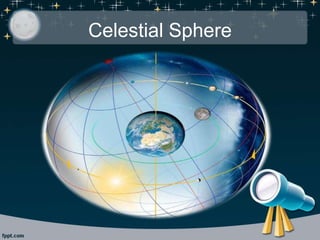
Celestial Sphere
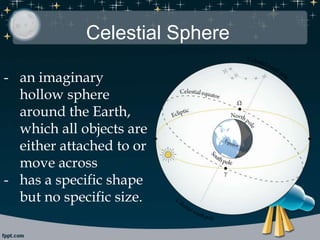
Celestial Sphere
- an imaginary
hollow sphere
around the Earth,
which all objects are
either attached to or
move across
- has a specific shape
but no specific size.
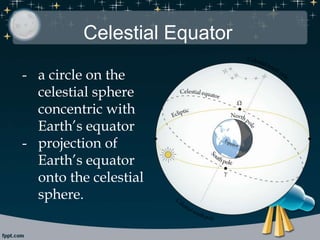
Celestial Equator
- a circle on the
celestial sphere
concentric with
Earth’s equator
- projection of
Earth’s equator
onto the celestial
sphere.
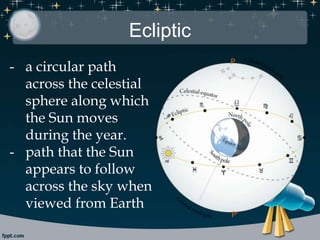
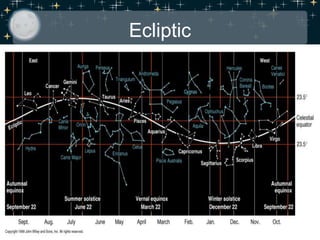
Ecliptic
- a circular path
across the celestial
sphere along which
the Sun moves
during the year.
- path that the Sun
appears to follow
across the sky when
viewed from Earth
Ecliptic
Constellation
Constellation
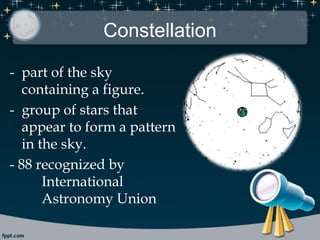
- part of the sky
containing a figure.
- group of stars that
appear to form a pattern
in the sky.
- 88 recognized by
International
Astronomy Union
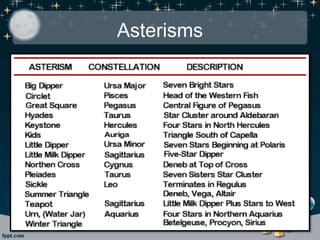
Asterisms
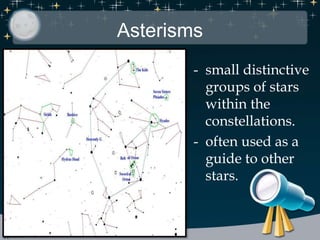
- small distinctive
groups of stars
within the
constellations.
- often used as a
guide to other
stars.
Asterisms
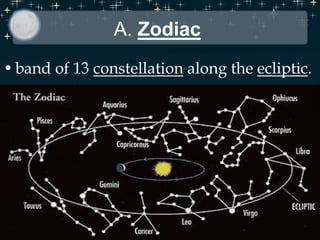
A. Zodiac
•band of 13 constellation along the ecliptic.
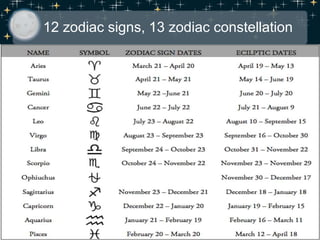
12 zodiac signs, 13 zodiac constellation
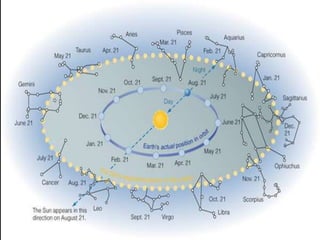
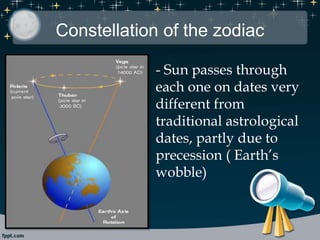
Constellation of the zodiac
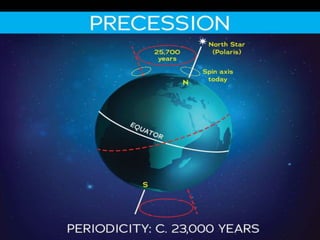
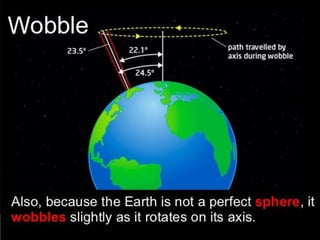
- Sun passes through
each one on dates very
different from
traditional astrological
dates, partly due to
precession ( Earth’s
wobble)
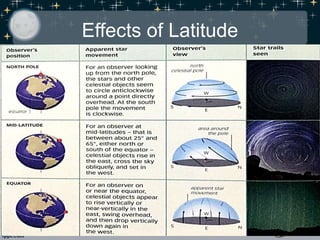
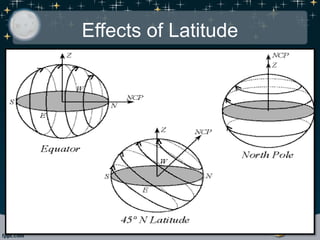
Effects of Latitude
Effects of Latitude
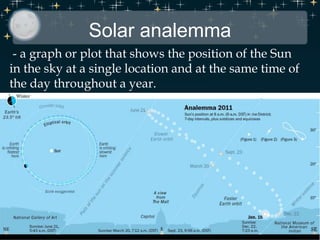
Solar analemma
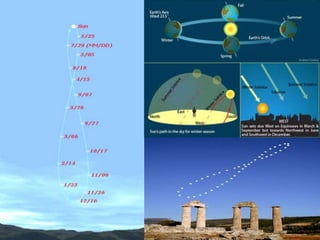
- a graph or plot that shows the position of the Sun
in the sky at a single location and at the same time of
the day throughout a year.
Naming Sky Objects
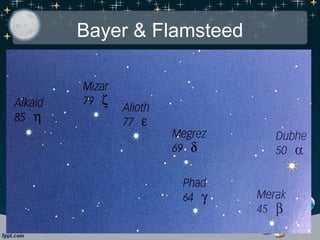
• Bayer System
- 1603 by German astronomer Johann
Bayer
- distinguish up to 24 stars in each
constellation, labelling them with
Greek letters in roughly decreasing
order of brightness.
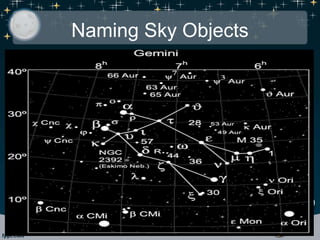
Naming Sky Objects
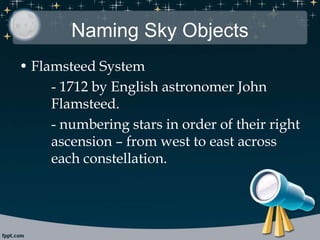
• Flamsteed System
- 1712 by English astronomer John
Flamsteed.
- numbering stars in order of their right
ascension – from west to east across
each constellation.
Bayer & Flamsteed
Naming Sky Objects
Tools & Techniques
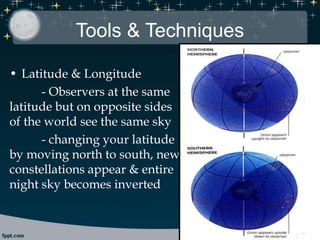
• Latitude & Longitude
- Observers at the same
latitude but on opposite sides
of the world see the same sky
- changing your latitude
by moving north to south, new
constellations appear & entire
night sky becomes inverted
Angles in the Sky
• Azimuth - the direction of a celestial
object from the observer, expressed as
the angular distance from the north or
south point of the horizon to the point
at which a vertical circle passing
through the object intersects the
horizon.
• Zenith - the point on the celestial sphere
vertically above a given position or
observer.
Angles in the Sky
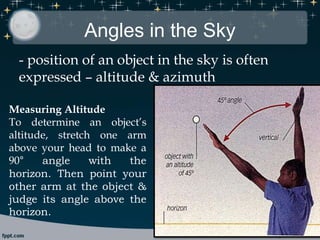
- position of an object in the sky is often
expressed – altitude & azimuth
Measuring Altitude
To determine an object’s
altitude, stretch one arm
above your head to make a
90° angle with the
horizon. Then point your
other arm at the object &
judge its angle above the
horizon.
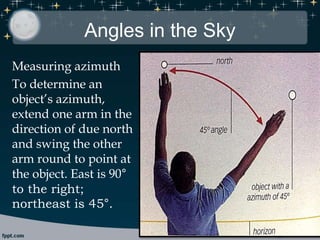
Measuring azimuth
To determine an
object’s azimuth,
extend one arm in the
direction of due north
and swing the other
arm round to point at
the object. East is 90°
to the right;
northeast is 45°.
Angles in the Sky
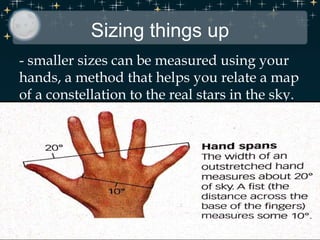
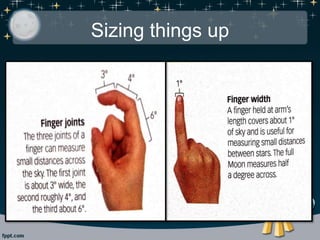
Sizing things up
- smaller sizes can be measured using your
hands, a method that helps you relate a map
of a constellation to the real stars in the sky.
Sizing things up
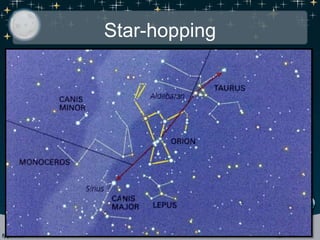
Star-hopping
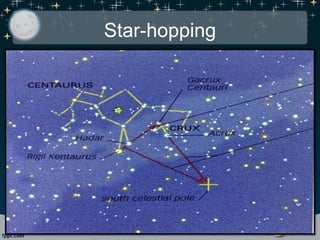
- Many constellations contain stars that act
as pointers to other parts of the night sky.
Star-hopping
Star-hopping
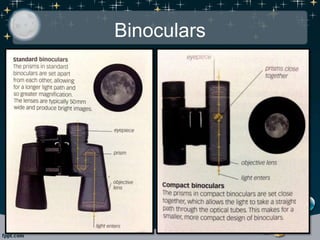
Binoculars
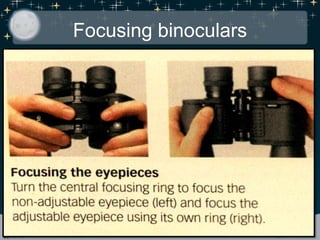
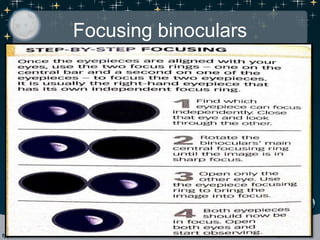
Focusing binoculars
Focusing binoculars
Using binoculars

Constellations-EV etc.

  • 1.
  • 2.
  • 3.
    Celestial Sphere - animaginary hollow sphere around the Earth, which all objects are either attached to or move across - has a specific shape but no specific size.
  • 4.
    Celestial Equator - acircle on the celestial sphere concentric with Earth’s equator - projection of Earth’s equator onto the celestial sphere.
  • 5.
    Ecliptic - a circularpath across the celestial sphere along which the Sun moves during the year. - path that the Sun appears to follow across the sky when viewed from Earth
  • 6.
  • 7.
  • 8.
    Constellation - part ofthe sky containing a figure. - group of stars that appear to form a pattern in the sky. - 88 recognized by International Astronomy Union
  • 9.
    Asterisms - small distinctive groupsof stars within the constellations. - often used as a guide to other stars.
  • 10.
  • 11.
    A. Zodiac •band of13 constellation along the ecliptic.
  • 12.
    12 zodiac signs,13 zodiac constellation
  • 14.
    Constellation of thezodiac - Sun passes through each one on dates very different from traditional astrological dates, partly due to precession ( Earth’s wobble)
  • 17.
  • 18.
  • 19.
    Solar analemma - agraph or plot that shows the position of the Sun in the sky at a single location and at the same time of the day throughout a year.
  • 21.
    Naming Sky Objects •Bayer System - 1603 by German astronomer Johann Bayer - distinguish up to 24 stars in each constellation, labelling them with Greek letters in roughly decreasing order of brightness.
  • 22.
    Naming Sky Objects •Flamsteed System - 1712 by English astronomer John Flamsteed. - numbering stars in order of their right ascension – from west to east across each constellation.
  • 23.
  • 24.
  • 25.
    Tools & Techniques •Latitude & Longitude - Observers at the same latitude but on opposite sides of the world see the same sky - changing your latitude by moving north to south, new constellations appear & entire night sky becomes inverted
  • 26.
    Angles in theSky • Azimuth - the direction of a celestial object from the observer, expressed as the angular distance from the north or south point of the horizon to the point at which a vertical circle passing through the object intersects the horizon. • Zenith - the point on the celestial sphere vertically above a given position or observer.
  • 27.
    Angles in theSky - position of an object in the sky is often expressed – altitude & azimuth Measuring Altitude To determine an object’s altitude, stretch one arm above your head to make a 90° angle with the horizon. Then point your other arm at the object & judge its angle above the horizon.
  • 28.
    Measuring azimuth To determinean object’s azimuth, extend one arm in the direction of due north and swing the other arm round to point at the object. East is 90° to the right; northeast is 45°. Angles in the Sky
  • 29.
    Sizing things up -smaller sizes can be measured using your hands, a method that helps you relate a map of a constellation to the real stars in the sky.
  • 30.
  • 31.
    Star-hopping - Many constellationscontain stars that act as pointers to other parts of the night sky.
  • 32.
  • 33.
  • 34.
  • 35.
  • 36.
  • 37.

Editor's Notes

  • #9 Ptolemy – created a definitive list in the 2nd century 1922 – IAU created a system w/c consist the 88 areas
  • #28 Azimuth - the direction of a celestial object from the observer, expressed as the angular distance from the north or south point of the horizon to the point at which a vertical circle passing through the object intersects the horizon. Zenith - the point on the celestial sphere vertically above a given position or observer.