
WIND POWER PLANT
Outline of the Presentation
 Introduction
 Site selection of wind power plant
 Parts of a wind turbine
 Working of a wind power plant
 Advantages of wind power
 Disadvantages of wind power plants
 Present scenario
 References
The horizontal axis wind turbine (HAWT) with upstream three-blade rotor has
resulted to be the most suitable typology and consequently has found a
remarkable development, characterized both by a quick grown in size and power,
as well as by a wide spread.
Wind power has always given the necessary propulsive force to sailing ships
and has been also used to run windmills.
Due to climate changes ,the demand to increase the amount of green energy
and fear of a decrease of oil fuel in the future
Why wind power?
Wind power is the conversion of wind energy into a useful form of
energy, such as using wind turbines to make electrical power,
windmills for mechanical power, wind pumps for water pumping
or drainage, or sails to propel ship.
Introduction
PHYSICS AND NATURE OF WIND
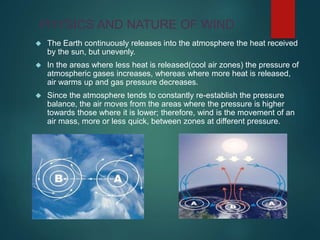
 The Earth continuously releases into the atmosphere the heat received
by the sun, but unevenly.
 In the areas where less heat is released(cool air zones) the pressure of
atmospheric gases increases, whereas where more heat is released,
air warms up and gas pressure decreases.
 Since the atmosphere tends to constantly re-establish the pressure
balance, the air moves from the areas where the pressure is higher
towards those where it is lower; therefore, wind is the movement of an
air mass, more or less quick, between zones at different pressure.
SITE SELECTION OF WIND POWER PLANT
 Most important decision throughout your installation.
 Vital part in the performance and efficiency of a wind turbine.
 High, exposed sites.
 Not suitable sites in highly populated residential areas.
 Avoid roof mounted turbines.
 Power transmission loss
 Distance between the turbine and the nearest obstacle
 Connection with national power grid
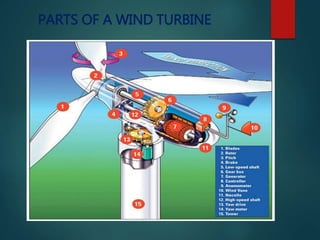
PARTS OF A WIND TURBINE
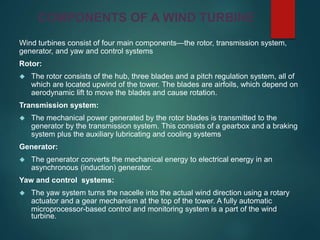
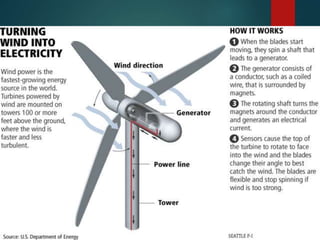
Wind turbines consist of four main components—the rotor, transmission system,
generator, and yaw and control systems
Rotor:
 The rotor consists of the hub, three blades and a pitch regulation system, all of
which are located upwind of the tower. The blades are airfoils, which depend on
aerodynamic lift to move the blades and cause rotation.
Transmission system:
 The mechanical power generated by the rotor blades is transmitted to the
generator by the transmission system. This consists of a gearbox and a braking
system plus the auxiliary lubricating and cooling systems
Generator:
 The generator converts the mechanical energy to electrical energy in an
asynchronous (induction) generator.
Yaw and control systems:
 The yaw system turns the nacelle into the actual wind direction using a rotary
actuator and a gear mechanism at the top of the tower. A fully automatic
microprocessor-based control and monitoring system is a part of the wind
turbine.
COMPONENTS OF A WIND TURBINE
WORKING OF WIND A POWER PLANT
 Wind turbines harness the wind's energy to generate
electricity. Here, in short, is how they do it:
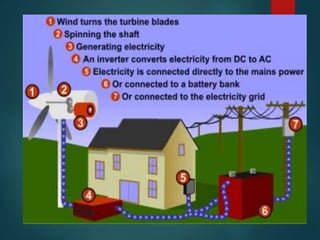
 Wind makes BLADES turn.
 Blades turn a shaft .
 Gearbox connected to shaft increases ROTATIONAL
speed.
 Direct drive, Gearless technology
 CONVERSION : Mechanical energy Electrical
energy.
 Power inverter
 Transformer : output voltage of inverter / 11 KV – 33KV.
 Local distribution / national greed.
ADVANTAGES OF WIND POWER PLANT
 Energy For Free Of Cost.
 Produces Electricity Throughout The Day.
 Pollution Free And Clean.
 Vast Wind Energy Is Available. (10 Million Mw)
 Can Supply The Power To Remote Areas.
 Economically Competitive.
 Mechanical Power For Grading, Pumping Etc. ;
Using Wind Energy.
 Wind Energy Domestic, Renewable
Source Of Energy .
 Up To 95 % Land Of Wind Farms Can Be
Used For Ranching, Farming And Forestry.
 Low energy density.
 Irregular , unsteady wind energy
 Variable speed.
 Variable wind direction.
 Higher capital cost.
 Can be located only in vast open areas .
 Far location from load centers.
 Complex designs.
DISADVANTAGES OF WIND POWER PLANT
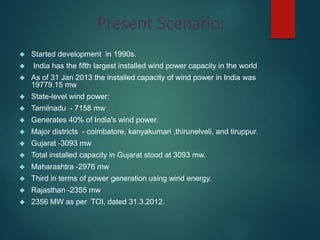
Present Scenario:
 Started development in 1990s.
 India has the fifth largest installed wind power capacity in the world
 As of 31 Jan 2013 the installed capacity of wind power in India was
19779.15 mw
 State-level wind power:
 Tamilnadu - 7158 mw
 Generates 40% of India's wind power.
 Major districts - coimbatore, kanyakumari ,thirunelveli, and tiruppur.
 Gujarat -3093 mw
 Total installed capacity in Gujarat stood at 3093 mw.
 Maharashtra -2976 mw
 Third in terms of power generation using wind energy.
 Rajasthan -2355 mw
 2356 MW as per TOI, dated 31.3.2012.
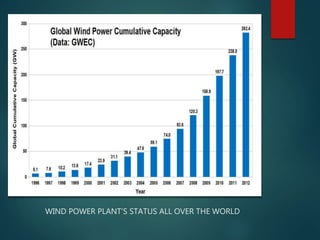
WIND POWER PLANT’S STATUS ALL OVER THE WORLD
References
• Wind Power Plants
Fundamentals, Design, Construction and Operation
• Gasch, Robert, Twele, Jochen (Eds.)
• http://cleangreenenergyzone.com/working-principle-
of-wind-energy/
• http://http://www.greenrhinoenergy.com/renewable/w
ind/
THANK YOU

Wind power plant

  • 1.
  • 2.
    Outline of thePresentation  Introduction  Site selection of wind power plant  Parts of a wind turbine  Working of a wind power plant  Advantages of wind power  Disadvantages of wind power plants  Present scenario  References
  • 3.
    The horizontal axiswind turbine (HAWT) with upstream three-blade rotor has resulted to be the most suitable typology and consequently has found a remarkable development, characterized both by a quick grown in size and power, as well as by a wide spread. Wind power has always given the necessary propulsive force to sailing ships and has been also used to run windmills. Due to climate changes ,the demand to increase the amount of green energy and fear of a decrease of oil fuel in the future Why wind power? Wind power is the conversion of wind energy into a useful form of energy, such as using wind turbines to make electrical power, windmills for mechanical power, wind pumps for water pumping or drainage, or sails to propel ship. Introduction
  • 4.
    PHYSICS AND NATUREOF WIND  The Earth continuously releases into the atmosphere the heat received by the sun, but unevenly.  In the areas where less heat is released(cool air zones) the pressure of atmospheric gases increases, whereas where more heat is released, air warms up and gas pressure decreases.  Since the atmosphere tends to constantly re-establish the pressure balance, the air moves from the areas where the pressure is higher towards those where it is lower; therefore, wind is the movement of an air mass, more or less quick, between zones at different pressure.
  • 5.
    SITE SELECTION OFWIND POWER PLANT  Most important decision throughout your installation.  Vital part in the performance and efficiency of a wind turbine.  High, exposed sites.  Not suitable sites in highly populated residential areas.  Avoid roof mounted turbines.  Power transmission loss  Distance between the turbine and the nearest obstacle  Connection with national power grid
  • 6.
    PARTS OF AWIND TURBINE
  • 7.
    Wind turbines consistof four main components—the rotor, transmission system, generator, and yaw and control systems Rotor:  The rotor consists of the hub, three blades and a pitch regulation system, all of which are located upwind of the tower. The blades are airfoils, which depend on aerodynamic lift to move the blades and cause rotation. Transmission system:  The mechanical power generated by the rotor blades is transmitted to the generator by the transmission system. This consists of a gearbox and a braking system plus the auxiliary lubricating and cooling systems Generator:  The generator converts the mechanical energy to electrical energy in an asynchronous (induction) generator. Yaw and control systems:  The yaw system turns the nacelle into the actual wind direction using a rotary actuator and a gear mechanism at the top of the tower. A fully automatic microprocessor-based control and monitoring system is a part of the wind turbine. COMPONENTS OF A WIND TURBINE
  • 8.
    WORKING OF WINDA POWER PLANT  Wind turbines harness the wind's energy to generate electricity. Here, in short, is how they do it:  Wind makes BLADES turn.  Blades turn a shaft .  Gearbox connected to shaft increases ROTATIONAL speed.  Direct drive, Gearless technology  CONVERSION : Mechanical energy Electrical energy.  Power inverter  Transformer : output voltage of inverter / 11 KV – 33KV.  Local distribution / national greed.
  • 11.
    ADVANTAGES OF WINDPOWER PLANT  Energy For Free Of Cost.  Produces Electricity Throughout The Day.  Pollution Free And Clean.  Vast Wind Energy Is Available. (10 Million Mw)  Can Supply The Power To Remote Areas.  Economically Competitive.  Mechanical Power For Grading, Pumping Etc. ; Using Wind Energy.  Wind Energy Domestic, Renewable Source Of Energy .  Up To 95 % Land Of Wind Farms Can Be Used For Ranching, Farming And Forestry.
  • 12.
     Low energydensity.  Irregular , unsteady wind energy  Variable speed.  Variable wind direction.  Higher capital cost.  Can be located only in vast open areas .  Far location from load centers.  Complex designs. DISADVANTAGES OF WIND POWER PLANT
  • 13.
    Present Scenario:  Starteddevelopment in 1990s.  India has the fifth largest installed wind power capacity in the world  As of 31 Jan 2013 the installed capacity of wind power in India was 19779.15 mw  State-level wind power:  Tamilnadu - 7158 mw  Generates 40% of India's wind power.  Major districts - coimbatore, kanyakumari ,thirunelveli, and tiruppur.  Gujarat -3093 mw  Total installed capacity in Gujarat stood at 3093 mw.  Maharashtra -2976 mw  Third in terms of power generation using wind energy.  Rajasthan -2355 mw  2356 MW as per TOI, dated 31.3.2012.
  • 14.
    WIND POWER PLANT’SSTATUS ALL OVER THE WORLD
  • 15.
    References • Wind PowerPlants Fundamentals, Design, Construction and Operation • Gasch, Robert, Twele, Jochen (Eds.) • http://cleangreenenergyzone.com/working-principle- of-wind-energy/ • http://http://www.greenrhinoenergy.com/renewable/w ind/
  • 16.

Editor's Notes

  • #3 Give a brief overview of the presentation. Describe the major focus of the presentation and why it is important. Introduce each of the major topics. To provide a road map for the audience, you can repeat this Overview slide throughout the presentation, highlighting the particular topic you will discuss next.
  • #4 Give a brief overview of the presentation. Describe the major focus of the presentation and why it is important. Introduce each of the major topics. To provide a road map for the audience, you can repeat this Overview slide throughout the presentation, highlighting the particular topic you will discuss next.
  • #16 What will the audience be able to do after this training is complete? Briefly describe each objective how the audience will benefit from this presentation.
  • #17 Microsoft Confidential