1
List of Astronomical Terms
The Celestial Sphere
The Zenith and Nadir
The Celestial Horizon
The Terrestrial Poles
and Equator
The Celestial Poles and
Equator
2Exploring the Sky
DEFINITIONS
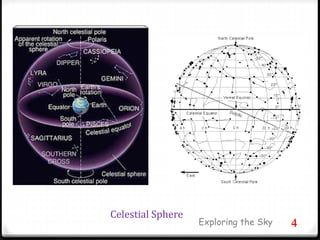
The millions of stars that we see in the sky on a clear cloudless
night are all at varying distances from us. Since we are concerned
with their relative distances rather than their actual distance
from the observer, it is exceedingly convenient to picture the
stars as distributed over the surface of an imaginary spherical
sky having its centre at the position of the observer. The
imaginary sphere on which the stars appear to lie or to be
studded is known as the Celestial Sphere
3Exploring the Sky
Celestial Sphere
4Exploring the Sky
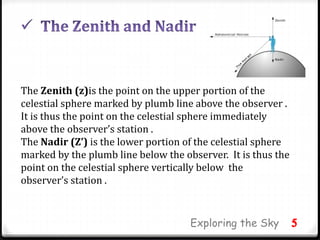
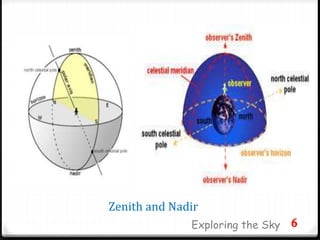
The Zenith (z)is the point on the upper portion of the
celestial sphere marked by plumb line above the observer .
It is thus the point on the celestial sphere immediately
above the observer’s station .
The Nadir (Z’) is the lower portion of the celestial sphere
marked by the plumb line below the observer. It is thus the
point on the celestial sphere vertically below the
observer’s station .
5Exploring the Sky
Zenith and Nadir
6Exploring the Sky
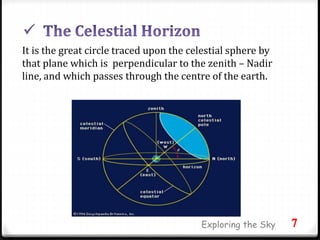
It is the great circle traced upon the celestial sphere by
that plane which is perpendicular to the zenith – Nadir
line, and which passes through the centre of the earth.
7Exploring the Sky
Exploring the Sky 8
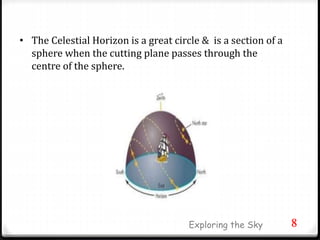
• The Celestial Horizon is a great circle & is a section of a
sphere when the cutting plane passes through the
centre of the sphere.
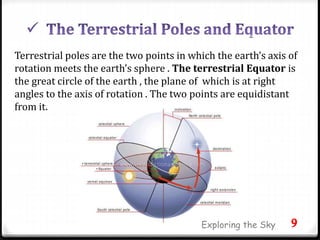
Terrestrial poles are the two points in which the earth’s axis of
rotation meets the earth’s sphere . The terrestrial Equator is
the great circle of the earth , the plane of which is at right
angles to the axis of rotation . The two points are equidistant
from it.
9Exploring the Sky
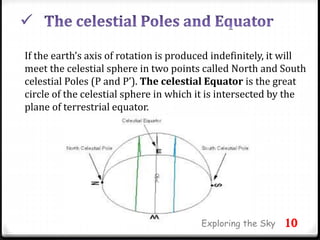
If the earth’s axis of rotation is produced indefinitely, it will
meet the celestial sphere in two points called North and South
celestial Poles (P and P’). The celestial Equator is the great
circle of the celestial sphere in which it is intersected by the
plane of terrestrial equator.
10Exploring the Sky
11Exploring the Sky

5 astronomical terms

  • 1.
  • 2.
    List of AstronomicalTerms The Celestial Sphere The Zenith and Nadir The Celestial Horizon The Terrestrial Poles and Equator The Celestial Poles and Equator 2Exploring the Sky
  • 3.
    DEFINITIONS The millions ofstars that we see in the sky on a clear cloudless night are all at varying distances from us. Since we are concerned with their relative distances rather than their actual distance from the observer, it is exceedingly convenient to picture the stars as distributed over the surface of an imaginary spherical sky having its centre at the position of the observer. The imaginary sphere on which the stars appear to lie or to be studded is known as the Celestial Sphere 3Exploring the Sky
  • 4.
  • 5.
    The Zenith (z)isthe point on the upper portion of the celestial sphere marked by plumb line above the observer . It is thus the point on the celestial sphere immediately above the observer’s station . The Nadir (Z’) is the lower portion of the celestial sphere marked by the plumb line below the observer. It is thus the point on the celestial sphere vertically below the observer’s station . 5Exploring the Sky
  • 6.
  • 7.
    It is thegreat circle traced upon the celestial sphere by that plane which is perpendicular to the zenith – Nadir line, and which passes through the centre of the earth. 7Exploring the Sky
  • 8.
    Exploring the Sky8 • The Celestial Horizon is a great circle & is a section of a sphere when the cutting plane passes through the centre of the sphere.
  • 9.
    Terrestrial poles arethe two points in which the earth’s axis of rotation meets the earth’s sphere . The terrestrial Equator is the great circle of the earth , the plane of which is at right angles to the axis of rotation . The two points are equidistant from it. 9Exploring the Sky
  • 10.
    If the earth’saxis of rotation is produced indefinitely, it will meet the celestial sphere in two points called North and South celestial Poles (P and P’). The celestial Equator is the great circle of the celestial sphere in which it is intersected by the plane of terrestrial equator. 10Exploring the Sky
  • 11.