1. Bradycardia
2. AV Block
(AV Conduction Block)
花蓮慈濟心臟 科內
蔡文欽醫師
1. Bradycardia
2. AV Block
(AV Conduction Block)
Bradycardia

A heart rate of <60 beats/min.

May be a normal physiological phenomenon
or result from a cardiac or non-cardiac
disorder.

Many patients tolerate heart rates of
40 beats/min
− Dizziness, near syncope, syncope, ischaemic
chest pain, and hypoxic seizures
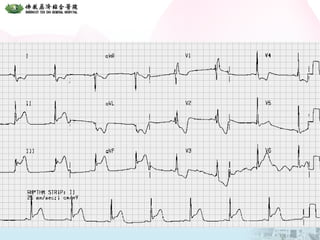
Sinus bradycardia

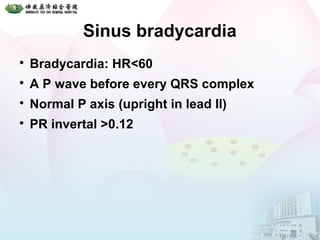
Bradycardia: HR<60

A P wave before every QRS complex

Normal P axis (upright in lead II)

PR invertal >0.12
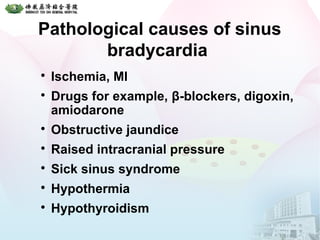
Pathological causes of sinus
bradycardia

Ischemia, MI

Drugs for example, β-blockers, digoxin,
amiodarone

Obstructive jaundice

Raised intracranial pressure

Sick sinus syndrome

Hypothermia

Hypothyroidism
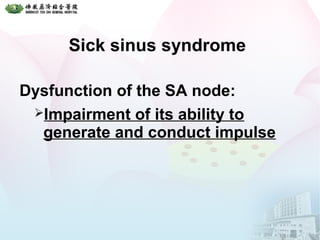
Sick sinus syndrome
Dysfunction of the SA node:
Impairment of its ability to
generate and conduct impulse
Conditions associated with
sinoatrial node dysfunction

Age

Idiopathic fibrosis

Ischemia, including myocardial infarction

High vagal tone

Myocarditis

Drug toxicity, such as Digoxin
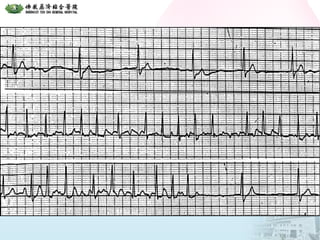
ECG feature of S.S.S.

Persistent sinus bradycardia

Periods of sinoatrial block

Sinus arrest

Junctional or ventricular escape rhythms

Tachycardia-bradycardia syndrome

Paroxysmal atrial flutter/fibrillation
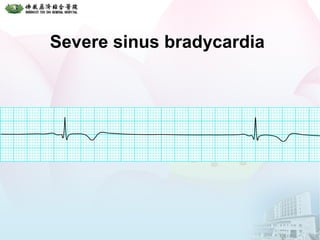
Severe sinus bradycardia
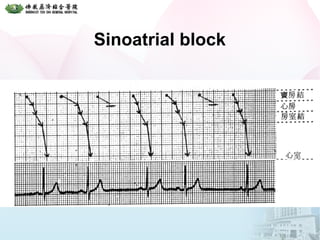
Sinoatrial block
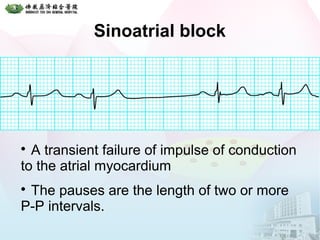
Sinoatrial block

A transient failure of impulse of conduction
to the atrial myocardium

The pauses are the length of two or more
P-P intervals.
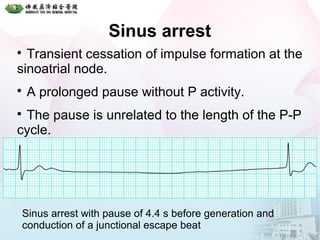
Sinus arrest
Sinus arrest with pause of 4.4 s before generation and
conduction of a junctional escape beat

Transient cessation of impulse formation at the
sinoatrial node.

A prolonged pause without P activity.

The pause is unrelated to the length of the P-P
cycle.
Escape rhythms

Escape rhythms are the result of
spontaneous activity from a subsidiary
pacemaker, located in the atria,
atrioventricular junction, or ventricles.


They take over when normal impulse
formation or conduction fails and may be
associated with any profound bradycardia.
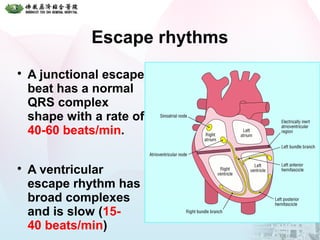
Escape rhythms

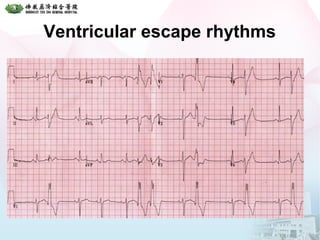
A junctional escape
beat has a normal
QRS complex
shape with a rate of
40-60 beats/min.

A ventricular
escape rhythm has
broad complexes
and is slow (15-
40 beats/min)
Ventricular escape rhythms
Tachycardia-bradycardia
syndrome

Common in sick sinus syndrome.

Characterised by bursts of atrial tachycardia
interspersed with periods of bradycardia.

Paroxysmal atrial flutter or fibrillation may
also occur, and cardioversion may be
followed by a severe bradycardia.
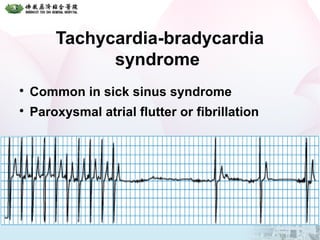
Tachycardia-bradycardia
syndrome

Common in sick sinus syndrome

Paroxysmal atrial flutter or fibrillation
1. Bradycardia
2. AV Block
(AV Conduction Block)
Atrioventricular conduction block

Atrioventricular conduction can be
delayed, intermittently blocked, or
completely blocked classified
correspondingly as first, second, or
third degree block.
Causes of atrioventricular
conduction block

Myocardial ischemia or infarction

Degeneration of the His-Purkinje system

Infection for example, Lyme disease,
diphtheria

Immunological disorders for example,
systemic lupus erythematosus

Surgery

Congenital disorders
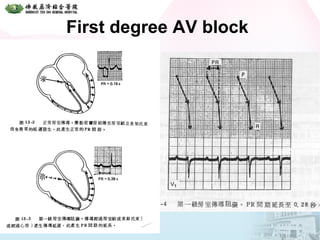
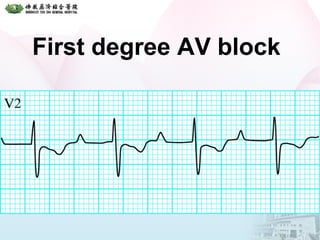
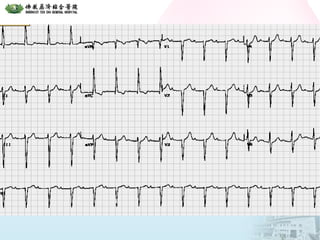
First degree AV block

In first degree block there is a delay in
conduction of the atrial impulse to the
ventricles, usually at the level of the
atrioventricular node.

This results in prolongation of the PR
interval to >0.2 s.


A QRS complex follows each P wave, and
the PR interval remains constant.
First degree AV block
Second degree AV block

In second degree block there is intermittent
failure of conduction between the atria and
ventricles.

Some P waves are not followed by a QRS
complex.

There are three types of second degree
block.
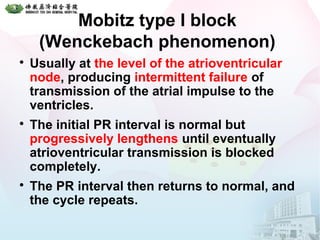
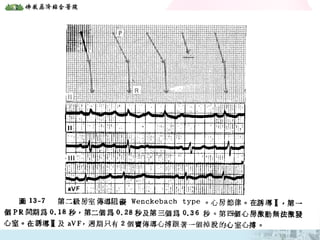
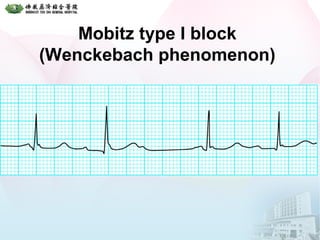
Mobitz type I block
(Wenckebach phenomenon)

Usually at the level of the atrioventricular
node, producing intermittent failure of
transmission of the atrial impulse to the
ventricles.

The initial PR interval is normal but
progressively lengthens until eventually
atrioventricular transmission is blocked
completely.

The PR interval then returns to normal, and
the cycle repeats.
Mobitz type I block
(Wenckebach phenomenon)
Mobitz type II block

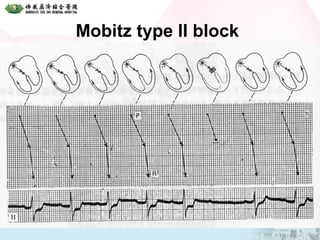
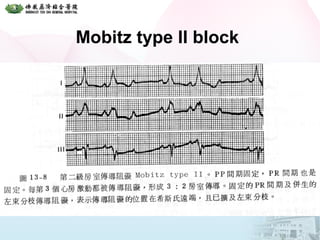
Less common but is more likely to produce
symptoms.

There is intermittent failure of conduction of
P waves.

The PR interval is constant.

The block is often at the level of the bundle
branches and is therefore associated with
wide QRS complexes.
Mobitz type II block

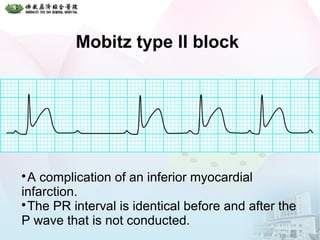
A complication of an inferior myocardial
infarction.

The PR interval is identical before and after the
P wave that is not conducted.
Mobitz type II block
2:1 atrioventricular block

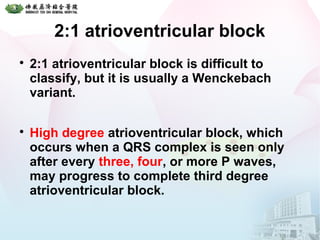
2:1 atrioventricular block is difficult to
classify, but it is usually a Wenckebach
variant.

High degree atrioventricular block, which
occurs when a QRS complex is seen only
after every three, four, or more P waves,
may progress to complete third degree
atrioventricular block.
Third degree block

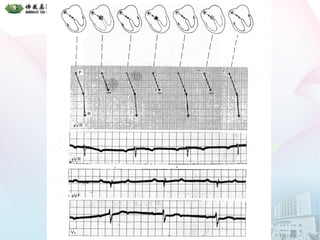
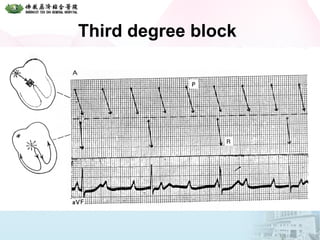
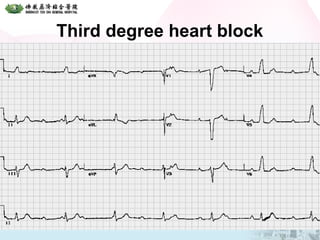
In third degree block there is complete
failure of conduction between the atria and
ventricles, with complete independence of
atrial and ventricular contractions.

The P waves bear no relation to the QRS
complexes and usually proceed at a faster
rate.
Third degree block
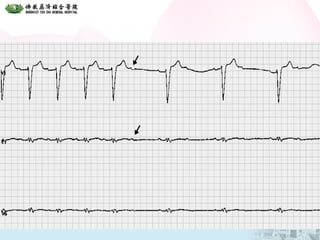
Third degree heart block

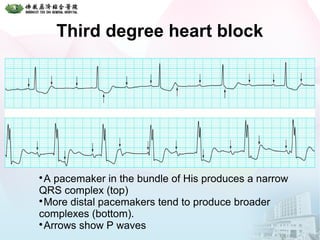
A pacemaker in the bundle of His produces a narrow
QRS complex (top)

More distal pacemakers tend to produce broader
complexes (bottom).

Arrows show P waves
Third degree heart block

Bundle branch block

Fascicular block
42

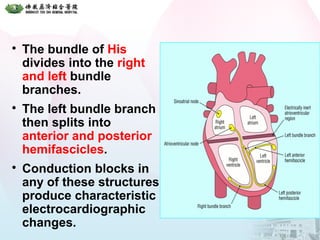
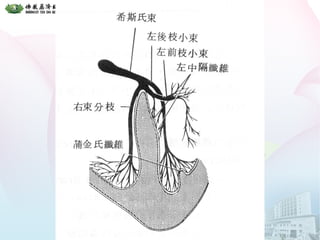
The bundle of His
divides into the right
and left bundle
branches.

The left bundle branch
then splits into
anterior and posterior
hemifascicles.

Conduction blocks in
any of these structures
produce characteristic
electrocardiographic
changes.
Right Bundle Branch Block

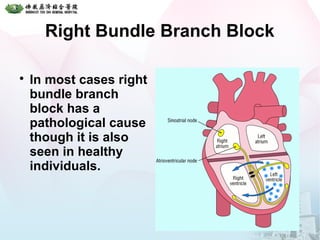
In most cases right
bundle branch
block has a
pathological cause
though it is also
seen in healthy
individuals.
Conditions associated with right
bundle branch block

Rheumatic heart disease

Cor pulmonale/right ventricular
hypertrophy

Myocarditis or cardiomyopathy

Ischaemic heart disease

Degenerative disease of the conduction
system

Pulmonary embolus

Congenital heart disease for example, in
atrial septal defects
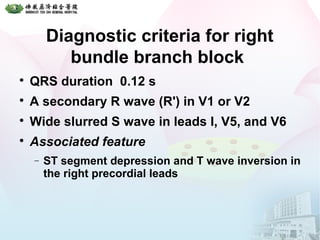
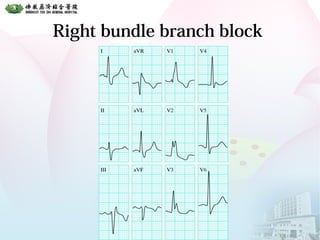
Diagnostic criteria for right
bundle branch block

QRS duration 0.12 s

A secondary R wave (R') in V1 or V2

Wide slurred S wave in leads I, V5, and V6

Associated feature
− ST segment depression and T wave inversion in
the right precordial leads
Right bundle branch block
Left Bundle Branch Block

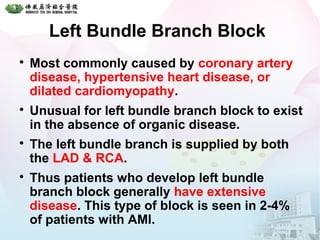
Most commonly caused by coronary artery
disease, hypertensive heart disease, or
dilated cardiomyopathy.

Unusual for left bundle branch block to exist
in the absence of organic disease.

The left bundle branch is supplied by both
the LAD & RCA.

Thus patients who develop left bundle
branch block generally have extensive
disease. This type of block is seen in 2-4%
of patients with AMI.

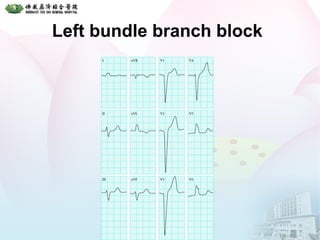
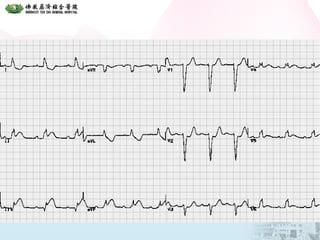
QRS duration of 0.12 s

Broad monophasic R wave in leads 1, V5, and
V6

Absence of Q waves in leads V5 and V6

Associated features
− Displacement of ST segment and T wave in an
opposite direction to the dominant deflection of the
QRS complex (appropriate discordance)
− Poor R wave progression in the chest leads
− RS complex, rather than monophasic complex, in
leads V5 and V6
− Left axis deviation common but not invariable
finding
Diagnostic criteria for left
bundle branch block
Left bundle branch block
Fascicular blocks

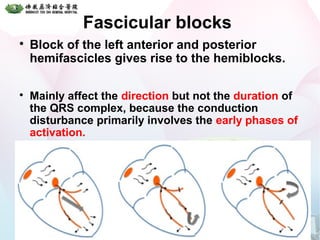
Block of the left anterior and posterior
hemifascicles gives rise to the hemiblocks.

Mainly affect the direction but not the duration of
the QRS complex, because the conduction
disturbance primarily involves the early phases of
activation.
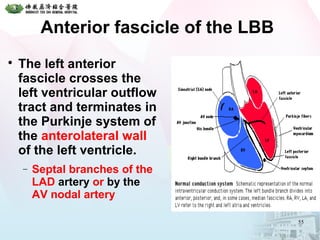
Anterior fascicle of the LBB

The left anterior
fascicle crosses the
left ventricular outflow
tract and terminates in
the Purkinje system of
the anterolateral wall
of the left ventricle.
− Septal branches of the
LAD artery or by the
AV nodal artery
55
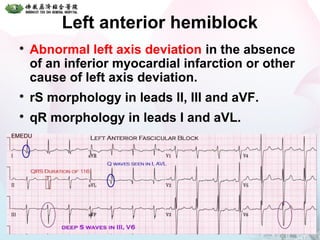
Left anterior hemiblock

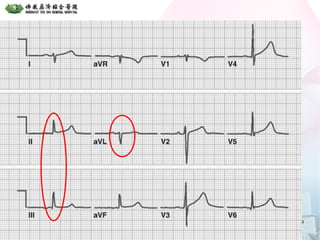
Abnormal left axis deviation in the absence
of an inferior myocardial infarction or other
cause of left axis deviation.

rS morphology in leads II, III and aVF.

qR morphology in leads I and aVL.
56
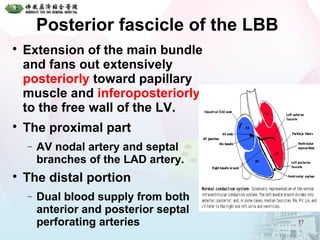
Posterior fascicle of the LBB

Extension of the main bundle
and fans out extensively
posteriorly toward papillary
muscle and inferoposteriorly
to the free wall of the LV.

The proximal part
− AV nodal artery and septal
branches of the LAD artery.

The distal portion
− Dual blood supply from both
anterior and posterior septal
perforating arteries 57
Left posterior hemiblock

Frontal plane axis of >90° in the absence of
other causes of right axis deviation, such as
RVH or lung disease…

qR morphology in leads II, III and aVF.

rS morphology in leads I and aVL.
58
59
Bifascicular block

Right bundle branch block with left or right
axis deviation.

Right bundle branch block with left anterior
hemiblock is the commonest type of
bifascicular block.

The left posterior fascicle is fairly stout and
more resistant to damage, so right bundle
branch block with left posterior hemiblock
is rarely seen.
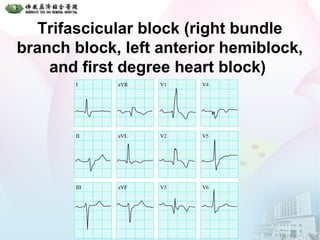
Trifascicular block

Trifascicular block is present when
bifascicular block is associated with first
degree heart block.

If conduction in the dysfunctional fascicle
also fails completely, complete heart block
ensues.
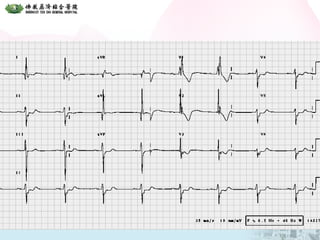
Trifascicular block (right bundle
branch block, left anterior hemiblock,
and first degree heart block)

The end!
64

Arrhythmia :ECG ---Bradycardia_20120902_北區

  • 1.
    1. Bradycardia 2. AVBlock (AV Conduction Block) 花蓮慈濟心臟 科內 蔡文欽醫師
  • 2.
    1. Bradycardia 2. AVBlock (AV Conduction Block)
  • 3.
    Bradycardia  A heart rateof <60 beats/min.  May be a normal physiological phenomenon or result from a cardiac or non-cardiac disorder.  Many patients tolerate heart rates of 40 beats/min − Dizziness, near syncope, syncope, ischaemic chest pain, and hypoxic seizures
  • 4.
    Sinus bradycardia  Bradycardia: HR<60  AP wave before every QRS complex  Normal P axis (upright in lead II)  PR invertal >0.12
  • 5.
    Pathological causes ofsinus bradycardia  Ischemia, MI  Drugs for example, β-blockers, digoxin, amiodarone  Obstructive jaundice  Raised intracranial pressure  Sick sinus syndrome  Hypothermia  Hypothyroidism
  • 7.
    Sick sinus syndrome Dysfunctionof the SA node: Impairment of its ability to generate and conduct impulse
  • 8.
    Conditions associated with sinoatrialnode dysfunction  Age  Idiopathic fibrosis  Ischemia, including myocardial infarction  High vagal tone  Myocarditis  Drug toxicity, such as Digoxin
  • 9.
    ECG feature ofS.S.S.  Persistent sinus bradycardia  Periods of sinoatrial block  Sinus arrest  Junctional or ventricular escape rhythms  Tachycardia-bradycardia syndrome  Paroxysmal atrial flutter/fibrillation
  • 10.
  • 11.
  • 12.
    Sinoatrial block  A transientfailure of impulse of conduction to the atrial myocardium  The pauses are the length of two or more P-P intervals.
  • 13.
    Sinus arrest Sinus arrestwith pause of 4.4 s before generation and conduction of a junctional escape beat  Transient cessation of impulse formation at the sinoatrial node.  A prolonged pause without P activity.  The pause is unrelated to the length of the P-P cycle.
  • 14.
    Escape rhythms  Escape rhythmsare the result of spontaneous activity from a subsidiary pacemaker, located in the atria, atrioventricular junction, or ventricles.   They take over when normal impulse formation or conduction fails and may be associated with any profound bradycardia.
  • 15.
    Escape rhythms  A junctionalescape beat has a normal QRS complex shape with a rate of 40-60 beats/min.  A ventricular escape rhythm has broad complexes and is slow (15- 40 beats/min)
  • 16.
  • 17.
    Tachycardia-bradycardia syndrome  Common in sicksinus syndrome.  Characterised by bursts of atrial tachycardia interspersed with periods of bradycardia.  Paroxysmal atrial flutter or fibrillation may also occur, and cardioversion may be followed by a severe bradycardia.
  • 18.
    Tachycardia-bradycardia syndrome  Common in sicksinus syndrome  Paroxysmal atrial flutter or fibrillation
  • 20.
    1. Bradycardia 2. AVBlock (AV Conduction Block)
  • 21.
    Atrioventricular conduction block  Atrioventricularconduction can be delayed, intermittently blocked, or completely blocked classified correspondingly as first, second, or third degree block.
  • 22.
    Causes of atrioventricular conductionblock  Myocardial ischemia or infarction  Degeneration of the His-Purkinje system  Infection for example, Lyme disease, diphtheria  Immunological disorders for example, systemic lupus erythematosus  Surgery  Congenital disorders
  • 23.
    First degree AVblock  In first degree block there is a delay in conduction of the atrial impulse to the ventricles, usually at the level of the atrioventricular node.  This results in prolongation of the PR interval to >0.2 s.   A QRS complex follows each P wave, and the PR interval remains constant.
  • 24.
  • 25.
  • 27.
    Second degree AVblock  In second degree block there is intermittent failure of conduction between the atria and ventricles.  Some P waves are not followed by a QRS complex.  There are three types of second degree block.
  • 28.
    Mobitz type Iblock (Wenckebach phenomenon)  Usually at the level of the atrioventricular node, producing intermittent failure of transmission of the atrial impulse to the ventricles.  The initial PR interval is normal but progressively lengthens until eventually atrioventricular transmission is blocked completely.  The PR interval then returns to normal, and the cycle repeats.
  • 30.
    Mobitz type Iblock (Wenckebach phenomenon)
  • 31.
    Mobitz type IIblock  Less common but is more likely to produce symptoms.  There is intermittent failure of conduction of P waves.  The PR interval is constant.  The block is often at the level of the bundle branches and is therefore associated with wide QRS complexes.
  • 32.
  • 33.
    Mobitz type IIblock  A complication of an inferior myocardial infarction.  The PR interval is identical before and after the P wave that is not conducted.
  • 34.
  • 35.
    2:1 atrioventricular block  2:1atrioventricular block is difficult to classify, but it is usually a Wenckebach variant.  High degree atrioventricular block, which occurs when a QRS complex is seen only after every three, four, or more P waves, may progress to complete third degree atrioventricular block.
  • 38.
    Third degree block  Inthird degree block there is complete failure of conduction between the atria and ventricles, with complete independence of atrial and ventricular contractions.  The P waves bear no relation to the QRS complexes and usually proceed at a faster rate.
  • 39.
  • 40.
    Third degree heartblock  A pacemaker in the bundle of His produces a narrow QRS complex (top)  More distal pacemakers tend to produce broader complexes (bottom).  Arrows show P waves
  • 41.
  • 42.
  • 43.
     The bundle ofHis divides into the right and left bundle branches.  The left bundle branch then splits into anterior and posterior hemifascicles.  Conduction blocks in any of these structures produce characteristic electrocardiographic changes.
  • 45.
    Right Bundle BranchBlock  In most cases right bundle branch block has a pathological cause though it is also seen in healthy individuals.
  • 46.
    Conditions associated withright bundle branch block  Rheumatic heart disease  Cor pulmonale/right ventricular hypertrophy  Myocarditis or cardiomyopathy  Ischaemic heart disease  Degenerative disease of the conduction system  Pulmonary embolus  Congenital heart disease for example, in atrial septal defects
  • 47.
    Diagnostic criteria forright bundle branch block  QRS duration 0.12 s  A secondary R wave (R') in V1 or V2  Wide slurred S wave in leads I, V5, and V6  Associated feature − ST segment depression and T wave inversion in the right precordial leads
  • 48.
  • 50.
    Left Bundle BranchBlock  Most commonly caused by coronary artery disease, hypertensive heart disease, or dilated cardiomyopathy.  Unusual for left bundle branch block to exist in the absence of organic disease.  The left bundle branch is supplied by both the LAD & RCA.  Thus patients who develop left bundle branch block generally have extensive disease. This type of block is seen in 2-4% of patients with AMI.
  • 51.
     QRS duration of0.12 s  Broad monophasic R wave in leads 1, V5, and V6  Absence of Q waves in leads V5 and V6  Associated features − Displacement of ST segment and T wave in an opposite direction to the dominant deflection of the QRS complex (appropriate discordance) − Poor R wave progression in the chest leads − RS complex, rather than monophasic complex, in leads V5 and V6 − Left axis deviation common but not invariable finding Diagnostic criteria for left bundle branch block
  • 52.
  • 54.
    Fascicular blocks  Block ofthe left anterior and posterior hemifascicles gives rise to the hemiblocks.  Mainly affect the direction but not the duration of the QRS complex, because the conduction disturbance primarily involves the early phases of activation.
  • 55.
    Anterior fascicle ofthe LBB  The left anterior fascicle crosses the left ventricular outflow tract and terminates in the Purkinje system of the anterolateral wall of the left ventricle. − Septal branches of the LAD artery or by the AV nodal artery 55
  • 56.
    Left anterior hemiblock  Abnormalleft axis deviation in the absence of an inferior myocardial infarction or other cause of left axis deviation.  rS morphology in leads II, III and aVF.  qR morphology in leads I and aVL. 56
  • 57.
    Posterior fascicle ofthe LBB  Extension of the main bundle and fans out extensively posteriorly toward papillary muscle and inferoposteriorly to the free wall of the LV.  The proximal part − AV nodal artery and septal branches of the LAD artery.  The distal portion − Dual blood supply from both anterior and posterior septal perforating arteries 57
  • 58.
    Left posterior hemiblock  Frontalplane axis of >90° in the absence of other causes of right axis deviation, such as RVH or lung disease…  qR morphology in leads II, III and aVF.  rS morphology in leads I and aVL. 58
  • 59.
  • 60.
    Bifascicular block  Right bundlebranch block with left or right axis deviation.  Right bundle branch block with left anterior hemiblock is the commonest type of bifascicular block.  The left posterior fascicle is fairly stout and more resistant to damage, so right bundle branch block with left posterior hemiblock is rarely seen.
  • 62.
    Trifascicular block  Trifascicular blockis present when bifascicular block is associated with first degree heart block.  If conduction in the dysfunctional fascicle also fails completely, complete heart block ensues.
  • 63.
    Trifascicular block (rightbundle branch block, left anterior hemiblock, and first degree heart block)
  • 64.