Atrial Tachycardia


Huang Bien‐Hsien
Kuang Tien General Hospital
Taichung
Taiwan
Atrial Tachycardia

Atrial tachycardias (ATs) are an uncommon cause of 
supraventricular tachycardia (SVT):
    Adults ‐ 5% of all SVTs subject to EP studies
    Pediatric patients:
         10‐15% of the SVTs in pediatric patients without 
         congenital heart defects (CHD)
         More in those who have undergone a surgical 
         correction of their CHD

(Zipes DP, Jalife J. Cardiac Electrophysiology: From cell to bedside, 4th edition. 2004; pg. 500)
Outline 

• Mechanism of atrial tachycadia
• Locations of focal atrial tachycaria
• Surface EKG of different sites of atrial 
  tachycardia
• Mapping 
• New mapping technology (Introduction)
• Ablation
Classification of Mechanisms


  Focal
  Macroreentrant tachycardias.


(Zipes DP, Jalife J. Cardiac Electrophysiology: From cell to bedside, 4th edition. 2004; pg. 500-501)
Focal Atrial Tachycardia 


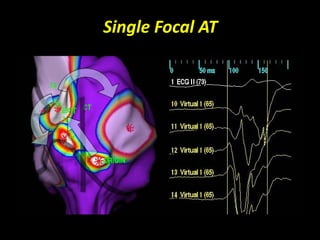
 Focal AT exhibits activation spreading from a 
single focus either radially, circularly or 
centrifugally without an electrical activation 
spanning the tachycardia cycle length. 
Mechanisms (Chen et al. Circulation 1994)


• Abnormal or enhanced automaticity
• Triggered Activity (delayed afterdepolarization)
• Microreentry
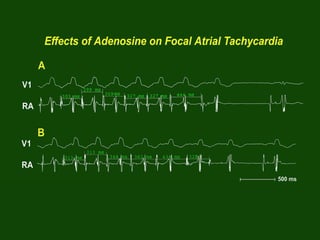
Effects of Adenosine on Reentrant AT


Microreentrant AT (probably focal AT)
Macroreentrant AT
   Reentrant circuit with zones of
conduction can
   demonstrate adenosine sensitivity
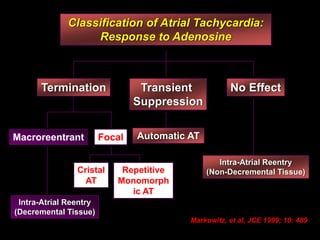
Classification of Atrial Tachycardia:
                  Response to Adenosine


      Termination                Transient           No Effect
                                Suppression


Macroreentrant          Focal   Automatic AT

                                                  Intra-Atrial Reentry
                Cristal     Repetitive         (Non-Decremental Tissue)
                  AT       Monomorph
                              ic AT
 Intra-Atrial Reentry
(Decremental Tissue)
                                          Markowitz, et al, JCE 1999; 10: 489
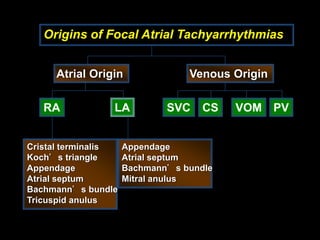
Origins of Focal Atrial Tachyarrhythmias


     Atrial Origin               Venous Origin

   RA            LA          SVC    CS   VOM     PV


Cristal terminalis   Appendage
Koch's triangle      Atrial septum
Appendage            Bachmann's bundle
Atrial septum        Mitral anulus
Bachmann's bundle
Tricuspid anulus
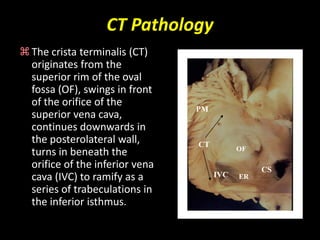
CT Pathology
The crista terminalis (CT) 
originates from the 
superior rim of the oval 
fossa (OF), swings in front 
of the orifice of the 
                                PM
superior vena cava, 
continues downwards in 
the posterolateral wall,        CT
                                           OF
turns in beneath the 
orifice of the inferior vena                    CS
cava (IVC) to ramify as a            IVC   ER
series of trabeculations in 
the inferior isthmus. 
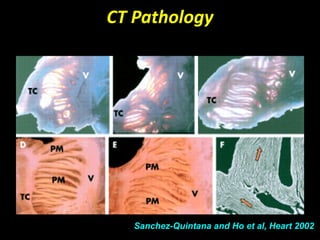
CT Pathology


   Sanchez-Quintana and Ho et al, Heart 2002
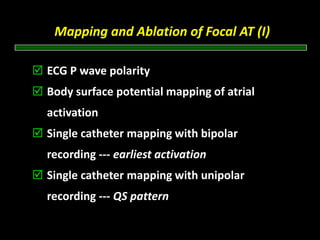
Mapping and Ablation of Focal AT (I) 

ECG P wave polarity 
Body surface potential mapping of atrial
activation
Single catheter mapping with bipolar
recording ‐‐‐ earliest activation
Single catheter mapping with unipolar
recording ‐‐‐ QS pattern
Mapping and Ablation of Focal AT (II) 


Double ring catheters mapping
Mechanical pressure by catheter tip
3‐D mapping using Carto or Ensite system
to find the earliest activation site
Intracardiac echocardiography to identify
the anatomic site
Angiography, 3‐D MRI, 3D‐CT to identify
the atrial – venous structure
EKG characteristics of 
  atrial tachycardia
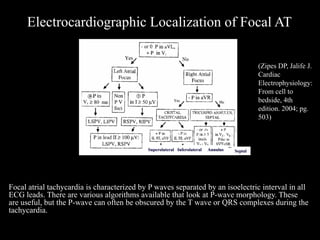
Electrocardiographic Localization of Focal AT

                                                                                             (Zipes DP, Jalife J.
                                                                                             Cardiac
                                                                                             Electrophysiology:
                                                                                             From cell to
                                                                                             bedside, 4th
                                                                                             edition. 2004; pg.
                                                                                             503)


                                            Superolateral Inferolateral   Annulus   Septal


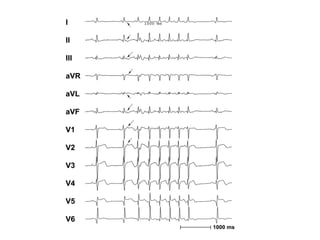
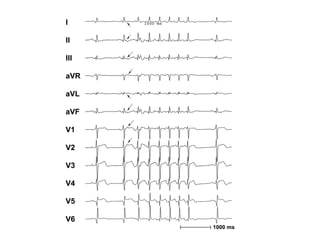
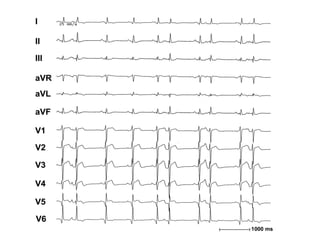
Focal atrial tachycardia is characterized by P waves separated by an isoelectric interval in all
ECG leads. There are various algorithms available that look at P-wave morphology. These
are useful, but the P-wave can often be obscured by the T wave or QRS complexes during the
tachycardia.
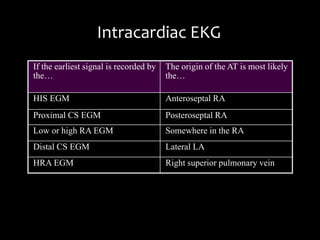
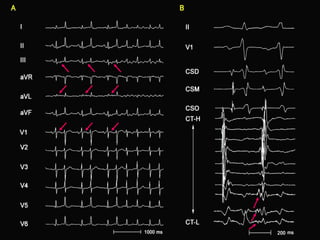
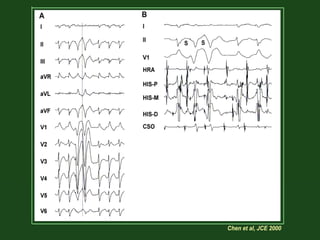
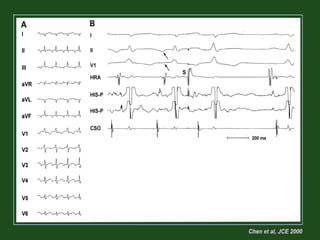
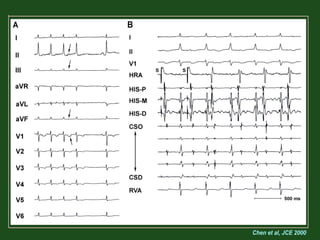
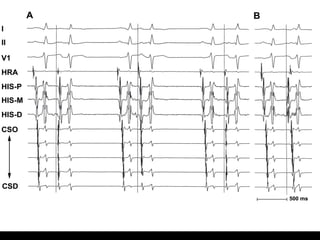
Intracardiac EKG
If the earliest signal is recorded by   The origin of the AT is most likely
the…                                    the…

HIS EGM                                 Anteroseptal RA
Proximal CS EGM                         Posteroseptal RA
Low or high RA EGM                      Somewhere in the RA
Distal CS EGM                           Lateral LA
HRA EGM                                 Right superior pulmonary vein
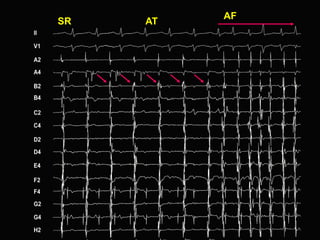
AF
SR   AT
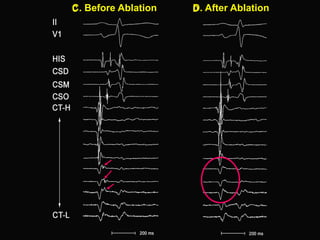
C. Before Ablation   D. After Ablation
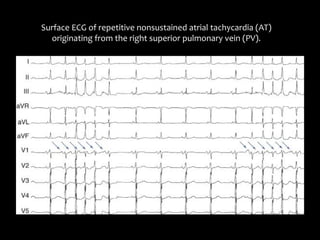
Surface ECG of repetitive nonsustained atrial tachycardia (AT) 
  originating from the right superior pulmonary vein (PV). 
Differential Diagnosis of AT During
              EP study
Differential Diagnosis of AT


• Ventricular burst pacing can be performed for longer periods of time
  at a rate just slightly faster than the tachycardia cycle length, and
  when the atrial activation is accelerated to the pacing rate,
  indicating 1:1 ventriculoatrial conduction,


(Zipes DP, Jalife J. Cardiac Electrophysiology: From cell to bedside, 4th edition. 2004; pg. 505)
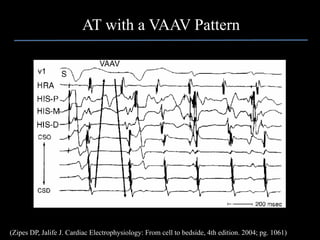
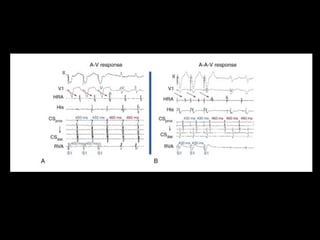
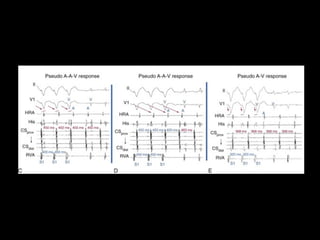
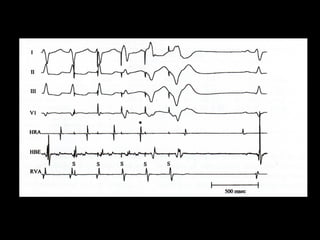
AT with a VAAV Pattern


(Zipes DP, Jalife J. Cardiac Electrophysiology: From cell to bedside, 4th edition. 2004; pg. 1061)
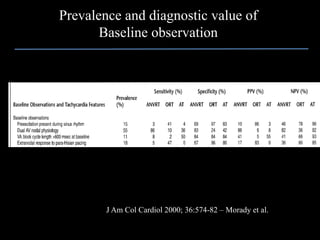
Prevalence and diagnostic value of
       Baseline observation


        J Am Col Cardiol 2000; 36:574-82 – Morady et al.
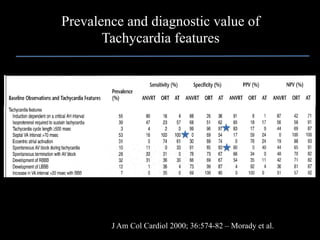
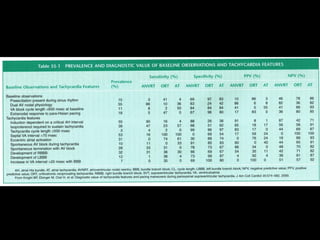
Prevalence and diagnostic value of
       Tachycardia features


        J Am Col Cardiol 2000; 36:574-82 – Morady et al.
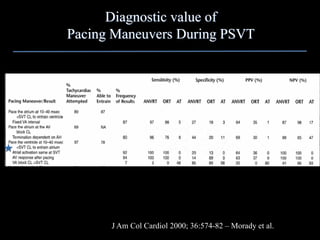
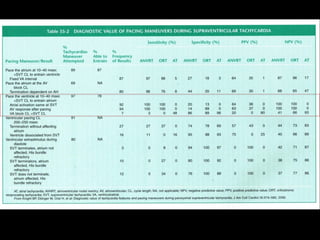
Diagnostic value of
Pacing Maneuvers During PSVT


      J Am Col Cardiol 2000; 36:574-82 – Morady et al.
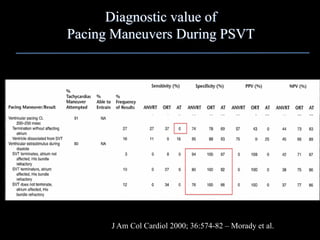
Diagnostic value of
Pacing Maneuvers During PSVT


      J Am Col Cardiol 2000; 36:574-82 – Morady et al.
New Mapping Technologies


• New mapping technologies such as basket catheters,
  electroanatomic mapping and non-contact mapping have helped to
  locate the site of the focus much quicker than the standard
  mapping techniques. Now with the advent of Spiral type catheters
  they also can be used to map the lower RA by the IVC, upper RA
  and SVC and CSos.


(Zipes DP, Jalife J. Cardiac Electrophysiology: From cell to bedside, 4th edition. 2004; pg. 508)
What is the benefit of 3‐D mapping in focal AT?

3‐D mapping really improves the knowledge and 
ablation results of focal AT?
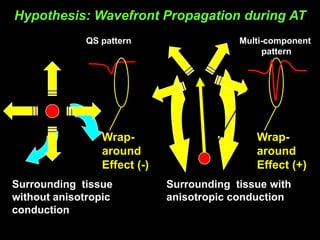
Hypothesis: Wavefront Propagation during AT
             QS pattern                   Multi-component
                                               pattern


                Wrap-                        Wrap-
                around                       around
                Effect (-)                   Effect (+)
Surrounding tissue           Surrounding tissue with
without anisotropic          anisotropic conduction
conduction
Single Focal AT
• Key Locations
  – Identification of Focal Sites (if applicable) ‐
    Focal
  – Identification of Anatomical Barriers (if 
    applicable) ‐ Macroreentrant
  – Identification of Scar (if applicable) –
    Microreentrant (Focal)
Focal Ablation


   •Once the site is identified 25 to 30Watts of RF energy are 
    delivered for 30‐60 seconds
   •Acceleration of the tachycardia before termination is an 
    excellent sign. 
   •Also rapid termination of the tachycardia within 10 seconds of 
    starting the RF delivery is also a good sign. 
   •Successful focal ablation is verified by failure to reinduce the 
    AT before and during an isoproterenol infusion.


(Zipes DP, Jalife J. Cardiac Electrophysiology: From cell to bedside, 4th edition. 2004; pg. 1062-1063)

Atrial tachycardia_lecture