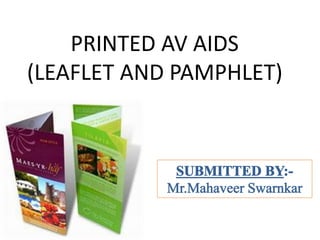
PRINTED AV AIDS
(LEAFLET AND PAMPHLET)
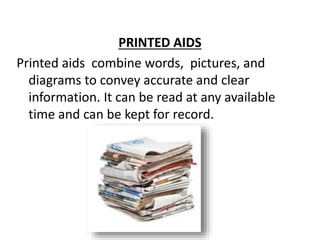
PRINTED AIDS
Printed aids combine words, pictures, and
diagrams to convey accurate and clear
information. It can be read at any available
time and can be kept for record.
CONT……..
It include
• posters,
• leaflets
• pamphlets,
• circular letters,
• newspapers,
and
• magazines.
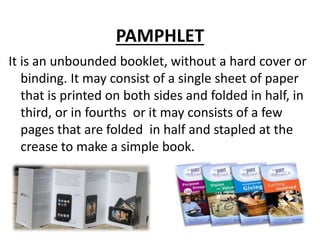
PAMPHLET
It is an unbounded booklet, without a hard cover or
binding. It may consist of a single sheet of paper
that is printed on both sides and folded in half, in
third, or in fourths or it may consists of a few
pages that are folded in half and stapled at the
crease to make a simple book.
STYLES OF PAMPHLET
1. The tutorial style
2. Using the frequently asked question
style
3. The testimonial style
The tutorial style –
• it is basic style .
• it basically involves easing in to the topic of the
pamphlet so that the reader reading it
gradually understands the content.
• It can be done by using different sections by
explaining every step, producing key definition
of the hardest words that they have to tackle
in to the pamphlet.
Using the frequently asked question style.-
• It preparing by frequently asked question
format,
• this involves listing down the frequently
asked questions about pamphlet topic and
answers are provided afterwards .
• By this Reader can centre on to the area of
the pamphlet with their question and read
the information they want.
The testimonial style. –
• it is just like a story telling mode. A story is
narrated about the pamphlet issue and
concepts are introduced one by one.
• It make the learning process ease for most
learners as they see how all concepts are
united together
Advantages.
• They cheap to produce and can be distributed
easily.
• Important tool for political protest and
political campaigning.
• This can be very useful for advertisers as
compared to advertising on the Internet.
• It can be use in a particular geographical area.
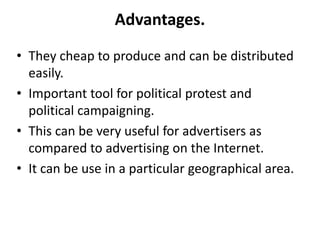
• They can fit a pocket or diary or the
purse so it is for individuals to carry
them home and read latter.
• They can be distributed in many ways
or easily. E.g. - handed out in the
streets or inserted in the newspapers
or left in the post-boxes.
• They are easy and simple to produce.
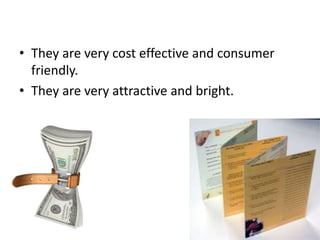
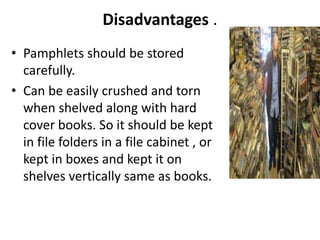
• They are very cost effective and consumer
friendly.
• They are very attractive and bright.
Disadvantages .
• Pamphlets should be stored
carefully.
• Can be easily crushed and torn
when shelved along with hard
cover books. So it should be kept
in file folders in a file cabinet , or
kept in boxes and kept it on
shelves vertically same as books.
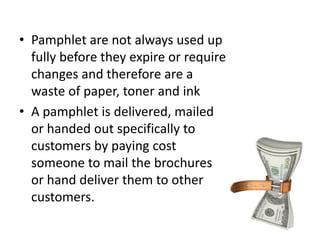
• Pamphlet are not always used up
fully before they expire or require
changes and therefore are a
waste of paper, toner and ink
• A pamphlet is delivered, mailed
or handed out specifically to
customers by paying cost
someone to mail the brochures
or hand deliver them to other
customers.
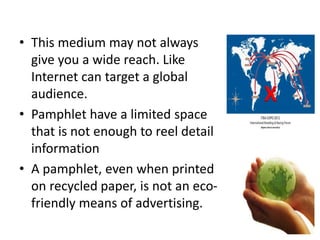
• This medium may not always
give you a wide reach. Like
Internet can target a global
audience.
• Pamphlet have a limited space
that is not enough to reel detail
information
• A pamphlet, even when printed
on recycled paper, is not an eco-
friendly means of advertising.
X
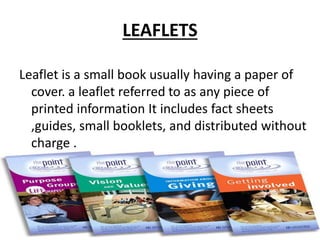
LEAFLETS
Leaflet is a small book usually having a paper of
cover. a leaflet referred to as any piece of
printed information It includes fact sheets
,guides, small booklets, and distributed without
charge .
Categories of leaflet.
• Persuasive.
• Informative.
• Directive.
• Persuasive – attains the objectives through
use of reason . facts are presented so that the
reader is convinced that the conclusion
reached by the propagandist are valid
• Informative – factual ,in presenting facts
previously unknown to the readers , it create
curiosity .
• Directive- it is used to direct and control
activity of ungrounded forces
Guideline for organizing the content of the
leafletsHeading –
1. It is most important part,
2. It should be eye catching.
3. It should be brief, summarizing the
theme by using short, forceful word
Sub-heading –
• used when it is impossible to summarise
the text in the main heading and further
explanation is needed to pointed out
the significance of message
• It should be separate paragraph and
bring gaps between heading and text.
Text-
• the first sentence of the text should
contain the substance of message with the
facts.
• the text should be simple and to the point
• presents only one theme. If more than one
theme is used, they should be closely
related.
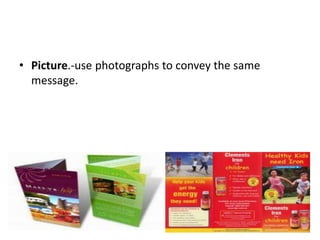
• Picture.-use photographs to convey the same
message.
Disadvantages
• A high illiteracy reduces the effectiveness of
printed materials.
• Printing requires special and logistical
supports.
• It is time consuming and costly.
• Development of effective printed material
requires trained and knowledgeable
persons.
Printed av aid

Printed av aid

  • 1.
  • 2.
    PRINTED AIDS Printed aidscombine words, pictures, and diagrams to convey accurate and clear information. It can be read at any available time and can be kept for record.
  • 3.
    CONT…….. It include • posters, •leaflets • pamphlets, • circular letters, • newspapers, and • magazines.
  • 4.
    PAMPHLET It is anunbounded booklet, without a hard cover or binding. It may consist of a single sheet of paper that is printed on both sides and folded in half, in third, or in fourths or it may consists of a few pages that are folded in half and stapled at the crease to make a simple book.
  • 5.
    STYLES OF PAMPHLET 1.The tutorial style 2. Using the frequently asked question style 3. The testimonial style
  • 6.
    The tutorial style– • it is basic style . • it basically involves easing in to the topic of the pamphlet so that the reader reading it gradually understands the content. • It can be done by using different sections by explaining every step, producing key definition of the hardest words that they have to tackle in to the pamphlet.
  • 7.
    Using the frequentlyasked question style.- • It preparing by frequently asked question format, • this involves listing down the frequently asked questions about pamphlet topic and answers are provided afterwards . • By this Reader can centre on to the area of the pamphlet with their question and read the information they want.
  • 8.
    The testimonial style.– • it is just like a story telling mode. A story is narrated about the pamphlet issue and concepts are introduced one by one. • It make the learning process ease for most learners as they see how all concepts are united together
  • 9.
    Advantages. • They cheapto produce and can be distributed easily. • Important tool for political protest and political campaigning. • This can be very useful for advertisers as compared to advertising on the Internet. • It can be use in a particular geographical area.
  • 10.
    • They canfit a pocket or diary or the purse so it is for individuals to carry them home and read latter. • They can be distributed in many ways or easily. E.g. - handed out in the streets or inserted in the newspapers or left in the post-boxes. • They are easy and simple to produce.
  • 11.
    • They arevery cost effective and consumer friendly. • They are very attractive and bright.
  • 12.
    Disadvantages . • Pamphletsshould be stored carefully. • Can be easily crushed and torn when shelved along with hard cover books. So it should be kept in file folders in a file cabinet , or kept in boxes and kept it on shelves vertically same as books.
  • 13.
    • Pamphlet arenot always used up fully before they expire or require changes and therefore are a waste of paper, toner and ink • A pamphlet is delivered, mailed or handed out specifically to customers by paying cost someone to mail the brochures or hand deliver them to other customers.
  • 14.
    • This mediummay not always give you a wide reach. Like Internet can target a global audience. • Pamphlet have a limited space that is not enough to reel detail information • A pamphlet, even when printed on recycled paper, is not an eco- friendly means of advertising. X
  • 15.
    LEAFLETS Leaflet is asmall book usually having a paper of cover. a leaflet referred to as any piece of printed information It includes fact sheets ,guides, small booklets, and distributed without charge .
  • 16.
    Categories of leaflet. •Persuasive. • Informative. • Directive.
  • 17.
    • Persuasive –attains the objectives through use of reason . facts are presented so that the reader is convinced that the conclusion reached by the propagandist are valid • Informative – factual ,in presenting facts previously unknown to the readers , it create curiosity . • Directive- it is used to direct and control activity of ungrounded forces
  • 18.
    Guideline for organizingthe content of the leafletsHeading – 1. It is most important part, 2. It should be eye catching. 3. It should be brief, summarizing the theme by using short, forceful word
  • 19.
    Sub-heading – • usedwhen it is impossible to summarise the text in the main heading and further explanation is needed to pointed out the significance of message • It should be separate paragraph and bring gaps between heading and text.
  • 20.
    Text- • the firstsentence of the text should contain the substance of message with the facts. • the text should be simple and to the point • presents only one theme. If more than one theme is used, they should be closely related.
  • 21.
    • Picture.-use photographsto convey the same message.
  • 22.
    Disadvantages • A highilliteracy reduces the effectiveness of printed materials. • Printing requires special and logistical supports. • It is time consuming and costly. • Development of effective printed material requires trained and knowledgeable persons.