Presentation on

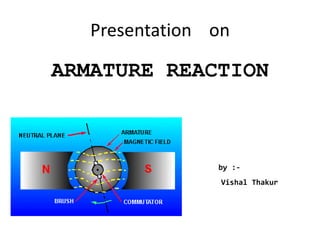
ARMATURE REACTION


                by :-
                 Vishal Thakur
What is Armature Reaction ?


 Armature Reaction in a d.c. machine is
basically the effect of armature produced
    flux on the main flux or field flux .
Effects…
• The armature reaction produces the following
  two undesirable effects:

 1. It demagnetizes or weakens the main flux.

 2. It cross-magnetizes or distorts the main flux.
Reduction in main flux per voltage reduces
the generated voltage and torque whereas
distortion of the main-field flux influences
the limits of successful commutation in d.c.
machines.
Explanation…
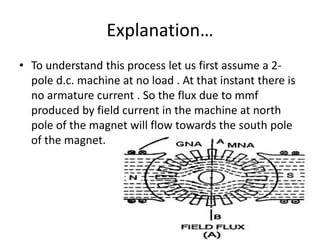
• To understand this process let us first assume a 2-
  pole d.c. machine at no load . At that instant there is
  no armature current . So the flux due to mmf
  produced by field current in the machine at north
  pole of the magnet will flow towards the south pole
  of the magnet.
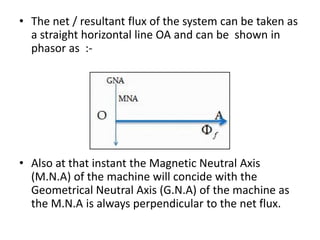
• The net / resultant flux of the system can be taken as
  a straight horizontal line OA and can be shown in
  phasor as :-


• Also at that instant the Magnetic Neutral Axis
  (M.N.A) of the machine will concide with the
  Geometrical Neutral Axis (G.N.A) of the machine as
  the M.N.A is always perpendicular to the net flux.
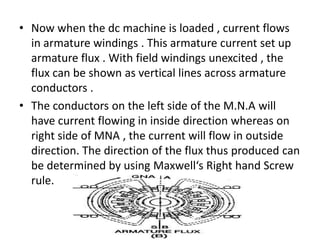
• Now when the dc machine is loaded , current flows
  in armature windings . This armature current set up
  armature flux . With field windings unexcited , the
  flux can be shown as vertical lines across armature
  conductors .
• The conductors on the left side of the M.N.A will
  have current flowing in inside direction whereas on
  right side of MNA , the current will flow in outside
  direction. The direction of the flux thus produced can
  be determined by using Maxwell‘s Right hand Screw
  rule.
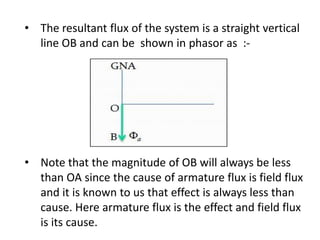
• The resultant flux of the system is a straight vertical
  line OB and can be shown in phasor as :-


• Note that the magnitude of OB will always be less
  than OA since the cause of armature flux is field flux
  and it is known to us that effect is always less than
  cause. Here armature flux is the effect and field flux
  is its cause.
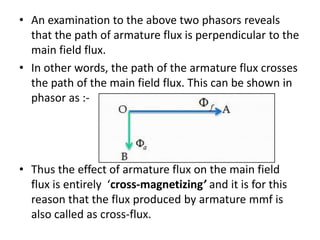
• An examination to the above two phasors reveals
  that the path of armature flux is perpendicular to the
  main field flux.
• In other words, the path of the armature flux crosses
  the path of the main field flux. This can be shown in
  phasor as :-


• Thus the effect of armature flux on the main field
  flux is entirely ‘cross-magnetizing’ and it is for this
  reason that the flux produced by armature mmf is
  also called as cross-flux.
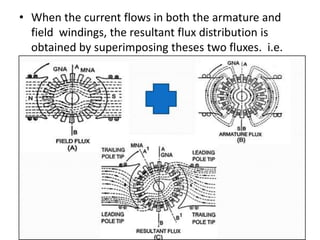
• When the current flows in both the armature and
  field windings, the resultant flux distribution is
  obtained by superimposing theses two fluxes. i.e.
• It is observed that the armature flux aids the main
  field flux at the lower end of the N-pole and at the
  upper end of the S-pole, therefore at these two
  poles, the armature flux strengthens the main field
  flux.
• Likewise, the armature flux weakens the main field
  flux at Upper end of the N-pole and at lower end of
  the S-pole.
• Now, if there is no magnetic saturation, then the
  amount of strengthening and weakening of the main
  field flux are equal and the resultant flux per pole
  remains unaltered from its no load value.

• Actually, the magnetic saturation does occurs and as
  a consequence, the strengthening effect is less as
  compared to the weakening effect and the resultant
  flux is decreased from its no-load value. This is called
  ‘Demagnetizing effect of armature reaction’
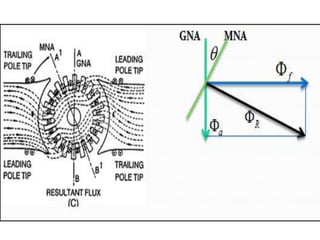
• So when the machine is run loaded , M.N.A will shift
  from G.N.A of the machine .

• The resultant shift is completely dependent on the
  magnitude of armature current.

• Thus, greater the value of armature current , greater
  is the shift of MNA from GNA .
• It may therefore be stated from the above that
  net effect of armature flux on the main field flux
  is:-

1. To distort the main field flux thereby causing
   non-uniform distribution of flux under the main
   poles.
2. To shift the MNA in the direction of the rotation
   for a generator and against the direction of
   rotation for a motor.
3. To reduce the main field flux from its no-load
   value due to magnetic saturation.
Methods to reduce Armature Reaction
• There are various methods of reducing the armature
  reaction, some of them are:-

1. Compensate Windings

2. Interpoles or copoles
Compensating Windings
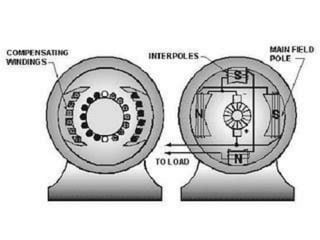
• The compensating windings consist of a series
  of coils embedded in slots in the pole faces.


• These coils are connected in series with the
  armature in such a way that the current in
  them flows in opposite direction to that
  flowing in armature conductors directly below
  the pole shoes.
• The series-connected compensating windings
  produce a magnetic field, which varies directly
  with armature current.


• As the compensating windings are wound to
  produce a field that opposes the magnetic
  field of the armature, they tend to cancel the
  effects of the armature magnetic field.
Interpoles
• Another way to reduce the effects of armature
  reaction is to place small auxiliary poles
  called "interpoles" between the main field
  poles.

• Interpoles have a few turns of large wire and
  are connected in series with the armature.
• Interpoles are wound and placed so that each
  interpole has the same magnetic polarity as the
  main pole ahead of it, in the direction of rotation.

• The field generated by the interpoles produces
  the same effect as the compensating winding.
  This field, in effect, cancels the armature reaction
  for all values of load current.
Armature Reaction

Armature Reaction

  • 1.
  • 2.
    What is ArmatureReaction ? Armature Reaction in a d.c. machine is basically the effect of armature produced flux on the main flux or field flux .
  • 3.
    Effects… • The armaturereaction produces the following two undesirable effects: 1. It demagnetizes or weakens the main flux. 2. It cross-magnetizes or distorts the main flux.
  • 4.
    Reduction in mainflux per voltage reduces the generated voltage and torque whereas distortion of the main-field flux influences the limits of successful commutation in d.c. machines.
  • 5.
    Explanation… • To understandthis process let us first assume a 2- pole d.c. machine at no load . At that instant there is no armature current . So the flux due to mmf produced by field current in the machine at north pole of the magnet will flow towards the south pole of the magnet.
  • 6.
    • The net/ resultant flux of the system can be taken as a straight horizontal line OA and can be shown in phasor as :- • Also at that instant the Magnetic Neutral Axis (M.N.A) of the machine will concide with the Geometrical Neutral Axis (G.N.A) of the machine as the M.N.A is always perpendicular to the net flux.
  • 7.
    • Now whenthe dc machine is loaded , current flows in armature windings . This armature current set up armature flux . With field windings unexcited , the flux can be shown as vertical lines across armature conductors . • The conductors on the left side of the M.N.A will have current flowing in inside direction whereas on right side of MNA , the current will flow in outside direction. The direction of the flux thus produced can be determined by using Maxwell‘s Right hand Screw rule.
  • 8.
    • The resultantflux of the system is a straight vertical line OB and can be shown in phasor as :- • Note that the magnitude of OB will always be less than OA since the cause of armature flux is field flux and it is known to us that effect is always less than cause. Here armature flux is the effect and field flux is its cause.
  • 9.
    • An examinationto the above two phasors reveals that the path of armature flux is perpendicular to the main field flux. • In other words, the path of the armature flux crosses the path of the main field flux. This can be shown in phasor as :- • Thus the effect of armature flux on the main field flux is entirely ‘cross-magnetizing’ and it is for this reason that the flux produced by armature mmf is also called as cross-flux.
  • 10.
    • When thecurrent flows in both the armature and field windings, the resultant flux distribution is obtained by superimposing theses two fluxes. i.e.
  • 11.
    • It isobserved that the armature flux aids the main field flux at the lower end of the N-pole and at the upper end of the S-pole, therefore at these two poles, the armature flux strengthens the main field flux. • Likewise, the armature flux weakens the main field flux at Upper end of the N-pole and at lower end of the S-pole.
  • 13.
    • Now, ifthere is no magnetic saturation, then the amount of strengthening and weakening of the main field flux are equal and the resultant flux per pole remains unaltered from its no load value. • Actually, the magnetic saturation does occurs and as a consequence, the strengthening effect is less as compared to the weakening effect and the resultant flux is decreased from its no-load value. This is called ‘Demagnetizing effect of armature reaction’
  • 14.
    • So whenthe machine is run loaded , M.N.A will shift from G.N.A of the machine . • The resultant shift is completely dependent on the magnitude of armature current. • Thus, greater the value of armature current , greater is the shift of MNA from GNA .
  • 15.
    • It maytherefore be stated from the above that net effect of armature flux on the main field flux is:- 1. To distort the main field flux thereby causing non-uniform distribution of flux under the main poles. 2. To shift the MNA in the direction of the rotation for a generator and against the direction of rotation for a motor. 3. To reduce the main field flux from its no-load value due to magnetic saturation.
  • 16.
    Methods to reduceArmature Reaction • There are various methods of reducing the armature reaction, some of them are:- 1. Compensate Windings 2. Interpoles or copoles
  • 17.
    Compensating Windings • Thecompensating windings consist of a series of coils embedded in slots in the pole faces. • These coils are connected in series with the armature in such a way that the current in them flows in opposite direction to that flowing in armature conductors directly below the pole shoes.
  • 18.
    • The series-connectedcompensating windings produce a magnetic field, which varies directly with armature current. • As the compensating windings are wound to produce a field that opposes the magnetic field of the armature, they tend to cancel the effects of the armature magnetic field.
  • 20.
    Interpoles • Another wayto reduce the effects of armature reaction is to place small auxiliary poles called "interpoles" between the main field poles. • Interpoles have a few turns of large wire and are connected in series with the armature.
  • 21.
    • Interpoles arewound and placed so that each interpole has the same magnetic polarity as the main pole ahead of it, in the direction of rotation. • The field generated by the interpoles produces the same effect as the compensating winding. This field, in effect, cancels the armature reaction for all values of load current.