GANDHINAGAR INSTITUTE OF
TECHNOLOGY
Design of dc machines and transformer
Subject Code:(2160912)
Topic :
“Effect and minimization of armature reaction”
PREPARED BY: GUIDED BY:
Prof. Purv Mistry
NAYAN SOLANKI(130120109055)
VIPUL SOLANKI(130120109061)
KAUSHEEL CHARAN(130120109064)
Content
• Armature reaction
• Demagnetizing and Cross-magnetizing Conductors
• Compensating Windings
• Commutation
• Methods of Improving Commutation
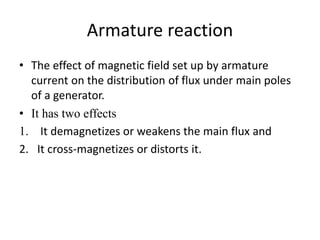
Armature reaction
• The effect of magnetic field set up by armature
current on the distribution of flux under main poles
of a generator.
• It has two effects
1. It demagnetizes or weakens the main flux and
2. It cross-magnetizes or distorts it.
Continue..
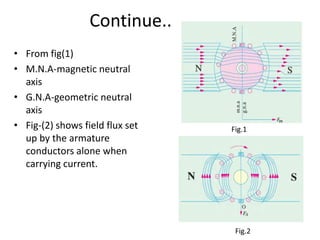
• From fig(1)
• M.N.A-magnetic neutral
axis
• G.N.A-geometric neutral
axis
• Fig-(2) shows field flux set
up by the armature
conductors alone when
carrying current.
Fig.1
Fig.2
Continue..
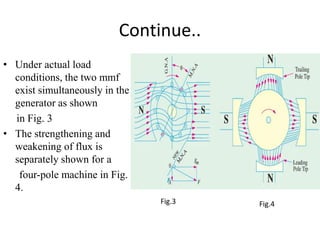
• Under actual load
conditions, the two mmf
exist simultaneously in the
generator as shown
in Fig. 3
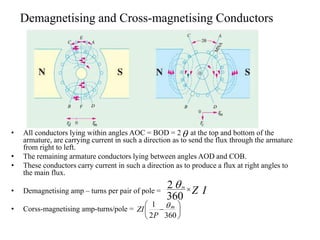
• The strengthening and
weakening of flux is
separately shown for a
four-pole machine in Fig.
4.
Fig.3 Fig.4
Demagnetising and Cross-magnetising Conductors
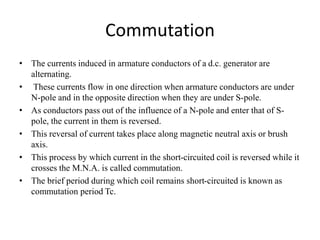
• All conductors lying within angles AOC = BOD = 2 at the top and bottom of the
armature, are carrying current in such a direction as to send the flux through the armature
from right to left.
• The remaining armature conductors lying between angles AOD and COB.
• These conductors carry current in such a direction as to produce a flux at right angles to
the main flux.
• Demagnetising amp – turns per pair of pole =
• Corss-magnetising amp-turns/pole =

IZm

360
2 







3602
1 m
P
ZI
Compensating Windings
• These are used for large direct
current machines which are
subjected to large fluctuations
in load.
• Their function is to neutralize
the cross magnetizing effect of
armature reaction.
• No. of armature-turns
immediately under one pole=
pitchpole
arcpole

p2
z
No. of armature amp-turns/pole for compensating winding=
p
z
2
7.0 
Commutation
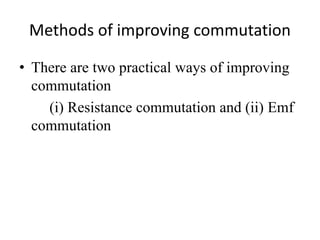
• The currents induced in armature conductors of a d.c. generator are
alternating.
• These currents flow in one direction when armature conductors are under
N-pole and in the opposite direction when they are under S-pole.
• As conductors pass out of the influence of a N-pole and enter that of S-
pole, the current in them is reversed.
• This reversal of current takes place along magnetic neutral axis or brush
axis.
• This process by which current in the short-circuited coil is reversed while it
crosses the M.N.A. is called commutation.
• The brief period during which coil remains short-circuited is known as
commutation period Tc.
Methods of improving commutation
• There are two practical ways of improving
commutation
(i) Resistance commutation and (ii) Emf
commutation
Resistance commutation
• This method of improving commutation consists of replacing low-
resistance Cu brushes by comparatively high-resistance carbon brushes.
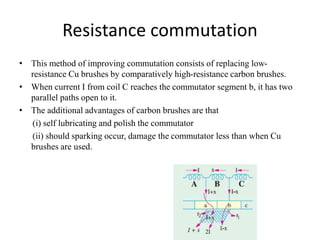
• When current I from coil C reaches the commutator segment b, it has two
parallel paths open to it.
• The additional advantages of carbon brushes are that
(i) self lubricating and polish the commutator
(ii) should sparking occur, damage the commutator less than when Cu
brushes are used.
Continue..
• Disadvantages are:
(i) Due to their high contact resistance -which is beneficial to sparkless
commutation a loss of approximately 2 volt is caused. Hence, they are not
much suitable for small machines where this voltage forms an appreciable
percentage loss.
(ii) Owing to this large loss, the commutator has to be made some what
larger than with Cu brushes in order to dissipate heat efficiently without
greater rise of temperature.
(iii) because of their lower current density (about 7-8 A/cm2 as compared to
25-30 A/cm2 for Cu brushes) they need larger brush holders
Emf commutation
• In this method, arrangement is made to neutralize the reactance voltage by
producing a reversing emf in the short-circuited coil under commutation.
• This reversing emf, as the name shows, is an emf in opposition to the
reactance voltage and if its value is made equal to the latter, it will
completely wipe it off, thereby producing quick reversal of current in the
short-circuited coil which will result in sparkless commutation.
• The reversing emf may be produced in two ways:
(i) either by giving the brushes a forward lead sufficient enough to bring
the short-circuited coil under the influence of next pole of opposite polarity
or
(ii) by using interpoles. The first method was used in the early machines
but has now been abandoned due to many other
• difficulties it brings along with.
Interpoles of Compoles
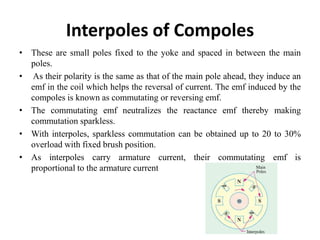
• These are small poles fixed to the yoke and spaced in between the main
poles.
• As their polarity is the same as that of the main pole ahead, they induce an
emf in the coil which helps the reversal of current. The emf induced by the
compoles is known as commutating or reversing emf.
• The commutating emf neutralizes the reactance emf thereby making
commutation sparkless.
• With interpoles, sparkless commutation can be obtained up to 20 to 30%
overload with fixed brush position.
• As interpoles carry armature current, their commutating emf is
proportional to the armature current
Continue…
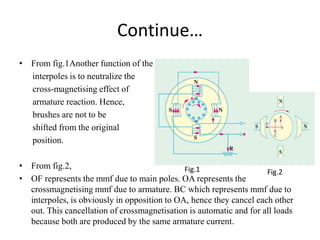
• From fig.1Another function of the
interpoles is to neutralize the
cross-magnetising effect of
armature reaction. Hence,
brushes are not to be
shifted from the original
position.
• From fig.2,
• OF represents the mmf due to main poles. OA represents the
crossmagnetising mmf due to armature. BC which represents mmf due to
interpoles, is obviously in opposition to OA, hence they cancel each other
out. This cancellation of crossmagnetisation is automatic and for all loads
because both are produced by the same armature current.
Fig.1 Fig.2
armature reaction effect and minimization methods

armature reaction effect and minimization methods

  • 1.
    GANDHINAGAR INSTITUTE OF TECHNOLOGY Designof dc machines and transformer Subject Code:(2160912) Topic : “Effect and minimization of armature reaction” PREPARED BY: GUIDED BY: Prof. Purv Mistry NAYAN SOLANKI(130120109055) VIPUL SOLANKI(130120109061) KAUSHEEL CHARAN(130120109064)
  • 2.
    Content • Armature reaction •Demagnetizing and Cross-magnetizing Conductors • Compensating Windings • Commutation • Methods of Improving Commutation
  • 3.
    Armature reaction • Theeffect of magnetic field set up by armature current on the distribution of flux under main poles of a generator. • It has two effects 1. It demagnetizes or weakens the main flux and 2. It cross-magnetizes or distorts it.
  • 4.
    Continue.. • From fig(1) •M.N.A-magnetic neutral axis • G.N.A-geometric neutral axis • Fig-(2) shows field flux set up by the armature conductors alone when carrying current. Fig.1 Fig.2
  • 5.
    Continue.. • Under actualload conditions, the two mmf exist simultaneously in the generator as shown in Fig. 3 • The strengthening and weakening of flux is separately shown for a four-pole machine in Fig. 4. Fig.3 Fig.4
  • 6.
    Demagnetising and Cross-magnetisingConductors • All conductors lying within angles AOC = BOD = 2 at the top and bottom of the armature, are carrying current in such a direction as to send the flux through the armature from right to left. • The remaining armature conductors lying between angles AOD and COB. • These conductors carry current in such a direction as to produce a flux at right angles to the main flux. • Demagnetising amp – turns per pair of pole = • Corss-magnetising amp-turns/pole =  IZm  360 2         3602 1 m P ZI
  • 7.
    Compensating Windings • Theseare used for large direct current machines which are subjected to large fluctuations in load. • Their function is to neutralize the cross magnetizing effect of armature reaction. • No. of armature-turns immediately under one pole= pitchpole arcpole  p2 z No. of armature amp-turns/pole for compensating winding= p z 2 7.0 
  • 8.
    Commutation • The currentsinduced in armature conductors of a d.c. generator are alternating. • These currents flow in one direction when armature conductors are under N-pole and in the opposite direction when they are under S-pole. • As conductors pass out of the influence of a N-pole and enter that of S- pole, the current in them is reversed. • This reversal of current takes place along magnetic neutral axis or brush axis. • This process by which current in the short-circuited coil is reversed while it crosses the M.N.A. is called commutation. • The brief period during which coil remains short-circuited is known as commutation period Tc.
  • 9.
    Methods of improvingcommutation • There are two practical ways of improving commutation (i) Resistance commutation and (ii) Emf commutation
  • 10.
    Resistance commutation • Thismethod of improving commutation consists of replacing low- resistance Cu brushes by comparatively high-resistance carbon brushes. • When current I from coil C reaches the commutator segment b, it has two parallel paths open to it. • The additional advantages of carbon brushes are that (i) self lubricating and polish the commutator (ii) should sparking occur, damage the commutator less than when Cu brushes are used.
  • 11.
    Continue.. • Disadvantages are: (i)Due to their high contact resistance -which is beneficial to sparkless commutation a loss of approximately 2 volt is caused. Hence, they are not much suitable for small machines where this voltage forms an appreciable percentage loss. (ii) Owing to this large loss, the commutator has to be made some what larger than with Cu brushes in order to dissipate heat efficiently without greater rise of temperature. (iii) because of their lower current density (about 7-8 A/cm2 as compared to 25-30 A/cm2 for Cu brushes) they need larger brush holders
  • 12.
    Emf commutation • Inthis method, arrangement is made to neutralize the reactance voltage by producing a reversing emf in the short-circuited coil under commutation. • This reversing emf, as the name shows, is an emf in opposition to the reactance voltage and if its value is made equal to the latter, it will completely wipe it off, thereby producing quick reversal of current in the short-circuited coil which will result in sparkless commutation. • The reversing emf may be produced in two ways: (i) either by giving the brushes a forward lead sufficient enough to bring the short-circuited coil under the influence of next pole of opposite polarity or (ii) by using interpoles. The first method was used in the early machines but has now been abandoned due to many other • difficulties it brings along with.
  • 13.
    Interpoles of Compoles •These are small poles fixed to the yoke and spaced in between the main poles. • As their polarity is the same as that of the main pole ahead, they induce an emf in the coil which helps the reversal of current. The emf induced by the compoles is known as commutating or reversing emf. • The commutating emf neutralizes the reactance emf thereby making commutation sparkless. • With interpoles, sparkless commutation can be obtained up to 20 to 30% overload with fixed brush position. • As interpoles carry armature current, their commutating emf is proportional to the armature current
  • 14.
    Continue… • From fig.1Anotherfunction of the interpoles is to neutralize the cross-magnetising effect of armature reaction. Hence, brushes are not to be shifted from the original position. • From fig.2, • OF represents the mmf due to main poles. OA represents the crossmagnetising mmf due to armature. BC which represents mmf due to interpoles, is obviously in opposition to OA, hence they cancel each other out. This cancellation of crossmagnetisation is automatic and for all loads because both are produced by the same armature current. Fig.1 Fig.2