Decision Making
An essence to problem solving


                                Page 1
Decision Making


• ― the process of responding to a problem by searching
  and selecting a solution or course of action‖.

• There are basically two kinds of decision that are called
  upon to make:


  Programmed and non-programmed
                                                        Page 2
Types of Problems and Decisions
• Structured problems
 * Involve clear goals.
 *Are familiar (have occurred
   before)
 *Are easily and completely
  defined- information about the
   problem is available and complete.

• Programmed decision
 *A repetitive decision the can be handled by a
 routine approach.

                                             Page 3
• Unstructured problems
 * Problems that are new or unusual and for which
 information is ambiguous or incomplete.
 * Problems that will require custom-made
 solutions.


• Non-programmed decisions
 * Decision that are unique and non-recurring.
 * Decision that generate unique responses.


                                                 Page 4
Vitals of Decision making process
• Policy
• a general guideline for making a decision about a
  problem.
• Procedure
  * A series of interrelated steps that decision maker
  can use to respond ( applying a policy) to a problem.
• Rule
  * an explicit statement that limits what can or cannot
  be done.


                                                  Page 5
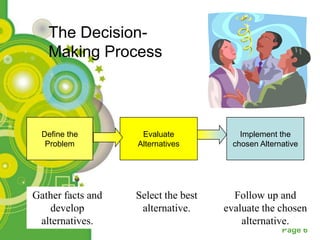
The Decision-
   Making Process


  Define the        Evaluate             Implement the
   Problem         Alternatives        chosen Alternative


Gather facts and   Select the best     Follow up and
   develop          alternative.     evaluate the chosen
 alternatives.                           alternative.
                                                    Page 6
Decision Making Process

•   Identifying Problem
•   Identifying Decision Criteria
•   Allocating Weights to the Criteria
•   Developing Alternatives
•   Analyzing Alternatives
•   Select Alternatives.
•   Implement Alternatives.
•   Evaluating decision’s effectiveness.


                                           Page 7
Step 1: Identifying the Problem

* A problem becomes a problem when
someone becomes aware of it.
* there is always a pressure to solve the
problem.
* the person must have the
authority, information, or resources
needed to solve the problem.


                                        Page 8
Step 2: Identify the Decision Criteria
 • Decision criteria are factors that are
   important ( relevant) to resolving the
   problem.
   * Costs that will be incurred (investment
   required).
   * Risks likely to be encountered ( chance
   of failure).
   * Outcomes that are desired ( growth of
   the firm).

                                           Page 9
Step 3: Allocating Weights to the
             Criteria
• Decision criteria is of equal importance:
  * Assigning a weight to each item.
  * Places the items in the correct priority
  order of their importance in the decision
  making process.


                                               Page 10
Step 4: Developing Alternatives

• Identifying viable alternatives.
  * Alternatives are listed ( without
  evaluation) that can resolve the problem.


                                      Page 11
Step 5 :Analyzing alternatives


• Appraising each alternative’s
  strengths and weaknesses
  * An alternative’s appraisal is based
  on its ability to resolve the issues
  identified


                                      Page 12
Step 6: Selecting the alternative

   • Choosing the best
     alternative
     * The alternative with the
        highest total weight is chosen.


                                     Page 13
Step 7: Implementing the
           Alternative

• Putting the decision to and gaining
  comment from those whose will carry
  out the decision.


                                   Page 14
Step 8: Evaluating the decision’s
            effectiveness

• The soundness of the decision
   is judged by its outcomes.
  * How effectively was the problem
  resolved by outcomes resulting from
  the chosen alternatives?
  * if the problem was not resolve, what
  went wrong?
                                           Page 15
Intuition

* It is making decisions on the
basis of experience, feelings, and
accumulated judgment.


                                 Page 16
Decision Making Conditions

• Certainty
  * A situation in which someone can make
  an accurate decision because the
  outcome of every alternative choice is
  known.
• Risk
  * A situation in which the someone is able
  to estimate the likelihood (probability) of
  outcomes that result from the choice of
  particular alternatives.
                                           Page 17
• Uncertainty
  * limited information prevents estimation of
  outcome probabilities for alternatives
  associated with the problem and may force to
  rely on intuition, hunches, and ―gut feelings‖.
   # Maximax: The optimistic person’s choice to
  maximize the maximum outcome.
   # Maximin: The pessimistic person’s choice to
  maximize the minimum outcome.
    # Minimax: The choice to minimize maximum
  regret.
                                            Page 18
Types of Decision Makers
* Directive
  # Use minimal information and consider few
alternatives.
* Analytic
  # Make careful decisions in unique situations.
* Conceptual
  # Maintain a broad outlook and consider many
alternatives in making decisions.
* Behavioral
  # Avoid conflict by working well with others and
being receptive to suggestions.
                                               Page 19
Rational (Logical) Decision Model
Steps
Scanning the situation—identifying a signal that a
 decision should be made.

Classify the decision as routine, apply the
 appropriate decision rule; as non-
 programmed, begin comprehensive problem
 solving.

Monitor and follow-up as necessary.

                                               Page 20
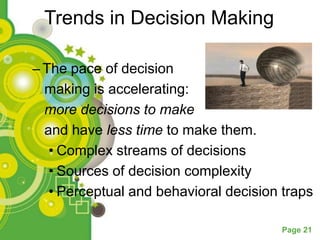
Trends in Decision Making

– The pace of decision
 making is accelerating:
 more decisions to make
 and have less time to make them.
  • Complex streams of decisions
  • Sources of decision complexity
  • Perceptual and behavioral decision traps

                                       Page 21
Dealing with Complex Streams
           of Decisions
– Multiple criteria to be satisfied by a decision.
– Intangibles that often determine decision
  alternatives.
– Risk and uncertainty about decision alternatives.
– Long-term implications of the effects of the
  choice of a particular alternative.
– Interdisciplinary input increases the number of
  persons to be consulted before a decision is made.


                                                 Page 22
– Pooled decision making increases the
 number of persons playing a part in the decision
 process.
– Value judgments by differing participants
 in the process create disagreement over
 whether a decision is right or wrong, good or
 bad, and ethical or unethical.
– Unintended consequences occur because
 the results of purposeful actions cannot always
 be predicted.

                                             Page 23
Guidelines for effective
          decision making
 Categorical interpretation- the problem should be
  defined properly.
 Application of limiting factor- limiting factor
  should be taken into account in order to analyze
 Adequate information- more quantity of reliable
  information leads to effective decision making.
 Considering other views- various views at the
  same point are taken into account for quality
  decision.
 Timeliness- decision should be ,made at proper
  time to meet the competitive advantages.
                                              Page 24
Techniques improving decision
              making
 Brainstorming – idea generation for decision
  making.
 Nominal group technique (NGT)- problem
  outlined, presentation of solution in written
  form, discussion over written solutions, and final
  decision.
 Delphi technique- decision made on the basis of
  questionnaire filled by the respondents.
 Consensus mapping- decision made on the basis
  of the report presented by the representative of
  each group after                                 Page 25
Page 26

Decision making

  • 1.
    Decision Making An essenceto problem solving Page 1
  • 2.
    Decision Making • ―the process of responding to a problem by searching and selecting a solution or course of action‖. • There are basically two kinds of decision that are called upon to make: Programmed and non-programmed Page 2
  • 3.
    Types of Problemsand Decisions • Structured problems * Involve clear goals. *Are familiar (have occurred before) *Are easily and completely defined- information about the problem is available and complete. • Programmed decision *A repetitive decision the can be handled by a routine approach. Page 3
  • 4.
    • Unstructured problems * Problems that are new or unusual and for which information is ambiguous or incomplete. * Problems that will require custom-made solutions. • Non-programmed decisions * Decision that are unique and non-recurring. * Decision that generate unique responses. Page 4
  • 5.
    Vitals of Decisionmaking process • Policy • a general guideline for making a decision about a problem. • Procedure * A series of interrelated steps that decision maker can use to respond ( applying a policy) to a problem. • Rule * an explicit statement that limits what can or cannot be done. Page 5
  • 6.
    The Decision- Making Process Define the Evaluate Implement the Problem Alternatives chosen Alternative Gather facts and Select the best Follow up and develop alternative. evaluate the chosen alternatives. alternative. Page 6
  • 7.
    Decision Making Process • Identifying Problem • Identifying Decision Criteria • Allocating Weights to the Criteria • Developing Alternatives • Analyzing Alternatives • Select Alternatives. • Implement Alternatives. • Evaluating decision’s effectiveness. Page 7
  • 8.
    Step 1: Identifyingthe Problem * A problem becomes a problem when someone becomes aware of it. * there is always a pressure to solve the problem. * the person must have the authority, information, or resources needed to solve the problem. Page 8
  • 9.
    Step 2: Identifythe Decision Criteria • Decision criteria are factors that are important ( relevant) to resolving the problem. * Costs that will be incurred (investment required). * Risks likely to be encountered ( chance of failure). * Outcomes that are desired ( growth of the firm). Page 9
  • 10.
    Step 3: AllocatingWeights to the Criteria • Decision criteria is of equal importance: * Assigning a weight to each item. * Places the items in the correct priority order of their importance in the decision making process. Page 10
  • 11.
    Step 4: DevelopingAlternatives • Identifying viable alternatives. * Alternatives are listed ( without evaluation) that can resolve the problem. Page 11
  • 12.
    Step 5 :Analyzingalternatives • Appraising each alternative’s strengths and weaknesses * An alternative’s appraisal is based on its ability to resolve the issues identified Page 12
  • 13.
    Step 6: Selectingthe alternative • Choosing the best alternative * The alternative with the highest total weight is chosen. Page 13
  • 14.
    Step 7: Implementingthe Alternative • Putting the decision to and gaining comment from those whose will carry out the decision. Page 14
  • 15.
    Step 8: Evaluatingthe decision’s effectiveness • The soundness of the decision is judged by its outcomes. * How effectively was the problem resolved by outcomes resulting from the chosen alternatives? * if the problem was not resolve, what went wrong? Page 15
  • 16.
    Intuition * It ismaking decisions on the basis of experience, feelings, and accumulated judgment. Page 16
  • 17.
    Decision Making Conditions •Certainty * A situation in which someone can make an accurate decision because the outcome of every alternative choice is known. • Risk * A situation in which the someone is able to estimate the likelihood (probability) of outcomes that result from the choice of particular alternatives. Page 17
  • 18.
    • Uncertainty * limited information prevents estimation of outcome probabilities for alternatives associated with the problem and may force to rely on intuition, hunches, and ―gut feelings‖. # Maximax: The optimistic person’s choice to maximize the maximum outcome. # Maximin: The pessimistic person’s choice to maximize the minimum outcome. # Minimax: The choice to minimize maximum regret. Page 18
  • 19.
    Types of DecisionMakers * Directive # Use minimal information and consider few alternatives. * Analytic # Make careful decisions in unique situations. * Conceptual # Maintain a broad outlook and consider many alternatives in making decisions. * Behavioral # Avoid conflict by working well with others and being receptive to suggestions. Page 19
  • 20.
    Rational (Logical) DecisionModel Steps Scanning the situation—identifying a signal that a decision should be made. Classify the decision as routine, apply the appropriate decision rule; as non- programmed, begin comprehensive problem solving. Monitor and follow-up as necessary. Page 20
  • 21.
    Trends in DecisionMaking – The pace of decision making is accelerating: more decisions to make and have less time to make them. • Complex streams of decisions • Sources of decision complexity • Perceptual and behavioral decision traps Page 21
  • 22.
    Dealing with ComplexStreams of Decisions – Multiple criteria to be satisfied by a decision. – Intangibles that often determine decision alternatives. – Risk and uncertainty about decision alternatives. – Long-term implications of the effects of the choice of a particular alternative. – Interdisciplinary input increases the number of persons to be consulted before a decision is made. Page 22
  • 23.
    – Pooled decisionmaking increases the number of persons playing a part in the decision process. – Value judgments by differing participants in the process create disagreement over whether a decision is right or wrong, good or bad, and ethical or unethical. – Unintended consequences occur because the results of purposeful actions cannot always be predicted. Page 23
  • 24.
    Guidelines for effective decision making  Categorical interpretation- the problem should be defined properly.  Application of limiting factor- limiting factor should be taken into account in order to analyze  Adequate information- more quantity of reliable information leads to effective decision making.  Considering other views- various views at the same point are taken into account for quality decision.  Timeliness- decision should be ,made at proper time to meet the competitive advantages. Page 24
  • 25.
    Techniques improving decision making  Brainstorming – idea generation for decision making.  Nominal group technique (NGT)- problem outlined, presentation of solution in written form, discussion over written solutions, and final decision.  Delphi technique- decision made on the basis of questionnaire filled by the respondents.  Consensus mapping- decision made on the basis of the report presented by the representative of each group after Page 25
  • 26.