3 point starter
Unit 3
1
3 point starter
• A 3 point starter in simple words is a device
that helps in the starting and running of
a shunt wound dc motor or compound wound
dc motor in a safe mode.
• Now the question is why these types of dc
motors require the assistance of the starter in
the first case
2
3 point starter
• The only explanation to that is given by the
presence of back emf Eb, which plays a critical
role in governing the operation of the motor.
• The back emf, develops as the motor
armature starts to rotate in presence of the
magnetic field, by generating action and
counters the supply voltage.
3
Back EMF
• When the armature of a DC motor rotates
under the influence of the driving torque, the
armature conductors move through the
magnetic field and hence emf is induced in
them as in a generator. The induced emf acts
in opposite direction to the applied voltage V
(Lenz's law) and is known as Back EMF or
Counter EMF (Eb).
4
3 point starter
• This also essentially means, that the back emf
at the starting is zero, and develops gradually
as the motor gathers speed.
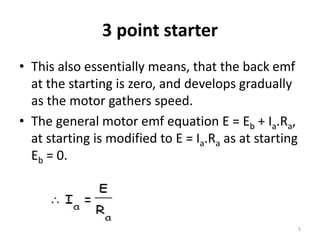
• The general motor emf equation E = Eb + Ia.Ra,
at starting is modified to E = Ia.Ra as at starting
Eb = 0.
5
3 point starter
• Thus we can well understand from the above
equation that the current will be dangerously
high at starting (as armature resistance Ra is
small) and hence its important that we make
use of a device like the 3 point starter to limit
the starting current to an allowable lower
value.
6
Construction
7
Construction
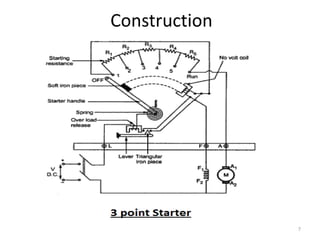
• Construction wise a starter is a variable
resistance, integrated into number of sections
as shown in the figure .
• The contact points of these sections are called
studs and are shown separately as OFF, 1,
2,3,4,5, RUN.
8
Construction
• Other than that there are 3 main points, referred
to as
1. ‘L’ Line terminal. (Connected to positive of
supply.)
2. ‘A’ Armature terminal. (Connected to the
armature winding.)
3. ‘F’ Field terminal. (Connected to the field
winding.)
9
Construction
• And from there it gets the name 3 point starter
• The Point ‘L’ is connected to an electromagnet
called overload release (OLR) as shown in the
figure.
• The other end of ‘OLR’ is connected to the lower
end of conducting lever of starter handle where a
spring is also attached with it and the starter
handle contains also a soft iron piece housed on
it.
10
Construction
• This handle is free to move to the other side
RUN against the force of the spring.
• This spring brings back the handle to its
original OFF position under the influence of its
own force.
• Another parallel path is derived from the stud
’1′, given to the another electromagnet called
No Volt Coil (NVC)which is further connected
to terminal ‘F’.
11
Construction
• The starting resistance at starting is entirely in
series with the armature. The OLR and NVC
acts as the two protecting devices of the
starter.
12
Working of Three Point Starter
• To start with the handle is in the OFF position
when the supply to the d.c. motor is switched
on.
• Then handle is slowly moved against the
spring force to make a contact with stud No. 1.
• At this point, field winding of the shunt or the
compound motor gets supply through the
parallel path provided to starting resistance,
through No Voltage Coil.
13
Working of Three Point Starter
• While entire starting resistance comes in series
with the armature.
• The high starting armature current thus gets
limited as the current equation at this stage
becomes Ia = E/(Ra+Rst).
• As the handle is moved further, it goes on making
contact with studs 2, 3, 4 etc.,
• Thus gradually cutting off the series resistance
from the armature circuit as the motor gathers
speed.
14
Working of Three Point Starter
• Finally when the starter handle is in ‘RUN’
position, the entire starting resistance is
eliminated and the motor runs with normal
speed.
• This is because back emf is developed
consequently with speed to counter the
supply voltage and reduce the armature
current.
15
Working of Three Point Starter
• So the external resistance is not required
anymore, and is removed for optimum operation.
• The handle is moved manually from OFF to the
RUN position with development of speed. Now
the obvious question is once the handle is taken
to the RUN position how is it supposed to stay
there, as long as motor is running ?
• To find the answer to this question let us look
into the working of No Voltage Coil.
16
Working of No Voltage Coil of 3 point
starter
• The supply to the field winding is derived
through No Voltage Coil.
• So when field current flows, the NVC is
magnetized.
• Now when the handle is in the ‘RUN’ position,
soft iron piece connected to the handle and
gets attracted by the magnetic force produced
by NVC, because of flow of current through it.
17
Working of No Voltage Coil of 3 point
starter
• The NVC is designed in such a way that it
holds the handle in ‘RUN’ position against the
force of the spring as long as supply is given to
the motor.
• Thus NVC holds the handle in the ‘RUN’
position and hence also called hold on coil.
18
Working of No Voltage Coil of 3 point
starter
• Now when there is any kind of supply failure,
the current flow through NVC is affected and it
immediately looses its magnetic property and
is unable to keep the soft iron piece on the
handle, attracted.
• At this point under the action of the spring
force, the handle comes back to OFF position,
opening the circuit and thus switching off the
motor.
19
Working of No Voltage Coil of 3 point
starter
• So due to the combination of NVC and the
spring, the starter handle always comes back
to OFF position whenever there is any supply
problems.
• Thus it also acts as a protective device
safeguarding the motor from any kind of
abnormality.
20
Drawbacks of a Three Point Starter
• To increase the speed of the motor field
resistance can be increased.
• Therefore current through the shunt field is
reduced.
• Field current becomes very low which results
in holding electromagnet too weak to
overcome the force exerted by the spring.
21
Thank you
22

3 point starter

  • 1.
  • 2.
    3 point starter •A 3 point starter in simple words is a device that helps in the starting and running of a shunt wound dc motor or compound wound dc motor in a safe mode. • Now the question is why these types of dc motors require the assistance of the starter in the first case 2
  • 3.
    3 point starter •The only explanation to that is given by the presence of back emf Eb, which plays a critical role in governing the operation of the motor. • The back emf, develops as the motor armature starts to rotate in presence of the magnetic field, by generating action and counters the supply voltage. 3
  • 4.
    Back EMF • Whenthe armature of a DC motor rotates under the influence of the driving torque, the armature conductors move through the magnetic field and hence emf is induced in them as in a generator. The induced emf acts in opposite direction to the applied voltage V (Lenz's law) and is known as Back EMF or Counter EMF (Eb). 4
  • 5.
    3 point starter •This also essentially means, that the back emf at the starting is zero, and develops gradually as the motor gathers speed. • The general motor emf equation E = Eb + Ia.Ra, at starting is modified to E = Ia.Ra as at starting Eb = 0. 5
  • 6.
    3 point starter •Thus we can well understand from the above equation that the current will be dangerously high at starting (as armature resistance Ra is small) and hence its important that we make use of a device like the 3 point starter to limit the starting current to an allowable lower value. 6
  • 7.
  • 8.
    Construction • Construction wisea starter is a variable resistance, integrated into number of sections as shown in the figure . • The contact points of these sections are called studs and are shown separately as OFF, 1, 2,3,4,5, RUN. 8
  • 9.
    Construction • Other thanthat there are 3 main points, referred to as 1. ‘L’ Line terminal. (Connected to positive of supply.) 2. ‘A’ Armature terminal. (Connected to the armature winding.) 3. ‘F’ Field terminal. (Connected to the field winding.) 9
  • 10.
    Construction • And fromthere it gets the name 3 point starter • The Point ‘L’ is connected to an electromagnet called overload release (OLR) as shown in the figure. • The other end of ‘OLR’ is connected to the lower end of conducting lever of starter handle where a spring is also attached with it and the starter handle contains also a soft iron piece housed on it. 10
  • 11.
    Construction • This handleis free to move to the other side RUN against the force of the spring. • This spring brings back the handle to its original OFF position under the influence of its own force. • Another parallel path is derived from the stud ’1′, given to the another electromagnet called No Volt Coil (NVC)which is further connected to terminal ‘F’. 11
  • 12.
    Construction • The startingresistance at starting is entirely in series with the armature. The OLR and NVC acts as the two protecting devices of the starter. 12
  • 13.
    Working of ThreePoint Starter • To start with the handle is in the OFF position when the supply to the d.c. motor is switched on. • Then handle is slowly moved against the spring force to make a contact with stud No. 1. • At this point, field winding of the shunt or the compound motor gets supply through the parallel path provided to starting resistance, through No Voltage Coil. 13
  • 14.
    Working of ThreePoint Starter • While entire starting resistance comes in series with the armature. • The high starting armature current thus gets limited as the current equation at this stage becomes Ia = E/(Ra+Rst). • As the handle is moved further, it goes on making contact with studs 2, 3, 4 etc., • Thus gradually cutting off the series resistance from the armature circuit as the motor gathers speed. 14
  • 15.
    Working of ThreePoint Starter • Finally when the starter handle is in ‘RUN’ position, the entire starting resistance is eliminated and the motor runs with normal speed. • This is because back emf is developed consequently with speed to counter the supply voltage and reduce the armature current. 15
  • 16.
    Working of ThreePoint Starter • So the external resistance is not required anymore, and is removed for optimum operation. • The handle is moved manually from OFF to the RUN position with development of speed. Now the obvious question is once the handle is taken to the RUN position how is it supposed to stay there, as long as motor is running ? • To find the answer to this question let us look into the working of No Voltage Coil. 16
  • 17.
    Working of NoVoltage Coil of 3 point starter • The supply to the field winding is derived through No Voltage Coil. • So when field current flows, the NVC is magnetized. • Now when the handle is in the ‘RUN’ position, soft iron piece connected to the handle and gets attracted by the magnetic force produced by NVC, because of flow of current through it. 17
  • 18.
    Working of NoVoltage Coil of 3 point starter • The NVC is designed in such a way that it holds the handle in ‘RUN’ position against the force of the spring as long as supply is given to the motor. • Thus NVC holds the handle in the ‘RUN’ position and hence also called hold on coil. 18
  • 19.
    Working of NoVoltage Coil of 3 point starter • Now when there is any kind of supply failure, the current flow through NVC is affected and it immediately looses its magnetic property and is unable to keep the soft iron piece on the handle, attracted. • At this point under the action of the spring force, the handle comes back to OFF position, opening the circuit and thus switching off the motor. 19
  • 20.
    Working of NoVoltage Coil of 3 point starter • So due to the combination of NVC and the spring, the starter handle always comes back to OFF position whenever there is any supply problems. • Thus it also acts as a protective device safeguarding the motor from any kind of abnormality. 20
  • 21.
    Drawbacks of aThree Point Starter • To increase the speed of the motor field resistance can be increased. • Therefore current through the shunt field is reduced. • Field current becomes very low which results in holding electromagnet too weak to overcome the force exerted by the spring. 21
  • 22.