Presentation On

Harmonic Oscillators


            By:-

            Vishal Thakur


                            Page 1
What is an oscillator…???


An oscillator is an electronic circuit that
    produces a repetitive electronic
 signal, often a sine wave or a square
wave. They are widely used in electronic
                devices .


                                              Page 2
Harmonic Oscillators

• The harmonic, or linear, oscillators are
  those oscillators that produces
  a sinusoidal output.

• The basic form of a harmonic oscillator is
  an electronic amplifier connected in a
  positive feedback loop with its output fed
  back into its input through a filter.

                                             Page 3
Essential Parts of any Oscillator

• Tank Circuit (R-C , L-C , etc.)

• Transistor Amplifier (180 phase shift)

• Feedback Circuit


                                           Page 4
Barkhausen Stability Criteria

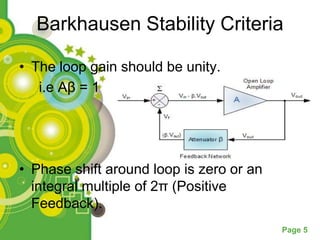
• The loop gain should be unity.
   i.e Aβ = 1


• Phase shift around loop is zero or an
  integral multiple of 2π (Positive
  Feedback).
                                          Page 5
Some Harmonic Oscillators…
    Tuned Collector Oscillator
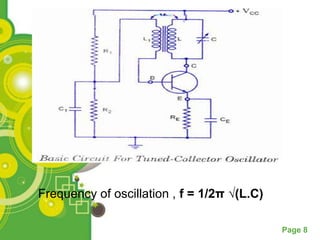
• It is called the tuned-collector oscilla-tor
  because the tuned circuit (L-C circuit) is
  connected to the collector of the transistor.

• The tuned circuit constitutes of the
  capacitor C and inductor L.

                                            Page 6
• When the supply is switched on, a transient
  current is produced in the tuned L-C circuit.
• It induces voltage in L1 by mutual induction
  which causes corresponding vari-ations in
  base current.
• These variations in base current are
  amplified β times and appear in the
  collector circuit.
• A part of this amplified energy is used to
  meet the losses that occur in the tank circuit
  and the rest is radiated out.
                                            Page 7
Frequency of oscillation , f = 1/2π √(L.C)

                                             Page 8
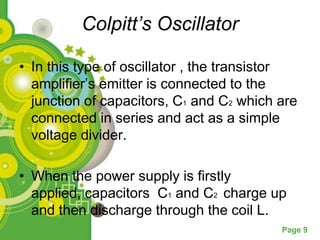
Colpitt’s Oscillator

• In this type of oscillator , the transistor
  amplifier’s emitter is connected to the
  junction of capacitors, C1 and C2 which are
  connected in series and act as a simple
  voltage divider.

• When the power supply is firstly
  applied, capacitors C1 and C2 charge up
  and then discharge through the coil L.
                                          Page 9
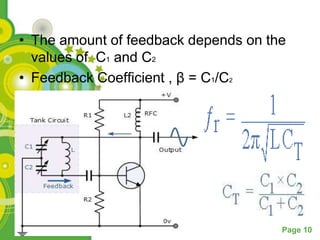
• The amount of feedback depends on the
  values of C1 and C2
• Feedback Coefficient , β = C1/C2


                                      Page 10
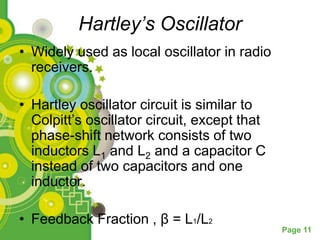
Hartley’s Oscillator
• Widely used as local oscillator in radio
  receivers.

• Hartley oscillator circuit is similar to
  Colpitt’s oscillator circuit, except that
  phase-shift network consists of two
  inductors L1 and L2 and a capacitor C
  instead of two capacitors and one
  inductor.

• Feedback Fraction , β = L1/L2
                                              Page 11
F = 1 / 2π√[C (L1 + L2 + 2M)]
                                Page 12
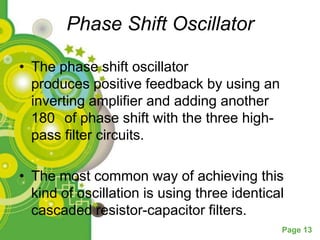
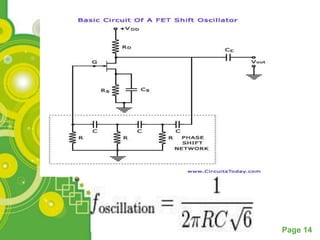
Phase Shift Oscillator

• The phase shift oscillator
  produces positive feedback by using an
  inverting amplifier and adding another
  180 of phase shift with the three high-
  pass filter circuits.

• The most common way of achieving this
  kind of oscillation is using three identical
  cascaded resistor-capacitor filters.
                                             Page 13
Page 14
Wein-Bridge Oscillator

• It is one of the most popular type of
  oscillators used in audio frequency ranges.
• It is a two-stage amplifier with an R-C
  bridge circuit.
• This type of oscillator is simple in
  design, compact in size, and remarkably
  stable in its frequency output.
• Furthermore, its output is relatively free
  from distortion and its fre-quency can be
  varied easily.
                                          Page 15
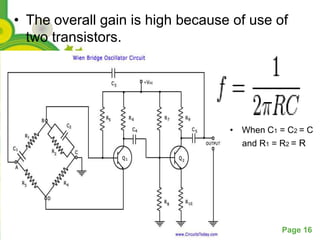
• The overall gain is high because of use of
  two transistors.


                                  • When C1 = C2 = C
                                    and R1 = R2 = R


                                             Page 16
Crystal Oscillator
• This is a type of oscillator that is controlled
  by a crystal.
• The big advantage of a crystal oscillator is
  high frequency stablility. Common crystals
  used are Rochelle salts and quartz.
• The natural frequency of a crystal's
  vibrations is found to be more constant
  than the oscillations in a LC circuit.
   Natural Ferquency = K/T
   where K = cut angle constant
   and T = thickness of crystal
                                              Page 17
• The LC circuit is the electricial equilavent of
  the crystal.
• It has limited power output.
• Crystals will overheat or crack when fed
  with too much voltage. The current flowing
  through a crystal generally should not be
  more than 100mA (.1A)
• Frequencies :-
• Series resonant Frequency , fs =1/2π √(L.C)
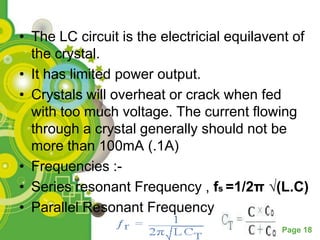
• Parallel Resonant Frequency
                                            Page 18
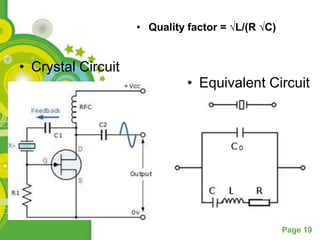
• Quality factor = √L/(R √C)


• Crystal Circuit
                              • Equivalent Circuit


                                                   Page 19
Page 20

Harmonic Oscillators

  • 1.
    Presentation On Harmonic Oscillators By:- Vishal Thakur Page 1
  • 2.
    What is anoscillator…??? An oscillator is an electronic circuit that produces a repetitive electronic signal, often a sine wave or a square wave. They are widely used in electronic devices . Page 2
  • 3.
    Harmonic Oscillators • Theharmonic, or linear, oscillators are those oscillators that produces a sinusoidal output. • The basic form of a harmonic oscillator is an electronic amplifier connected in a positive feedback loop with its output fed back into its input through a filter. Page 3
  • 4.
    Essential Parts ofany Oscillator • Tank Circuit (R-C , L-C , etc.) • Transistor Amplifier (180 phase shift) • Feedback Circuit Page 4
  • 5.
    Barkhausen Stability Criteria •The loop gain should be unity. i.e Aβ = 1 • Phase shift around loop is zero or an integral multiple of 2π (Positive Feedback). Page 5
  • 6.
    Some Harmonic Oscillators… Tuned Collector Oscillator • It is called the tuned-collector oscilla-tor because the tuned circuit (L-C circuit) is connected to the collector of the transistor. • The tuned circuit constitutes of the capacitor C and inductor L. Page 6
  • 7.
    • When thesupply is switched on, a transient current is produced in the tuned L-C circuit. • It induces voltage in L1 by mutual induction which causes corresponding vari-ations in base current. • These variations in base current are amplified β times and appear in the collector circuit. • A part of this amplified energy is used to meet the losses that occur in the tank circuit and the rest is radiated out. Page 7
  • 8.
    Frequency of oscillation, f = 1/2π √(L.C) Page 8
  • 9.
    Colpitt’s Oscillator • Inthis type of oscillator , the transistor amplifier’s emitter is connected to the junction of capacitors, C1 and C2 which are connected in series and act as a simple voltage divider. • When the power supply is firstly applied, capacitors C1 and C2 charge up and then discharge through the coil L. Page 9
  • 10.
    • The amountof feedback depends on the values of C1 and C2 • Feedback Coefficient , β = C1/C2 Page 10
  • 11.
    Hartley’s Oscillator • Widelyused as local oscillator in radio receivers. • Hartley oscillator circuit is similar to Colpitt’s oscillator circuit, except that phase-shift network consists of two inductors L1 and L2 and a capacitor C instead of two capacitors and one inductor. • Feedback Fraction , β = L1/L2 Page 11
  • 12.
    F = 1/ 2π√[C (L1 + L2 + 2M)] Page 12
  • 13.
    Phase Shift Oscillator •The phase shift oscillator produces positive feedback by using an inverting amplifier and adding another 180 of phase shift with the three high- pass filter circuits. • The most common way of achieving this kind of oscillation is using three identical cascaded resistor-capacitor filters. Page 13
  • 14.
  • 15.
    Wein-Bridge Oscillator • Itis one of the most popular type of oscillators used in audio frequency ranges. • It is a two-stage amplifier with an R-C bridge circuit. • This type of oscillator is simple in design, compact in size, and remarkably stable in its frequency output. • Furthermore, its output is relatively free from distortion and its fre-quency can be varied easily. Page 15
  • 16.
    • The overallgain is high because of use of two transistors. • When C1 = C2 = C and R1 = R2 = R Page 16
  • 17.
    Crystal Oscillator • Thisis a type of oscillator that is controlled by a crystal. • The big advantage of a crystal oscillator is high frequency stablility. Common crystals used are Rochelle salts and quartz. • The natural frequency of a crystal's vibrations is found to be more constant than the oscillations in a LC circuit. Natural Ferquency = K/T where K = cut angle constant and T = thickness of crystal Page 17
  • 18.
    • The LCcircuit is the electricial equilavent of the crystal. • It has limited power output. • Crystals will overheat or crack when fed with too much voltage. The current flowing through a crystal generally should not be more than 100mA (.1A) • Frequencies :- • Series resonant Frequency , fs =1/2π √(L.C) • Parallel Resonant Frequency Page 18
  • 19.
    • Quality factor= √L/(R √C) • Crystal Circuit • Equivalent Circuit Page 19
  • 20.