Power Factor Improvement
SUBMITTED BY:
Saiful Islam Rukon
EEE-00805552
Azizur Rahman
EEE-00505573
SUBMITTED TO:
Nahid Nasrin
Chairman,
Department of Electrical & Electronic
Engineering,
Port City International University
CONTENTS
 Introduction
 Causes of Low Power Factor
 Effect of Low Power Factor
 Methods of Improving Power Factor
 Power Triangle
 Conculasion
Introduction of Power factor
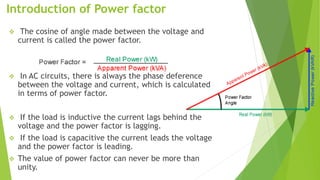
 The cosine of angle made between the voltage and
current is called the power factor.
 In AC circuits, there is always the phase deference
between the voltage and current, which is calculated
in terms of power factor.
 If the load is inductive the current lags behind the
voltage and the power factor is lagging.
 If the load is capacitive the current leads the voltage
and the power factor is leading.
 The value of power factor can never be more than
unity.
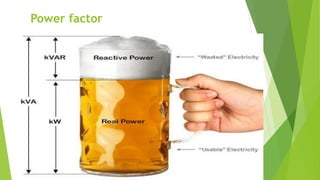
Power factor
Causes of Low Power Factor
 Single phase and three phase induction Motors(Usually, Induction motor
works at poor power factor .
 Varying Load in Power System(As we know that load on power system is
varying. During low load period, supply voltage is increased which
increase the magnetizing current which cause the decreased power
factor).
 Industrial heating furnaces.
 Electrical discharge lamps (High intensity discharge lighting) Arc lamps
(operate a very low power factor)
Effect of low poor power factor
 Line losses will be more.
 The useful load that can be transmitted is reduced.
 There will be a poor voltage regulation
 It reduces the handling capacity of the plant.
Improving Power Factor
 Normally the power factor of the system ranges between 0.8 to 0.9,
however in case of low P.F. there is a need of improving power factor.
 There are some methods used to improve the power factor of the system:
i. Static Capacitor
ii. Synchronous Condenser
i. Static Capacitor
 The power factor can be improved by connecting capacitors in parallel with the equipment operating at
lagging power factor.
 Static capacitors are invariably used for power factor improvement in factories.
Static Capacitor
Advantages:
i. They have low losses.
ii. They require little maintenance as there are no rotating parts.
iii. They can be easily installed as they are light and require no foundation.
iv. They can work under ordinary atmospheric conditions.
Disadvantages:
i. They have short service life ranging from 8 to 10 years.
ii. They are easily damaged if the voltage exceeds the rated value.
iii. Once the capacitors are damaged, their repair is uneconomical.
ii) Synchronous Condenser
 A synchronous motor takes a leading current when over-excited and,
therefore, behaves as a capacitor.
 An over-excited synchronous motor running on no load is known as
“Synchronous condenser”.
 Synchronous condensers are generally used at major bulk supply sub-
stations for power factor improvement.
Synchronous Condenser
Advantages:
i. The motor windings have high thermal stability to short circuit
currents.
ii. The fault can be removed easily.
Disadvantages:
i. There are considerable losses in the motor.
ii. The maintenance cost is high.
iii. It produces noise.
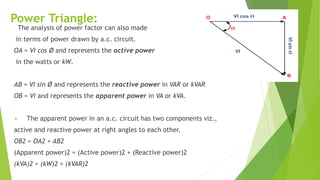
Power Triangle:
The analysis of power factor can also made
in terms of power drawn by a.c. circuit.
OA = VI cos Ø and represents the active power
in the watts or kW.
AB = VI sin Ø and represents the reactive power in VAR or kVAR
OB = VI and represents the apparent power in VA or kVA.
 The apparent power in an a.c. circuit has two components viz.,
active and reactive power at right angles to each other.
OB2 = OA2 + AB2
(Apparent power)2 = (Active power)2 + (Reactive power)2
(kVA)2 = (kW)2 + (kVAR)2
 Power factor, cos Ø = OA / OB
= active power/ apparent power
= kW / kVA
CONCLUSION
By observing all aspects of the power factor it is clear that power factor is the most
significant part for the utility Company as well as for the consumer on electrical
side. Utility company gets rid of from the power losses while the consumer free
from low power factor penalty charges.
Power factor improvement

Power factor improvement

  • 1.
    Power Factor Improvement SUBMITTEDBY: Saiful Islam Rukon EEE-00805552 Azizur Rahman EEE-00505573 SUBMITTED TO: Nahid Nasrin Chairman, Department of Electrical & Electronic Engineering, Port City International University
  • 2.
    CONTENTS  Introduction  Causesof Low Power Factor  Effect of Low Power Factor  Methods of Improving Power Factor  Power Triangle  Conculasion
  • 3.
    Introduction of Powerfactor  The cosine of angle made between the voltage and current is called the power factor.  In AC circuits, there is always the phase deference between the voltage and current, which is calculated in terms of power factor.  If the load is inductive the current lags behind the voltage and the power factor is lagging.  If the load is capacitive the current leads the voltage and the power factor is leading.  The value of power factor can never be more than unity.
  • 4.
  • 5.
    Causes of LowPower Factor  Single phase and three phase induction Motors(Usually, Induction motor works at poor power factor .  Varying Load in Power System(As we know that load on power system is varying. During low load period, supply voltage is increased which increase the magnetizing current which cause the decreased power factor).  Industrial heating furnaces.  Electrical discharge lamps (High intensity discharge lighting) Arc lamps (operate a very low power factor)
  • 6.
    Effect of lowpoor power factor  Line losses will be more.  The useful load that can be transmitted is reduced.  There will be a poor voltage regulation  It reduces the handling capacity of the plant.
  • 7.
    Improving Power Factor Normally the power factor of the system ranges between 0.8 to 0.9, however in case of low P.F. there is a need of improving power factor.  There are some methods used to improve the power factor of the system: i. Static Capacitor ii. Synchronous Condenser i. Static Capacitor  The power factor can be improved by connecting capacitors in parallel with the equipment operating at lagging power factor.  Static capacitors are invariably used for power factor improvement in factories.
  • 8.
  • 9.
    Advantages: i. They havelow losses. ii. They require little maintenance as there are no rotating parts. iii. They can be easily installed as they are light and require no foundation. iv. They can work under ordinary atmospheric conditions. Disadvantages: i. They have short service life ranging from 8 to 10 years. ii. They are easily damaged if the voltage exceeds the rated value. iii. Once the capacitors are damaged, their repair is uneconomical.
  • 10.
    ii) Synchronous Condenser A synchronous motor takes a leading current when over-excited and, therefore, behaves as a capacitor.  An over-excited synchronous motor running on no load is known as “Synchronous condenser”.  Synchronous condensers are generally used at major bulk supply sub- stations for power factor improvement.
  • 11.
  • 12.
    Advantages: i. The motorwindings have high thermal stability to short circuit currents. ii. The fault can be removed easily. Disadvantages: i. There are considerable losses in the motor. ii. The maintenance cost is high. iii. It produces noise.
  • 13.
    Power Triangle: The analysisof power factor can also made in terms of power drawn by a.c. circuit. OA = VI cos Ø and represents the active power in the watts or kW. AB = VI sin Ø and represents the reactive power in VAR or kVAR OB = VI and represents the apparent power in VA or kVA.  The apparent power in an a.c. circuit has two components viz., active and reactive power at right angles to each other. OB2 = OA2 + AB2 (Apparent power)2 = (Active power)2 + (Reactive power)2 (kVA)2 = (kW)2 + (kVAR)2
  • 14.
     Power factor,cos Ø = OA / OB = active power/ apparent power = kW / kVA CONCLUSION By observing all aspects of the power factor it is clear that power factor is the most significant part for the utility Company as well as for the consumer on electrical side. Utility company gets rid of from the power losses while the consumer free from low power factor penalty charges.