DC MOTORS 
• Presenter… 
-Sumeet Patel (99)
TOPICS TO DISCUSS 
 Introduction to DC MOTORS. 
 Principle. 
 Construction. 
Working. 
 Types. 
 Applications.
DC MOTOR 
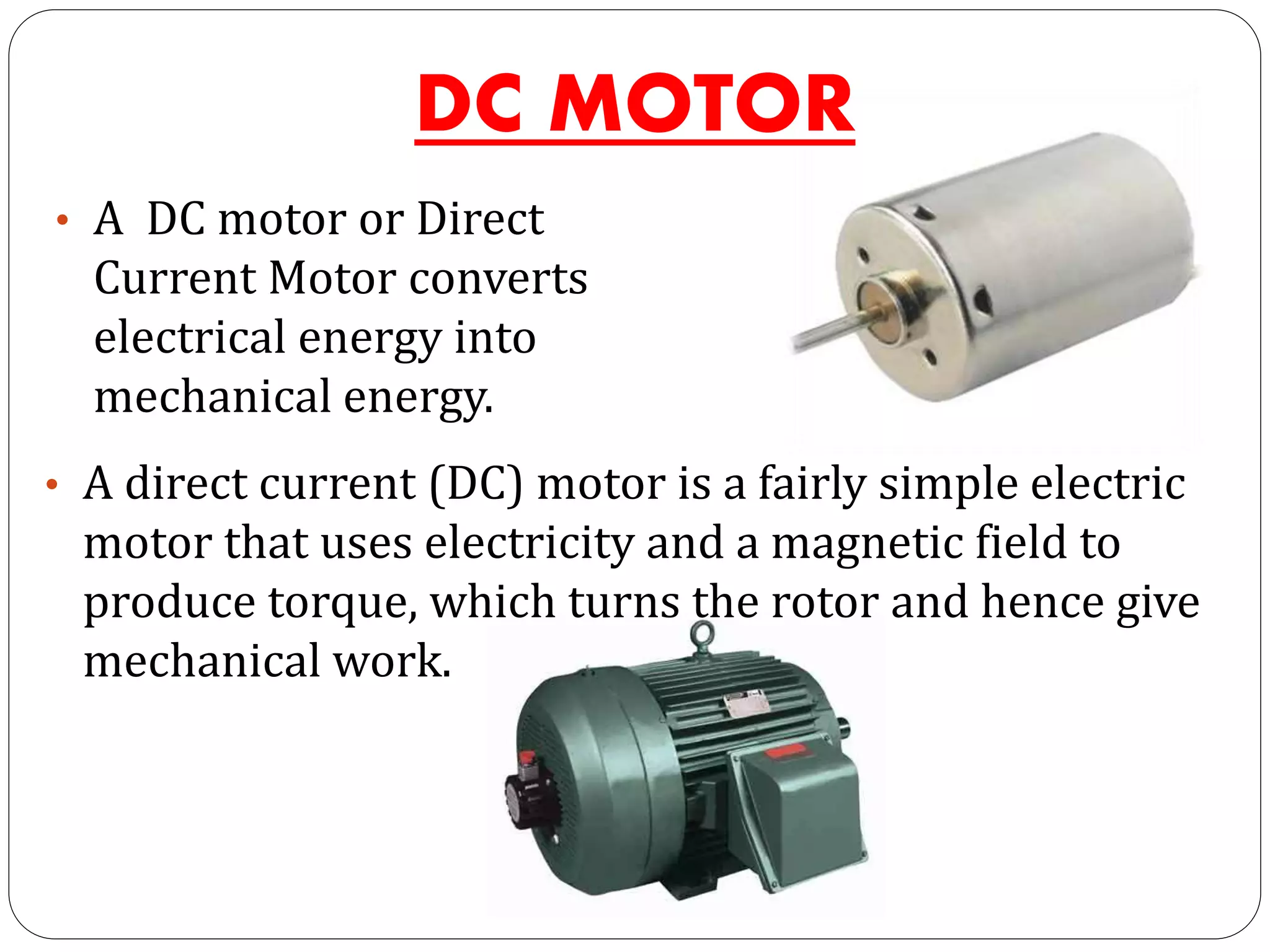
• A DC motor or Direct 
Current Motor converts 
electrical energy into 
mechanical energy. 
• A direct current (DC) motor is a fairly simple electric 
motor that uses electricity and a magnetic field to 
produce torque, which turns the rotor and hence give 
mechanical work.
PRINCIPLE OF DC MOTORS 
• In any electric motor, operation is 
based on simple 
electromagnetism. 
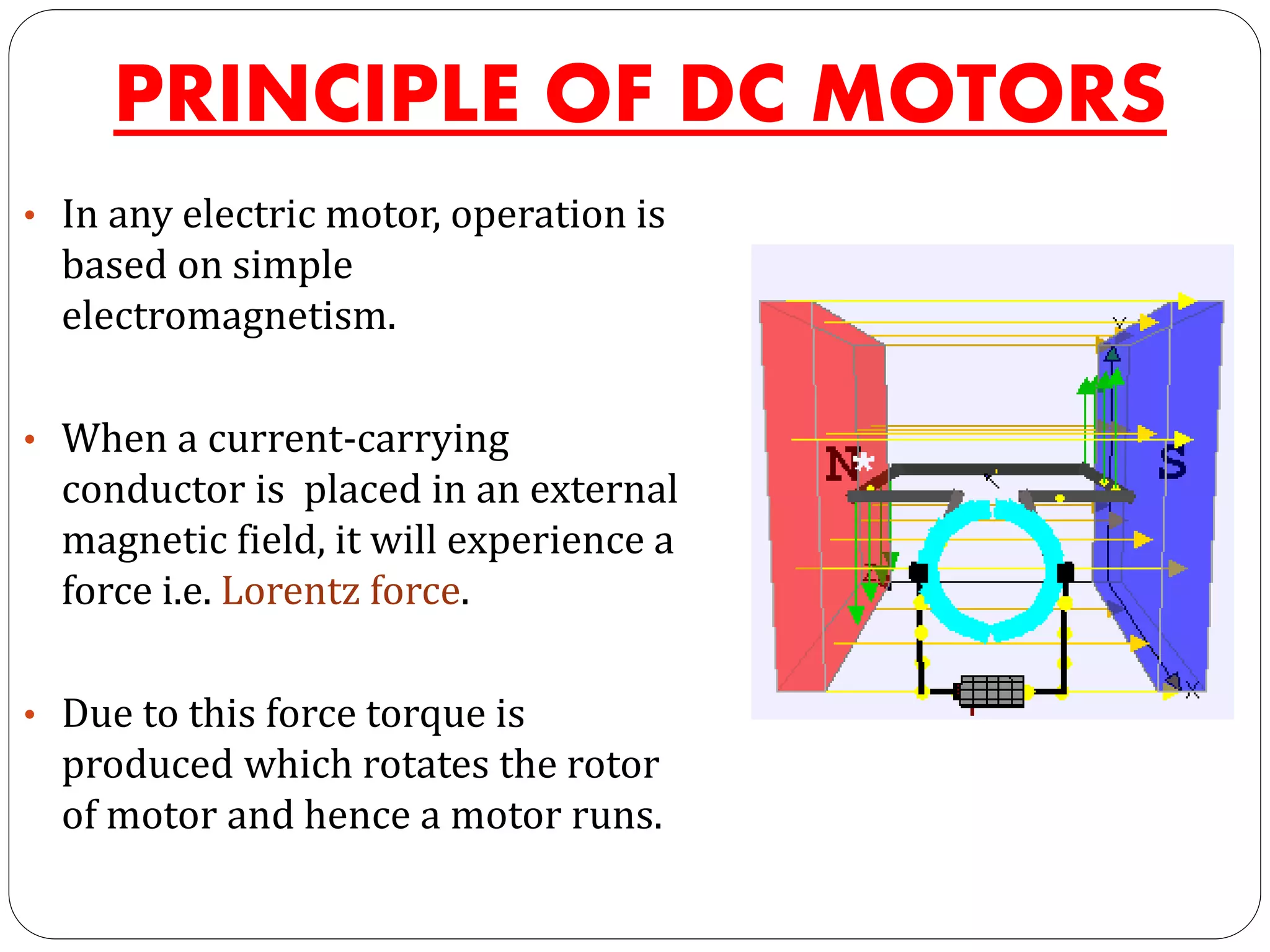
• When a current-carrying 
conductor is placed in an external 
magnetic field, it will experience a 
force i.e. Lorentz force. 
• Due to this force torque is 
produced which rotates the rotor 
of motor and hence a motor runs.
CONSTRUCTION 
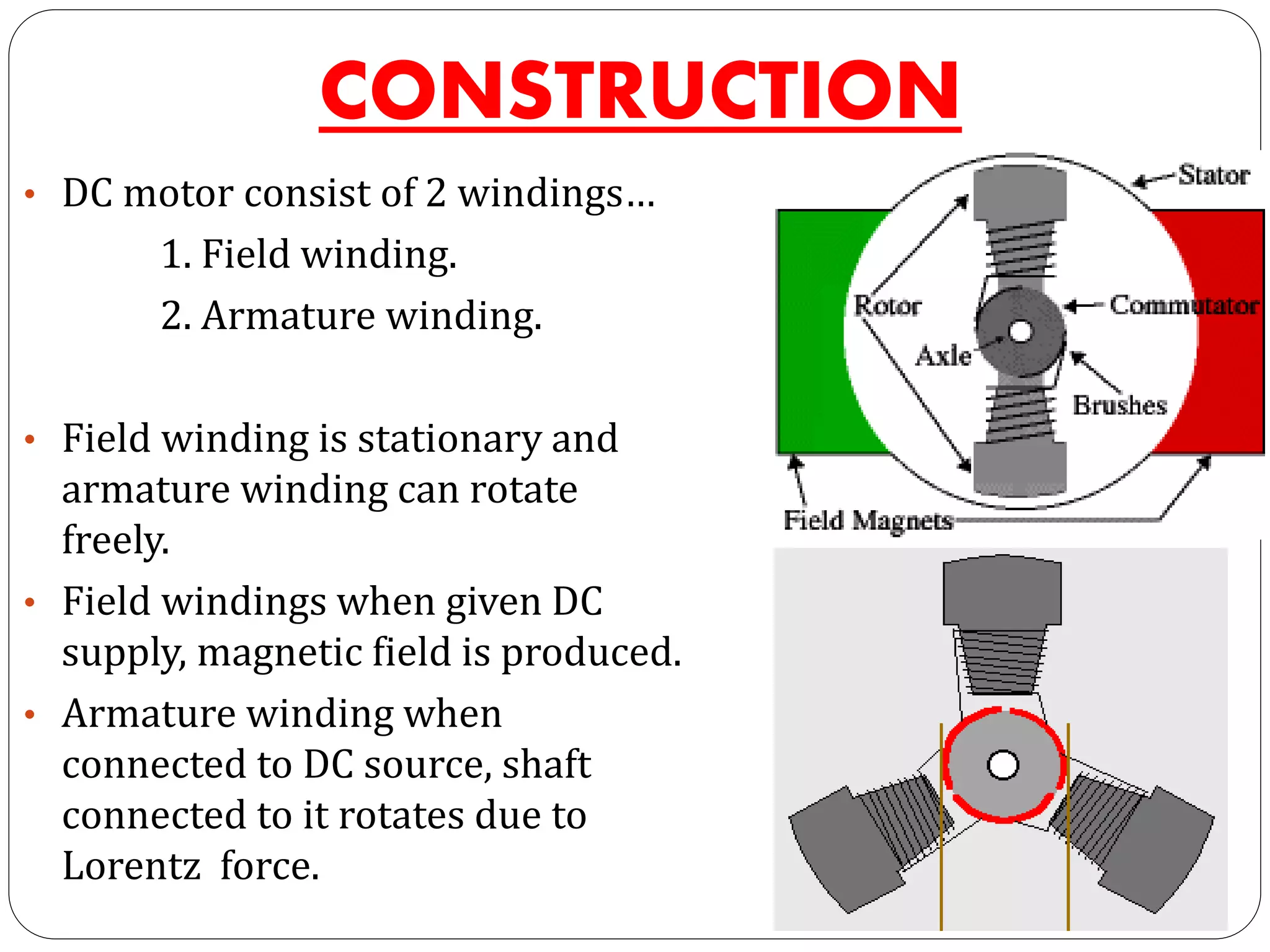
• DC motor consist of 2 windings… 
1. Field winding. 
2. Armature winding. 
• Field winding is stationary and 
armature winding can rotate 
freely. 
• Field windings when given DC 
supply, magnetic field is produced. 
• Armature winding when 
connected to DC source, shaft 
connected to it rotates due to 
Lorentz force.
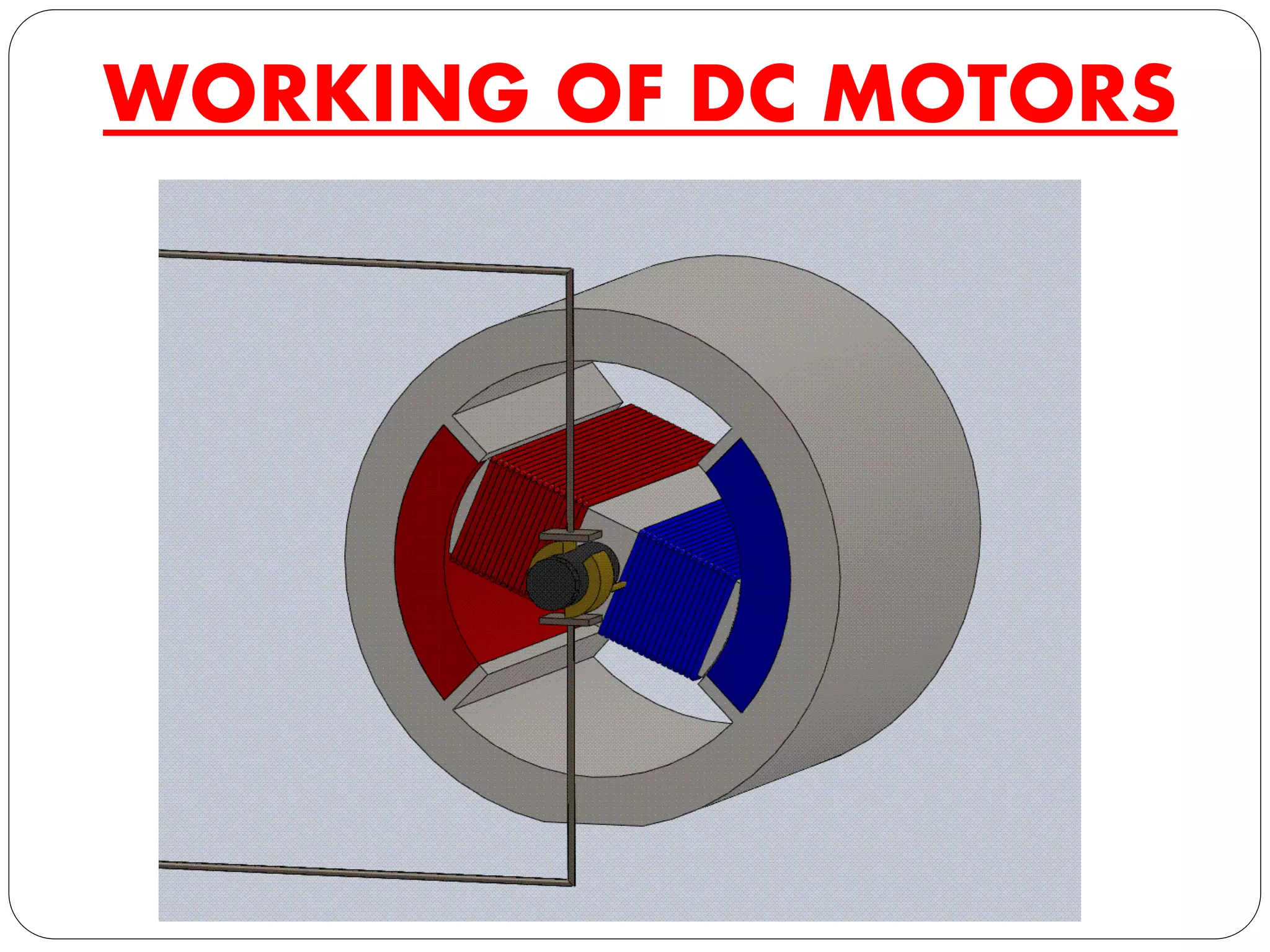
WORKING OF DC MOTORS
TYPES OF DC MOTORS 
• DC motor are of 3 types they are….. 
1. DC SHUNT MOTOR 
2. DC SERIES MOTOR 
3. DC COMPOUND MOTOR
1. DC SHUNT MOTOR 
Armature 
• The parallel combination of two 
windings is connected across a 
common dc power supply. 
• The resistance of shunt field 
winding (Rsh) is always higher 
than that is armature winding. 
• This is because the number of 
turns for the field winding is more 
than that of armature winding. 
• The cross-sectional area of the 
wire used for field winding is 
smaller than that of the wire used 
for armature winding.
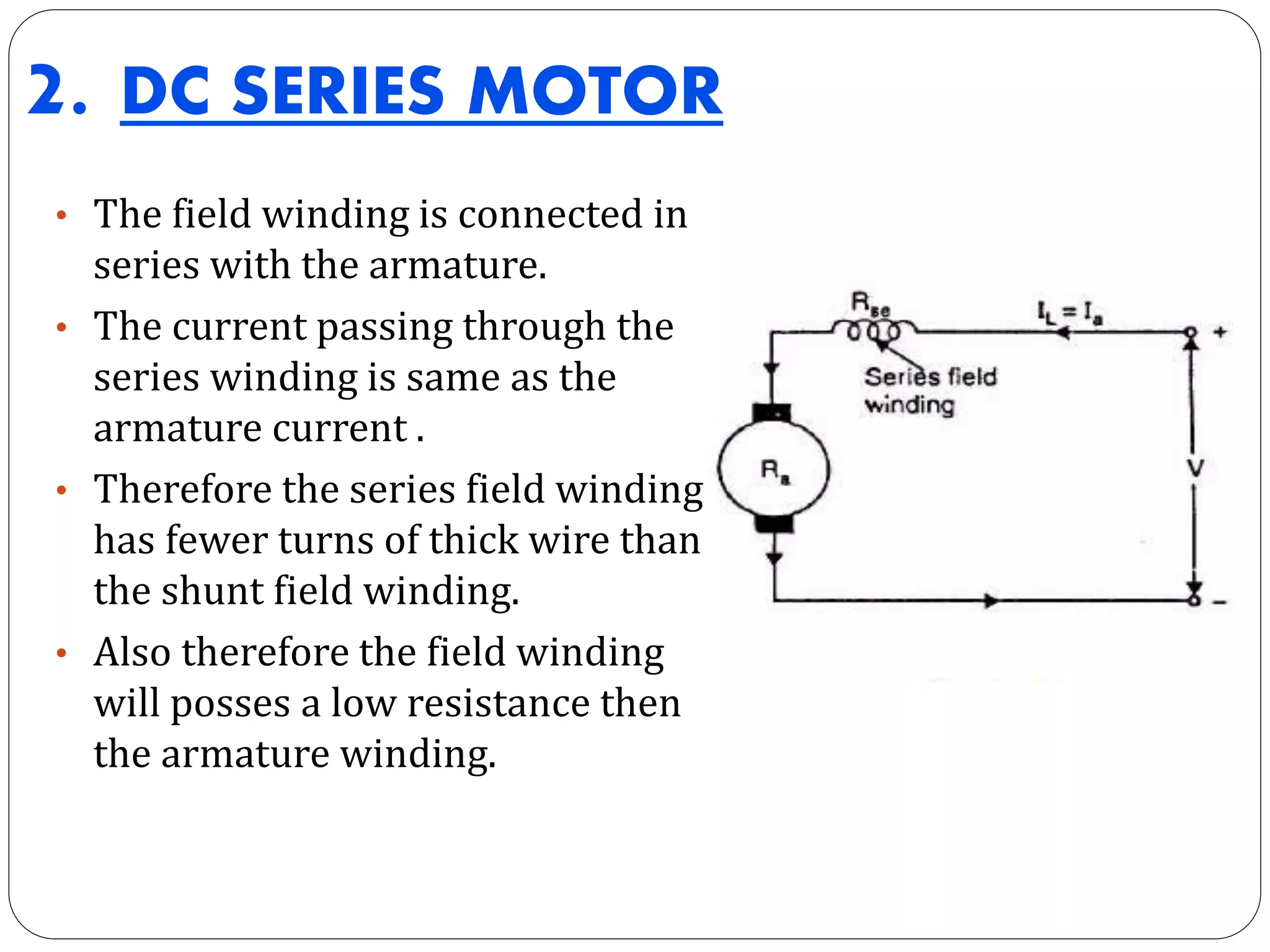
2. DC SERIES MOTOR 
• The field winding is connected in 
series with the armature. 
• The current passing through the 
series winding is same as the 
armature current . 
• Therefore the series field winding 
has fewer turns of thick wire than 
the shunt field winding. 
• Also therefore the field winding 
will posses a low resistance then 
the armature winding.
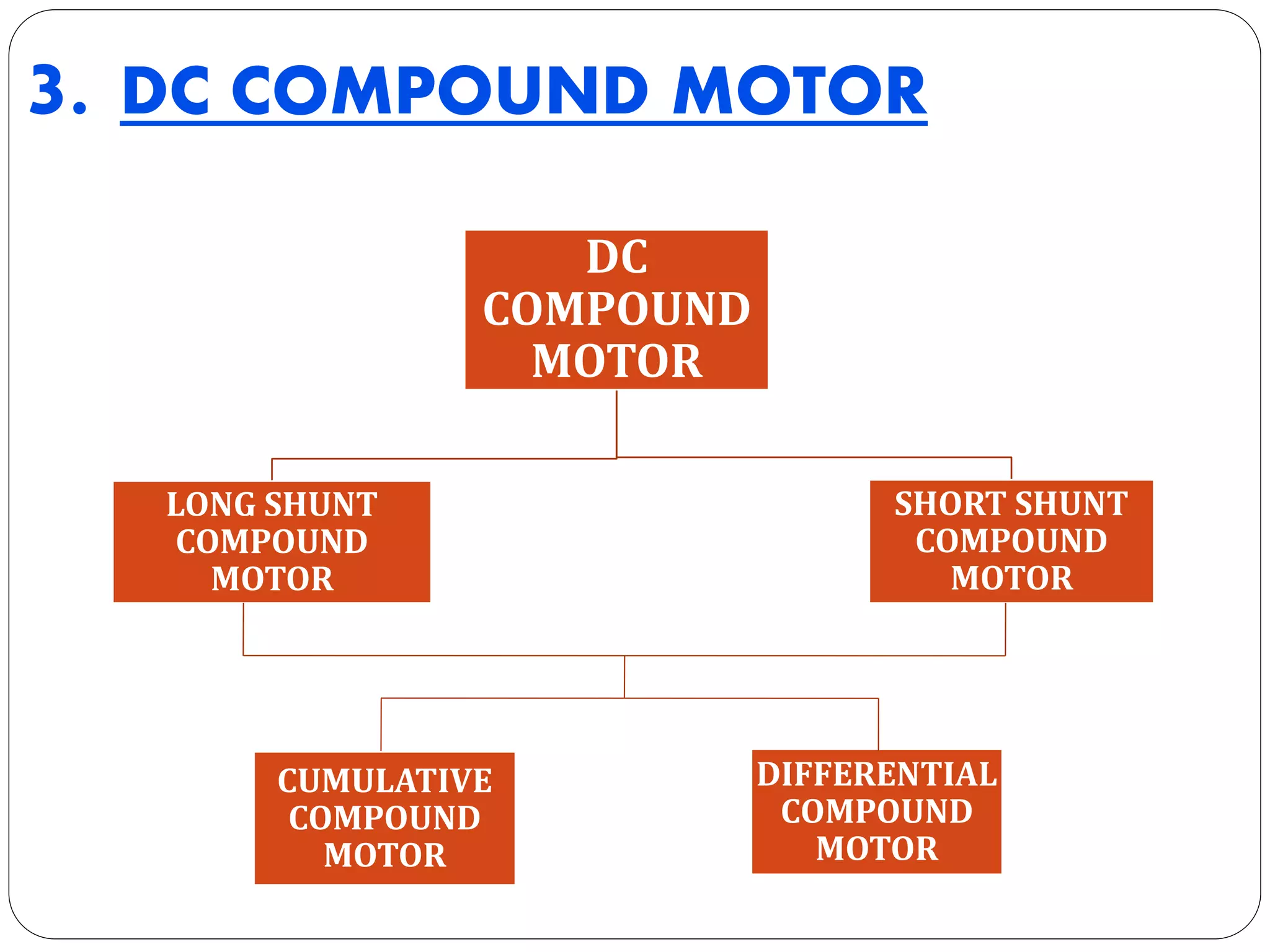
3. DC COMPOUND MOTOR 
DC 
COMPOUND 
MOTOR 
LONG SHUNT 
COMPOUND 
MOTOR 
SHORT SHUNT 
COMPOUND 
MOTOR 
CUMULATIVE 
COMPOUND 
MOTOR 
DIFFERENTIAL 
COMPOUND 
MOTOR
I. LONG SHUNT COMPOUND MOTOR 
• In this the series winding is 
connected in series with the 
armature winding and the 
shunt winding is connected in 
parallel with the armature 
connection.
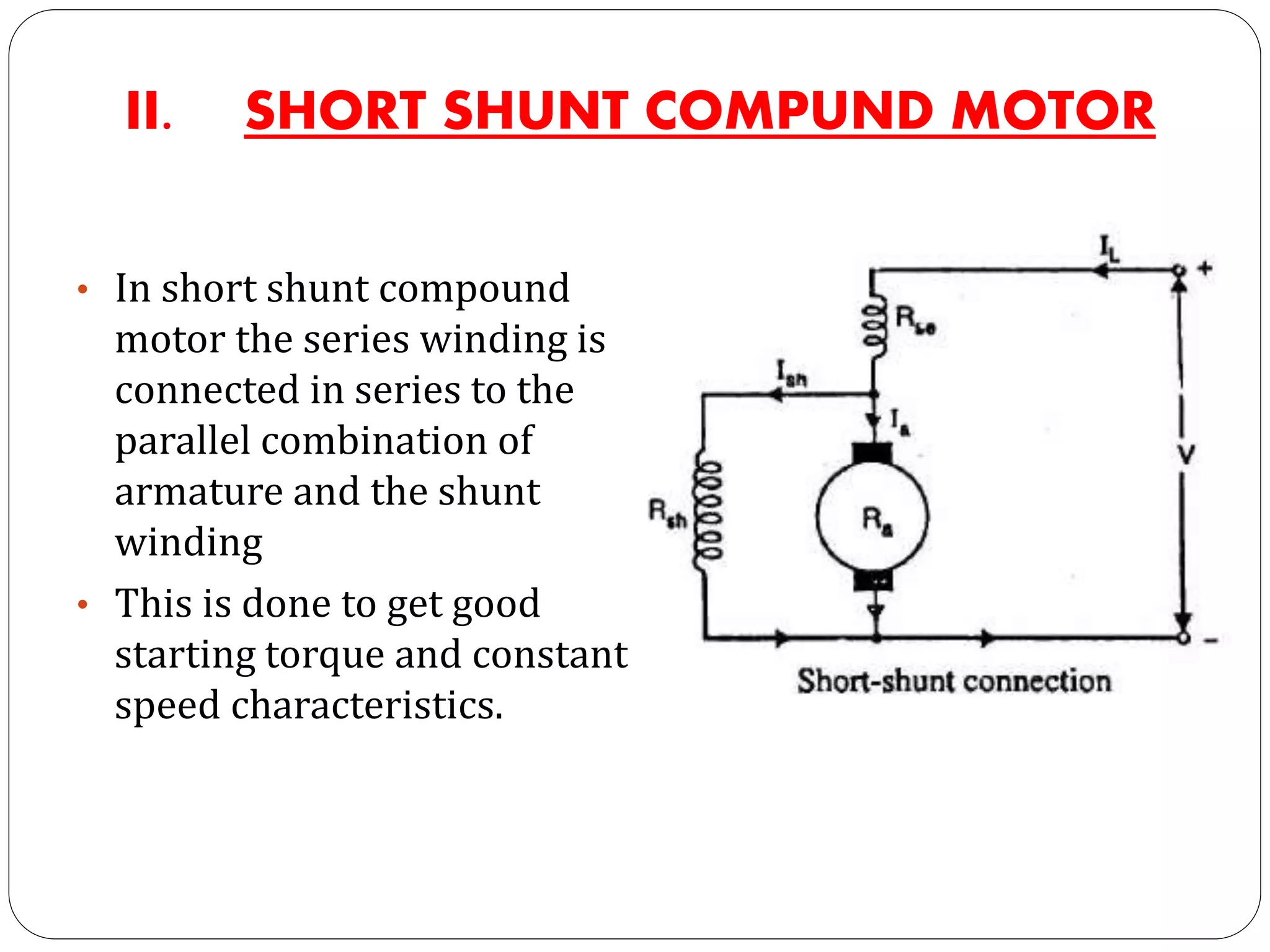
II. SHORT SHUNT COMPUND MOTOR 
• In short shunt compound 
motor the series winding is 
connected in series to the 
parallel combination of 
armature and the shunt 
winding 
• This is done to get good 
starting torque and constant 
speed characteristics.
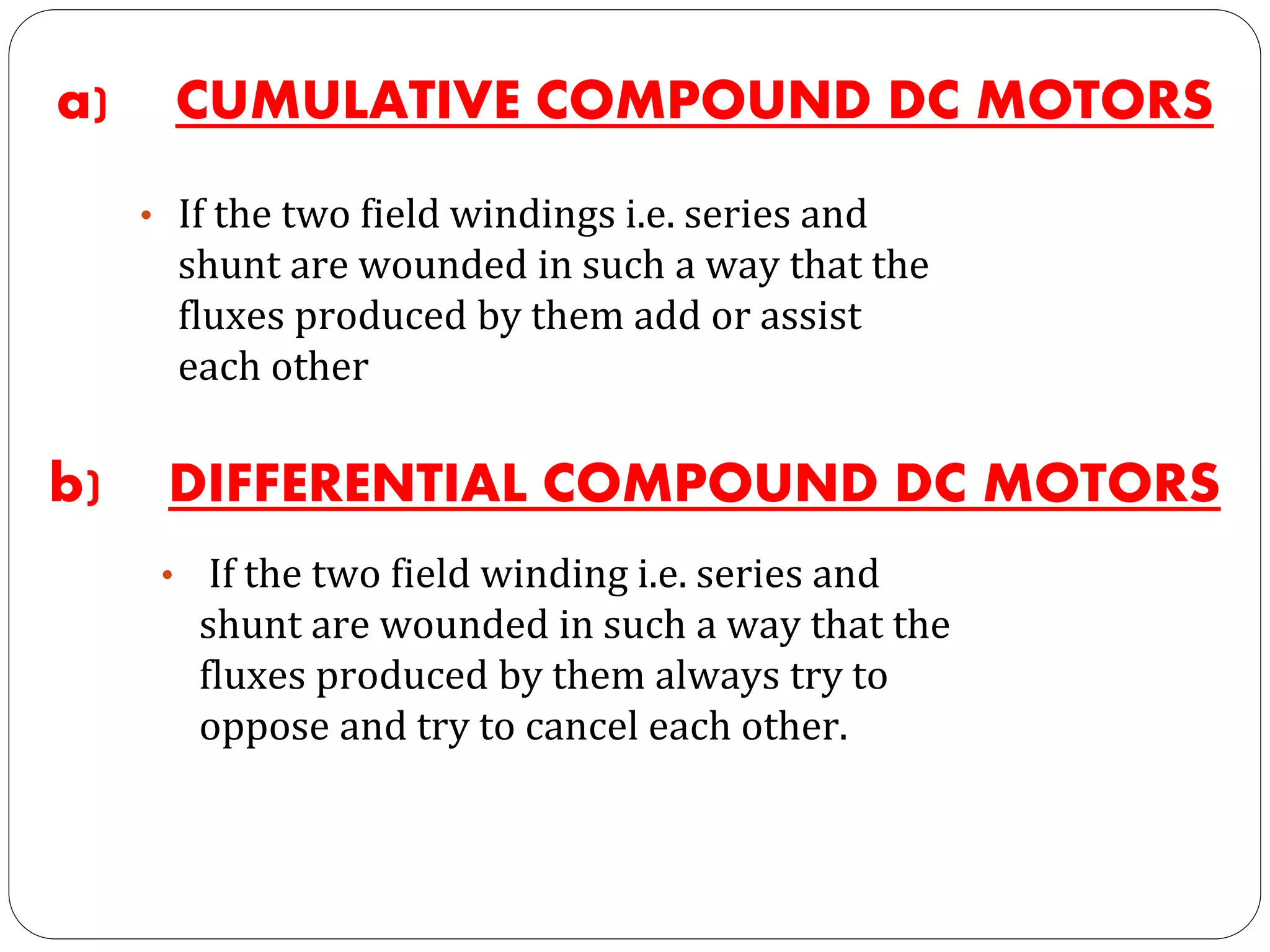
a) CUMULATIVE COMPOUND DC MOTORS 
• If the two field windings i.e. series and 
shunt are wounded in such a way that the 
fluxes produced by them add or assist 
each other 
b) DIFFERENTIAL COMPOUND DC MOTORS 
• If the two field winding i.e. series and 
shunt are wounded in such a way that the 
fluxes produced by them always try to 
oppose and try to cancel each other.
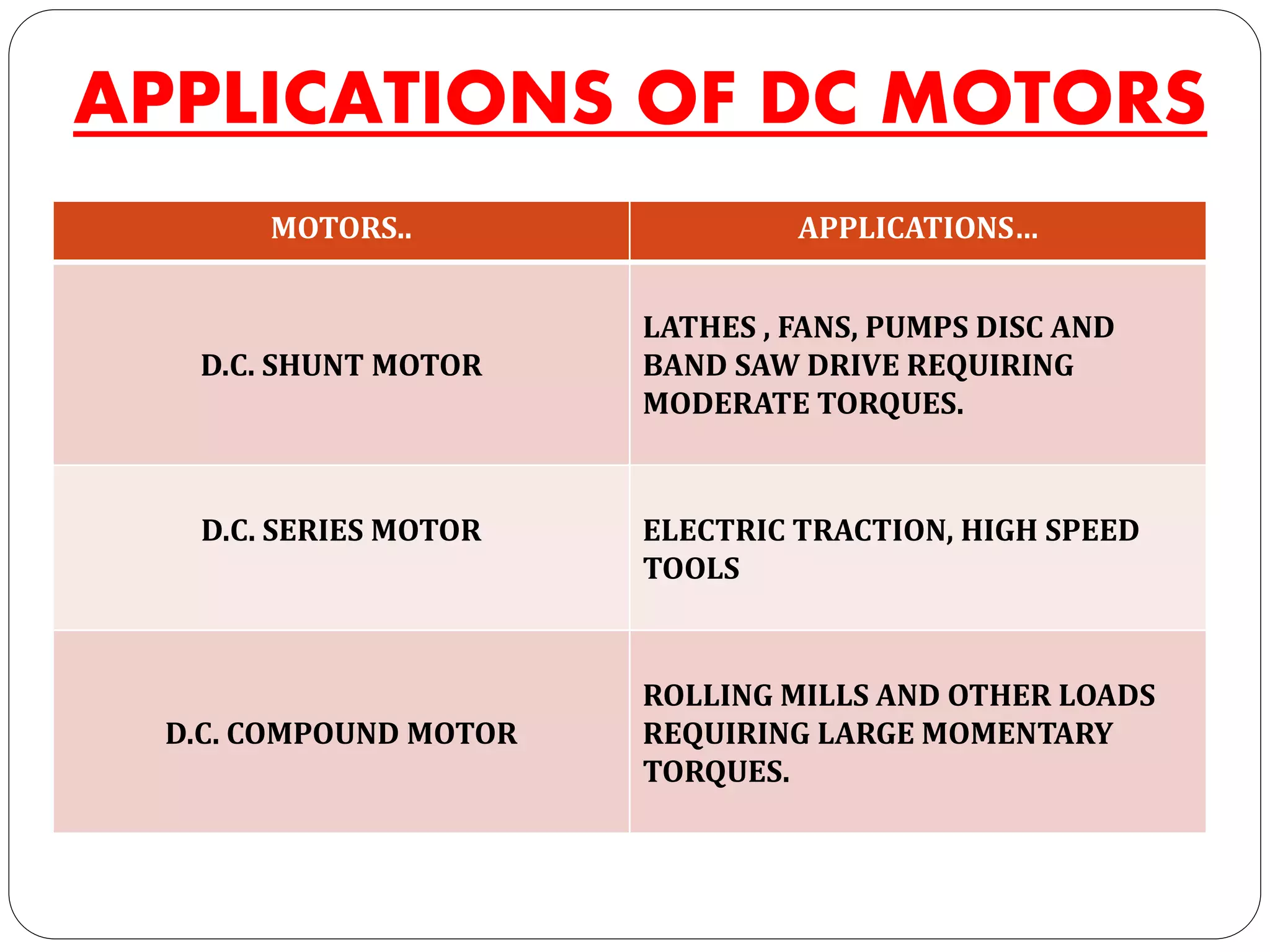
APPLICATIONS OF DC MOTORS 
MOTORS.. APPLICATIONS… 
D.C. SHUNT MOTOR 
LATHES , FANS, PUMPS DISC AND 
BAND SAW DRIVE REQUIRING 
MODERATE TORQUES. 
D.C. SERIES MOTOR ELECTRIC TRACTION, HIGH SPEED 
TOOLS 
D.C. COMPOUND MOTOR 
ROLLING MILLS AND OTHER LOADS 
REQUIRING LARGE MOMENTARY 
TORQUES.
BIBLIOGRAPHY 
www.google.com 
en.wikipedia.org 
Electrical technology 
–B.L. Theraja 
–A.K. Theraja
ANY QUESTIONS ???

Dc motors and its types

  • 1.
    DC MOTORS •Presenter… -Sumeet Patel (99)
  • 2.
    TOPICS TO DISCUSS  Introduction to DC MOTORS.  Principle.  Construction. Working.  Types.  Applications.
  • 3.
    DC MOTOR •A DC motor or Direct Current Motor converts electrical energy into mechanical energy. • A direct current (DC) motor is a fairly simple electric motor that uses electricity and a magnetic field to produce torque, which turns the rotor and hence give mechanical work.
  • 4.
    PRINCIPLE OF DCMOTORS • In any electric motor, operation is based on simple electromagnetism. • When a current-carrying conductor is placed in an external magnetic field, it will experience a force i.e. Lorentz force. • Due to this force torque is produced which rotates the rotor of motor and hence a motor runs.
  • 5.
    CONSTRUCTION • DCmotor consist of 2 windings… 1. Field winding. 2. Armature winding. • Field winding is stationary and armature winding can rotate freely. • Field windings when given DC supply, magnetic field is produced. • Armature winding when connected to DC source, shaft connected to it rotates due to Lorentz force.
  • 7.
  • 8.
    TYPES OF DCMOTORS • DC motor are of 3 types they are….. 1. DC SHUNT MOTOR 2. DC SERIES MOTOR 3. DC COMPOUND MOTOR
  • 9.
    1. DC SHUNTMOTOR Armature • The parallel combination of two windings is connected across a common dc power supply. • The resistance of shunt field winding (Rsh) is always higher than that is armature winding. • This is because the number of turns for the field winding is more than that of armature winding. • The cross-sectional area of the wire used for field winding is smaller than that of the wire used for armature winding.
  • 10.
    2. DC SERIESMOTOR • The field winding is connected in series with the armature. • The current passing through the series winding is same as the armature current . • Therefore the series field winding has fewer turns of thick wire than the shunt field winding. • Also therefore the field winding will posses a low resistance then the armature winding.
  • 11.
    3. DC COMPOUNDMOTOR DC COMPOUND MOTOR LONG SHUNT COMPOUND MOTOR SHORT SHUNT COMPOUND MOTOR CUMULATIVE COMPOUND MOTOR DIFFERENTIAL COMPOUND MOTOR
  • 12.
    I. LONG SHUNTCOMPOUND MOTOR • In this the series winding is connected in series with the armature winding and the shunt winding is connected in parallel with the armature connection.
  • 13.
    II. SHORT SHUNTCOMPUND MOTOR • In short shunt compound motor the series winding is connected in series to the parallel combination of armature and the shunt winding • This is done to get good starting torque and constant speed characteristics.
  • 14.
    a) CUMULATIVE COMPOUNDDC MOTORS • If the two field windings i.e. series and shunt are wounded in such a way that the fluxes produced by them add or assist each other b) DIFFERENTIAL COMPOUND DC MOTORS • If the two field winding i.e. series and shunt are wounded in such a way that the fluxes produced by them always try to oppose and try to cancel each other.
  • 15.
    APPLICATIONS OF DCMOTORS MOTORS.. APPLICATIONS… D.C. SHUNT MOTOR LATHES , FANS, PUMPS DISC AND BAND SAW DRIVE REQUIRING MODERATE TORQUES. D.C. SERIES MOTOR ELECTRIC TRACTION, HIGH SPEED TOOLS D.C. COMPOUND MOTOR ROLLING MILLS AND OTHER LOADS REQUIRING LARGE MOMENTARY TORQUES.
  • 16.
    BIBLIOGRAPHY www.google.com en.wikipedia.org Electrical technology –B.L. Theraja –A.K. Theraja
  • 18.