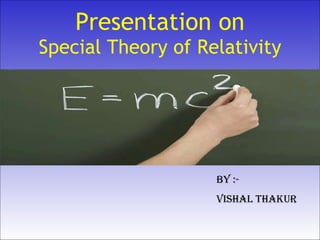
Presentation on Special Theory of Relativity By :- Vishal Thakur
The Special Theory of Relativity ( published in 1905 by Albert Einstein) Aimed to answer some burning questions: Could Maxwell’s equations for electricity and magnetism reconcile with the laws of mechanics? Where was the  Luminiferous  aether  ? ( null result of 1887 Michelson–Morley  experiment)
Postulates of Relativity : First  “ The  laws of physics  are same for all the observers in uniform motion relative to each other ”
Second “ The  speed of light  in vacuum is same for all the observers, regardless of their relative motion or of the motion of the source of the light ” (Speed of light  c  = 3 x 10 8  metres/second    = 670,616,629 mph)
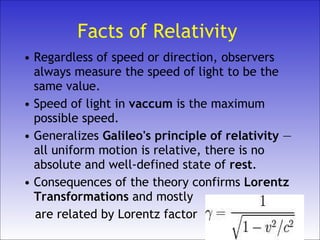
Facts of Relativity Regardless of speed or direction, observers always measure the speed of light to be the same value. Speed of light in  vaccum  is the maximum possible speed. Generalizes  Galileo's principle of relativity  —all uniform motion is relative, there is no absolute and well-defined state of  rest . Consequences of the theory confirms  Lorentz Transformations  and mostly are related by Lorentz factor
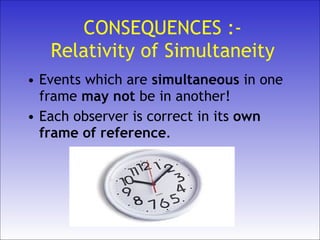
CONSEQUENCES :- Relativity of Simultaneity Events which are  simultaneous  in one frame  may   not  be in another! Each observer is correct in its   own   frame of reference .
Time Dilation Time lapse between two events is  not invariant  to observer, but depend on the  relative speeds  of the observers reference frames. Observer measure moving clock run slow. Example –  Twin Paradox  ( concerns a twin who flies off in a spaceship traveling near the speed of light and returns to discover that his or her twin sibling has aged much more)
Length Contraction Observers measure moving objects to be  shorter   than they were at rest. Only applies to the direction  parallel  to the motion on objects moving near to the speed of light!
1 + 1 not equals to 2 Velocities(and speeds) do not simply  add up. Also called  composition law for velocities .  For collinear motions of two objects (u and v as their velocities),the velocity of  each object relative to a stationary observer is :- Isn't noticeable at low velocities but as the velocity approaches the speed of light it becomes important.
Thomas Rotation Orientation  of an object (i.e. the alignment of its axes with the observer's axes) may be different for different observers.  Unlike other relativistic effects, this effect becomes quite significant at fairly  low velocities  as can be seen in the  spin of moving particles .
E = mc 2 Famous  Mass-Energy equivalence … This is also the  Rest Mass Energy  of the particle Much amount of energy is released when a relative small amount of mass gets lost!   Important consequences: nuclear fission (as in atom bombs)… nuclear fusion (as in sun and other stars)!
How does SR help us? Mass Energy Equivalence Particles can  annihilate   with their antiparticles, releasing much energy. Production of new particles! Time Dilation Allows particles to travel  much further  than previously expected. Easier to detect and identify particles! Spacetime Space and Time – now considered different components of single  entity . Divided in different ways by observers in relative motion.
How does SR hinder us? Accelerator beam energy must be  high enough  for the mass of particles you want to produce. Need to have long acceleration times than expected. SLAC( Stanford Linear Accelerator Center )   accelerator needs a 3-km path to get speed that Newtonian dynamics predicts for 1.5 cm! LHC  ( Large Hadron Collider  - world's largest and highest-energy particle accelerator  ring) diameter = 27 km!
 
Summary 2 postulates, strange consequences Relativity of simultaneity Time dilation Length contraction Composition of velocities Thomas Rotation Mass - Energy Equivalence  Spacetime Particle physics Production of new particles Easier to measure, harder to accelerate
 

Str

  • 1.
    Presentation on SpecialTheory of Relativity By :- Vishal Thakur
  • 2.
    The Special Theoryof Relativity ( published in 1905 by Albert Einstein) Aimed to answer some burning questions: Could Maxwell’s equations for electricity and magnetism reconcile with the laws of mechanics? Where was the Luminiferous aether ? ( null result of 1887 Michelson–Morley experiment)
  • 3.
    Postulates of Relativity: First “ The laws of physics are same for all the observers in uniform motion relative to each other ”
  • 4.
    Second “ The speed of light  in vacuum is same for all the observers, regardless of their relative motion or of the motion of the source of the light ” (Speed of light c = 3 x 10 8 metres/second = 670,616,629 mph)
  • 5.
    Facts of RelativityRegardless of speed or direction, observers always measure the speed of light to be the same value. Speed of light in vaccum is the maximum possible speed. Generalizes  Galileo's principle of relativity —all uniform motion is relative, there is no absolute and well-defined state of rest . Consequences of the theory confirms Lorentz Transformations and mostly are related by Lorentz factor
  • 6.
    CONSEQUENCES :- Relativityof Simultaneity Events which are simultaneous in one frame may not be in another! Each observer is correct in its own frame of reference .
  • 7.
    Time Dilation Timelapse between two events is not invariant to observer, but depend on the relative speeds of the observers reference frames. Observer measure moving clock run slow. Example – Twin Paradox ( concerns a twin who flies off in a spaceship traveling near the speed of light and returns to discover that his or her twin sibling has aged much more)
  • 8.
    Length Contraction Observersmeasure moving objects to be shorter than they were at rest. Only applies to the direction parallel to the motion on objects moving near to the speed of light!
  • 9.
    1 + 1not equals to 2 Velocities(and speeds) do not simply add up. Also called  composition law for velocities . For collinear motions of two objects (u and v as their velocities),the velocity of each object relative to a stationary observer is :- Isn't noticeable at low velocities but as the velocity approaches the speed of light it becomes important.
  • 10.
    Thomas Rotation Orientation of an object (i.e. the alignment of its axes with the observer's axes) may be different for different observers. Unlike other relativistic effects, this effect becomes quite significant at fairly low velocities as can be seen in the  spin of moving particles .
  • 11.
    E = mc2 Famous Mass-Energy equivalence … This is also the Rest Mass Energy of the particle Much amount of energy is released when a relative small amount of mass gets lost!   Important consequences: nuclear fission (as in atom bombs)… nuclear fusion (as in sun and other stars)!
  • 12.
    How does SRhelp us? Mass Energy Equivalence Particles can annihilate with their antiparticles, releasing much energy. Production of new particles! Time Dilation Allows particles to travel much further than previously expected. Easier to detect and identify particles! Spacetime Space and Time – now considered different components of single entity . Divided in different ways by observers in relative motion.
  • 13.
    How does SRhinder us? Accelerator beam energy must be high enough for the mass of particles you want to produce. Need to have long acceleration times than expected. SLAC( Stanford Linear Accelerator Center ) accelerator needs a 3-km path to get speed that Newtonian dynamics predicts for 1.5 cm! LHC ( Large Hadron Collider - world's largest and highest-energy particle accelerator ring) diameter = 27 km!
  • 14.
  • 15.
    Summary 2 postulates,strange consequences Relativity of simultaneity Time dilation Length contraction Composition of velocities Thomas Rotation Mass - Energy Equivalence Spacetime Particle physics Production of new particles Easier to measure, harder to accelerate
  • 16.