APLASTIC ANEMIA
-Dr.APOORVA.E
PG,DCMS
• Comprises a group of disorders of the
hematopoietic stem cells
resulting in suppression of one or more of
erythroid,myeloid and megakaryocytic cell lines
Inherited
•
Acquired
• Incidence of 2-6/million
• M/C- pancytopenia with hypocellularity (aplasia)
of the bone marrow.
• There are no leukemic, cancerous or other
abnormal cells in the peripheral blood or bone
marrow.
ETIOPATHOGENESIS
• Deficiency of hematopoietic stem cells may be
due to
1. Acquired injury from viruses,toxins,chemicals
2. Abnormal marrow microenvironment
3. Antibody or cytotoxic T cell mediated
suppression of hematopoiesis
4. Gene mutations
• Due to a reduction in the number of
pleuripotent stem cells together with a fault
in those remaining
or
• An immune reaction against them so that
they are unable to repopulate the bone
marrow.
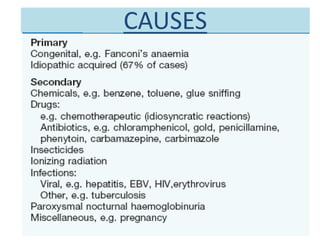
CAUSES
CONGENITAL SYNDROMES
ASSOCIATED WITH BONE MARROW
FAILURE
• Pancytopenia :
1. Fanconi anemia
2. Dyskeratosis congenita
• Single lineage cytopenias :
1. Amegakaryoctic thrombocytopenia
2. Diamond-Blackfan syndrome
3. Thrombocytopenia absent radii
FANCONI ANEMIA
• AR.
• Between the ages 5-10 years.
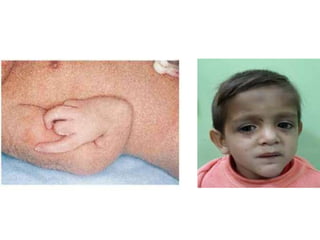
• Absent thumbs,absent radius,microcephaly,renal
anomalies,short stature,cafe au lait spots,skin
pigmentation(M/C).
• MR in 10%
• High risk of transformation to acute myeloid
leukemia,myelodysplasia,oral cancer,esophagus
cancer,liver cancer.
DYSKERATOSIS CONGENITA
• X-linked recessive/AD/AR
• Ectodermal triad-reticulate skin pigmentation
of upper body,dystrophic nails,leukoplakia
• Eye abnormalities in 50%
• May transform to skin SCC,myelodysplasia
DIAMOND-BLACKFAN SYNDROME
• AD/AR
• Short stature,elevated fetal
HGB,macrocytosis,raised ADA
• Risk of leukemia,myelodysplasia.
DRUGS THAT CAUSE MARROW APLASIA
Cytotoxic drugs:
• Busulfan
• Doxorubicin
Non-cytotoxic drugs:
• chloramphenicol
• gold
• carbimazole
• chlorpromazine
• phenytoin
• ribovirin
• tolbutamide
• NSAIDs.
CLINICAL FEATURES
• Severe anemia -> pallor + signs of congestive
heart failure
• Thrombocytopenia ->
petechiae,ecchymoses,gum bleeding,nose
bleeds
• Neutropenia -> fever,pneumonia,sepsis
BONE MARROW PICTURE
• Pancytopenia or bilineage involvement or
single cytopenia
• The virtual absence of reticulocytes
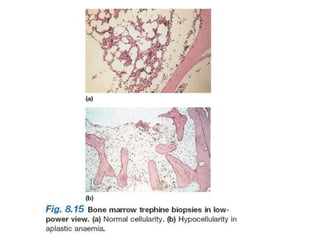
• A hypocellular or aplastic bone marrow with
increased fat cells and lymphocytes
SMEAR PICTURE
• Anemia -> macrocytosis
• Thrombocytopenia
• Agranulocytosis
• Reticulocyte count < 1%
SPECIFIC TESTS
• Incubation with DNA crosslinking agents like
mitomycin C shows >> chromosomal fragility
in peripheral blood cells (in Fanconi’s)
TREATMENT
• Supportive : prbc’s for severe anemia
platelets for thrombocytopenia
antibiotics to treat infections
• Definitive : Hematopoietic stem cell transplant
CRITERIA FOR REFERRAL FOR HSCT
• Young age
• Severe aplastic anemia
• Availability of matched sibling
Other modalities :
• Infusion of antithymocyte
globulin(ATG),antilymphocyte globulin(ALG) +
oral cyclosporine.
• Neutropenia + infection -> G-CSF
(prolonged use leads to malignant transformation).
• Steroids to treat children with congenital pure
red cell aplasia (Diamond–Blackfan syndrome).
• Androgens
PROGNOSIS
• Depends on extent of cytopenias
• Presence of two of the following three
features -> bad prognosis (severe aplastic
anemia)
-platelet count of <20000
-ANC <500
-reticulocyte count <1%
• Post HSCT,survival rates are poor for
unrelated donors.
• For those with HLA-identical sibling
donor, 75–90% chance of long-term
survival.
HEMATOPOIETIC
STEM CELL TRANSPLANTATION
• Definitive therapy for several malignant and
non malignant disorders
-autologous : stem cells harvested from the
patient
-allogeneic : stem cells collected from a donor
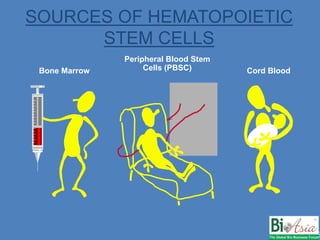
Bone Marrow
Peripheral Blood Stem
Cells (PBSC) Cord Blood
SOURCES OF HEMATOPOIETIC
STEM CELLS
NKM / AIIMS
1. Hematologic Malignancies
Acute and Chronic Myeloid Leukemia
Acute and Chronic lymphocytic leukemia
Myelodysplastic Syndromes
Lymphomas – Hodgkins and Non Hodgkins(relapse/refractory)
Multiple Myelomas
Neuroblastoma
Ewing sarcoma
Gliomas
2. Non Malignant Disorders
Severe Aplastic Anemia
Hurler’s Syndrome
Wiskott – Aldrich Syndrome
Diamond – Blackfan Anemia
Osteopetrosis
Fanconi anemia
INDICATIONS
3. Inherited Blood Disorders
Beta Thalassaemia Major
4. Severe combined immunodeficiency (SCID)
5. Autoimmune diseases
6.Solid Tumors (Breast cancer, Teratomas, ovarian tumors etc.)
7.Inborn errors of metabolism
ALLOGENEIC HSCT
• Ideal donor is a HLA-identical sibling
• Even minor histocompatibility loci variations
can cause graft rejection/graft versus host
disease
• ABO blood group compatibility not essential
• If HSCT is successful,blood group of recipient
changes to that of donor
• Conditioning procedure :
- myeloablative -> high doses chemotherapy
administered to eradicate malignant cells,to
clear space for growth of donor stem cells,to
suppress host immune response
- non myeloablative -> donor T cells are used to
eradicate both malignant and non malignant
cells of host origin
• Harvesting :
-Under GA/spinal.
-Repeated aspiration done.
-From posterior iliac crests.
-Minimum no.of marrow cells required is 1-3 X 10
power 8 cells/kg of recipient’s body weight.
• Engraftment :
-These donor marrow cells are transfused
through peripheral veins.
-Enter into host marrow space and start
engrafting.
-2-3 weeks for engraftment to occur.
-Prone to bacterial and fungal infections.
-Protective isolation required during this period.
-Require multiple red cell and platelet transfusions for
the thrombocytopenia.
-Engraftment considered successful when peripheral
ANC > 500/mm3 on three successive days.
• Risk of GVHD after transplant -> irradiation prior to
transplant to inactivate donor lymphocytes
AUTOLOGOUS SCT
• Patient’s own bone marrow/peripheral blood
stem cells used.
• Harvested prior to chemotherapy.
• Engraftment more rapid with peripheral blood
stem cells.
• Useful only for malignancies sensitive to
chemo/radiotherapy
(leukemias,lymphomas,neuroblastomas).
• Absence of GVHD.
• Low chances of graft rejection.
PERIPHERAL BLOOD SCT
• Autologous/allogeneic.
• Contains small proportions of stem cells
-> these are increased by administration of G-CSF for
5days
Results in high numbers of stem cells,collected by
apheresis.
• Avoids hospital admission,anesthesia,pain
associated with marrow aspiration.
CORD BLOOD SCT
• Source is blood from umbilical cord.
• Advantage is lower incidence and severity of
GVHD.
• Limitations are less number of nucleated cells
per unit,prolonged time for
engraftment,chances of non engraftment.
GRAFT VERSUS HOST DISEASE
• Occurs in allogeneic stem cell transplant.
• Acute / chronic .
• Acute :
Occurs within the first 3 months after transplant
Classically affects only skin,gut and liver
(skin lesions,diarrhoea,jaundice)
Accompanied by fever
• Chronic :
Develops later than 100 days after the transplant.
De novo / follows acute GVHD .
Limited/extensive .
Resembles scleroderma( skin rash,sicca
complex,sclerosing bronchiolitis,hepatic
dysfunction ).
Mortality of 20-40% .
Mx – immunosuppressive agents.
THANK YOU!!

APLASTIC ANEMIA, HEMATOPOIETIC STEM CELL TRANSPLANT

  • 1.
  • 2.
    • Comprises agroup of disorders of the hematopoietic stem cells resulting in suppression of one or more of erythroid,myeloid and megakaryocytic cell lines Inherited • Acquired
  • 3.
    • Incidence of2-6/million • M/C- pancytopenia with hypocellularity (aplasia) of the bone marrow. • There are no leukemic, cancerous or other abnormal cells in the peripheral blood or bone marrow.
  • 4.
    ETIOPATHOGENESIS • Deficiency ofhematopoietic stem cells may be due to 1. Acquired injury from viruses,toxins,chemicals 2. Abnormal marrow microenvironment 3. Antibody or cytotoxic T cell mediated suppression of hematopoiesis 4. Gene mutations
  • 5.
    • Due toa reduction in the number of pleuripotent stem cells together with a fault in those remaining or • An immune reaction against them so that they are unable to repopulate the bone marrow.
  • 6.
  • 7.
    CONGENITAL SYNDROMES ASSOCIATED WITHBONE MARROW FAILURE • Pancytopenia : 1. Fanconi anemia 2. Dyskeratosis congenita • Single lineage cytopenias : 1. Amegakaryoctic thrombocytopenia 2. Diamond-Blackfan syndrome 3. Thrombocytopenia absent radii
  • 8.
    FANCONI ANEMIA • AR. •Between the ages 5-10 years. • Absent thumbs,absent radius,microcephaly,renal anomalies,short stature,cafe au lait spots,skin pigmentation(M/C). • MR in 10% • High risk of transformation to acute myeloid leukemia,myelodysplasia,oral cancer,esophagus cancer,liver cancer.
  • 10.
    DYSKERATOSIS CONGENITA • X-linkedrecessive/AD/AR • Ectodermal triad-reticulate skin pigmentation of upper body,dystrophic nails,leukoplakia • Eye abnormalities in 50% • May transform to skin SCC,myelodysplasia
  • 11.
    DIAMOND-BLACKFAN SYNDROME • AD/AR •Short stature,elevated fetal HGB,macrocytosis,raised ADA • Risk of leukemia,myelodysplasia.
  • 12.
    DRUGS THAT CAUSEMARROW APLASIA Cytotoxic drugs: • Busulfan • Doxorubicin Non-cytotoxic drugs: • chloramphenicol • gold • carbimazole • chlorpromazine • phenytoin • ribovirin • tolbutamide • NSAIDs.
  • 13.

    CLINICAL FEATURES • Severeanemia -> pallor + signs of congestive heart failure • Thrombocytopenia -> petechiae,ecchymoses,gum bleeding,nose bleeds • Neutropenia -> fever,pneumonia,sepsis
  • 14.
    BONE MARROW PICTURE •Pancytopenia or bilineage involvement or single cytopenia • The virtual absence of reticulocytes • A hypocellular or aplastic bone marrow with increased fat cells and lymphocytes
  • 16.
    SMEAR PICTURE • Anemia-> macrocytosis • Thrombocytopenia • Agranulocytosis • Reticulocyte count < 1%
  • 17.
    SPECIFIC TESTS • Incubationwith DNA crosslinking agents like mitomycin C shows >> chromosomal fragility in peripheral blood cells (in Fanconi’s)
  • 18.
    TREATMENT • Supportive :prbc’s for severe anemia platelets for thrombocytopenia antibiotics to treat infections • Definitive : Hematopoietic stem cell transplant
  • 19.
    CRITERIA FOR REFERRALFOR HSCT • Young age • Severe aplastic anemia • Availability of matched sibling
  • 20.
    Other modalities : •Infusion of antithymocyte globulin(ATG),antilymphocyte globulin(ALG) + oral cyclosporine. • Neutropenia + infection -> G-CSF (prolonged use leads to malignant transformation). • Steroids to treat children with congenital pure red cell aplasia (Diamond–Blackfan syndrome). • Androgens
  • 21.
    PROGNOSIS • Depends onextent of cytopenias • Presence of two of the following three features -> bad prognosis (severe aplastic anemia) -platelet count of <20000 -ANC <500 -reticulocyte count <1%
  • 22.
    • Post HSCT,survivalrates are poor for unrelated donors. • For those with HLA-identical sibling donor, 75–90% chance of long-term survival.
  • 23.
    HEMATOPOIETIC STEM CELL TRANSPLANTATION •Definitive therapy for several malignant and non malignant disorders -autologous : stem cells harvested from the patient -allogeneic : stem cells collected from a donor
  • 24.
    Bone Marrow Peripheral BloodStem Cells (PBSC) Cord Blood SOURCES OF HEMATOPOIETIC STEM CELLS NKM / AIIMS
  • 25.
    1. Hematologic Malignancies Acuteand Chronic Myeloid Leukemia Acute and Chronic lymphocytic leukemia Myelodysplastic Syndromes Lymphomas – Hodgkins and Non Hodgkins(relapse/refractory) Multiple Myelomas Neuroblastoma Ewing sarcoma Gliomas 2. Non Malignant Disorders Severe Aplastic Anemia Hurler’s Syndrome Wiskott – Aldrich Syndrome Diamond – Blackfan Anemia Osteopetrosis Fanconi anemia INDICATIONS
  • 26.
    3. Inherited BloodDisorders Beta Thalassaemia Major 4. Severe combined immunodeficiency (SCID) 5. Autoimmune diseases 6.Solid Tumors (Breast cancer, Teratomas, ovarian tumors etc.) 7.Inborn errors of metabolism
  • 27.
    ALLOGENEIC HSCT • Idealdonor is a HLA-identical sibling • Even minor histocompatibility loci variations can cause graft rejection/graft versus host disease • ABO blood group compatibility not essential • If HSCT is successful,blood group of recipient changes to that of donor
  • 28.
    • Conditioning procedure: - myeloablative -> high doses chemotherapy administered to eradicate malignant cells,to clear space for growth of donor stem cells,to suppress host immune response - non myeloablative -> donor T cells are used to eradicate both malignant and non malignant cells of host origin
  • 29.
    • Harvesting : -UnderGA/spinal. -Repeated aspiration done. -From posterior iliac crests. -Minimum no.of marrow cells required is 1-3 X 10 power 8 cells/kg of recipient’s body weight.
  • 30.
    • Engraftment : -Thesedonor marrow cells are transfused through peripheral veins. -Enter into host marrow space and start engrafting. -2-3 weeks for engraftment to occur.
  • 31.
    -Prone to bacterialand fungal infections. -Protective isolation required during this period. -Require multiple red cell and platelet transfusions for the thrombocytopenia. -Engraftment considered successful when peripheral ANC > 500/mm3 on three successive days. • Risk of GVHD after transplant -> irradiation prior to transplant to inactivate donor lymphocytes
  • 32.
    AUTOLOGOUS SCT • Patient’sown bone marrow/peripheral blood stem cells used. • Harvested prior to chemotherapy. • Engraftment more rapid with peripheral blood stem cells.
  • 33.
    • Useful onlyfor malignancies sensitive to chemo/radiotherapy (leukemias,lymphomas,neuroblastomas). • Absence of GVHD. • Low chances of graft rejection.
  • 34.
    PERIPHERAL BLOOD SCT •Autologous/allogeneic. • Contains small proportions of stem cells -> these are increased by administration of G-CSF for 5days Results in high numbers of stem cells,collected by apheresis. • Avoids hospital admission,anesthesia,pain associated with marrow aspiration.
  • 35.
    CORD BLOOD SCT •Source is blood from umbilical cord. • Advantage is lower incidence and severity of GVHD. • Limitations are less number of nucleated cells per unit,prolonged time for engraftment,chances of non engraftment.
  • 36.
    GRAFT VERSUS HOSTDISEASE • Occurs in allogeneic stem cell transplant. • Acute / chronic . • Acute : Occurs within the first 3 months after transplant Classically affects only skin,gut and liver (skin lesions,diarrhoea,jaundice) Accompanied by fever
  • 37.
    • Chronic : Developslater than 100 days after the transplant. De novo / follows acute GVHD . Limited/extensive . Resembles scleroderma( skin rash,sicca complex,sclerosing bronchiolitis,hepatic dysfunction ). Mortality of 20-40% . Mx – immunosuppressive agents.
  • 38.

Editor's Notes

  • #5 Resulting in inherited bone marrow failure syndromes
  • #8 Vharacteristic physical anomalies,positive family history,neonatal thrombocytopenia
  • #9 Renal anomalies- ectopic kidney,horse shoe kidney …facial defects- microcephaly microphthalmia abnormal position size n shape of ears..undescended testis phimosis hypospadias
  • #11 Eye defects- blepharitis,conjunctivitis,cataracts,strabismus
  • #15 Seen in most forms of aplastic anemia…….single cytopenia as seen in amegakaryocytic thrombocytopenic purpura
  • #18 Chromosomal fragility test
  • #21 If no response within 7days- discontinue….to treat serumsickness post alg
  • #25 Cytokine mobilized
  • #28 Unlike other organ transplants