Hemoglobinopathies:
approach and lab diagnosis
The haemoglobin molecule
embryonic
fetal
haemoglobinopathies
Haemoglobinopathies
structural variants
failure to synthesize
failure to
switch
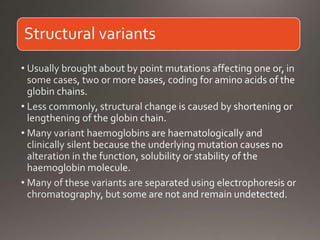
Structural variants
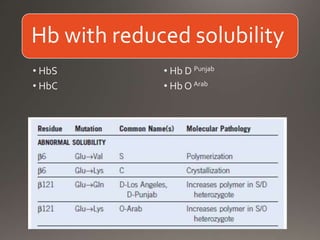
Hb with reduced solubility
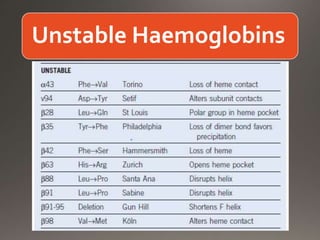
Unstable Haemoglobins
Haemoglobins with Altered Oxygen
Affinity
Haemoglobins with Altered Oxygen
Affinity
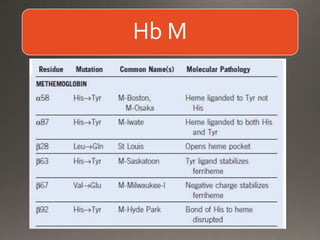
Hb M
Hb M
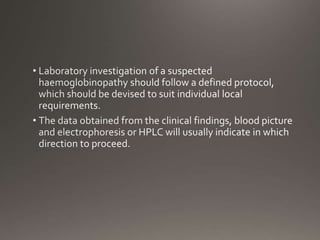
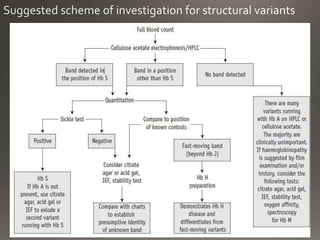
Investigation of patients with a suspected
haemoglobinopathy
Laboratory detection of hemoglobin
variants
Peripheral smear
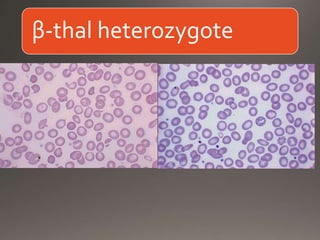
β-thal heterozygote
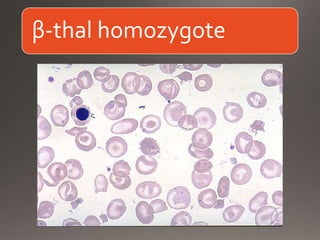
β-thal homozygote
Hb E trait
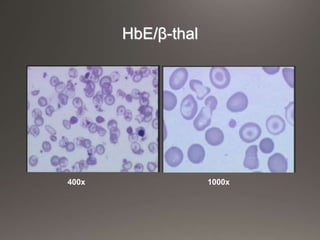
HbE/β-thal
400x 1000x
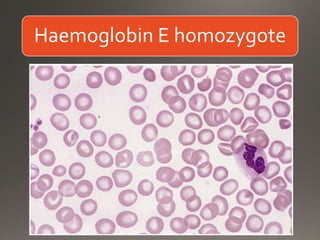
Haemoglobin E homozygote
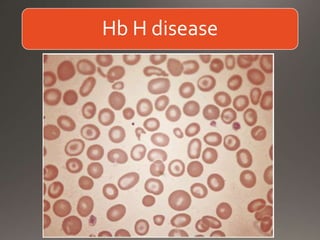
Hb H disease
Hb H disease
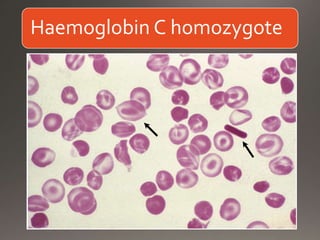
Haemoglobin C homozygote
HbSC disease
Sickle cell
homozygote
Collection of Blood and Preparation of
Haemolysates
• EDTA
Preparation of Haemolysate for Qualitative
Haemoglobin Electrophoresis
Control Samples
Preparation of controls
Quality Assurance
Quality Assurance
Cellulose Acetate Electrophoresis at
Alkaline pH
Principle
Procedure
Interpretation
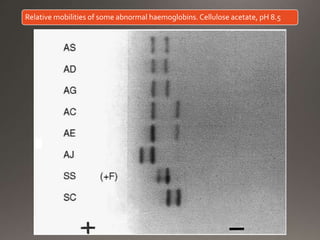
Relative mobilities of some abnormal haemoglobins. Cellulose acetate, pH 8.5
Citrate Agar Electrophoresis at pH 6.0
Interpretation
Agarose Gel Electrophoresis
Electrophoresis Advantages
• Commercial, widely available, rapid methods used for
many years.
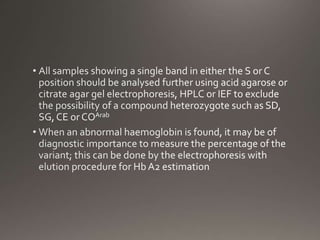
• Gives an estimate of HbA2 level.
• Identifies some variant haemoglobins which are well
characterized
Electrophoresis Disadvantages
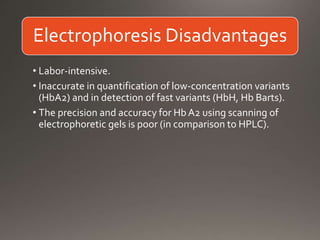
• Labor-intensive.
• Inaccurate in quantification of low-concentration variants
(HbA2) and in detection of fast variants (HbH, Hb Barts).
• The precision and accuracy for Hb A2 using scanning of
electrophoretic gels is poor (in comparison to HPLC).
Will be covered in subsequent session
Automated High-Performance Liquid
Chromatography
Isoelectric Focusing
Interpretation
still only provisional
Relative mobilities of some abnormal
haemoglobins in IEF
Tests for Hb S
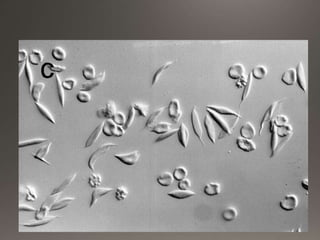
• The sickling phenomenon may be demonstrated in a thin
wet film of blood (sealed with a petroleum jelly/paraffin
wax mixture or with nail varnish).
• If Hb S is present, the red cells lose their smooth, round
shape and become sickled.

• This process may take up to 12 h in Hb S trait, whereas
changes are apparent in homozygotes and compound
heterozygotes after 1 h at 37°C.
• These changes can be hastened by the addition of a
reducing agent such as sodium metabisulphide or sodium
dithionite
• A test on a positive control of HbA plus Hb S must be
performed at the same time.
Sickling inWhole Blood
Hb S SolubilityTest
Interpretation
Tests for HbS
Detection of an unstable haemoglobin
Heat StabilityTest
Isopropanol StabilityTest
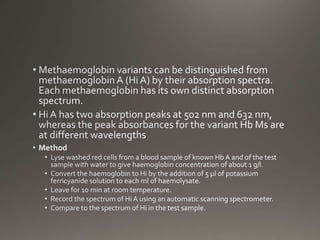
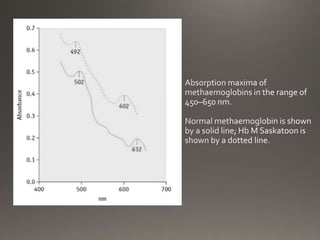
Detection of Hb Ms
Detection of altered affinity haemoglobins
Differential diagnosis of common
haemoglobin variants
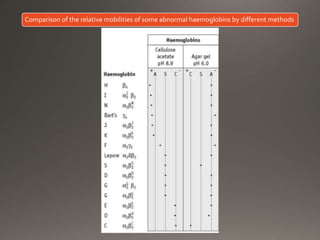
Comparison of the relative mobilities of some abnormal haemoglobins by different methods
Investigation of suspected
thalassaemia
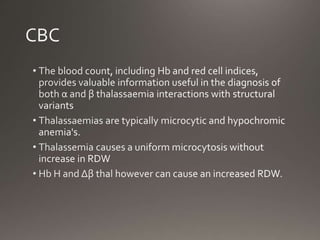
• Full blood count with red cell indices and blood film and,
in selected cases, reticulocyte count
• HbA2 measurement by cellulose acetate
electrophoresis with elution
• HbA2 measurement of microcolumn chromatography
• Automated HPLC
• Quantitation of Hb F
• Assessment of the distribution of Hb F
• Assessment of iron status
• Demonstration of red cell inclusion bodies
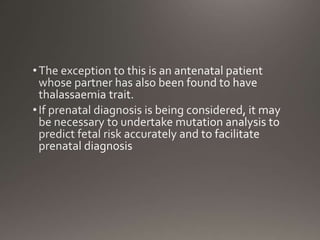
• DNA analysis
Quantitation of Hb A2
Measurement of Hb A2 by Elution from
Cellulose Acetate
•Principle
• Haemolysate is separated into its component fractions
by alkaline electrophoresis on cellulose acetate
membrane.
• The relative proportions of the separated fractions are
quantitated by spectrometry of the eluates of the
separated fractions
• Duplicate values obtained should be within 0.2%.
• This method is inaccurate in the presence of Hb C, Hb E
and Hb OArab because they do not separate from HbA2
Measurement of Hb A2 by Microcolumn
Chromatography
Microcolumn chromatography
Principle
+
+
+
+
+
+
+
+
+
+
+
Hb A
HbA2
Hb F
Hb E
Hb H
Hb Bart’s
Cl-
Cl-Cl- Cl-
Cl-
Cl-
Cl-
Cl-
Cl-
Cl-
Cl-
Cl-
Cl-
Cl-
Cl-
Cl-
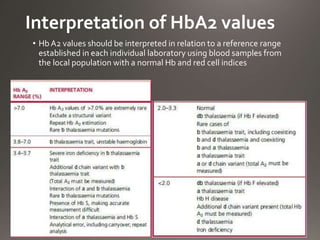
Interpretation of HbA2 values
• Hb A2 values should be interpreted in relation to a reference range
established in each individual laboratory using blood samples from
the local population with a normal Hb and red cell indices
Quantitation of Hb F
• Hb F may be estimated by several methods based on its
resistance to denaturation at alkaline pH, by HPLC or by
an immunological method
• Modified Betke Method
• Method of Jonxis andVisser
• Radial immunodiffusion method
Assessment of the intracellular
distribution of Hb F
• Differences in the intracellular distribution of Hb F
• heterozygotes for δβ thalassaemia -- heterocellular distribution
• ClassicalAfrican type of HPFH -- pancellular distribution
• Immunofluorescent Method
Interpretation of Hb F values
Demonstration of Hb H Inclusion
Bodies
• Staining solution. 1.0% brilliant cresyl blue or New
methylene blue
• Method
• Mix 2 volumes of fresh blood (within 24 h of collection) with 1
volume of staining solution.
• Incubate at 37°C for 2 h or at room temperature for 4 h.
• Resuspend the cells and spread a thin blood film.
• Examine the film as for a reticulocyte count.
• The inclusion bodies appear as multiple greenish-blue dots, like
the pitted pattern on a golf ball
• They can be readily distinguished from reticulocytes, which exhibit
uneven reticular material or infrequent fine dots.
HbH preparation interpretation
• In α+ thalassaemia trait, only a very occasional H body
(1:1000 to 1:10 000) is usually seen
• This test is most useful in Hb H disease, where inclusions
are usually found in more than 30% of red cells.
• Number of cells developing inclusions does not correlate
with genotype
• Absence of inclusion does not preclude a diagnosis
of α thalassaemia trait
Thank you!!

Hemoglobinopathies - Lab diagnosis