Hari Dev JJ
WHO DEFINITION
• A condition in which the haemoglobin content
  of blood is lower than normal as a result of
  deficiency of one or more essential nutrients
  regardless of the cause of such deficiency
WHO cut off points for diagnosis of
          Nutritional Anemia
                           Haemoglobin [ g/dl]   MCHC [ per cent]

Adult males                           13                    34

Adult females, non                    12                    34
pregnant


Adult females , pregnant              11                    34

Children, 6 months to 6               11                    34
years


Children, 6-14 years                  12                    34
Causes of Anaemia
• Most frequent cause – Iron deficiency

         other causes - Folate deficiency
                       Vitamin B12 deficiency

• Groups mainly affected
         Women of child bearing age [ 4-12 percent in
                                                India ]
         Young children

          During pregnancy [ 2/3 of pregnant woman and ½ of
    non pregnant woman in developing countries]

           During lactation
• Prevalence of anaemia in adolescent girls is
  very high [ 72.6%]
PATHOGENESIS
• Inadequate intake
• Poor bioavailability of dietary iron [ impt.]
• Excessive losses of iron from body.
  [ menstruation , malaria , hook worm
  infestations]
• Megaloblastic anaemia – poor socioeconomic
  groups.
Detrimental Effects
• During pregnancy- abortions, premature births, PPH,
  LBW babies, increased maternal and foetal mortality
  and morbidity.

• Infection - can be caused or be aggravated by
  diseases, increase susceptibility to infection

• Work capacity – great reduction in work
  performance
• Hb Less than 10g/dl – SEVERE – High dose of
  iron or blood transfusion. - REFERRAL

• If Hb 10 – 12 g/dl

 Iron and folic acid supplementation
 Iron fortification
 Other strategies
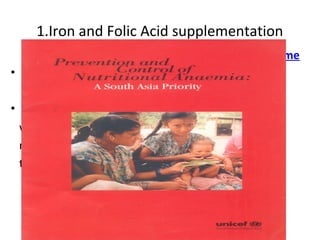
1.Iron and Folic Acid supplementation
  National Nutritional Anaemia Prophylaxis Programme
• Launched during 4th five year plan-1970

• Programme is based on daily supplementation
  with iron,folic acid –to prevent mild,
  moderate cases of anaemia, to double
  the quantity if pallor (+)
• Beneficiaries – pregnant women , lactating
  mothers and children under 12 years
• DOSAGE

1.CHILDREN [ 6m – 5yrs]
• If suspected , screening test done at 6   months,
  1 year , 2 years.
• 20mg iron + 100mcg FA X 100 days

• Liquid formulation – 1ml at a time
2. SCHOOL CHILDREN 6 – 10 yrs

•   30mg iron + 250 mcg FA X 100 days


3. ADULT & Adolescents

• 100mg iron + 500 mcg FA X 100 days
4. MOTHERS

• 100mg elemental Fe + 500 mcg FA daily until
  2-3 months after the Hb level has returned to
  normal.
2.Iron Fortification
• Developed by National Institute of Nutrition,
  Hyderabad

• Addition of ferric ortho phoshapte or ferrous
  sulphate with sodium bisulphate was enough to
  fortify salt with iron.

• When consumed for 12-18 months –
  reduce prevalence of anaemia.

• Commercial production since 1985.
3.Other Strategies
• Changing dietary habits

• Control of parasites

• Nutrition education
Anaemia Prophylaxis Programme

Anaemia Prophylaxis Programme

  • 1.
  • 2.
    WHO DEFINITION • Acondition in which the haemoglobin content of blood is lower than normal as a result of deficiency of one or more essential nutrients regardless of the cause of such deficiency
  • 3.
    WHO cut offpoints for diagnosis of Nutritional Anemia Haemoglobin [ g/dl] MCHC [ per cent] Adult males 13 34 Adult females, non 12 34 pregnant Adult females , pregnant 11 34 Children, 6 months to 6 11 34 years Children, 6-14 years 12 34
  • 4.
    Causes of Anaemia •Most frequent cause – Iron deficiency other causes - Folate deficiency Vitamin B12 deficiency • Groups mainly affected  Women of child bearing age [ 4-12 percent in India ]  Young children  During pregnancy [ 2/3 of pregnant woman and ½ of non pregnant woman in developing countries]  During lactation
  • 5.
    • Prevalence ofanaemia in adolescent girls is very high [ 72.6%]
  • 6.
    PATHOGENESIS • Inadequate intake •Poor bioavailability of dietary iron [ impt.] • Excessive losses of iron from body. [ menstruation , malaria , hook worm infestations] • Megaloblastic anaemia – poor socioeconomic groups.
  • 7.
    Detrimental Effects • Duringpregnancy- abortions, premature births, PPH, LBW babies, increased maternal and foetal mortality and morbidity. • Infection - can be caused or be aggravated by diseases, increase susceptibility to infection • Work capacity – great reduction in work performance
  • 8.
    • Hb Lessthan 10g/dl – SEVERE – High dose of iron or blood transfusion. - REFERRAL • If Hb 10 – 12 g/dl  Iron and folic acid supplementation  Iron fortification  Other strategies
  • 9.
    1.Iron and FolicAcid supplementation National Nutritional Anaemia Prophylaxis Programme • Launched during 4th five year plan-1970 • Programme is based on daily supplementation with iron,folic acid –to prevent mild, moderate cases of anaemia, to double the quantity if pallor (+)
  • 10.
    • Beneficiaries –pregnant women , lactating mothers and children under 12 years • DOSAGE 1.CHILDREN [ 6m – 5yrs] • If suspected , screening test done at 6 months, 1 year , 2 years. • 20mg iron + 100mcg FA X 100 days • Liquid formulation – 1ml at a time
  • 11.
    2. SCHOOL CHILDREN6 – 10 yrs • 30mg iron + 250 mcg FA X 100 days 3. ADULT & Adolescents • 100mg iron + 500 mcg FA X 100 days
  • 12.
    4. MOTHERS • 100mgelemental Fe + 500 mcg FA daily until 2-3 months after the Hb level has returned to normal.
  • 13.
    2.Iron Fortification • Developedby National Institute of Nutrition, Hyderabad • Addition of ferric ortho phoshapte or ferrous sulphate with sodium bisulphate was enough to fortify salt with iron. • When consumed for 12-18 months – reduce prevalence of anaemia. • Commercial production since 1985.
  • 14.
    3.Other Strategies • Changingdietary habits • Control of parasites • Nutrition education