DENGUE IN
CHILDREN
-Dr.Apoorva.E
PG,DCMS
EPIDEMIOLOGY
• Dengue is the most rapidly spreading
mosquito-borne viral disease in the world
• Increase in incidence by over 30-fold in
the last 50 years
• Currently endemic in all continents except
Europe
ETIOLOGY
THE VIRUS
• DEN- family flaviviridae
genus flavivirus
• Has four distinct serotypes (DEN1 – 4)
• DEN-2 and DEN-3 cause severe disease
• Cleaved by host and viral proteases into 3
structural proteins and 7 nonstructural
proteins(NS)
THE VECTOR
• Transmitted by infected Aedes
mosquitoes
• Highly urbanized,
fresh water,
day feeding mosquito
THE HOST
• Humans are the primary host of the virus
• Severity depends upon factors like
gender,secondary infection,age and
chronic diseases (sickle cell anemia,
asthma , DM)
• Vertical transmission and through infected
blood products +
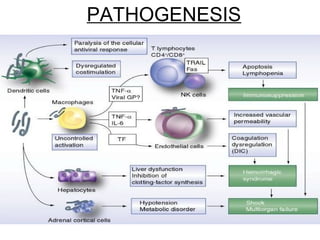
PATHOGENESIS
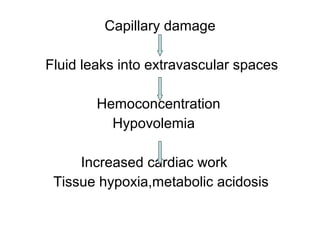
Capillary damage
Fluid leaks into extravascular spaces
Hemoconcentration
Hypovolemia
Increased cardiac work
Tissue hypoxia,metabolic acidosis
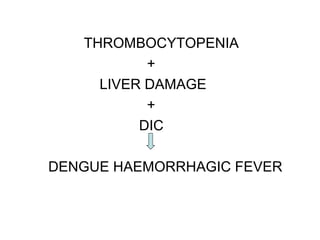
THROMBOCYTOPENIA
+
LIVER DAMAGE
+
DIC
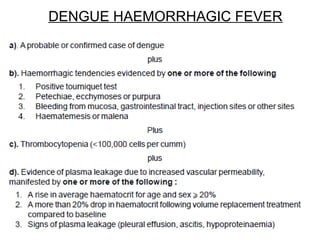
DENGUE HAEMORRHAGIC FEVER
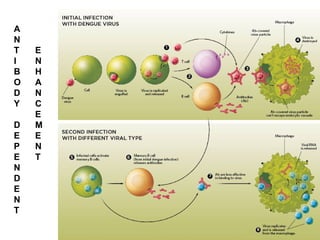
A
N
T
I
B
O
D
Y
D
E
P
E
N
D
E
N
T
E
N
H
A
N
C
E
M
E
N
T
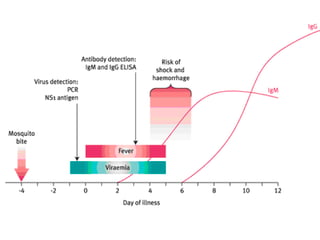
• Specific antibodies start appearing
around day 5 of illness.
• Infection with one serotype gives lifelong
immunity to that type, but only short term
protection against the other three.
• Secondary infection with DEN-2, DEN-3
is associated with dengue haemorrhagic
fever.
CLINICAL MANIFESTATIONS
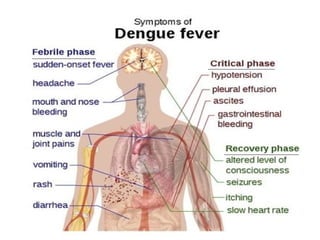
• Multisystem disease with a wide clinical
spectrum
• Incubation period – 4 to 10 days
• Illness begins abruptly following the
IP,divided into three phases
FEBRILE CRITICAL RECOVERY
FEBRILE PHASE
• High grade fever lasting for 2-7 days
• Accompanied by facial
flushing,rash,myalgia,arthralgia,headache,
nausea,vomiting,anorexia,sore
throat,injected pharynx and conjunctiva.
• Petechiae,epistaxis,gum bleed may be
seen.
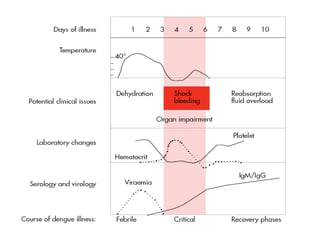
CRITICAL PHASE
• Usually occurs on days 3-6 of the illness
• Lasts for 24-48 hours
• Progressive leukopenia,increasing
hematocrit levels,decrease in platelet
count precede plasma leakage
Ascites Pleural effusion Shock
• Prolonged shock leads to DIC which
leads to severe haemorrhage
-Decrease in hematocrit
-GI bleeding usually
• Organ hypoperfusion can lead to
hepatitis,myocarditis,encephalitis
RECOVERY PHASE
• Reabsorption of the fluid from
extravascular compartment occurs
• General well-being improves,appetite
returns,hemodynamic status
stabilizes,urine output becomes normal,GI
symptoms abate
• Generalized pruritus,bradycardia ++
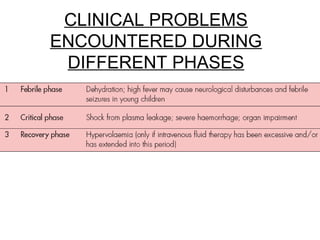
CLINICAL PROBLEMS
ENCOUNTERED DURING
DIFFERENT PHASES
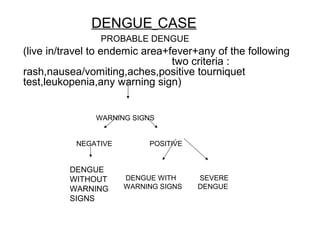
DENGUE CASE
PROBABLE DENGUE
(live in/travel to endemic area+fever+any of the following
two criteria :
rash,nausea/vomiting,aches,positive tourniquet
test,leukopenia,any warning sign)
WARNING SIGNS
NEGATIVE POSITIVE
DENGUE WITH SEVERE
WARNING SIGNS DENGUE
DENGUE
WITHOUT
WARNING
SIGNS
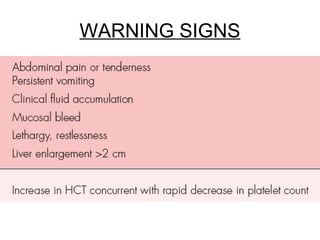
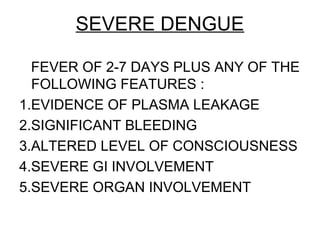
WARNING SIGNS
SEVERE DENGUE
FEVER OF 2-7 DAYS PLUS ANY OF THE
FOLLOWING FEATURES :
1.EVIDENCE OF PLASMA LEAKAGE
2.SIGNIFICANT BLEEDING
3.ALTERED LEVEL OF CONSCIOUSNESS
4.SEVERE GI INVOLVEMENT
5.SEVERE ORGAN INVOLVEMENT
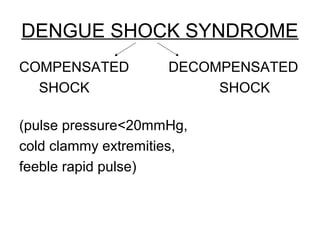
DENGUE SHOCK SYNDROME
COMPENSATED DECOMPENSATED
SHOCK SHOCK
(pulse pressure<20mmHg,
cold clammy extremities,
feeble rapid pulse)
DENGUE HAEMORRHAGIC FEVER
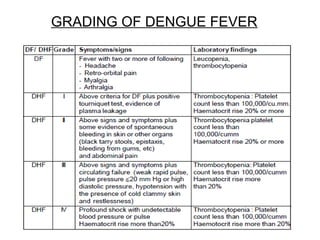
GRADING OF DENGUE FEVER
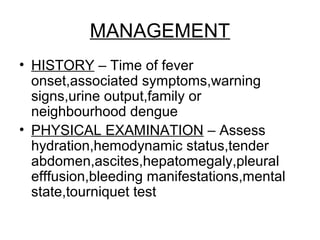
MANAGEMENT
• HISTORY – Time of fever
onset,associated symptoms,warning
signs,urine output,family or
neighbourhood dengue
• PHYSICAL EXAMINATION – Assess
hydration,hemodynamic status,tender
abdomen,ascites,hepatomegaly,pleural
efffusion,bleeding manifestations,mental
state,tourniquet test
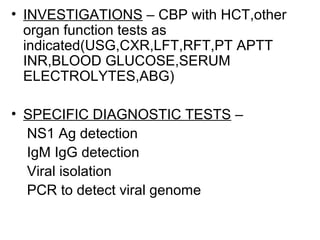
• INVESTIGATIONS – CBP with HCT,other
organ function tests as
indicated(USG,CXR,LFT,RFT,PT APTT
INR,BLOOD GLUCOSE,SERUM
ELECTROLYTES,ABG)
• SPECIFIC DIAGNOSTIC TESTS –
NS1 Ag detection
IgM IgG detection
Viral isolation
PCR to detect viral genome
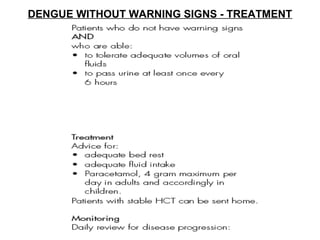
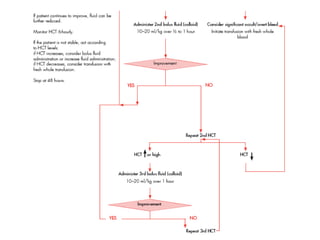
DENGUE WITHOUT WARNING SIGNS - TREATMENT
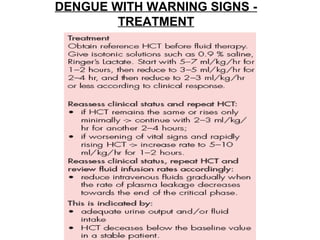
DENGUE WITH WARNING SIGNS -
TREATMENT
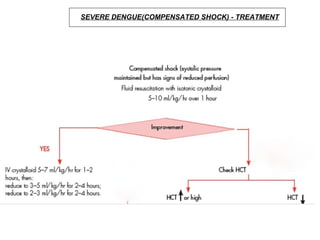
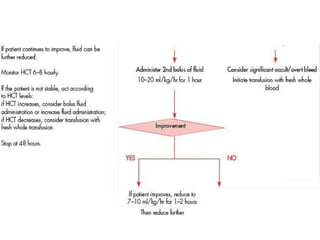
SEVERE DENGUE(COMPENSATED SHOCK) - TREATMENT
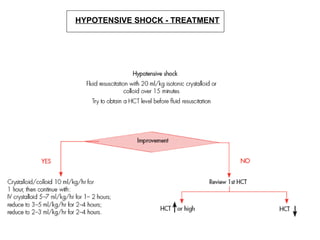
HYPOTENSIVE SHOCK - TREATMENT
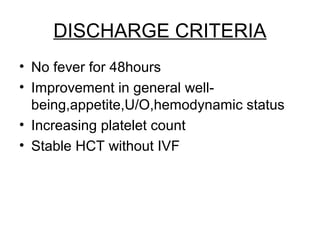
DISCHARGE CRITERIA
• No fever for 48hours
• Improvement in general well-
being,appetite,U/O,hemodynamic status
• Increasing platelet count
• Stable HCT without IVF
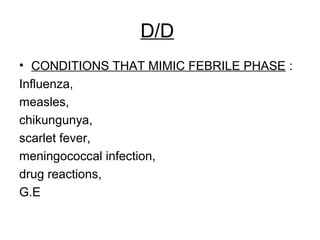
D/D
• CONDITIONS THAT MIMIC FEBRILE PHASE :
Influenza,
measles,
chikungunya,
scarlet fever,
meningococcal infection,
drug reactions,
G.E
• CONDITIONS THAT MIMIC CRITICAL PHASE :
Acute GE,
malaria,
viral hepatitis,
acute abdomen,
DKA,
lactic acidosis,
acute leukemia,
platelet disorders,
leptospirosis
THANK YOU !

DENGUE IN CHILDREN

  • 1.
  • 2.
    EPIDEMIOLOGY • Dengue isthe most rapidly spreading mosquito-borne viral disease in the world • Increase in incidence by over 30-fold in the last 50 years • Currently endemic in all continents except Europe
  • 3.
    ETIOLOGY THE VIRUS • DEN-family flaviviridae genus flavivirus • Has four distinct serotypes (DEN1 – 4) • DEN-2 and DEN-3 cause severe disease • Cleaved by host and viral proteases into 3 structural proteins and 7 nonstructural proteins(NS)
  • 4.
    THE VECTOR • Transmittedby infected Aedes mosquitoes • Highly urbanized, fresh water, day feeding mosquito
  • 5.
    THE HOST • Humansare the primary host of the virus • Severity depends upon factors like gender,secondary infection,age and chronic diseases (sickle cell anemia, asthma , DM) • Vertical transmission and through infected blood products +
  • 6.
  • 7.
    Capillary damage Fluid leaksinto extravascular spaces Hemoconcentration Hypovolemia Increased cardiac work Tissue hypoxia,metabolic acidosis
  • 8.
  • 9.
  • 10.
    • Specific antibodiesstart appearing around day 5 of illness. • Infection with one serotype gives lifelong immunity to that type, but only short term protection against the other three. • Secondary infection with DEN-2, DEN-3 is associated with dengue haemorrhagic fever.
  • 11.
    CLINICAL MANIFESTATIONS • Multisystemdisease with a wide clinical spectrum • Incubation period – 4 to 10 days • Illness begins abruptly following the IP,divided into three phases FEBRILE CRITICAL RECOVERY
  • 12.
    FEBRILE PHASE • Highgrade fever lasting for 2-7 days • Accompanied by facial flushing,rash,myalgia,arthralgia,headache, nausea,vomiting,anorexia,sore throat,injected pharynx and conjunctiva. • Petechiae,epistaxis,gum bleed may be seen.
  • 13.
    CRITICAL PHASE • Usuallyoccurs on days 3-6 of the illness • Lasts for 24-48 hours • Progressive leukopenia,increasing hematocrit levels,decrease in platelet count precede plasma leakage Ascites Pleural effusion Shock
  • 14.
    • Prolonged shockleads to DIC which leads to severe haemorrhage -Decrease in hematocrit -GI bleeding usually • Organ hypoperfusion can lead to hepatitis,myocarditis,encephalitis
  • 15.
    RECOVERY PHASE • Reabsorptionof the fluid from extravascular compartment occurs • General well-being improves,appetite returns,hemodynamic status stabilizes,urine output becomes normal,GI symptoms abate • Generalized pruritus,bradycardia ++
  • 17.
  • 18.
    DENGUE CASE PROBABLE DENGUE (livein/travel to endemic area+fever+any of the following two criteria : rash,nausea/vomiting,aches,positive tourniquet test,leukopenia,any warning sign) WARNING SIGNS NEGATIVE POSITIVE DENGUE WITH SEVERE WARNING SIGNS DENGUE DENGUE WITHOUT WARNING SIGNS
  • 19.
  • 20.
    SEVERE DENGUE FEVER OF2-7 DAYS PLUS ANY OF THE FOLLOWING FEATURES : 1.EVIDENCE OF PLASMA LEAKAGE 2.SIGNIFICANT BLEEDING 3.ALTERED LEVEL OF CONSCIOUSNESS 4.SEVERE GI INVOLVEMENT 5.SEVERE ORGAN INVOLVEMENT
  • 21.
    DENGUE SHOCK SYNDROME COMPENSATEDDECOMPENSATED SHOCK SHOCK (pulse pressure<20mmHg, cold clammy extremities, feeble rapid pulse)
  • 22.
  • 23.
  • 24.
    MANAGEMENT • HISTORY –Time of fever onset,associated symptoms,warning signs,urine output,family or neighbourhood dengue • PHYSICAL EXAMINATION – Assess hydration,hemodynamic status,tender abdomen,ascites,hepatomegaly,pleural efffusion,bleeding manifestations,mental state,tourniquet test
  • 25.
    • INVESTIGATIONS –CBP with HCT,other organ function tests as indicated(USG,CXR,LFT,RFT,PT APTT INR,BLOOD GLUCOSE,SERUM ELECTROLYTES,ABG) • SPECIFIC DIAGNOSTIC TESTS – NS1 Ag detection IgM IgG detection Viral isolation PCR to detect viral genome
  • 27.
    DENGUE WITHOUT WARNINGSIGNS - TREATMENT
  • 28.
    DENGUE WITH WARNINGSIGNS - TREATMENT
  • 29.
  • 31.
  • 33.
    DISCHARGE CRITERIA • Nofever for 48hours • Improvement in general well- being,appetite,U/O,hemodynamic status • Increasing platelet count • Stable HCT without IVF
  • 34.
    D/D • CONDITIONS THATMIMIC FEBRILE PHASE : Influenza, measles, chikungunya, scarlet fever, meningococcal infection, drug reactions, G.E
  • 35.
    • CONDITIONS THATMIMIC CRITICAL PHASE : Acute GE, malaria, viral hepatitis, acute abdomen, DKA, lactic acidosis, acute leukemia, platelet disorders, leptospirosis
  • 37.

Editor's Notes

  • #2 acute mosquito transmitted disease characterized by fever, headache, muscle, joint pains, rash, nausea and vomiting.
  • #3 Global case load of about 50 million annually ……endemic in all states except extreme north and the north east….cyclical trends with high epidemic years and non epidemic years
  • #4 Dengue fever virus is an ss rna virus…transmitted by arthropods hence also called arbovirus….asian genotypes ….viralgenome cleaved into capsid membrane envelope
  • #5 Prinicpally aedes aegyptyi..also albopictus polynesiensis scutellaris(stegomyia family)……….good vector coz its highly anthropophilic(close proximity to humans)
  • #6 Mechanism explain….extrinsic ip of 8-12 days females-more severe
  • #7  vasculopathy causing dss,coagulopathy causing dhf…mannose lectin receptors…..
  • #8 Electrolytes ,small proteins and sometimes rbcs
  • #9 ACT SYNERGISTICALLY
  • #10 ENHANCING ANTIBODIES ARE CONCENTRATION DEPENDENT AND SEROTYPE INDEPEMNDENT
  • #11 Coincident with the disappearance of virus and antigens
  • #13 Difficult to differentiate between dengue and non dengue fever in this phase.Positive tourniquet test during this phase increases probability of dengue
  • #14 Around the time of defervescence
  • #15 GI BLEEDING USUALLY
  • #16 Over 48 to 72 hours…no excess iv fluids .islets of white in sea of red rash
  • #20 CNS , GI MANIFESTATIONS
  • #21 SHOULD BE CONSIDERED WHEN THE PERSON IS FROM AN AREA AT DENGUE RISK
  • #24 ACC TO NVBDCP……..DHF GRADE 3 AND 4 IS DSS
  • #26 TO ESTABLISH BASELINE HCT…&amp;gt;20% rise……as early as day 1….igm varies….at around 5 days……nvbdcp using macelisa…HEMAGG INHIBITION METHOD
  • #29 MONITOR PERIPHERAL PERFUSION,VITALS,URINE OUTPUT,HCT,BLOOD GLUCOSE,OTHER ORGAN FUNCTIONS
  • #30 GROUP CRITERIA INCLUDE
  • #33 5-10 ML OF PACKED CELLS./10-20 ML OF FRESH WHOLE BLOOD…………correct the electrolyte dist,acid base imbalances
  • #36 Acute hiv seroconversion